SUBSCRIBE TO OUR FREE NEWSLETTER
Daily news & progressive opinion—funded by the people, not the corporations—delivered straight to your inbox.
5
#000000
#FFFFFF
To donate by check, phone, or other method, see our More Ways to Give page.
Daily news & progressive opinion—funded by the people, not the corporations—delivered straight to your inbox.
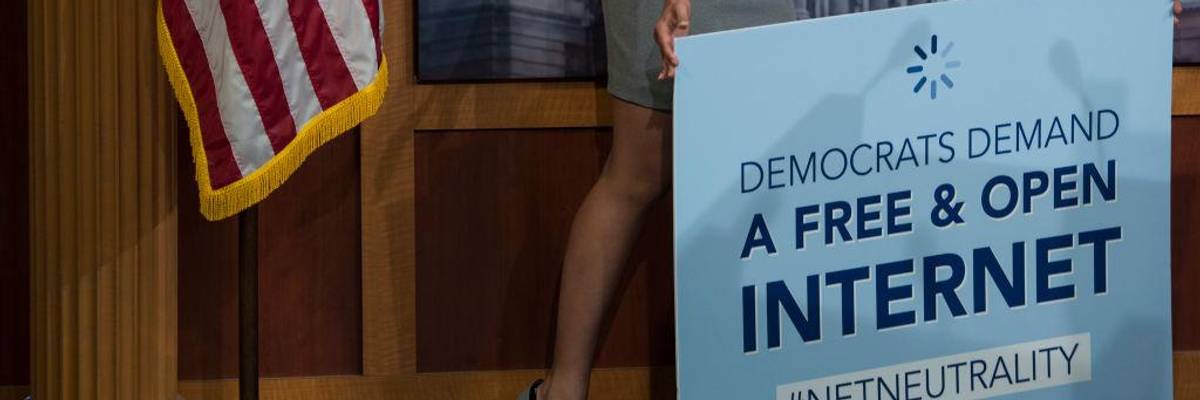
A staffer removes a 'net neutrality' sign after a press conference following the vote that would help stop the Federal Communications Commission's effort to reverse Obama-era regulations on net neutrality May 16, 2018. (Photo By Sarah Silbiger/CQ Roll Call)
Just over four years ago, Donald Trump's Federal Communications Commission eliminated net neutrality rules that ensured a free and open internet. Without these critical protections, internet service providers, or ISPs, were no longer required to provide equal access to all lawful content on the internet. That means ISPs were free to speed up customer access to information they like -- either because they agreed with the content politically, the opinion advanced their corporate interests, or a business partner was paying them to give its content preferential treatment. At the same time, ISPs were likewise free to deliberately slow down customer access to content they didn't like, or to block it entirely.
Through almost every political lens, getting rid of net neutrality was viewed as a terrible move. It turns out, Americans love a free and open internet. They want to have access to receive and communicate information free of corporate censorship. Even in Trump's divided states of America, people from every background and political philosophy were united in their desire to bring net neutrality back. According to a 2018 University of Maryland poll, 82 percent of Republicans, 90 percent of Democrats, and 85 percent of independents favor restoring net neutrality.
Proponents of net neutrality put up a fight. In 2018, the Republican-controlled Senate voted 52-47, via the Congressional Review Act, to reject the FCC's elimination of net neutrality protections (the House never got the chance to vote on the CRA). Throughout the nation, governors and state legislatures adopted laws and executive orders seeking to preserve net neutrality in their states. And the ACLU may have permanently harmed several of its staff members by filming them eating dangerously hot chicken wings while pleading with the federal government to save net neutrality.
With this overwhelming, pro-net neutrality consensus, who exactly were net neutrality's opponents? The answer was the ISPs, because eliminating net neutrality cleared the way for them to make a lot more money. Unsurprisingly, the FCC's successful effort to kill net neutrality was led by its chairperson, Ajit Pai, a former Verizon lawyer. Pai was all too pleased to do the bidding of his former (and perhaps future) employers, and Trump was happy to go along because, well, Trump loves giving wealthy companies more money, even when doing so comes at the expense of regular Americans.
Net neutrality advocates always knew that despite strong state-level actions, the only route to fully restoring net neutrality would be through a new president and FCC. Well guess what? As of Jan. 20, we have a new president who cares about the liberty and freedoms of the American people more than corporate profits, and a new vacancy on the FCC after Ajit Pai resigned on Inauguration Day that, when filled, should provide a 3-2 commissioners majority in favor of net neutrality.
Rarely are such important victories so ripe for the picking. We can get there, but victory is not yet 100 percent assured. We must remind President Biden that the time to fully restore net neutrality is now, and that he should reject any legislative or administrative compromises that would result in a "net neutrality lite."
People's access to a free and open internet should never be compromised. Please help us finish this fight by taking to social media and urging the president (@POTUS) and the acting FCC chair (@JRosenworcel) to restore #NetNeutrality within the Biden administration's first 100 days. The ACLU will do everything we can as well--except for making another hot sauce video; I still can't feel my tongue after the last one.
Dear Common Dreams reader, It’s been nearly 30 years since I co-founded Common Dreams with my late wife, Lina Newhouser. We had the radical notion that journalism should serve the public good, not corporate profits. It was clear to us from the outset what it would take to build such a project. No paid advertisements. No corporate sponsors. No millionaire publisher telling us what to think or do. Many people said we wouldn't last a year, but we proved those doubters wrong. Together with a tremendous team of journalists and dedicated staff, we built an independent media outlet free from the constraints of profits and corporate control. Our mission has always been simple: To inform. To inspire. To ignite change for the common good. Building Common Dreams was not easy. Our survival was never guaranteed. When you take on the most powerful forces—Wall Street greed, fossil fuel industry destruction, Big Tech lobbyists, and uber-rich oligarchs who have spent billions upon billions rigging the economy and democracy in their favor—the only bulwark you have is supporters who believe in your work. But here’s the urgent message from me today. It's never been this bad out there. And it's never been this hard to keep us going. At the very moment Common Dreams is most needed, the threats we face are intensifying. We need your support now more than ever. We don't accept corporate advertising and never will. We don't have a paywall because we don't think people should be blocked from critical news based on their ability to pay. Everything we do is funded by the donations of readers like you. When everyone does the little they can afford, we are strong. But if that support retreats or dries up, so do we. Will you donate now to make sure Common Dreams not only survives but thrives? —Craig Brown, Co-founder |
Just over four years ago, Donald Trump's Federal Communications Commission eliminated net neutrality rules that ensured a free and open internet. Without these critical protections, internet service providers, or ISPs, were no longer required to provide equal access to all lawful content on the internet. That means ISPs were free to speed up customer access to information they like -- either because they agreed with the content politically, the opinion advanced their corporate interests, or a business partner was paying them to give its content preferential treatment. At the same time, ISPs were likewise free to deliberately slow down customer access to content they didn't like, or to block it entirely.
Through almost every political lens, getting rid of net neutrality was viewed as a terrible move. It turns out, Americans love a free and open internet. They want to have access to receive and communicate information free of corporate censorship. Even in Trump's divided states of America, people from every background and political philosophy were united in their desire to bring net neutrality back. According to a 2018 University of Maryland poll, 82 percent of Republicans, 90 percent of Democrats, and 85 percent of independents favor restoring net neutrality.
Proponents of net neutrality put up a fight. In 2018, the Republican-controlled Senate voted 52-47, via the Congressional Review Act, to reject the FCC's elimination of net neutrality protections (the House never got the chance to vote on the CRA). Throughout the nation, governors and state legislatures adopted laws and executive orders seeking to preserve net neutrality in their states. And the ACLU may have permanently harmed several of its staff members by filming them eating dangerously hot chicken wings while pleading with the federal government to save net neutrality.
With this overwhelming, pro-net neutrality consensus, who exactly were net neutrality's opponents? The answer was the ISPs, because eliminating net neutrality cleared the way for them to make a lot more money. Unsurprisingly, the FCC's successful effort to kill net neutrality was led by its chairperson, Ajit Pai, a former Verizon lawyer. Pai was all too pleased to do the bidding of his former (and perhaps future) employers, and Trump was happy to go along because, well, Trump loves giving wealthy companies more money, even when doing so comes at the expense of regular Americans.
Net neutrality advocates always knew that despite strong state-level actions, the only route to fully restoring net neutrality would be through a new president and FCC. Well guess what? As of Jan. 20, we have a new president who cares about the liberty and freedoms of the American people more than corporate profits, and a new vacancy on the FCC after Ajit Pai resigned on Inauguration Day that, when filled, should provide a 3-2 commissioners majority in favor of net neutrality.
Rarely are such important victories so ripe for the picking. We can get there, but victory is not yet 100 percent assured. We must remind President Biden that the time to fully restore net neutrality is now, and that he should reject any legislative or administrative compromises that would result in a "net neutrality lite."
People's access to a free and open internet should never be compromised. Please help us finish this fight by taking to social media and urging the president (@POTUS) and the acting FCC chair (@JRosenworcel) to restore #NetNeutrality within the Biden administration's first 100 days. The ACLU will do everything we can as well--except for making another hot sauce video; I still can't feel my tongue after the last one.
Just over four years ago, Donald Trump's Federal Communications Commission eliminated net neutrality rules that ensured a free and open internet. Without these critical protections, internet service providers, or ISPs, were no longer required to provide equal access to all lawful content on the internet. That means ISPs were free to speed up customer access to information they like -- either because they agreed with the content politically, the opinion advanced their corporate interests, or a business partner was paying them to give its content preferential treatment. At the same time, ISPs were likewise free to deliberately slow down customer access to content they didn't like, or to block it entirely.
Through almost every political lens, getting rid of net neutrality was viewed as a terrible move. It turns out, Americans love a free and open internet. They want to have access to receive and communicate information free of corporate censorship. Even in Trump's divided states of America, people from every background and political philosophy were united in their desire to bring net neutrality back. According to a 2018 University of Maryland poll, 82 percent of Republicans, 90 percent of Democrats, and 85 percent of independents favor restoring net neutrality.
Proponents of net neutrality put up a fight. In 2018, the Republican-controlled Senate voted 52-47, via the Congressional Review Act, to reject the FCC's elimination of net neutrality protections (the House never got the chance to vote on the CRA). Throughout the nation, governors and state legislatures adopted laws and executive orders seeking to preserve net neutrality in their states. And the ACLU may have permanently harmed several of its staff members by filming them eating dangerously hot chicken wings while pleading with the federal government to save net neutrality.
With this overwhelming, pro-net neutrality consensus, who exactly were net neutrality's opponents? The answer was the ISPs, because eliminating net neutrality cleared the way for them to make a lot more money. Unsurprisingly, the FCC's successful effort to kill net neutrality was led by its chairperson, Ajit Pai, a former Verizon lawyer. Pai was all too pleased to do the bidding of his former (and perhaps future) employers, and Trump was happy to go along because, well, Trump loves giving wealthy companies more money, even when doing so comes at the expense of regular Americans.
Net neutrality advocates always knew that despite strong state-level actions, the only route to fully restoring net neutrality would be through a new president and FCC. Well guess what? As of Jan. 20, we have a new president who cares about the liberty and freedoms of the American people more than corporate profits, and a new vacancy on the FCC after Ajit Pai resigned on Inauguration Day that, when filled, should provide a 3-2 commissioners majority in favor of net neutrality.
Rarely are such important victories so ripe for the picking. We can get there, but victory is not yet 100 percent assured. We must remind President Biden that the time to fully restore net neutrality is now, and that he should reject any legislative or administrative compromises that would result in a "net neutrality lite."
People's access to a free and open internet should never be compromised. Please help us finish this fight by taking to social media and urging the president (@POTUS) and the acting FCC chair (@JRosenworcel) to restore #NetNeutrality within the Biden administration's first 100 days. The ACLU will do everything we can as well--except for making another hot sauce video; I still can't feel my tongue after the last one.