SUBSCRIBE TO OUR FREE NEWSLETTER
Daily news & progressive opinion—funded by the people, not the corporations—delivered straight to your inbox.
5
#000000
#FFFFFF
To donate by check, phone, or other method, see our More Ways to Give page.
Daily news & progressive opinion—funded by the people, not the corporations—delivered straight to your inbox.
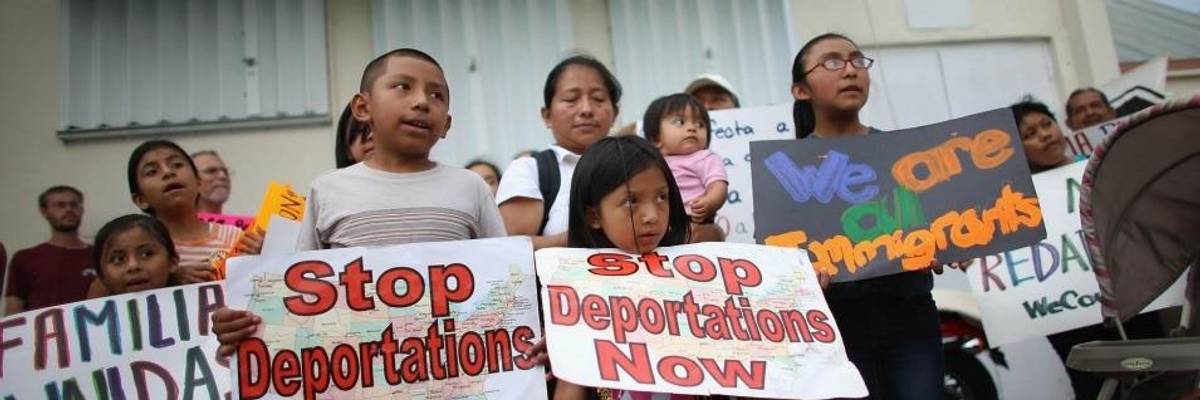
The Biden-Harris administration committed to an immediate moratorium on deportations. (Photo: Getty)
This blog is the eighth in a series outlining a reimagined, just, and humane immigration system for the United States.
The past four years proved that the Biden-Harris administration must be bold and focused on overhauling the immigration system. The Trump administration has touted the "breathtaking" changes it has made to our immigration system. The changes are indeed breathtaking -- in their dishonesty, abject cruelty, and white supremacist roots. The Trump administration has been single-mindedly obsessed with destroying our immigration and refugee system, using a global pandemic to upend it. On his way out, Trump is also shoving through "last-ditch efforts" at further harming immigrants.
Our border militarization and immigration enforcement machinery is overfunded, unaccountable, and increasingly lawless. It is this vast, "formidable machinery" that Trump has stretched to its limits, but the issue predates Trump. The last four years under Trump have highlighted how cruel and unjust our immigration system can be -- but also demonstrated the significant discretion the executive branch can exercise.
There is a real opportunity and political will to reimagine our country's approach to immigration: shifting from a detention and deportation-obsessed approach to one that is rooted in fundamental due process and human rights. The Biden-Harris administration committed to an immediate moratorium on deportations. Hitting pause on banishing people from the United States acknowledges that our immigration system is deeply flawed -- even more so after four years of Trump -- but also provides the space to begin laying the groundwork for an audacious and inclusive vision for immigrants' rights.
During a moratorium, the executive branch must immediately halt immigration enforcement and deportations while it works to undo policies like the Muslim ban, the public charge rule, the politicization of our immigration courts, and the evisceration of asylum. We know that just reversing course will be a massive task, but it is also not enough.
A moratorium also provides an opportunity for the Biden-Harris administration to reject our existing immigration system's reliance on the punitive, enforcement-based approach driven by mass detention and mass deportation. This system costs taxpayers tens of billions of dollars a year.
The executive branch should instead invest in a humane and effective system focused on helping people navigate a byzantine immigration system and on a pathway to citizenship. In this reimagined immigration system, ICE and CBP would not use states and localities to funnel immigrants into the detention and deportation system, and would work to end racial profiling rather than engage in and encourage it. Immigrants would not be caged while going through the immigration system, but instead be with family and a support system as they pursue relief under the supervision of a judge. And the government would provide lawyers for people who are too poor to afford one because that is what fairness and justice demand.
There is a real opportunity and political will to reimagine our country's approach to immigration: shifting from a detention and deportation-obsessed approach to one that is rooted in fundamental due process and human rights.
Take, for example, expedited removal, created by Congress in 1996 as part of a radical alteration of our immigration system. This law allows for summary deportations with virtually no safeguards -- the antithesis of due process. As a result, many people do not have a hearing before an immigration judge before they're ordered deported. In 2013, 83 percent of deportation orders did not come from an immigration judge.
Unfortunately, it's gotten worse in the last four years. In 2019, the Trump administration issued an order vastly expanding expedited removal, which was halted until recently because of a lawsuit brought by the ACLU and its partners. While that lawsuit continues, and we hope to once again halt the expansion, the Trump administration currently has the ability to apply the summary removal procedures more widely than ever before.
The Trump administration's move to expand the government's ability to round up and hurriedly deport immigrants -- especially as a pandemic rages on -- is horrifying. So many of the people detained and deported by our government have lives, families, and roots in this country. It is impossible to gloss over their rights and humanity without irrevocably demeaning the values we profess as a nation.
It is clear that our existing enforcement infrastructure can no longer exist. A moratorium on deportations gives the Biden-Harris administration an opportunity to reset our system, and implement policies that will:
This is a unique moment in our history. We have faced unprecedented challenges this year, from a pandemic that has killed 318,000 people in the United States to thousands of protests nationwide fighting for Black lives and an end to racism in policing. Immigrants' rights are inextricably linked to these moments: from our communities on the front lines of the COVID-19 fight to the disproportionate impact of enforcement, detention, and deportation on Black immigrants. While the ACLU works to achieve citizenship for all so that immigrants no longer live in fear, we will simultaneously push for a reimagined immigration system.
Dear Common Dreams reader, It’s been nearly 30 years since I co-founded Common Dreams with my late wife, Lina Newhouser. We had the radical notion that journalism should serve the public good, not corporate profits. It was clear to us from the outset what it would take to build such a project. No paid advertisements. No corporate sponsors. No millionaire publisher telling us what to think or do. Many people said we wouldn't last a year, but we proved those doubters wrong. Together with a tremendous team of journalists and dedicated staff, we built an independent media outlet free from the constraints of profits and corporate control. Our mission has always been simple: To inform. To inspire. To ignite change for the common good. Building Common Dreams was not easy. Our survival was never guaranteed. When you take on the most powerful forces—Wall Street greed, fossil fuel industry destruction, Big Tech lobbyists, and uber-rich oligarchs who have spent billions upon billions rigging the economy and democracy in their favor—the only bulwark you have is supporters who believe in your work. But here’s the urgent message from me today. It's never been this bad out there. And it's never been this hard to keep us going. At the very moment Common Dreams is most needed, the threats we face are intensifying. We need your support now more than ever. We don't accept corporate advertising and never will. We don't have a paywall because we don't think people should be blocked from critical news based on their ability to pay. Everything we do is funded by the donations of readers like you. When everyone does the little they can afford, we are strong. But if that support retreats or dries up, so do we. Will you donate now to make sure Common Dreams not only survives but thrives? —Craig Brown, Co-founder |
This blog is the eighth in a series outlining a reimagined, just, and humane immigration system for the United States.
The past four years proved that the Biden-Harris administration must be bold and focused on overhauling the immigration system. The Trump administration has touted the "breathtaking" changes it has made to our immigration system. The changes are indeed breathtaking -- in their dishonesty, abject cruelty, and white supremacist roots. The Trump administration has been single-mindedly obsessed with destroying our immigration and refugee system, using a global pandemic to upend it. On his way out, Trump is also shoving through "last-ditch efforts" at further harming immigrants.
Our border militarization and immigration enforcement machinery is overfunded, unaccountable, and increasingly lawless. It is this vast, "formidable machinery" that Trump has stretched to its limits, but the issue predates Trump. The last four years under Trump have highlighted how cruel and unjust our immigration system can be -- but also demonstrated the significant discretion the executive branch can exercise.
There is a real opportunity and political will to reimagine our country's approach to immigration: shifting from a detention and deportation-obsessed approach to one that is rooted in fundamental due process and human rights. The Biden-Harris administration committed to an immediate moratorium on deportations. Hitting pause on banishing people from the United States acknowledges that our immigration system is deeply flawed -- even more so after four years of Trump -- but also provides the space to begin laying the groundwork for an audacious and inclusive vision for immigrants' rights.
During a moratorium, the executive branch must immediately halt immigration enforcement and deportations while it works to undo policies like the Muslim ban, the public charge rule, the politicization of our immigration courts, and the evisceration of asylum. We know that just reversing course will be a massive task, but it is also not enough.
A moratorium also provides an opportunity for the Biden-Harris administration to reject our existing immigration system's reliance on the punitive, enforcement-based approach driven by mass detention and mass deportation. This system costs taxpayers tens of billions of dollars a year.
The executive branch should instead invest in a humane and effective system focused on helping people navigate a byzantine immigration system and on a pathway to citizenship. In this reimagined immigration system, ICE and CBP would not use states and localities to funnel immigrants into the detention and deportation system, and would work to end racial profiling rather than engage in and encourage it. Immigrants would not be caged while going through the immigration system, but instead be with family and a support system as they pursue relief under the supervision of a judge. And the government would provide lawyers for people who are too poor to afford one because that is what fairness and justice demand.
There is a real opportunity and political will to reimagine our country's approach to immigration: shifting from a detention and deportation-obsessed approach to one that is rooted in fundamental due process and human rights.
Take, for example, expedited removal, created by Congress in 1996 as part of a radical alteration of our immigration system. This law allows for summary deportations with virtually no safeguards -- the antithesis of due process. As a result, many people do not have a hearing before an immigration judge before they're ordered deported. In 2013, 83 percent of deportation orders did not come from an immigration judge.
Unfortunately, it's gotten worse in the last four years. In 2019, the Trump administration issued an order vastly expanding expedited removal, which was halted until recently because of a lawsuit brought by the ACLU and its partners. While that lawsuit continues, and we hope to once again halt the expansion, the Trump administration currently has the ability to apply the summary removal procedures more widely than ever before.
The Trump administration's move to expand the government's ability to round up and hurriedly deport immigrants -- especially as a pandemic rages on -- is horrifying. So many of the people detained and deported by our government have lives, families, and roots in this country. It is impossible to gloss over their rights and humanity without irrevocably demeaning the values we profess as a nation.
It is clear that our existing enforcement infrastructure can no longer exist. A moratorium on deportations gives the Biden-Harris administration an opportunity to reset our system, and implement policies that will:
This is a unique moment in our history. We have faced unprecedented challenges this year, from a pandemic that has killed 318,000 people in the United States to thousands of protests nationwide fighting for Black lives and an end to racism in policing. Immigrants' rights are inextricably linked to these moments: from our communities on the front lines of the COVID-19 fight to the disproportionate impact of enforcement, detention, and deportation on Black immigrants. While the ACLU works to achieve citizenship for all so that immigrants no longer live in fear, we will simultaneously push for a reimagined immigration system.
This blog is the eighth in a series outlining a reimagined, just, and humane immigration system for the United States.
The past four years proved that the Biden-Harris administration must be bold and focused on overhauling the immigration system. The Trump administration has touted the "breathtaking" changes it has made to our immigration system. The changes are indeed breathtaking -- in their dishonesty, abject cruelty, and white supremacist roots. The Trump administration has been single-mindedly obsessed with destroying our immigration and refugee system, using a global pandemic to upend it. On his way out, Trump is also shoving through "last-ditch efforts" at further harming immigrants.
Our border militarization and immigration enforcement machinery is overfunded, unaccountable, and increasingly lawless. It is this vast, "formidable machinery" that Trump has stretched to its limits, but the issue predates Trump. The last four years under Trump have highlighted how cruel and unjust our immigration system can be -- but also demonstrated the significant discretion the executive branch can exercise.
There is a real opportunity and political will to reimagine our country's approach to immigration: shifting from a detention and deportation-obsessed approach to one that is rooted in fundamental due process and human rights. The Biden-Harris administration committed to an immediate moratorium on deportations. Hitting pause on banishing people from the United States acknowledges that our immigration system is deeply flawed -- even more so after four years of Trump -- but also provides the space to begin laying the groundwork for an audacious and inclusive vision for immigrants' rights.
During a moratorium, the executive branch must immediately halt immigration enforcement and deportations while it works to undo policies like the Muslim ban, the public charge rule, the politicization of our immigration courts, and the evisceration of asylum. We know that just reversing course will be a massive task, but it is also not enough.
A moratorium also provides an opportunity for the Biden-Harris administration to reject our existing immigration system's reliance on the punitive, enforcement-based approach driven by mass detention and mass deportation. This system costs taxpayers tens of billions of dollars a year.
The executive branch should instead invest in a humane and effective system focused on helping people navigate a byzantine immigration system and on a pathway to citizenship. In this reimagined immigration system, ICE and CBP would not use states and localities to funnel immigrants into the detention and deportation system, and would work to end racial profiling rather than engage in and encourage it. Immigrants would not be caged while going through the immigration system, but instead be with family and a support system as they pursue relief under the supervision of a judge. And the government would provide lawyers for people who are too poor to afford one because that is what fairness and justice demand.
There is a real opportunity and political will to reimagine our country's approach to immigration: shifting from a detention and deportation-obsessed approach to one that is rooted in fundamental due process and human rights.
Take, for example, expedited removal, created by Congress in 1996 as part of a radical alteration of our immigration system. This law allows for summary deportations with virtually no safeguards -- the antithesis of due process. As a result, many people do not have a hearing before an immigration judge before they're ordered deported. In 2013, 83 percent of deportation orders did not come from an immigration judge.
Unfortunately, it's gotten worse in the last four years. In 2019, the Trump administration issued an order vastly expanding expedited removal, which was halted until recently because of a lawsuit brought by the ACLU and its partners. While that lawsuit continues, and we hope to once again halt the expansion, the Trump administration currently has the ability to apply the summary removal procedures more widely than ever before.
The Trump administration's move to expand the government's ability to round up and hurriedly deport immigrants -- especially as a pandemic rages on -- is horrifying. So many of the people detained and deported by our government have lives, families, and roots in this country. It is impossible to gloss over their rights and humanity without irrevocably demeaning the values we profess as a nation.
It is clear that our existing enforcement infrastructure can no longer exist. A moratorium on deportations gives the Biden-Harris administration an opportunity to reset our system, and implement policies that will:
This is a unique moment in our history. We have faced unprecedented challenges this year, from a pandemic that has killed 318,000 people in the United States to thousands of protests nationwide fighting for Black lives and an end to racism in policing. Immigrants' rights are inextricably linked to these moments: from our communities on the front lines of the COVID-19 fight to the disproportionate impact of enforcement, detention, and deportation on Black immigrants. While the ACLU works to achieve citizenship for all so that immigrants no longer live in fear, we will simultaneously push for a reimagined immigration system.