SUBSCRIBE TO OUR FREE NEWSLETTER
Daily news & progressive opinion—funded by the people, not the corporations—delivered straight to your inbox.
5
#000000
#FFFFFF
To donate by check, phone, or other method, see our More Ways to Give page.
Daily news & progressive opinion—funded by the people, not the corporations—delivered straight to your inbox.
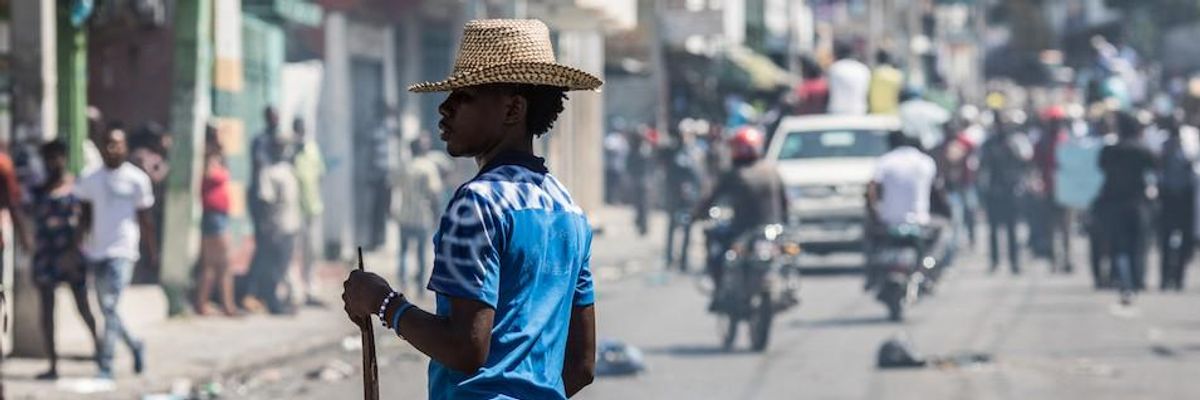
Protesters, medical professionals, and political opponents take part in a demonstration demanding the resignation of President Jovenel Moise in the Haitian capital in Port-au-Prince on October 30, 2019. (Photo: Valerie Baeriswyl/AFP/Getty Images)
While remembering their past has not prevented history from repeating itself, it is not possible for the descendants of the world's first successful large-scale slave revolt to forget the trauma inflicted by their northern neighbours.
One hundred and five years ago today a brutal US occupation of Haiti began. To commemorate an intervention that continues to shape that country Solidarity Quebec Haiti is organizing a sit in in front of the US Consulate on Saint Catherine St.
On July 28, 1915 the USS Washington, with 900-men and 20 canons, docked in Port-au-Prince. US troops withdrew in 1934 but Washington largely controlled the country's finances until 1941 and the Banque de la Republique d'Haiti remained under US supervision until 1947.
The occupation wasn't Washington's first instance of interference in Haiti but rather consolidated its grip over the country. Six months beforehand US Marines marched on the treasury in Port-au-Prince and took the nation's entire gold reserve.
At the height, 5000 US Marines were stationed in the country of less than 3 million. US-led forces brutally suppressed a largely peasant resistance movement, killing 15,000 Haitians.
In one of many instances of overt US racism, a top commander in the occupation, Colonel Littleton (Tony) Waller, descendent of a prominent family of slaveowners, said, "I know the nigger and how to handle him."
To suppress the anti-occupation movement the US employed the nascent technique of aerial bombardment. Most of the fighting ended when rebel leader Charlemagne Peralte was killed, pinned to a door and left on a street to rot for days at the end of 1919. The US military described Peralte as the "supreme bandit of Haiti".
In a famous mea culpa, an architect of the occupation confessed he was in fact the true "gangster". Describing himself as a "high class muscle man for Big Business" and "gangster for capitalism", Marine Corps General Smedley Butler wrote in an article years later, "I helped make Haiti ... a decent place for the National City Bank Boys to collect revenues in."
Opposition to the occupation was fed by conscription. US authorities captured civilians and compelled them to work on public roadway, buildings and other infrastructure. One reason the Marines wanted new roads was to help them bypass rugged terrain to suppress the resistance.
During the occupation the US established a new military. Created to crush resistance to the foreign presence, the National Guard "never fought anyone but Haitians." For the next 70 years it would be used by Washington and the elite against Haiti's poor. Haiti's current government is seeking to revive that force.
In general, the occupation devastated the peasantry. Wealth extracted from the countryside was overwhelmingly channeled to infrastructure in the capital and foreign banks. The occupation spurred migration to Port-au-Prince and out of the country.
The US instigated other major changes to rural ways. In 1918 they rewrote the constitution to allow foreigners to purchase land, which had been outlawed since independence. A number of US corporations took advantage of the changes. The US controlled North Haytian Sugar Company and Haytian Pineapple Company both acquired hundreds of acres of land while the Haitian American Development Corporation, Haytian Corporation of America and Haytian Agricultural Corporation acquired tens of thousands of acres.
Toronto-based Sun Life Assurance Company initiated its operations in Haiti during this period. Canada's largest bank also benefited from the US occupation. In 1919 the Royal Bank of Canada became the second bank in Haiti. RBC hired former finance minister Louis Borno as a legal advisor and officials of the Canadian firm subsequently financed his successful presidential bid during the US occupation.
Unfortunately, Solidarity Quebec Haiti's sit in is not only about drawing attention to a dark chapter in Haitian history. Washington retains significant influence over the country. In fact, the only reason the corrupt, repressive and illegitimate Jovenel Moise is currently president of Haiti is due to US (and Canadian) support.
Dear Common Dreams reader, It’s been nearly 30 years since I co-founded Common Dreams with my late wife, Lina Newhouser. We had the radical notion that journalism should serve the public good, not corporate profits. It was clear to us from the outset what it would take to build such a project. No paid advertisements. No corporate sponsors. No millionaire publisher telling us what to think or do. Many people said we wouldn't last a year, but we proved those doubters wrong. Together with a tremendous team of journalists and dedicated staff, we built an independent media outlet free from the constraints of profits and corporate control. Our mission has always been simple: To inform. To inspire. To ignite change for the common good. Building Common Dreams was not easy. Our survival was never guaranteed. When you take on the most powerful forces—Wall Street greed, fossil fuel industry destruction, Big Tech lobbyists, and uber-rich oligarchs who have spent billions upon billions rigging the economy and democracy in their favor—the only bulwark you have is supporters who believe in your work. But here’s the urgent message from me today. It's never been this bad out there. And it's never been this hard to keep us going. At the very moment Common Dreams is most needed, the threats we face are intensifying. We need your support now more than ever. We don't accept corporate advertising and never will. We don't have a paywall because we don't think people should be blocked from critical news based on their ability to pay. Everything we do is funded by the donations of readers like you. When everyone does the little they can afford, we are strong. But if that support retreats or dries up, so do we. Will you donate now to make sure Common Dreams not only survives but thrives? —Craig Brown, Co-founder |
While remembering their past has not prevented history from repeating itself, it is not possible for the descendants of the world's first successful large-scale slave revolt to forget the trauma inflicted by their northern neighbours.
One hundred and five years ago today a brutal US occupation of Haiti began. To commemorate an intervention that continues to shape that country Solidarity Quebec Haiti is organizing a sit in in front of the US Consulate on Saint Catherine St.
On July 28, 1915 the USS Washington, with 900-men and 20 canons, docked in Port-au-Prince. US troops withdrew in 1934 but Washington largely controlled the country's finances until 1941 and the Banque de la Republique d'Haiti remained under US supervision until 1947.
The occupation wasn't Washington's first instance of interference in Haiti but rather consolidated its grip over the country. Six months beforehand US Marines marched on the treasury in Port-au-Prince and took the nation's entire gold reserve.
At the height, 5000 US Marines were stationed in the country of less than 3 million. US-led forces brutally suppressed a largely peasant resistance movement, killing 15,000 Haitians.
In one of many instances of overt US racism, a top commander in the occupation, Colonel Littleton (Tony) Waller, descendent of a prominent family of slaveowners, said, "I know the nigger and how to handle him."
To suppress the anti-occupation movement the US employed the nascent technique of aerial bombardment. Most of the fighting ended when rebel leader Charlemagne Peralte was killed, pinned to a door and left on a street to rot for days at the end of 1919. The US military described Peralte as the "supreme bandit of Haiti".
In a famous mea culpa, an architect of the occupation confessed he was in fact the true "gangster". Describing himself as a "high class muscle man for Big Business" and "gangster for capitalism", Marine Corps General Smedley Butler wrote in an article years later, "I helped make Haiti ... a decent place for the National City Bank Boys to collect revenues in."
Opposition to the occupation was fed by conscription. US authorities captured civilians and compelled them to work on public roadway, buildings and other infrastructure. One reason the Marines wanted new roads was to help them bypass rugged terrain to suppress the resistance.
During the occupation the US established a new military. Created to crush resistance to the foreign presence, the National Guard "never fought anyone but Haitians." For the next 70 years it would be used by Washington and the elite against Haiti's poor. Haiti's current government is seeking to revive that force.
In general, the occupation devastated the peasantry. Wealth extracted from the countryside was overwhelmingly channeled to infrastructure in the capital and foreign banks. The occupation spurred migration to Port-au-Prince and out of the country.
The US instigated other major changes to rural ways. In 1918 they rewrote the constitution to allow foreigners to purchase land, which had been outlawed since independence. A number of US corporations took advantage of the changes. The US controlled North Haytian Sugar Company and Haytian Pineapple Company both acquired hundreds of acres of land while the Haitian American Development Corporation, Haytian Corporation of America and Haytian Agricultural Corporation acquired tens of thousands of acres.
Toronto-based Sun Life Assurance Company initiated its operations in Haiti during this period. Canada's largest bank also benefited from the US occupation. In 1919 the Royal Bank of Canada became the second bank in Haiti. RBC hired former finance minister Louis Borno as a legal advisor and officials of the Canadian firm subsequently financed his successful presidential bid during the US occupation.
Unfortunately, Solidarity Quebec Haiti's sit in is not only about drawing attention to a dark chapter in Haitian history. Washington retains significant influence over the country. In fact, the only reason the corrupt, repressive and illegitimate Jovenel Moise is currently president of Haiti is due to US (and Canadian) support.
While remembering their past has not prevented history from repeating itself, it is not possible for the descendants of the world's first successful large-scale slave revolt to forget the trauma inflicted by their northern neighbours.
One hundred and five years ago today a brutal US occupation of Haiti began. To commemorate an intervention that continues to shape that country Solidarity Quebec Haiti is organizing a sit in in front of the US Consulate on Saint Catherine St.
On July 28, 1915 the USS Washington, with 900-men and 20 canons, docked in Port-au-Prince. US troops withdrew in 1934 but Washington largely controlled the country's finances until 1941 and the Banque de la Republique d'Haiti remained under US supervision until 1947.
The occupation wasn't Washington's first instance of interference in Haiti but rather consolidated its grip over the country. Six months beforehand US Marines marched on the treasury in Port-au-Prince and took the nation's entire gold reserve.
At the height, 5000 US Marines were stationed in the country of less than 3 million. US-led forces brutally suppressed a largely peasant resistance movement, killing 15,000 Haitians.
In one of many instances of overt US racism, a top commander in the occupation, Colonel Littleton (Tony) Waller, descendent of a prominent family of slaveowners, said, "I know the nigger and how to handle him."
To suppress the anti-occupation movement the US employed the nascent technique of aerial bombardment. Most of the fighting ended when rebel leader Charlemagne Peralte was killed, pinned to a door and left on a street to rot for days at the end of 1919. The US military described Peralte as the "supreme bandit of Haiti".
In a famous mea culpa, an architect of the occupation confessed he was in fact the true "gangster". Describing himself as a "high class muscle man for Big Business" and "gangster for capitalism", Marine Corps General Smedley Butler wrote in an article years later, "I helped make Haiti ... a decent place for the National City Bank Boys to collect revenues in."
Opposition to the occupation was fed by conscription. US authorities captured civilians and compelled them to work on public roadway, buildings and other infrastructure. One reason the Marines wanted new roads was to help them bypass rugged terrain to suppress the resistance.
During the occupation the US established a new military. Created to crush resistance to the foreign presence, the National Guard "never fought anyone but Haitians." For the next 70 years it would be used by Washington and the elite against Haiti's poor. Haiti's current government is seeking to revive that force.
In general, the occupation devastated the peasantry. Wealth extracted from the countryside was overwhelmingly channeled to infrastructure in the capital and foreign banks. The occupation spurred migration to Port-au-Prince and out of the country.
The US instigated other major changes to rural ways. In 1918 they rewrote the constitution to allow foreigners to purchase land, which had been outlawed since independence. A number of US corporations took advantage of the changes. The US controlled North Haytian Sugar Company and Haytian Pineapple Company both acquired hundreds of acres of land while the Haitian American Development Corporation, Haytian Corporation of America and Haytian Agricultural Corporation acquired tens of thousands of acres.
Toronto-based Sun Life Assurance Company initiated its operations in Haiti during this period. Canada's largest bank also benefited from the US occupation. In 1919 the Royal Bank of Canada became the second bank in Haiti. RBC hired former finance minister Louis Borno as a legal advisor and officials of the Canadian firm subsequently financed his successful presidential bid during the US occupation.
Unfortunately, Solidarity Quebec Haiti's sit in is not only about drawing attention to a dark chapter in Haitian history. Washington retains significant influence over the country. In fact, the only reason the corrupt, repressive and illegitimate Jovenel Moise is currently president of Haiti is due to US (and Canadian) support.