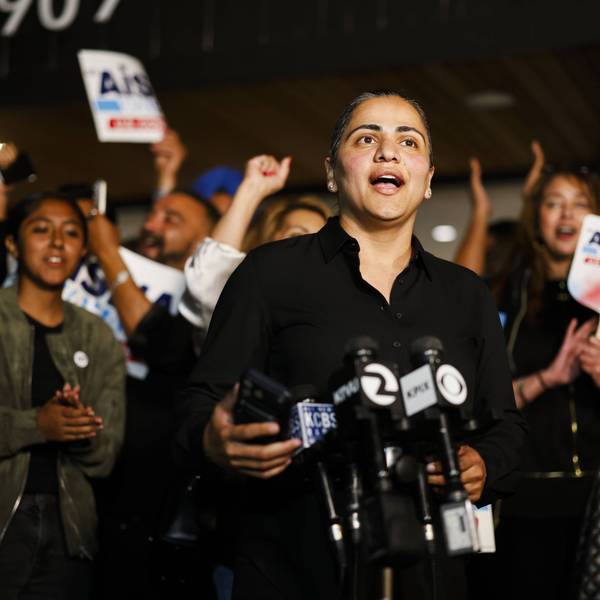


The new populists are devoted, in contrast, to diversity, tolerance, and inclusiveness. (Photo: Dr Case/Flickr)
Progressive Populism and a 21st Century Challenge
Grassroots activists are re-defining populism for a new era.
Eugene Lim was on his way to hitting rock bottom. After graduating from Chicago's Shimer College in 2011, he'd spent two years trying to find a permanent job. And he was increasingly blaming himself for his plight.
"I thought I was poor through some fault of my own," he said in a speech before the Populism2015 conference that I helped organize this April in Washington.
After a serious mauling from a stray dog landed him in an emergency room, Lim was left with an $11,000 hospital bill he couldn't pay. That's when he began to redirect his anger.
Fortunately, Lim was eligible for Illinois' Medicaid program. But then he learned that Illinois Governor Bruce Rauner was pushing for deep cuts in the state's Medicaid program--while also pushing tax cuts for corporations and the wealthy.
That spurred Lim to join the Chicago community action group One Northside, one of the key voices pushing back against Rauner's right-wing economic policies.
Now, Lim says, "I blame systemic economic injustice for those two hard years" of unemployment. That injustice has made him a foot soldier in a new movement that's challenging both major American political parties.
At the Populism2015 gathering, some 800 grassroots activists and community organizers like Lim sought to define this new 21st-century movement. They discussed how it could boost campaigns around the country.
As progressives reclaiming the mantle of "populism," our alliance is tapping a deep American tradition rooted in the nation's founding. We see the government as an instrument for the public good.
The meeting included many political activists who are rooting for a Democratic presidential challenger to Hillary Clinton--largely due to her ties with Wall Street and concerns about her commitment to forcefully addressing extreme wealth concentration--as well as those who aren't.
Both camps are working together to build an independent political force powerful enough to diminish the influence of big money in politics at all levels of government.
United People's Action, Alliance for a Just Society, USAction, and Campaign for America's Future, which together have more than 2 million members, organized the conference.
As progressives reclaiming the mantle of "populism," our alliance is tapping a deep American tradition rooted in the nation's founding. We see the government as an instrument for the public good.
"Populism reached back to the Founders to challenge the concentration of power and wealth and prevailing ideology of social Darwinism," recalled Harvey Kaye, a professor at the University of Wisconsin-Green Bay and author of Thomas Paine and the Promise of America.
The turn-of-the-20th-century populist movement, he explained, "called for government action to control the big banks and nationalize the railroad companies, support the setting up of public agricultural cooperatives, enact a graduated income tax, and guarantee the rights of workers to organize unions."
But the earlier populists also too often "turned to anti-immigrant, anti-semitic, and racist rhetoric" to rally supporters. The new populists are devoted, in contrast, to diversity, tolerance, and inclusiveness.
"This new populism has to be equally committed to class, race, and gender," explains George Goehl, president of National People's Action. "Everybody in, nobody out."
Conference participants ratified a 12-point platform "for people and the planet." Organizers will use it to size up candidates running for everything from the White House to your local school board.
We're building a movement that will reshape the political process, said Robert Borosage, a Campaign for America's Future co-director. It will "shake the boardrooms of corporations and the bordellos of Wall Street."
An Urgent Message From Our Co-Founder
Dear Common Dreams reader, It’s been nearly 30 years since I co-founded Common Dreams with my late wife, Lina Newhouser. We had the radical notion that journalism should serve the public good, not corporate profits. It was clear to us from the outset what it would take to build such a project. No paid advertisements. No corporate sponsors. No millionaire publisher telling us what to think or do. Many people said we wouldn't last a year, but we proved those doubters wrong. Together with a tremendous team of journalists and dedicated staff, we built an independent media outlet free from the constraints of profits and corporate control. Our mission has always been simple: To inform. To inspire. To ignite change for the common good. Building Common Dreams was not easy. Our survival was never guaranteed. When you take on the most powerful forces—Wall Street greed, fossil fuel industry destruction, Big Tech lobbyists, and uber-rich oligarchs who have spent billions upon billions rigging the economy and democracy in their favor—the only bulwark you have is supporters who believe in your work. But here’s the urgent message from me today. It's never been this bad out there. And it's never been this hard to keep us going. At the very moment Common Dreams is most needed, the threats we face are intensifying. We need your support now more than ever. We don't accept corporate advertising and never will. We don't have a paywall because we don't think people should be blocked from critical news based on their ability to pay. Everything we do is funded by the donations of readers like you. When everyone does the little they can afford, we are strong. But if that support retreats or dries up, so do we. Will you donate now to make sure Common Dreams not only survives but thrives? —Craig Brown, Co-founder |
Eugene Lim was on his way to hitting rock bottom. After graduating from Chicago's Shimer College in 2011, he'd spent two years trying to find a permanent job. And he was increasingly blaming himself for his plight.
"I thought I was poor through some fault of my own," he said in a speech before the Populism2015 conference that I helped organize this April in Washington.
After a serious mauling from a stray dog landed him in an emergency room, Lim was left with an $11,000 hospital bill he couldn't pay. That's when he began to redirect his anger.
Fortunately, Lim was eligible for Illinois' Medicaid program. But then he learned that Illinois Governor Bruce Rauner was pushing for deep cuts in the state's Medicaid program--while also pushing tax cuts for corporations and the wealthy.
That spurred Lim to join the Chicago community action group One Northside, one of the key voices pushing back against Rauner's right-wing economic policies.
Now, Lim says, "I blame systemic economic injustice for those two hard years" of unemployment. That injustice has made him a foot soldier in a new movement that's challenging both major American political parties.
At the Populism2015 gathering, some 800 grassroots activists and community organizers like Lim sought to define this new 21st-century movement. They discussed how it could boost campaigns around the country.
As progressives reclaiming the mantle of "populism," our alliance is tapping a deep American tradition rooted in the nation's founding. We see the government as an instrument for the public good.
The meeting included many political activists who are rooting for a Democratic presidential challenger to Hillary Clinton--largely due to her ties with Wall Street and concerns about her commitment to forcefully addressing extreme wealth concentration--as well as those who aren't.
Both camps are working together to build an independent political force powerful enough to diminish the influence of big money in politics at all levels of government.
United People's Action, Alliance for a Just Society, USAction, and Campaign for America's Future, which together have more than 2 million members, organized the conference.
As progressives reclaiming the mantle of "populism," our alliance is tapping a deep American tradition rooted in the nation's founding. We see the government as an instrument for the public good.
"Populism reached back to the Founders to challenge the concentration of power and wealth and prevailing ideology of social Darwinism," recalled Harvey Kaye, a professor at the University of Wisconsin-Green Bay and author of Thomas Paine and the Promise of America.
The turn-of-the-20th-century populist movement, he explained, "called for government action to control the big banks and nationalize the railroad companies, support the setting up of public agricultural cooperatives, enact a graduated income tax, and guarantee the rights of workers to organize unions."
But the earlier populists also too often "turned to anti-immigrant, anti-semitic, and racist rhetoric" to rally supporters. The new populists are devoted, in contrast, to diversity, tolerance, and inclusiveness.
"This new populism has to be equally committed to class, race, and gender," explains George Goehl, president of National People's Action. "Everybody in, nobody out."
Conference participants ratified a 12-point platform "for people and the planet." Organizers will use it to size up candidates running for everything from the White House to your local school board.
We're building a movement that will reshape the political process, said Robert Borosage, a Campaign for America's Future co-director. It will "shake the boardrooms of corporations and the bordellos of Wall Street."
Eugene Lim was on his way to hitting rock bottom. After graduating from Chicago's Shimer College in 2011, he'd spent two years trying to find a permanent job. And he was increasingly blaming himself for his plight.
"I thought I was poor through some fault of my own," he said in a speech before the Populism2015 conference that I helped organize this April in Washington.
After a serious mauling from a stray dog landed him in an emergency room, Lim was left with an $11,000 hospital bill he couldn't pay. That's when he began to redirect his anger.
Fortunately, Lim was eligible for Illinois' Medicaid program. But then he learned that Illinois Governor Bruce Rauner was pushing for deep cuts in the state's Medicaid program--while also pushing tax cuts for corporations and the wealthy.
That spurred Lim to join the Chicago community action group One Northside, one of the key voices pushing back against Rauner's right-wing economic policies.
Now, Lim says, "I blame systemic economic injustice for those two hard years" of unemployment. That injustice has made him a foot soldier in a new movement that's challenging both major American political parties.
At the Populism2015 gathering, some 800 grassroots activists and community organizers like Lim sought to define this new 21st-century movement. They discussed how it could boost campaigns around the country.
As progressives reclaiming the mantle of "populism," our alliance is tapping a deep American tradition rooted in the nation's founding. We see the government as an instrument for the public good.
The meeting included many political activists who are rooting for a Democratic presidential challenger to Hillary Clinton--largely due to her ties with Wall Street and concerns about her commitment to forcefully addressing extreme wealth concentration--as well as those who aren't.
Both camps are working together to build an independent political force powerful enough to diminish the influence of big money in politics at all levels of government.
United People's Action, Alliance for a Just Society, USAction, and Campaign for America's Future, which together have more than 2 million members, organized the conference.
As progressives reclaiming the mantle of "populism," our alliance is tapping a deep American tradition rooted in the nation's founding. We see the government as an instrument for the public good.
"Populism reached back to the Founders to challenge the concentration of power and wealth and prevailing ideology of social Darwinism," recalled Harvey Kaye, a professor at the University of Wisconsin-Green Bay and author of Thomas Paine and the Promise of America.
The turn-of-the-20th-century populist movement, he explained, "called for government action to control the big banks and nationalize the railroad companies, support the setting up of public agricultural cooperatives, enact a graduated income tax, and guarantee the rights of workers to organize unions."
But the earlier populists also too often "turned to anti-immigrant, anti-semitic, and racist rhetoric" to rally supporters. The new populists are devoted, in contrast, to diversity, tolerance, and inclusiveness.
"This new populism has to be equally committed to class, race, and gender," explains George Goehl, president of National People's Action. "Everybody in, nobody out."
Conference participants ratified a 12-point platform "for people and the planet." Organizers will use it to size up candidates running for everything from the White House to your local school board.
We're building a movement that will reshape the political process, said Robert Borosage, a Campaign for America's Future co-director. It will "shake the boardrooms of corporations and the bordellos of Wall Street."