SUBSCRIBE TO OUR FREE NEWSLETTER
Daily news & progressive opinion—funded by the people, not the corporations—delivered straight to your inbox.
5
#000000
#FFFFFF
To donate by check, phone, or other method, see our More Ways to Give page.
Daily news & progressive opinion—funded by the people, not the corporations—delivered straight to your inbox.
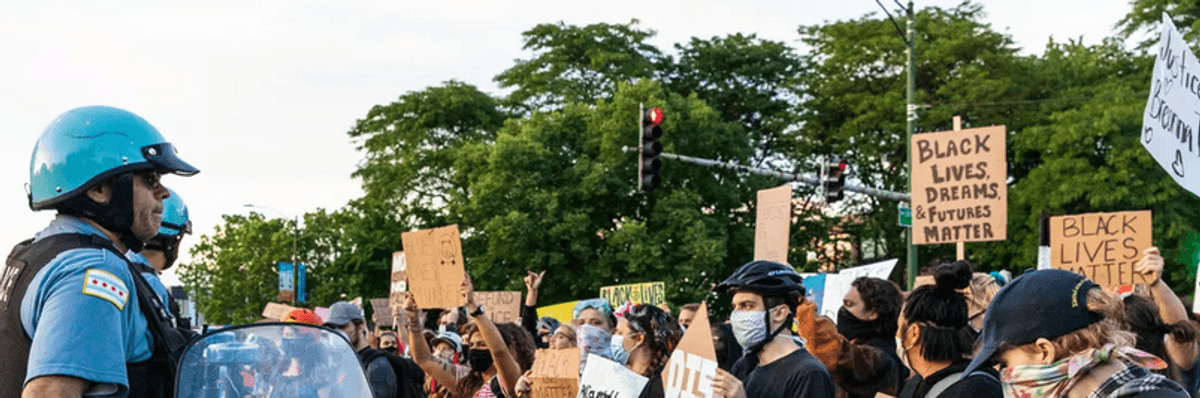
Fundamental policing reforms, writes Jesse Jackson, would begin with ending the "qualified immunity" of police, curbing the militarization of police forces, transferring funds and functions to social agencies, imposing residency requirements and finally making lynching a hate crime. (Photo: Natasha Moustache/Getty Images)
As the worldwide demonstrations continue two weeks after the murder of George Floyd by a Minneapolis policeman, the question is whether outrage will lead to real reforms?
Fundamental reforms would begin with ending the "qualified immunity" of police, curbing the militarization of police forces, transferring funds and functions to social agencies, imposing residency requirements and finally making lynching a hate crime.
There is good reason to be skeptical. After the remarkable Black Lives Matter demonstrations across the country in 2014, very little changed. Police continue to kill more than 250 African Americans a year (of nearly 1,000 Americans each year). In most cities, racial profiling, constant harassment, routine brutality and mass arrests continue. Powerful police unions block reforms.
Cynical politicians--in this case led by Donald Trump who has been tweeting "more money for Law Enforcement--fan fears. Callous officials like Attorney General William Barr deny the existence of systemic racism in our criminal justice system. With 18,000 separate police organizations organized locally across the country, real reform is hard.
There is also reason for hope. After dozens of commissions beginning with the Kerner Commission in 1967 and moving forward, we know a lot about what needs to be done. What has been missing is will, not ideas. And now, as the demonstrations reveal, Americans--black and white, young and old--are demanding change.
On Monday, Democrats--led by Rep. Karen Bass, chair of the CBC, and Senators Corey Booker and Kamala Harris--introduced The Justice in Policing Act of 2020 which calls for basic reforms.
It would revise the "qualified immunity," which has protected police from liability for excessive use of force, curb the transfer of military equipment to state and local law enforcement agencies, mandate data collection of police misconduct and a centralized registry of offenders, mandate racial training and outlaw choke holds and no-knock warrants. It would finally make lynching a hate crime, passing legislation that has been pending for over 100 years.
Many of these same reforms can and should be passed at a state level, not allowing Mitch McConnell and Donald Trump to bottle up reform.
Similarly, as Campaign Zero has detailed in #8Can'tWait, local officials or city councils can simply order basic changes in police techniques: outlawing choke holds, mandating de-escalation efforts, requiring warning before shooting, creating a duty to intervene against excessive force by other officers, banning shooting at moving vehicles and more.
"Defund the police" has been added to the massive "Black Lives Matter" painted on the road leading to the White House in Washington. Trump, of course, has jumped on the slogan in an effort to discredit any reform.
But the advocates of "defund the police" aren't fools. They understand that the police will be with us -- but that their role and their functions need to be dramatically rethought. "We must end policing as we know it," stated Lisa Bender, the Minneapolis City Council President who leads a veto-proof majority of the city council dedicated to "recreating a system of public safety that will actually keep us safe."
Defunding means transferring resources that now go to police into investments in communities in health care, schools, housing. It reflects the reality that in minority communities, particularly, overcriminalization has made virtually everyone a potential target. Police have gotten involved in areas better left to others, from school discipline, eviction enforcement, addiction and substance abuse. Police are soldiers in the so-called War on Drugs when it is fought in poor and minority communities while deferring to public health agencies addressing opioid and drug abuse in suburban and exurban neighborhoods.
Defending would include organizing community groups to help intervene to de-escalate tense situations that can lead to violence. Mayors in Los Angeles to New York have announced plans to transfer some funds from the police budget to social services, but what's required is a real commitment like that of the Minneapolis City Council to rethink public safety from top to bottom.
One part of this has to recreate real community policing. In Minneapolis, 92 percent of the police live outside the city. They are literally an outside occupying army, too often seeing the neighborhoods they patrol as alien, even enemy territory.
Residence requirements that a far higher percentage of police come from the neighborhoods they patrol would dramatically change the tenor of the cops and the trust of the citizens.
Real change won't be easy. The resistance will be fierce. At the national level, Senate Republicans will no doubt seek to block the reforms that pass the House. Trump will enlist the police unions to posture as a law-and-order strong man. The demonstrators must build a political force able not only to defeat those who stand in the way, but to hold those promising change accountable.
What is clear is that the abuses won't stop, the police murders won't end until fundamental reforms are made.
Dear Common Dreams reader, It’s been nearly 30 years since I co-founded Common Dreams with my late wife, Lina Newhouser. We had the radical notion that journalism should serve the public good, not corporate profits. It was clear to us from the outset what it would take to build such a project. No paid advertisements. No corporate sponsors. No millionaire publisher telling us what to think or do. Many people said we wouldn't last a year, but we proved those doubters wrong. Together with a tremendous team of journalists and dedicated staff, we built an independent media outlet free from the constraints of profits and corporate control. Our mission has always been simple: To inform. To inspire. To ignite change for the common good. Building Common Dreams was not easy. Our survival was never guaranteed. When you take on the most powerful forces—Wall Street greed, fossil fuel industry destruction, Big Tech lobbyists, and uber-rich oligarchs who have spent billions upon billions rigging the economy and democracy in their favor—the only bulwark you have is supporters who believe in your work. But here’s the urgent message from me today. It's never been this bad out there. And it's never been this hard to keep us going. At the very moment Common Dreams is most needed, the threats we face are intensifying. We need your support now more than ever. We don't accept corporate advertising and never will. We don't have a paywall because we don't think people should be blocked from critical news based on their ability to pay. Everything we do is funded by the donations of readers like you. When everyone does the little they can afford, we are strong. But if that support retreats or dries up, so do we. Will you donate now to make sure Common Dreams not only survives but thrives? —Craig Brown, Co-founder |
As the worldwide demonstrations continue two weeks after the murder of George Floyd by a Minneapolis policeman, the question is whether outrage will lead to real reforms?
Fundamental reforms would begin with ending the "qualified immunity" of police, curbing the militarization of police forces, transferring funds and functions to social agencies, imposing residency requirements and finally making lynching a hate crime.
There is good reason to be skeptical. After the remarkable Black Lives Matter demonstrations across the country in 2014, very little changed. Police continue to kill more than 250 African Americans a year (of nearly 1,000 Americans each year). In most cities, racial profiling, constant harassment, routine brutality and mass arrests continue. Powerful police unions block reforms.
Cynical politicians--in this case led by Donald Trump who has been tweeting "more money for Law Enforcement--fan fears. Callous officials like Attorney General William Barr deny the existence of systemic racism in our criminal justice system. With 18,000 separate police organizations organized locally across the country, real reform is hard.
There is also reason for hope. After dozens of commissions beginning with the Kerner Commission in 1967 and moving forward, we know a lot about what needs to be done. What has been missing is will, not ideas. And now, as the demonstrations reveal, Americans--black and white, young and old--are demanding change.
On Monday, Democrats--led by Rep. Karen Bass, chair of the CBC, and Senators Corey Booker and Kamala Harris--introduced The Justice in Policing Act of 2020 which calls for basic reforms.
It would revise the "qualified immunity," which has protected police from liability for excessive use of force, curb the transfer of military equipment to state and local law enforcement agencies, mandate data collection of police misconduct and a centralized registry of offenders, mandate racial training and outlaw choke holds and no-knock warrants. It would finally make lynching a hate crime, passing legislation that has been pending for over 100 years.
Many of these same reforms can and should be passed at a state level, not allowing Mitch McConnell and Donald Trump to bottle up reform.
Similarly, as Campaign Zero has detailed in #8Can'tWait, local officials or city councils can simply order basic changes in police techniques: outlawing choke holds, mandating de-escalation efforts, requiring warning before shooting, creating a duty to intervene against excessive force by other officers, banning shooting at moving vehicles and more.
"Defund the police" has been added to the massive "Black Lives Matter" painted on the road leading to the White House in Washington. Trump, of course, has jumped on the slogan in an effort to discredit any reform.
But the advocates of "defund the police" aren't fools. They understand that the police will be with us -- but that their role and their functions need to be dramatically rethought. "We must end policing as we know it," stated Lisa Bender, the Minneapolis City Council President who leads a veto-proof majority of the city council dedicated to "recreating a system of public safety that will actually keep us safe."
Defunding means transferring resources that now go to police into investments in communities in health care, schools, housing. It reflects the reality that in minority communities, particularly, overcriminalization has made virtually everyone a potential target. Police have gotten involved in areas better left to others, from school discipline, eviction enforcement, addiction and substance abuse. Police are soldiers in the so-called War on Drugs when it is fought in poor and minority communities while deferring to public health agencies addressing opioid and drug abuse in suburban and exurban neighborhoods.
Defending would include organizing community groups to help intervene to de-escalate tense situations that can lead to violence. Mayors in Los Angeles to New York have announced plans to transfer some funds from the police budget to social services, but what's required is a real commitment like that of the Minneapolis City Council to rethink public safety from top to bottom.
One part of this has to recreate real community policing. In Minneapolis, 92 percent of the police live outside the city. They are literally an outside occupying army, too often seeing the neighborhoods they patrol as alien, even enemy territory.
Residence requirements that a far higher percentage of police come from the neighborhoods they patrol would dramatically change the tenor of the cops and the trust of the citizens.
Real change won't be easy. The resistance will be fierce. At the national level, Senate Republicans will no doubt seek to block the reforms that pass the House. Trump will enlist the police unions to posture as a law-and-order strong man. The demonstrators must build a political force able not only to defeat those who stand in the way, but to hold those promising change accountable.
What is clear is that the abuses won't stop, the police murders won't end until fundamental reforms are made.
As the worldwide demonstrations continue two weeks after the murder of George Floyd by a Minneapolis policeman, the question is whether outrage will lead to real reforms?
Fundamental reforms would begin with ending the "qualified immunity" of police, curbing the militarization of police forces, transferring funds and functions to social agencies, imposing residency requirements and finally making lynching a hate crime.
There is good reason to be skeptical. After the remarkable Black Lives Matter demonstrations across the country in 2014, very little changed. Police continue to kill more than 250 African Americans a year (of nearly 1,000 Americans each year). In most cities, racial profiling, constant harassment, routine brutality and mass arrests continue. Powerful police unions block reforms.
Cynical politicians--in this case led by Donald Trump who has been tweeting "more money for Law Enforcement--fan fears. Callous officials like Attorney General William Barr deny the existence of systemic racism in our criminal justice system. With 18,000 separate police organizations organized locally across the country, real reform is hard.
There is also reason for hope. After dozens of commissions beginning with the Kerner Commission in 1967 and moving forward, we know a lot about what needs to be done. What has been missing is will, not ideas. And now, as the demonstrations reveal, Americans--black and white, young and old--are demanding change.
On Monday, Democrats--led by Rep. Karen Bass, chair of the CBC, and Senators Corey Booker and Kamala Harris--introduced The Justice in Policing Act of 2020 which calls for basic reforms.
It would revise the "qualified immunity," which has protected police from liability for excessive use of force, curb the transfer of military equipment to state and local law enforcement agencies, mandate data collection of police misconduct and a centralized registry of offenders, mandate racial training and outlaw choke holds and no-knock warrants. It would finally make lynching a hate crime, passing legislation that has been pending for over 100 years.
Many of these same reforms can and should be passed at a state level, not allowing Mitch McConnell and Donald Trump to bottle up reform.
Similarly, as Campaign Zero has detailed in #8Can'tWait, local officials or city councils can simply order basic changes in police techniques: outlawing choke holds, mandating de-escalation efforts, requiring warning before shooting, creating a duty to intervene against excessive force by other officers, banning shooting at moving vehicles and more.
"Defund the police" has been added to the massive "Black Lives Matter" painted on the road leading to the White House in Washington. Trump, of course, has jumped on the slogan in an effort to discredit any reform.
But the advocates of "defund the police" aren't fools. They understand that the police will be with us -- but that their role and their functions need to be dramatically rethought. "We must end policing as we know it," stated Lisa Bender, the Minneapolis City Council President who leads a veto-proof majority of the city council dedicated to "recreating a system of public safety that will actually keep us safe."
Defunding means transferring resources that now go to police into investments in communities in health care, schools, housing. It reflects the reality that in minority communities, particularly, overcriminalization has made virtually everyone a potential target. Police have gotten involved in areas better left to others, from school discipline, eviction enforcement, addiction and substance abuse. Police are soldiers in the so-called War on Drugs when it is fought in poor and minority communities while deferring to public health agencies addressing opioid and drug abuse in suburban and exurban neighborhoods.
Defending would include organizing community groups to help intervene to de-escalate tense situations that can lead to violence. Mayors in Los Angeles to New York have announced plans to transfer some funds from the police budget to social services, but what's required is a real commitment like that of the Minneapolis City Council to rethink public safety from top to bottom.
One part of this has to recreate real community policing. In Minneapolis, 92 percent of the police live outside the city. They are literally an outside occupying army, too often seeing the neighborhoods they patrol as alien, even enemy territory.
Residence requirements that a far higher percentage of police come from the neighborhoods they patrol would dramatically change the tenor of the cops and the trust of the citizens.
Real change won't be easy. The resistance will be fierce. At the national level, Senate Republicans will no doubt seek to block the reforms that pass the House. Trump will enlist the police unions to posture as a law-and-order strong man. The demonstrators must build a political force able not only to defeat those who stand in the way, but to hold those promising change accountable.
What is clear is that the abuses won't stop, the police murders won't end until fundamental reforms are made.