SUBSCRIBE TO OUR FREE NEWSLETTER
Daily news & progressive opinion—funded by the people, not the corporations—delivered straight to your inbox.
5
#000000
#FFFFFF
To donate by check, phone, or other method, see our More Ways to Give page.
Daily news & progressive opinion—funded by the people, not the corporations—delivered straight to your inbox.
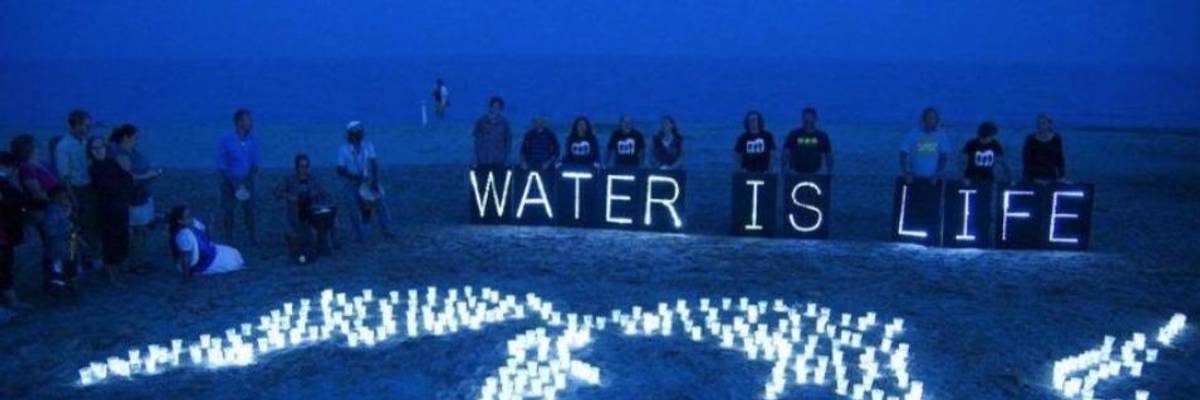
Healthcare officials have stated over and over again that washing your hands is the most important step to manage the spread of the virus, but access to clean water and adequate hand-washing facilities is not yet a reality to billions around the world.(Photo: Detroit Water Brigade)
Today, a global pandemic brings into focus how important water is to our lives and to public health and reveals how much more needs to be done to fully guarantee water and sanitation is available to everyone, both as a human right and as a critical way to protect our community.
On March 11, 2020, the World Health Organization declared COVID-19 a global pandemic. Spreading to nearly every country worldwide, the COVID-19 virus has infected hundreds of thousands of people. Along with placing travel restrictions and encouraging social distancing, healthcare officials have stated over and over again that washing your hands is the most important step to manage the spread of the virus.
Access to clean water and adequate hand-washing facilities is not yet a reality to billions around the world. 2020 marks ten years since the United Nations recognized water and sanitation as a fundamental human right. The COVID-19 virus demonstrates why water and sanitation must be available, accessible and affordable to all to keep our communities safe, healthy and thriving.
Across Canada, there are still over 100 First Nations communities without access to safe, clean water. To date, Indigenous Services Canada (ISC) reports 74 communities have experienced drinking water advisories for over a year, and only 61 of those are actively receiving support from the ISC. This number does not include at least 40 First Nations communities that have had either boil water or do-not-consume water advisories for less than a year. The federal government's commitment to lift all long-term drinking water advisories by 2021 seems increasingly unlikely.
Indigenous communities are more vulnerable to the COVID-19 virus. In addition to the lack of clean water, First Nations communities also lack adequate health care facilities, housing or food reserves, as well as the necessary staff to implement any emergency response. Inuit communities are also at higher risk due to higher rates of tuberculosis, overcrowded housing and inadequate health facilities. The federal government has allocated $300 million to support Indigenous communities, and communities are anxious to access that funding. As COVID-19 continues to expose weaknesses in our systems and Canada's history of colonization, the government must provide sufficient and timely emergency support to Indigenous communities.
Around the world, many people struggle for access to safe, clean, affordable water. Three quarters of households in the developing world don't have access to sufficient water facilities. Even in areas with sufficient water infrastructure, the policy implementation still leaves many at risk of contracting the virus due to lack of access to water and sanitation. In South Africa, Cape Town Municipality continues their water disconnection policy, shutting off residents' water access despite the pandemic.
Water shutoffs are a huge problem in the U.S., leaving up to 15 million Americans without running water, according to Food and Water Watch. Ninety US cities have suspended water shutoffs to help combat the coronavirus, including Detroit, where water shutoffs had become a crisis that affected close to 12,000 people each year. Moratoriums on shutoffs are the right thing to do, and we must work to make them permanent so that no one has to go without running water, no matter their location, economic status or circumstances.
In Canada, a growing number of municipalities, including Ottawa, Halifax and Saint John, have suspended water disconnection due to non-payment, and many others are providing an extended period of deferred payment without interest. However, many Canadian municipalities still reserve the right to shut off residents' water when residents fail to pay their water bills. Without a federal framework to implement the human right to water, Canadians are left with the patchwork of policies across municipalities that puts the most vulnerable communities at increased risk of COVID-19.
In addition to committing to not shutting off water, municipalities can also support homeless and housing-insecure people access water, sanitation and shelter facilities to stop the spread of the virus. There have been positive moves from Vancouver, Ottawa and Edmonton to provide isolation shelters, install handwashing stations, increase shelter capacity by using hotels and community centres, and provide testing and health care services to people experiencing homelessness. These measures are welcome, and must continue even after the outbreak as we confront the housing and homelessness crisis across the country.
I'm encouraged by the growing number of communities that have joined our Blue Communities Project, an effort to protect water as a human right, secure commitments of no water shutoffs and keep water services in public hands. Protecting water as a human right at all levels of government must be a priority to protect our communities during this and any future public health crises.
Decades of neoliberal policies have gutted our health care system, sold off essential services to private companies and left the most vulnerable members of our communities at tremendous risk. This global pandemic exposes the gaps and the ways that divestment from public services makes it harder to respond to crises, including COVID-19. We must expand core services, support communities and protect the commons. As we continue to keep ourselves, our family and communities safe, elected officials must show leadership to protect everyone and guarantee access to essential services like water to all.
Dear Common Dreams reader, It’s been nearly 30 years since I co-founded Common Dreams with my late wife, Lina Newhouser. We had the radical notion that journalism should serve the public good, not corporate profits. It was clear to us from the outset what it would take to build such a project. No paid advertisements. No corporate sponsors. No millionaire publisher telling us what to think or do. Many people said we wouldn't last a year, but we proved those doubters wrong. Together with a tremendous team of journalists and dedicated staff, we built an independent media outlet free from the constraints of profits and corporate control. Our mission has always been simple: To inform. To inspire. To ignite change for the common good. Building Common Dreams was not easy. Our survival was never guaranteed. When you take on the most powerful forces—Wall Street greed, fossil fuel industry destruction, Big Tech lobbyists, and uber-rich oligarchs who have spent billions upon billions rigging the economy and democracy in their favor—the only bulwark you have is supporters who believe in your work. But here’s the urgent message from me today. It's never been this bad out there. And it's never been this hard to keep us going. At the very moment Common Dreams is most needed, the threats we face are intensifying. We need your support now more than ever. We don't accept corporate advertising and never will. We don't have a paywall because we don't think people should be blocked from critical news based on their ability to pay. Everything we do is funded by the donations of readers like you. When everyone does the little they can afford, we are strong. But if that support retreats or dries up, so do we. Will you donate now to make sure Common Dreams not only survives but thrives? —Craig Brown, Co-founder |
Today, a global pandemic brings into focus how important water is to our lives and to public health and reveals how much more needs to be done to fully guarantee water and sanitation is available to everyone, both as a human right and as a critical way to protect our community.
On March 11, 2020, the World Health Organization declared COVID-19 a global pandemic. Spreading to nearly every country worldwide, the COVID-19 virus has infected hundreds of thousands of people. Along with placing travel restrictions and encouraging social distancing, healthcare officials have stated over and over again that washing your hands is the most important step to manage the spread of the virus.
Access to clean water and adequate hand-washing facilities is not yet a reality to billions around the world. 2020 marks ten years since the United Nations recognized water and sanitation as a fundamental human right. The COVID-19 virus demonstrates why water and sanitation must be available, accessible and affordable to all to keep our communities safe, healthy and thriving.
Across Canada, there are still over 100 First Nations communities without access to safe, clean water. To date, Indigenous Services Canada (ISC) reports 74 communities have experienced drinking water advisories for over a year, and only 61 of those are actively receiving support from the ISC. This number does not include at least 40 First Nations communities that have had either boil water or do-not-consume water advisories for less than a year. The federal government's commitment to lift all long-term drinking water advisories by 2021 seems increasingly unlikely.
Indigenous communities are more vulnerable to the COVID-19 virus. In addition to the lack of clean water, First Nations communities also lack adequate health care facilities, housing or food reserves, as well as the necessary staff to implement any emergency response. Inuit communities are also at higher risk due to higher rates of tuberculosis, overcrowded housing and inadequate health facilities. The federal government has allocated $300 million to support Indigenous communities, and communities are anxious to access that funding. As COVID-19 continues to expose weaknesses in our systems and Canada's history of colonization, the government must provide sufficient and timely emergency support to Indigenous communities.
Around the world, many people struggle for access to safe, clean, affordable water. Three quarters of households in the developing world don't have access to sufficient water facilities. Even in areas with sufficient water infrastructure, the policy implementation still leaves many at risk of contracting the virus due to lack of access to water and sanitation. In South Africa, Cape Town Municipality continues their water disconnection policy, shutting off residents' water access despite the pandemic.
Water shutoffs are a huge problem in the U.S., leaving up to 15 million Americans without running water, according to Food and Water Watch. Ninety US cities have suspended water shutoffs to help combat the coronavirus, including Detroit, where water shutoffs had become a crisis that affected close to 12,000 people each year. Moratoriums on shutoffs are the right thing to do, and we must work to make them permanent so that no one has to go without running water, no matter their location, economic status or circumstances.
In Canada, a growing number of municipalities, including Ottawa, Halifax and Saint John, have suspended water disconnection due to non-payment, and many others are providing an extended period of deferred payment without interest. However, many Canadian municipalities still reserve the right to shut off residents' water when residents fail to pay their water bills. Without a federal framework to implement the human right to water, Canadians are left with the patchwork of policies across municipalities that puts the most vulnerable communities at increased risk of COVID-19.
In addition to committing to not shutting off water, municipalities can also support homeless and housing-insecure people access water, sanitation and shelter facilities to stop the spread of the virus. There have been positive moves from Vancouver, Ottawa and Edmonton to provide isolation shelters, install handwashing stations, increase shelter capacity by using hotels and community centres, and provide testing and health care services to people experiencing homelessness. These measures are welcome, and must continue even after the outbreak as we confront the housing and homelessness crisis across the country.
I'm encouraged by the growing number of communities that have joined our Blue Communities Project, an effort to protect water as a human right, secure commitments of no water shutoffs and keep water services in public hands. Protecting water as a human right at all levels of government must be a priority to protect our communities during this and any future public health crises.
Decades of neoliberal policies have gutted our health care system, sold off essential services to private companies and left the most vulnerable members of our communities at tremendous risk. This global pandemic exposes the gaps and the ways that divestment from public services makes it harder to respond to crises, including COVID-19. We must expand core services, support communities and protect the commons. As we continue to keep ourselves, our family and communities safe, elected officials must show leadership to protect everyone and guarantee access to essential services like water to all.
Today, a global pandemic brings into focus how important water is to our lives and to public health and reveals how much more needs to be done to fully guarantee water and sanitation is available to everyone, both as a human right and as a critical way to protect our community.
On March 11, 2020, the World Health Organization declared COVID-19 a global pandemic. Spreading to nearly every country worldwide, the COVID-19 virus has infected hundreds of thousands of people. Along with placing travel restrictions and encouraging social distancing, healthcare officials have stated over and over again that washing your hands is the most important step to manage the spread of the virus.
Access to clean water and adequate hand-washing facilities is not yet a reality to billions around the world. 2020 marks ten years since the United Nations recognized water and sanitation as a fundamental human right. The COVID-19 virus demonstrates why water and sanitation must be available, accessible and affordable to all to keep our communities safe, healthy and thriving.
Across Canada, there are still over 100 First Nations communities without access to safe, clean water. To date, Indigenous Services Canada (ISC) reports 74 communities have experienced drinking water advisories for over a year, and only 61 of those are actively receiving support from the ISC. This number does not include at least 40 First Nations communities that have had either boil water or do-not-consume water advisories for less than a year. The federal government's commitment to lift all long-term drinking water advisories by 2021 seems increasingly unlikely.
Indigenous communities are more vulnerable to the COVID-19 virus. In addition to the lack of clean water, First Nations communities also lack adequate health care facilities, housing or food reserves, as well as the necessary staff to implement any emergency response. Inuit communities are also at higher risk due to higher rates of tuberculosis, overcrowded housing and inadequate health facilities. The federal government has allocated $300 million to support Indigenous communities, and communities are anxious to access that funding. As COVID-19 continues to expose weaknesses in our systems and Canada's history of colonization, the government must provide sufficient and timely emergency support to Indigenous communities.
Around the world, many people struggle for access to safe, clean, affordable water. Three quarters of households in the developing world don't have access to sufficient water facilities. Even in areas with sufficient water infrastructure, the policy implementation still leaves many at risk of contracting the virus due to lack of access to water and sanitation. In South Africa, Cape Town Municipality continues their water disconnection policy, shutting off residents' water access despite the pandemic.
Water shutoffs are a huge problem in the U.S., leaving up to 15 million Americans without running water, according to Food and Water Watch. Ninety US cities have suspended water shutoffs to help combat the coronavirus, including Detroit, where water shutoffs had become a crisis that affected close to 12,000 people each year. Moratoriums on shutoffs are the right thing to do, and we must work to make them permanent so that no one has to go without running water, no matter their location, economic status or circumstances.
In Canada, a growing number of municipalities, including Ottawa, Halifax and Saint John, have suspended water disconnection due to non-payment, and many others are providing an extended period of deferred payment without interest. However, many Canadian municipalities still reserve the right to shut off residents' water when residents fail to pay their water bills. Without a federal framework to implement the human right to water, Canadians are left with the patchwork of policies across municipalities that puts the most vulnerable communities at increased risk of COVID-19.
In addition to committing to not shutting off water, municipalities can also support homeless and housing-insecure people access water, sanitation and shelter facilities to stop the spread of the virus. There have been positive moves from Vancouver, Ottawa and Edmonton to provide isolation shelters, install handwashing stations, increase shelter capacity by using hotels and community centres, and provide testing and health care services to people experiencing homelessness. These measures are welcome, and must continue even after the outbreak as we confront the housing and homelessness crisis across the country.
I'm encouraged by the growing number of communities that have joined our Blue Communities Project, an effort to protect water as a human right, secure commitments of no water shutoffs and keep water services in public hands. Protecting water as a human right at all levels of government must be a priority to protect our communities during this and any future public health crises.
Decades of neoliberal policies have gutted our health care system, sold off essential services to private companies and left the most vulnerable members of our communities at tremendous risk. This global pandemic exposes the gaps and the ways that divestment from public services makes it harder to respond to crises, including COVID-19. We must expand core services, support communities and protect the commons. As we continue to keep ourselves, our family and communities safe, elected officials must show leadership to protect everyone and guarantee access to essential services like water to all.