SUBSCRIBE TO OUR FREE NEWSLETTER
Daily news & progressive opinion—funded by the people, not the corporations—delivered straight to your inbox.
5
#000000
#FFFFFF
To donate by check, phone, or other method, see our More Ways to Give page.
Daily news & progressive opinion—funded by the people, not the corporations—delivered straight to your inbox.
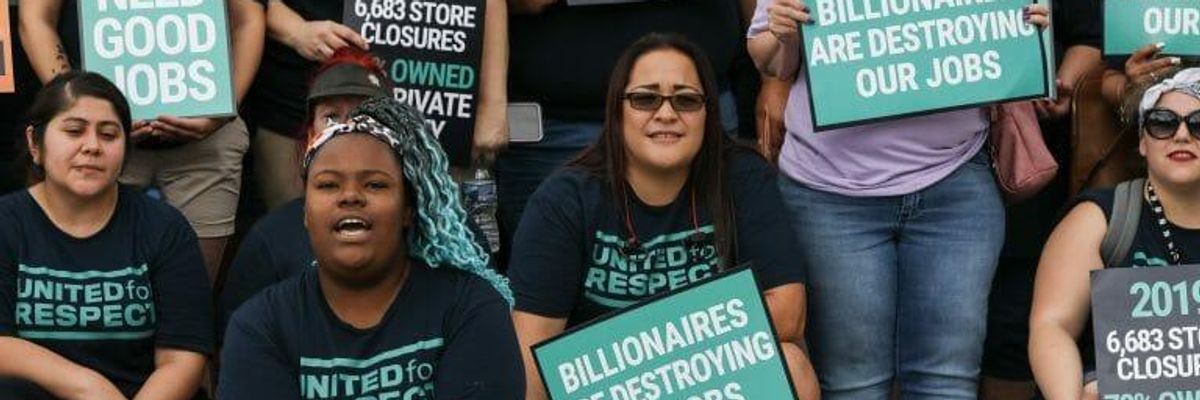
Giovanna De La Rosa (center) at a United for Respect demonstration.
For many years, Giovanna De La Rosa enjoyed working at Toys 'R' Us--especially during the holiday shopping season.
"I loved bringing joy to families and to children," she shared at a recent congressional hearing. "I watched so many of the local kids grow up over the years while shopping in our store."
De La Rosa's 20-year career with Toys 'R' Us came to an abrupt end in 2018 when the bankrupt company shuttered all of its 700 U.S. outlets, leaving more than 30,000 employees jobless.
Now Toys 'R' Us is trying to make a comeback. It re-opened its first U.S. store in New Jersey just in time for Black Friday, and it's planning to open another in Texas before Christmas.
But the company is a shadow of its former self, and many former Toys 'R' Us employees are still struggling to get back on their feet. De La Rosa, an assistant store manager at the time of the layoffs, searched for a year and a half to find another full-time position before having to settle for a seasonal job.
Who does she blame for her employer's collapse? Greedy Wall Street firms.
Toys 'R' Us was still profitable in 2005 when three private equity funds--KKR, Bain, and Vornado--acquired the retailer and loaded it up with billions of dollars in debt. This level of indebtedness "served no rational business need for Toys 'R Us," according to Eileen Appelbaum, co-director of the Center for Economic and Policy Research.
The buyout forced the company to pay more than $400 million per year in interest, on top of hundreds of millions of dollars in "advisory" fees to the private equity funds who'd purchased it. All these extra costs drove the company to ruin.
This is the typical M.O. for private equity funds that specialize in highly leveraged buyouts. They take out massive loans to finance corporate takeovers, quickly suck out whatever value they can, and then stick the companies with the IOUs.
ShopKo, Payless ShoeSource, Gymboree, The Limited, and Sports Authority have all collapsed under the weight of their debts after being taken over by private equity funds. Over the past decade, nearly 600,000 retail jobs in private-equity backed companies have been lost.
De La Rosa traveled from her home near San Diego, California, to Washington, D.C. recently to advocate for legislation that would crack down on this Wall Street recklessness. The Stop Wall Street Looting Act would make private equity firms jointly liable for repaying debts they burden companies with in leveraged buyouts.
The bill also aims to prevent executives from lining their pockets while workers suffer.
The kinds of ridiculous fees that private equity fund managers extracted from Toys 'R' Us would face a 100 percent tax. It would also help protect workers in a bankruptcy by banning special executive payouts until employees receive promised severance payments.
After filing for bankruptcy, Toys 'R' Us gave its workers zero severance, despite a longstanding policy of giving a week of pay for every year of service. Meanwhile, the co-founders of just one of the private equity firms that took over the company--KKR--both made about $100 million in 2018.
Toys 'R' Us has new owners now, and De La Rosa is encouraged by the fact that they have asked her and two other former employees to serve on an advisory group. But what makes her even more optimistic is to see more and more workers standing together to fight for Wall Street accountability.
She's now a leader in United for Respect, a retail worker advocacy group that has helped pressure the private equity funds to provide some financial support for laid off Toys 'R' Us workers.
Her bigger goal: to regulate private equity so they can no longer make money by putting people out of work.
Dear Common Dreams reader, It’s been nearly 30 years since I co-founded Common Dreams with my late wife, Lina Newhouser. We had the radical notion that journalism should serve the public good, not corporate profits. It was clear to us from the outset what it would take to build such a project. No paid advertisements. No corporate sponsors. No millionaire publisher telling us what to think or do. Many people said we wouldn't last a year, but we proved those doubters wrong. Together with a tremendous team of journalists and dedicated staff, we built an independent media outlet free from the constraints of profits and corporate control. Our mission has always been simple: To inform. To inspire. To ignite change for the common good. Building Common Dreams was not easy. Our survival was never guaranteed. When you take on the most powerful forces—Wall Street greed, fossil fuel industry destruction, Big Tech lobbyists, and uber-rich oligarchs who have spent billions upon billions rigging the economy and democracy in their favor—the only bulwark you have is supporters who believe in your work. But here’s the urgent message from me today. It's never been this bad out there. And it's never been this hard to keep us going. At the very moment Common Dreams is most needed, the threats we face are intensifying. We need your support now more than ever. We don't accept corporate advertising and never will. We don't have a paywall because we don't think people should be blocked from critical news based on their ability to pay. Everything we do is funded by the donations of readers like you. When everyone does the little they can afford, we are strong. But if that support retreats or dries up, so do we. Will you donate now to make sure Common Dreams not only survives but thrives? —Craig Brown, Co-founder |
For many years, Giovanna De La Rosa enjoyed working at Toys 'R' Us--especially during the holiday shopping season.
"I loved bringing joy to families and to children," she shared at a recent congressional hearing. "I watched so many of the local kids grow up over the years while shopping in our store."
De La Rosa's 20-year career with Toys 'R' Us came to an abrupt end in 2018 when the bankrupt company shuttered all of its 700 U.S. outlets, leaving more than 30,000 employees jobless.
Now Toys 'R' Us is trying to make a comeback. It re-opened its first U.S. store in New Jersey just in time for Black Friday, and it's planning to open another in Texas before Christmas.
But the company is a shadow of its former self, and many former Toys 'R' Us employees are still struggling to get back on their feet. De La Rosa, an assistant store manager at the time of the layoffs, searched for a year and a half to find another full-time position before having to settle for a seasonal job.
Who does she blame for her employer's collapse? Greedy Wall Street firms.
Toys 'R' Us was still profitable in 2005 when three private equity funds--KKR, Bain, and Vornado--acquired the retailer and loaded it up with billions of dollars in debt. This level of indebtedness "served no rational business need for Toys 'R Us," according to Eileen Appelbaum, co-director of the Center for Economic and Policy Research.
The buyout forced the company to pay more than $400 million per year in interest, on top of hundreds of millions of dollars in "advisory" fees to the private equity funds who'd purchased it. All these extra costs drove the company to ruin.
This is the typical M.O. for private equity funds that specialize in highly leveraged buyouts. They take out massive loans to finance corporate takeovers, quickly suck out whatever value they can, and then stick the companies with the IOUs.
ShopKo, Payless ShoeSource, Gymboree, The Limited, and Sports Authority have all collapsed under the weight of their debts after being taken over by private equity funds. Over the past decade, nearly 600,000 retail jobs in private-equity backed companies have been lost.
De La Rosa traveled from her home near San Diego, California, to Washington, D.C. recently to advocate for legislation that would crack down on this Wall Street recklessness. The Stop Wall Street Looting Act would make private equity firms jointly liable for repaying debts they burden companies with in leveraged buyouts.
The bill also aims to prevent executives from lining their pockets while workers suffer.
The kinds of ridiculous fees that private equity fund managers extracted from Toys 'R' Us would face a 100 percent tax. It would also help protect workers in a bankruptcy by banning special executive payouts until employees receive promised severance payments.
After filing for bankruptcy, Toys 'R' Us gave its workers zero severance, despite a longstanding policy of giving a week of pay for every year of service. Meanwhile, the co-founders of just one of the private equity firms that took over the company--KKR--both made about $100 million in 2018.
Toys 'R' Us has new owners now, and De La Rosa is encouraged by the fact that they have asked her and two other former employees to serve on an advisory group. But what makes her even more optimistic is to see more and more workers standing together to fight for Wall Street accountability.
She's now a leader in United for Respect, a retail worker advocacy group that has helped pressure the private equity funds to provide some financial support for laid off Toys 'R' Us workers.
Her bigger goal: to regulate private equity so they can no longer make money by putting people out of work.
For many years, Giovanna De La Rosa enjoyed working at Toys 'R' Us--especially during the holiday shopping season.
"I loved bringing joy to families and to children," she shared at a recent congressional hearing. "I watched so many of the local kids grow up over the years while shopping in our store."
De La Rosa's 20-year career with Toys 'R' Us came to an abrupt end in 2018 when the bankrupt company shuttered all of its 700 U.S. outlets, leaving more than 30,000 employees jobless.
Now Toys 'R' Us is trying to make a comeback. It re-opened its first U.S. store in New Jersey just in time for Black Friday, and it's planning to open another in Texas before Christmas.
But the company is a shadow of its former self, and many former Toys 'R' Us employees are still struggling to get back on their feet. De La Rosa, an assistant store manager at the time of the layoffs, searched for a year and a half to find another full-time position before having to settle for a seasonal job.
Who does she blame for her employer's collapse? Greedy Wall Street firms.
Toys 'R' Us was still profitable in 2005 when three private equity funds--KKR, Bain, and Vornado--acquired the retailer and loaded it up with billions of dollars in debt. This level of indebtedness "served no rational business need for Toys 'R Us," according to Eileen Appelbaum, co-director of the Center for Economic and Policy Research.
The buyout forced the company to pay more than $400 million per year in interest, on top of hundreds of millions of dollars in "advisory" fees to the private equity funds who'd purchased it. All these extra costs drove the company to ruin.
This is the typical M.O. for private equity funds that specialize in highly leveraged buyouts. They take out massive loans to finance corporate takeovers, quickly suck out whatever value they can, and then stick the companies with the IOUs.
ShopKo, Payless ShoeSource, Gymboree, The Limited, and Sports Authority have all collapsed under the weight of their debts after being taken over by private equity funds. Over the past decade, nearly 600,000 retail jobs in private-equity backed companies have been lost.
De La Rosa traveled from her home near San Diego, California, to Washington, D.C. recently to advocate for legislation that would crack down on this Wall Street recklessness. The Stop Wall Street Looting Act would make private equity firms jointly liable for repaying debts they burden companies with in leveraged buyouts.
The bill also aims to prevent executives from lining their pockets while workers suffer.
The kinds of ridiculous fees that private equity fund managers extracted from Toys 'R' Us would face a 100 percent tax. It would also help protect workers in a bankruptcy by banning special executive payouts until employees receive promised severance payments.
After filing for bankruptcy, Toys 'R' Us gave its workers zero severance, despite a longstanding policy of giving a week of pay for every year of service. Meanwhile, the co-founders of just one of the private equity firms that took over the company--KKR--both made about $100 million in 2018.
Toys 'R' Us has new owners now, and De La Rosa is encouraged by the fact that they have asked her and two other former employees to serve on an advisory group. But what makes her even more optimistic is to see more and more workers standing together to fight for Wall Street accountability.
She's now a leader in United for Respect, a retail worker advocacy group that has helped pressure the private equity funds to provide some financial support for laid off Toys 'R' Us workers.
Her bigger goal: to regulate private equity so they can no longer make money by putting people out of work.