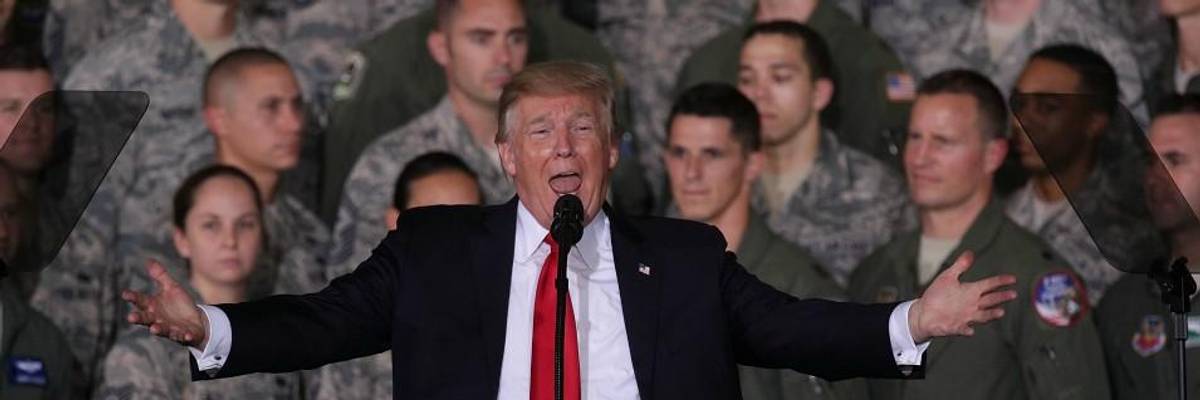
President Donald Trump speaks to Air Force personnel during an event Sept. 15, 2017 at Joint Base Andrews in Maryland. President Trump attended the event to celebrate the 70th birthday of the U.S. Air Force. (Photo: Alex Wong/Getty Images)
Trump Isn't Really Ending Endless Wars, He's Making Them Worse
Here's what progressives should support in Syria.
Civil war and foreign interventions in Syria have created a geopolitical Gordian knot, an intractable humanitarian crisis, and a maddeningly complex conflict zone of wars within wars. It should come as no surprise that an erratic leader like President Donald Trump would make the suffering worse.
The complexity of the crisis can create cognitive dissonance. What if I desperately wish to end our endless wars but I also care about the fate of Kurdish and other Syrian civilians? What if I wish U.S. hadn't invaded these countries in the first place but I now worry that Trump's recklessness will make matters worse?
There is a coherent strategy that can cut this Gordian knot, but it involves imagining a new U.S. foreign policy based on diplomacy and humanitarian initiatives.
Trump's Impetuous, Corrupt Foreign Policy Must Be Stopped--While Expeditiously Implementing a Responsible U.S. Withdrawal
The scope of progressives' moral imagination needs to be large enough to include two goals. We need to push hard to end the unauthorized U.S. intervention in Syria and Iraq that has killed thousands of civilians. But as we push for peace we must oppose a president whose narcissistic foreign policy instincts display careless disregard for allies and civilians.
Trump has said, "We're getting out of the endless wars... We are out of there..." and "We have no soldiers in Syria." Here's a shocker: He's lying. In fact, the roughly 50 soldiers he moved are moving to another military base. The roughly 1,000 U.S. troops in Syria are still all there. There are also 5,000 troops across the border in Iraq. The U.S.-led airstrikes in Syria, Iraq, and Libya that have killed thousands of civilians continued into 2019. The U.N. says these airstrikes amount to war crimes and have "led to the near complete destruction of towns and villages." Now Trump is sending 1,800 U.S. troops to Saudi Arabia.
What Can Be Done Right Now to Protect Civilians in Northeast Syria
Currently, U.S. officials are articulating an inscrutable U.S. policy on the Turkish offensive. As challenging as it is to gain agreement at the U.N. Security Council, the U.S. should join with European states in clear, sustained opposition. Members of Congress should use tools at their disposal--starting with a cutoff of military aid and arms sales--to press Turkey to withdraw.
Meanwhile, measures should be put in place to protect civilians, including:
- Humanitarian access for the U.N. and its partner NGOs to civilians in northeast Syria so that aid and medical care can be delivered.
- Congress must also resume U.S. funding for Syria stabilization. Stabilization funds include rebuilding infrastructure for clean water and electricity, schools, and transportation that help restore stability.
- The U.S. must do its fair share to address the global refugee crisis and admit more Syrian refugees.
What's Been Needed, and Is Still Needed: A Diplomatic Surge for Syria and the Kurds
There was a solution to protecting northeast Syria. But the solution wasn't relying on 50 U.S. troops to stand between 60,000 battle-hardened Kurds and the full might of an angry and fearful Turkish military right across the border. This wasn't sustainable. Amanda Sloat, an assistant secretary of state under former President Barack Obama, called the tensions between Turkey and the Syrian Kurds "a ticking time bomb." Most experts knew the only way out was a twofold diplomatic offensive.
The first push needed was for the Syrian Kurds and the Syrian government to come to an agreement that would have stabilized the northeast region though a sustainable governance and security arrangement that could have integrated the northeast into a wider Syria. As Obama's ambassador to Syria, Robert Ford, said to NPR, "The Syrian Kurds are part of Syria, and they will have to come to an agreement with the Syrian government." With the Syrian Kurds more vulnerable now, said Sloat, "a likely outcome... is that the YPG makes a deal with the Syrian regime." Such a deal should have been prioritized a long time ago, but the U.S. opposed that deal out of animus toward Assad.
The second diplomatic push needed was between the Kurds and Turkey. Under pressure from the U.S., the Syrian Kurdish YPG could have have found ways to offer Turkey security assurances in exchange for Turkey agreeing to stay out of Syria. Some of the bungled U.S. diplomacy has been very straightforward. The U.S. has repeatedly broken promises to Turkey about its support for the Kurdish YPG and some of these broken promises are headscratchers. The Trump administration armed the YPG for the fight against ISIS in Raqqa and it promised Turkey it would collect the weapons afterward--an idea one U.S. official called "asinine." You guessed it, that promise didn't get carried out so well. That's a telling detail that reveals a U.S. policymaking apparatus focused on weapons and fighting battles, one that fails to attend to the most basic aspect of maintaining relationships that undergird a wider diplomatic strategy.
U.S. Foreign Policy Needs a "Revolution" or "Big Structural Change" or Civilians Will Continue to Suffer
Ultimately, to end endless wars and to minimize bloodshed and violence, U.S. foreign policy needs a full top-to-bottom rebuild. We need to center human rights and civilians' welfare in our foreign policy and stop looking at military force as the go-to tool. The platforms of presidential candidates like Sens. Bernie Sanders (I-Vt.) and Elizabeth Warren (D-Mass.) are beginning to articulate a break from endless wars. Pro-peace voters must push them to go further and to make a new progressive foreign policy a centerpiece of their campaigns. Peace is possible, even in intractable conflicts, with the right leadership. The freshly minted Nobel Peace Prize winner, Abiy Ahmed, the Ethiopian prime minister who ended a 20-year-long military standoff with Eritrea, has proven that.
A wise man once said, "If you plant ice, you're gonna harvest wind." For the last two decades, it's been proven time and time again that U.S. foreign policy lopsidedly focused on war and military force simply leads to more violence. The only strategies that can truly protect the Syrian Kurds and their neighbors in northeast Syria are smart diplomacy and political solutions. The same is true for Yemen, Afghanistan, Libya, Somalia, and the rest of the long-suffering war-torn regions of the world.
We are at a crossroads
This country and this world are at a monumental crossroads. In a few short weeks, US voters will have an opportunity to beat back the forces of fascism and confront the billionaires who are rigging the economy, our media system, and our democracy, making it increasingly impossible for ordinary people to get by. We’re not just talking about the election. We’re talking about what must be done once these fascist elements are vanquished from power. We need a bolder set of solutions than what either major party has so far been willing to offer and a working-class movement ready to fight like hell for it. Trump didn't emerge from nowhere. The conditions that fueled MAGA authoritarianism were created by decades of radical neoliberal economic policies and a corrupt political system dominated by corporate interests. They slashed taxes on the super-rich, promising that the benefits would trickle down. They said giveaways to the corporate titans would make life more affordable for the rest of us. It was all bullshit. And when a bitter, betrayed populace searches for someone to blame, right-wing demagogues have little trouble finding scapegoats. People know when they're being lied to, but you won't hear any of this from the corporate media. Only independent journalism—powered and funded by people who believe in building a better world—can deliver truly trustworthy daily news. Our Fall Campaign is underway, and we need your help. To power our newsroom through the rest of the year, we need to raise $125,000 by midnight on October 31. So if you share our vision, please contribute whatever you can to sustain our work. |
Civil war and foreign interventions in Syria have created a geopolitical Gordian knot, an intractable humanitarian crisis, and a maddeningly complex conflict zone of wars within wars. It should come as no surprise that an erratic leader like President Donald Trump would make the suffering worse.
The complexity of the crisis can create cognitive dissonance. What if I desperately wish to end our endless wars but I also care about the fate of Kurdish and other Syrian civilians? What if I wish U.S. hadn't invaded these countries in the first place but I now worry that Trump's recklessness will make matters worse?
There is a coherent strategy that can cut this Gordian knot, but it involves imagining a new U.S. foreign policy based on diplomacy and humanitarian initiatives.
Trump's Impetuous, Corrupt Foreign Policy Must Be Stopped--While Expeditiously Implementing a Responsible U.S. Withdrawal
The scope of progressives' moral imagination needs to be large enough to include two goals. We need to push hard to end the unauthorized U.S. intervention in Syria and Iraq that has killed thousands of civilians. But as we push for peace we must oppose a president whose narcissistic foreign policy instincts display careless disregard for allies and civilians.
Trump has said, "We're getting out of the endless wars... We are out of there..." and "We have no soldiers in Syria." Here's a shocker: He's lying. In fact, the roughly 50 soldiers he moved are moving to another military base. The roughly 1,000 U.S. troops in Syria are still all there. There are also 5,000 troops across the border in Iraq. The U.S.-led airstrikes in Syria, Iraq, and Libya that have killed thousands of civilians continued into 2019. The U.N. says these airstrikes amount to war crimes and have "led to the near complete destruction of towns and villages." Now Trump is sending 1,800 U.S. troops to Saudi Arabia.
What Can Be Done Right Now to Protect Civilians in Northeast Syria
Currently, U.S. officials are articulating an inscrutable U.S. policy on the Turkish offensive. As challenging as it is to gain agreement at the U.N. Security Council, the U.S. should join with European states in clear, sustained opposition. Members of Congress should use tools at their disposal--starting with a cutoff of military aid and arms sales--to press Turkey to withdraw.
Meanwhile, measures should be put in place to protect civilians, including:
- Humanitarian access for the U.N. and its partner NGOs to civilians in northeast Syria so that aid and medical care can be delivered.
- Congress must also resume U.S. funding for Syria stabilization. Stabilization funds include rebuilding infrastructure for clean water and electricity, schools, and transportation that help restore stability.
- The U.S. must do its fair share to address the global refugee crisis and admit more Syrian refugees.
What's Been Needed, and Is Still Needed: A Diplomatic Surge for Syria and the Kurds
There was a solution to protecting northeast Syria. But the solution wasn't relying on 50 U.S. troops to stand between 60,000 battle-hardened Kurds and the full might of an angry and fearful Turkish military right across the border. This wasn't sustainable. Amanda Sloat, an assistant secretary of state under former President Barack Obama, called the tensions between Turkey and the Syrian Kurds "a ticking time bomb." Most experts knew the only way out was a twofold diplomatic offensive.
The first push needed was for the Syrian Kurds and the Syrian government to come to an agreement that would have stabilized the northeast region though a sustainable governance and security arrangement that could have integrated the northeast into a wider Syria. As Obama's ambassador to Syria, Robert Ford, said to NPR, "The Syrian Kurds are part of Syria, and they will have to come to an agreement with the Syrian government." With the Syrian Kurds more vulnerable now, said Sloat, "a likely outcome... is that the YPG makes a deal with the Syrian regime." Such a deal should have been prioritized a long time ago, but the U.S. opposed that deal out of animus toward Assad.
The second diplomatic push needed was between the Kurds and Turkey. Under pressure from the U.S., the Syrian Kurdish YPG could have have found ways to offer Turkey security assurances in exchange for Turkey agreeing to stay out of Syria. Some of the bungled U.S. diplomacy has been very straightforward. The U.S. has repeatedly broken promises to Turkey about its support for the Kurdish YPG and some of these broken promises are headscratchers. The Trump administration armed the YPG for the fight against ISIS in Raqqa and it promised Turkey it would collect the weapons afterward--an idea one U.S. official called "asinine." You guessed it, that promise didn't get carried out so well. That's a telling detail that reveals a U.S. policymaking apparatus focused on weapons and fighting battles, one that fails to attend to the most basic aspect of maintaining relationships that undergird a wider diplomatic strategy.
U.S. Foreign Policy Needs a "Revolution" or "Big Structural Change" or Civilians Will Continue to Suffer
Ultimately, to end endless wars and to minimize bloodshed and violence, U.S. foreign policy needs a full top-to-bottom rebuild. We need to center human rights and civilians' welfare in our foreign policy and stop looking at military force as the go-to tool. The platforms of presidential candidates like Sens. Bernie Sanders (I-Vt.) and Elizabeth Warren (D-Mass.) are beginning to articulate a break from endless wars. Pro-peace voters must push them to go further and to make a new progressive foreign policy a centerpiece of their campaigns. Peace is possible, even in intractable conflicts, with the right leadership. The freshly minted Nobel Peace Prize winner, Abiy Ahmed, the Ethiopian prime minister who ended a 20-year-long military standoff with Eritrea, has proven that.
A wise man once said, "If you plant ice, you're gonna harvest wind." For the last two decades, it's been proven time and time again that U.S. foreign policy lopsidedly focused on war and military force simply leads to more violence. The only strategies that can truly protect the Syrian Kurds and their neighbors in northeast Syria are smart diplomacy and political solutions. The same is true for Yemen, Afghanistan, Libya, Somalia, and the rest of the long-suffering war-torn regions of the world.
Civil war and foreign interventions in Syria have created a geopolitical Gordian knot, an intractable humanitarian crisis, and a maddeningly complex conflict zone of wars within wars. It should come as no surprise that an erratic leader like President Donald Trump would make the suffering worse.
The complexity of the crisis can create cognitive dissonance. What if I desperately wish to end our endless wars but I also care about the fate of Kurdish and other Syrian civilians? What if I wish U.S. hadn't invaded these countries in the first place but I now worry that Trump's recklessness will make matters worse?
There is a coherent strategy that can cut this Gordian knot, but it involves imagining a new U.S. foreign policy based on diplomacy and humanitarian initiatives.
Trump's Impetuous, Corrupt Foreign Policy Must Be Stopped--While Expeditiously Implementing a Responsible U.S. Withdrawal
The scope of progressives' moral imagination needs to be large enough to include two goals. We need to push hard to end the unauthorized U.S. intervention in Syria and Iraq that has killed thousands of civilians. But as we push for peace we must oppose a president whose narcissistic foreign policy instincts display careless disregard for allies and civilians.
Trump has said, "We're getting out of the endless wars... We are out of there..." and "We have no soldiers in Syria." Here's a shocker: He's lying. In fact, the roughly 50 soldiers he moved are moving to another military base. The roughly 1,000 U.S. troops in Syria are still all there. There are also 5,000 troops across the border in Iraq. The U.S.-led airstrikes in Syria, Iraq, and Libya that have killed thousands of civilians continued into 2019. The U.N. says these airstrikes amount to war crimes and have "led to the near complete destruction of towns and villages." Now Trump is sending 1,800 U.S. troops to Saudi Arabia.
What Can Be Done Right Now to Protect Civilians in Northeast Syria
Currently, U.S. officials are articulating an inscrutable U.S. policy on the Turkish offensive. As challenging as it is to gain agreement at the U.N. Security Council, the U.S. should join with European states in clear, sustained opposition. Members of Congress should use tools at their disposal--starting with a cutoff of military aid and arms sales--to press Turkey to withdraw.
Meanwhile, measures should be put in place to protect civilians, including:
- Humanitarian access for the U.N. and its partner NGOs to civilians in northeast Syria so that aid and medical care can be delivered.
- Congress must also resume U.S. funding for Syria stabilization. Stabilization funds include rebuilding infrastructure for clean water and electricity, schools, and transportation that help restore stability.
- The U.S. must do its fair share to address the global refugee crisis and admit more Syrian refugees.
What's Been Needed, and Is Still Needed: A Diplomatic Surge for Syria and the Kurds
There was a solution to protecting northeast Syria. But the solution wasn't relying on 50 U.S. troops to stand between 60,000 battle-hardened Kurds and the full might of an angry and fearful Turkish military right across the border. This wasn't sustainable. Amanda Sloat, an assistant secretary of state under former President Barack Obama, called the tensions between Turkey and the Syrian Kurds "a ticking time bomb." Most experts knew the only way out was a twofold diplomatic offensive.
The first push needed was for the Syrian Kurds and the Syrian government to come to an agreement that would have stabilized the northeast region though a sustainable governance and security arrangement that could have integrated the northeast into a wider Syria. As Obama's ambassador to Syria, Robert Ford, said to NPR, "The Syrian Kurds are part of Syria, and they will have to come to an agreement with the Syrian government." With the Syrian Kurds more vulnerable now, said Sloat, "a likely outcome... is that the YPG makes a deal with the Syrian regime." Such a deal should have been prioritized a long time ago, but the U.S. opposed that deal out of animus toward Assad.
The second diplomatic push needed was between the Kurds and Turkey. Under pressure from the U.S., the Syrian Kurdish YPG could have have found ways to offer Turkey security assurances in exchange for Turkey agreeing to stay out of Syria. Some of the bungled U.S. diplomacy has been very straightforward. The U.S. has repeatedly broken promises to Turkey about its support for the Kurdish YPG and some of these broken promises are headscratchers. The Trump administration armed the YPG for the fight against ISIS in Raqqa and it promised Turkey it would collect the weapons afterward--an idea one U.S. official called "asinine." You guessed it, that promise didn't get carried out so well. That's a telling detail that reveals a U.S. policymaking apparatus focused on weapons and fighting battles, one that fails to attend to the most basic aspect of maintaining relationships that undergird a wider diplomatic strategy.
U.S. Foreign Policy Needs a "Revolution" or "Big Structural Change" or Civilians Will Continue to Suffer
Ultimately, to end endless wars and to minimize bloodshed and violence, U.S. foreign policy needs a full top-to-bottom rebuild. We need to center human rights and civilians' welfare in our foreign policy and stop looking at military force as the go-to tool. The platforms of presidential candidates like Sens. Bernie Sanders (I-Vt.) and Elizabeth Warren (D-Mass.) are beginning to articulate a break from endless wars. Pro-peace voters must push them to go further and to make a new progressive foreign policy a centerpiece of their campaigns. Peace is possible, even in intractable conflicts, with the right leadership. The freshly minted Nobel Peace Prize winner, Abiy Ahmed, the Ethiopian prime minister who ended a 20-year-long military standoff with Eritrea, has proven that.
A wise man once said, "If you plant ice, you're gonna harvest wind." For the last two decades, it's been proven time and time again that U.S. foreign policy lopsidedly focused on war and military force simply leads to more violence. The only strategies that can truly protect the Syrian Kurds and their neighbors in northeast Syria are smart diplomacy and political solutions. The same is true for Yemen, Afghanistan, Libya, Somalia, and the rest of the long-suffering war-torn regions of the world.