SUBSCRIBE TO OUR FREE NEWSLETTER
Daily news & progressive opinion—funded by the people, not the corporations—delivered straight to your inbox.
5
#000000
#FFFFFF
To donate by check, phone, or other method, see our More Ways to Give page.


Daily news & progressive opinion—funded by the people, not the corporations—delivered straight to your inbox.

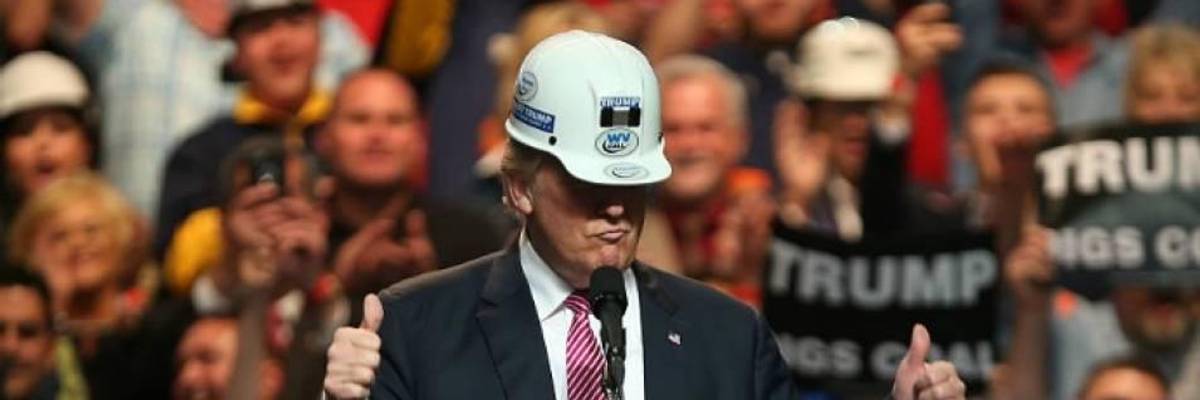
Donald Trump models a hard hat during a rally at the Charleston Civic Center in Charleston, West Virginia. (Photo: Mark Lyons/Getty Images)
Anya Litvak at the Pittsburgh Post-Gazette reports that a contractor handling the Trump appearance at the Royal Dutch Shell plant instructed the workers not to yell or protest and informed them that they would not to be paid that day unless they came to the Trump event. Their attendance was worth as much as $700 in pay, benefits and overtime. Shell denies having instructed the workers not to protest. This was a White House event and not a campaign rally, on the surface, but we have had all the trappings of campaigning- including Trump bashing his political opponents by name and calling on the union workers in attendance to unseat their union leaders if the latter did not support Trump. The contractor attempted to imply that this rally resembled entertainment events when celebrities visited the plant and workers were given off to hear them.
In fact this campaign rally was a way for Royal Dutch Shell to force its workers to show up for Trump and to put them under his political influence. It is all about climate change, because this is a gas extraction plant, and Trump does not believe in global heating. Indeed, he believes that the climate crisis is a Chinese piece of fake news. If you did believe in climate emergency you would stop the extraction of fossil fuels. That would hurt the bottom line of Royal Dutch Shell. As for the workers, while they no doubt benefit from the jobs provided by this extraction venture there are other jobs to be had in the green energy field and indeed wind and solar are the fastest growing job sector in energy.
The entire episode sheds enormous light on the ways in which the United States is one large company town. The company town was an institution of the early 20th century where, for instance, miners would work in a place where they were given housing and staples, the costs of which were deducted from their salaries. These provisions were a form of loan and the workers never quite got out from under their debt burden. Obviously in a company town there is no room for democracy, and workers are not free to speak their minds about company policy or even about national politics. Royal Dutch Shell has managed to re-create the conditions of the company town at their rally for Trump. In the early 20th century the state of Montana was essentially a company town of Anaconda Mining, and going against the company was a form of suicide. The noir mystery writer Dashiell Hammett maintained that he was offered $5000 to kill a union agitator named Frank little. Indeed, noir as a genre of fiction may well owe its existence to this incident, since Hammett was horrified, quit the Pinkerton Detective Agency, and turned to writing.
Noir mysteries (from the French roman noir or "black novel") have as their premise that the very structures of polite society that are to be upheld by the law and which ought to ensure justice for victims are those structures that actually oppress the innocent and commit the murders that the hard-boiled detectives have to solve.
You might say that from the day that Donald J. Trump was elected president, the United States entered a timeline where the whole country is living in a dreary noir pulp novel, but the fact is that Trump's election simply made very clear what has been going on all along.
As for Royal Dutch Shell, it was a major engine of colonial oppression in what is now Indonesia, and there is a sense in which all colonialism is a form of company town writ large. Now, that's America.
Dear Common Dreams reader, It’s been nearly 30 years since I co-founded Common Dreams with my late wife, Lina Newhouser. We had the radical notion that journalism should serve the public good, not corporate profits. It was clear to us from the outset what it would take to build such a project. No paid advertisements. No corporate sponsors. No millionaire publisher telling us what to think or do. Many people said we wouldn't last a year, but we proved those doubters wrong. Together with a tremendous team of journalists and dedicated staff, we built an independent media outlet free from the constraints of profits and corporate control. Our mission has always been simple: To inform. To inspire. To ignite change for the common good. Building Common Dreams was not easy. Our survival was never guaranteed. When you take on the most powerful forces—Wall Street greed, fossil fuel industry destruction, Big Tech lobbyists, and uber-rich oligarchs who have spent billions upon billions rigging the economy and democracy in their favor—the only bulwark you have is supporters who believe in your work. But here’s the urgent message from me today. It's never been this bad out there. And it's never been this hard to keep us going. At the very moment Common Dreams is most needed, the threats we face are intensifying. We need your support now more than ever. We don't accept corporate advertising and never will. We don't have a paywall because we don't think people should be blocked from critical news based on their ability to pay. Everything we do is funded by the donations of readers like you. When everyone does the little they can afford, we are strong. But if that support retreats or dries up, so do we. Will you donate now to make sure Common Dreams not only survives but thrives? —Craig Brown, Co-founder |
Anya Litvak at the Pittsburgh Post-Gazette reports that a contractor handling the Trump appearance at the Royal Dutch Shell plant instructed the workers not to yell or protest and informed them that they would not to be paid that day unless they came to the Trump event. Their attendance was worth as much as $700 in pay, benefits and overtime. Shell denies having instructed the workers not to protest. This was a White House event and not a campaign rally, on the surface, but we have had all the trappings of campaigning- including Trump bashing his political opponents by name and calling on the union workers in attendance to unseat their union leaders if the latter did not support Trump. The contractor attempted to imply that this rally resembled entertainment events when celebrities visited the plant and workers were given off to hear them.
In fact this campaign rally was a way for Royal Dutch Shell to force its workers to show up for Trump and to put them under his political influence. It is all about climate change, because this is a gas extraction plant, and Trump does not believe in global heating. Indeed, he believes that the climate crisis is a Chinese piece of fake news. If you did believe in climate emergency you would stop the extraction of fossil fuels. That would hurt the bottom line of Royal Dutch Shell. As for the workers, while they no doubt benefit from the jobs provided by this extraction venture there are other jobs to be had in the green energy field and indeed wind and solar are the fastest growing job sector in energy.
The entire episode sheds enormous light on the ways in which the United States is one large company town. The company town was an institution of the early 20th century where, for instance, miners would work in a place where they were given housing and staples, the costs of which were deducted from their salaries. These provisions were a form of loan and the workers never quite got out from under their debt burden. Obviously in a company town there is no room for democracy, and workers are not free to speak their minds about company policy or even about national politics. Royal Dutch Shell has managed to re-create the conditions of the company town at their rally for Trump. In the early 20th century the state of Montana was essentially a company town of Anaconda Mining, and going against the company was a form of suicide. The noir mystery writer Dashiell Hammett maintained that he was offered $5000 to kill a union agitator named Frank little. Indeed, noir as a genre of fiction may well owe its existence to this incident, since Hammett was horrified, quit the Pinkerton Detective Agency, and turned to writing.
Noir mysteries (from the French roman noir or "black novel") have as their premise that the very structures of polite society that are to be upheld by the law and which ought to ensure justice for victims are those structures that actually oppress the innocent and commit the murders that the hard-boiled detectives have to solve.
You might say that from the day that Donald J. Trump was elected president, the United States entered a timeline where the whole country is living in a dreary noir pulp novel, but the fact is that Trump's election simply made very clear what has been going on all along.
As for Royal Dutch Shell, it was a major engine of colonial oppression in what is now Indonesia, and there is a sense in which all colonialism is a form of company town writ large. Now, that's America.
Anya Litvak at the Pittsburgh Post-Gazette reports that a contractor handling the Trump appearance at the Royal Dutch Shell plant instructed the workers not to yell or protest and informed them that they would not to be paid that day unless they came to the Trump event. Their attendance was worth as much as $700 in pay, benefits and overtime. Shell denies having instructed the workers not to protest. This was a White House event and not a campaign rally, on the surface, but we have had all the trappings of campaigning- including Trump bashing his political opponents by name and calling on the union workers in attendance to unseat their union leaders if the latter did not support Trump. The contractor attempted to imply that this rally resembled entertainment events when celebrities visited the plant and workers were given off to hear them.
In fact this campaign rally was a way for Royal Dutch Shell to force its workers to show up for Trump and to put them under his political influence. It is all about climate change, because this is a gas extraction plant, and Trump does not believe in global heating. Indeed, he believes that the climate crisis is a Chinese piece of fake news. If you did believe in climate emergency you would stop the extraction of fossil fuels. That would hurt the bottom line of Royal Dutch Shell. As for the workers, while they no doubt benefit from the jobs provided by this extraction venture there are other jobs to be had in the green energy field and indeed wind and solar are the fastest growing job sector in energy.
The entire episode sheds enormous light on the ways in which the United States is one large company town. The company town was an institution of the early 20th century where, for instance, miners would work in a place where they were given housing and staples, the costs of which were deducted from their salaries. These provisions were a form of loan and the workers never quite got out from under their debt burden. Obviously in a company town there is no room for democracy, and workers are not free to speak their minds about company policy or even about national politics. Royal Dutch Shell has managed to re-create the conditions of the company town at their rally for Trump. In the early 20th century the state of Montana was essentially a company town of Anaconda Mining, and going against the company was a form of suicide. The noir mystery writer Dashiell Hammett maintained that he was offered $5000 to kill a union agitator named Frank little. Indeed, noir as a genre of fiction may well owe its existence to this incident, since Hammett was horrified, quit the Pinkerton Detective Agency, and turned to writing.
Noir mysteries (from the French roman noir or "black novel") have as their premise that the very structures of polite society that are to be upheld by the law and which ought to ensure justice for victims are those structures that actually oppress the innocent and commit the murders that the hard-boiled detectives have to solve.
You might say that from the day that Donald J. Trump was elected president, the United States entered a timeline where the whole country is living in a dreary noir pulp novel, but the fact is that Trump's election simply made very clear what has been going on all along.
As for Royal Dutch Shell, it was a major engine of colonial oppression in what is now Indonesia, and there is a sense in which all colonialism is a form of company town writ large. Now, that's America.