
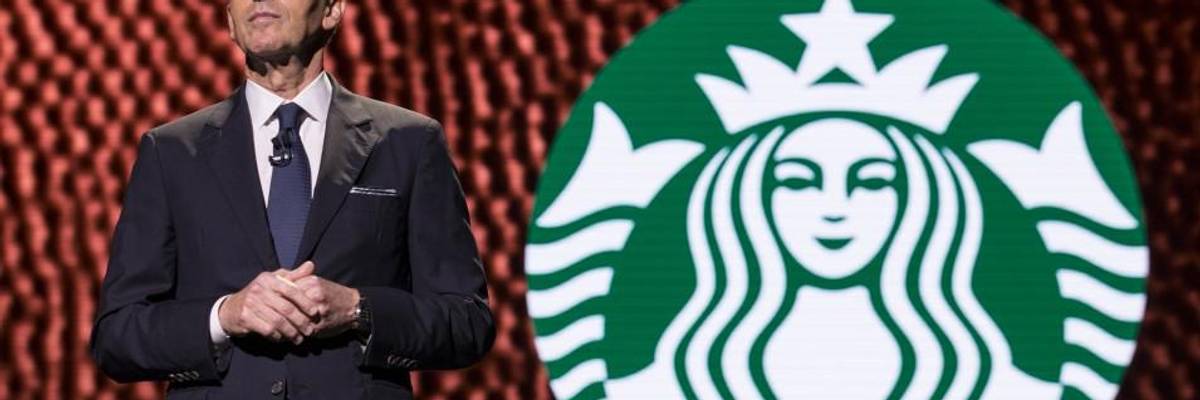
CNN does not deserve praise for grilling Schultz on his wealth when Schultz's wealth is the only reason he was on CNN. (Photo by Stephen Brashear/Getty Images)
Howard Schultz and the Media's Unlearned Lesson
The fact CNN chose Schultz for its second town hall of the season—ahead of a raft of serious candidates or potential candidates on both sides of the aisle—is yet another bad sign that the requisite lessons have not been learned
A BILLIONAIRE FLIRTS with a run for president and gets grossly disproportionate free airtime. We all know the punchline. Howard Schultz, the running-but-not-yet-running former CEO of Starbucks, has attracted intense media interest over the past two and a half weeks, sitting for a string of newspaper and broadcast interviews, including a profile on 60 Minutes. Last night, he became the second potential 2020 candidate, after Kamala Harris, to get CNN's town-hall treatment. In the run-up, prominent media-watchers criticized the network's decision to offer Schultz such an elevated platform; CNN's own polls, they pointed out, have Schultz way down. "These decisions can have a big effect on a candidacy," Jay Rosen, a professor at NYU, told The Daily Beast. "But there's no coherent logic to them."
As had been the case in his recent interview round, Schultz offered little of substance last night: he repeatedly bashed "far left" and "far right" bogeymen without proposing specific, distinctive solutions of his own. It took 10 minutes of biographical soft soap to get to a policy question at all. When one came, on immigration, Schultz's answer was cliched and contradictory--"We should be building bridges and allow people in," but also securing the border to "not allow bad people in"--yet no request for clarification was made. Much later in proceedings, Poppy Harlow, CNN's moderator for the night, did start asking for details. When she pushed him, however, Schultz simply sidestepped, and the conversation moved on. "What would you do to fix it?" Harlow asked on veterans' healthcare. "You have to put the quality people in charge," Schultz replied.
Schultz faced tougher scrutiny over his personal finances and record in business. Occasionally, this overlapped with policy: after Schultz admitted he should pay more tax, Harlow pushed, repeatedly, for a percentage figure (she didn't get one). Otherwise, these questions felt wildly hypothetical. Do we really need to know what President Schultz would do with his Starbucks shares when the odds of that scenario are basically nil? Rich business people merit scrutiny, of course. But scrutiny is weakened when the forum in which it's administered confers a clear judgment of political legitimacy.
CNN does not deserve praise for grilling Schultz on his wealth when Schultz's wealth is the only reason he was on CNN. As Vox's Ezra Klein writes, "in American politics, money is a shortcut to legitimacy." Shutting out uber-wealthy candidates, or at least waiting a minute until they've proven they're serious, isn't censorship or bias--it's the media's responsibility to conserve a level political playing field, organized around substantive issues of concern to the voting public.
But as political scientist Lee Drutman tells Klein, "the media uses ability to spend money as a proxy for seriousness of campaign. And when the media bestows seriousness on a candidate, the public follows along." We're not passive stenographers of candidates' movements; our coverage choices can be self-fulfilling prophecies.
Much ink has been spilled lately on how the media as a whole can do better going into 2020. The fact CNN chose Schultz for its second town hall of the season--ahead of a raft of serious candidates or potential candidates on both sides of the aisle--is yet another bad sign that the requisite lessons have not been learned. Maybe Schultz will find his policy stride, and a serious constituency that embraces it. Until he does, networks should save their airtime for candidates who already reached that point.
At the very least, town halls could be saved for candidates who are actually running. Whenever he was asked a tough, personal question last night, Schultz looked at Harlow with a furrowed brow and protested that he couldn't say as he wasn't running yet. "I think we're getting way premature!" he exclaimed at one point. For once, he had a point.
An Urgent Message From Our Co-Founder
Dear Common Dreams reader, It’s been nearly 30 years since I co-founded Common Dreams with my late wife, Lina Newhouser. We had the radical notion that journalism should serve the public good, not corporate profits. It was clear to us from the outset what it would take to build such a project. No paid advertisements. No corporate sponsors. No millionaire publisher telling us what to think or do. Many people said we wouldn't last a year, but we proved those doubters wrong. Together with a tremendous team of journalists and dedicated staff, we built an independent media outlet free from the constraints of profits and corporate control. Our mission has always been simple: To inform. To inspire. To ignite change for the common good. Building Common Dreams was not easy. Our survival was never guaranteed. When you take on the most powerful forces—Wall Street greed, fossil fuel industry destruction, Big Tech lobbyists, and uber-rich oligarchs who have spent billions upon billions rigging the economy and democracy in their favor—the only bulwark you have is supporters who believe in your work. But here’s the urgent message from me today. It's never been this bad out there. And it's never been this hard to keep us going. At the very moment Common Dreams is most needed, the threats we face are intensifying. We need your support now more than ever. We don't accept corporate advertising and never will. We don't have a paywall because we don't think people should be blocked from critical news based on their ability to pay. Everything we do is funded by the donations of readers like you. When everyone does the little they can afford, we are strong. But if that support retreats or dries up, so do we. Will you donate now to make sure Common Dreams not only survives but thrives? —Craig Brown, Co-founder |
A BILLIONAIRE FLIRTS with a run for president and gets grossly disproportionate free airtime. We all know the punchline. Howard Schultz, the running-but-not-yet-running former CEO of Starbucks, has attracted intense media interest over the past two and a half weeks, sitting for a string of newspaper and broadcast interviews, including a profile on 60 Minutes. Last night, he became the second potential 2020 candidate, after Kamala Harris, to get CNN's town-hall treatment. In the run-up, prominent media-watchers criticized the network's decision to offer Schultz such an elevated platform; CNN's own polls, they pointed out, have Schultz way down. "These decisions can have a big effect on a candidacy," Jay Rosen, a professor at NYU, told The Daily Beast. "But there's no coherent logic to them."
As had been the case in his recent interview round, Schultz offered little of substance last night: he repeatedly bashed "far left" and "far right" bogeymen without proposing specific, distinctive solutions of his own. It took 10 minutes of biographical soft soap to get to a policy question at all. When one came, on immigration, Schultz's answer was cliched and contradictory--"We should be building bridges and allow people in," but also securing the border to "not allow bad people in"--yet no request for clarification was made. Much later in proceedings, Poppy Harlow, CNN's moderator for the night, did start asking for details. When she pushed him, however, Schultz simply sidestepped, and the conversation moved on. "What would you do to fix it?" Harlow asked on veterans' healthcare. "You have to put the quality people in charge," Schultz replied.
Schultz faced tougher scrutiny over his personal finances and record in business. Occasionally, this overlapped with policy: after Schultz admitted he should pay more tax, Harlow pushed, repeatedly, for a percentage figure (she didn't get one). Otherwise, these questions felt wildly hypothetical. Do we really need to know what President Schultz would do with his Starbucks shares when the odds of that scenario are basically nil? Rich business people merit scrutiny, of course. But scrutiny is weakened when the forum in which it's administered confers a clear judgment of political legitimacy.
CNN does not deserve praise for grilling Schultz on his wealth when Schultz's wealth is the only reason he was on CNN. As Vox's Ezra Klein writes, "in American politics, money is a shortcut to legitimacy." Shutting out uber-wealthy candidates, or at least waiting a minute until they've proven they're serious, isn't censorship or bias--it's the media's responsibility to conserve a level political playing field, organized around substantive issues of concern to the voting public.
But as political scientist Lee Drutman tells Klein, "the media uses ability to spend money as a proxy for seriousness of campaign. And when the media bestows seriousness on a candidate, the public follows along." We're not passive stenographers of candidates' movements; our coverage choices can be self-fulfilling prophecies.
Much ink has been spilled lately on how the media as a whole can do better going into 2020. The fact CNN chose Schultz for its second town hall of the season--ahead of a raft of serious candidates or potential candidates on both sides of the aisle--is yet another bad sign that the requisite lessons have not been learned. Maybe Schultz will find his policy stride, and a serious constituency that embraces it. Until he does, networks should save their airtime for candidates who already reached that point.
At the very least, town halls could be saved for candidates who are actually running. Whenever he was asked a tough, personal question last night, Schultz looked at Harlow with a furrowed brow and protested that he couldn't say as he wasn't running yet. "I think we're getting way premature!" he exclaimed at one point. For once, he had a point.
A BILLIONAIRE FLIRTS with a run for president and gets grossly disproportionate free airtime. We all know the punchline. Howard Schultz, the running-but-not-yet-running former CEO of Starbucks, has attracted intense media interest over the past two and a half weeks, sitting for a string of newspaper and broadcast interviews, including a profile on 60 Minutes. Last night, he became the second potential 2020 candidate, after Kamala Harris, to get CNN's town-hall treatment. In the run-up, prominent media-watchers criticized the network's decision to offer Schultz such an elevated platform; CNN's own polls, they pointed out, have Schultz way down. "These decisions can have a big effect on a candidacy," Jay Rosen, a professor at NYU, told The Daily Beast. "But there's no coherent logic to them."
As had been the case in his recent interview round, Schultz offered little of substance last night: he repeatedly bashed "far left" and "far right" bogeymen without proposing specific, distinctive solutions of his own. It took 10 minutes of biographical soft soap to get to a policy question at all. When one came, on immigration, Schultz's answer was cliched and contradictory--"We should be building bridges and allow people in," but also securing the border to "not allow bad people in"--yet no request for clarification was made. Much later in proceedings, Poppy Harlow, CNN's moderator for the night, did start asking for details. When she pushed him, however, Schultz simply sidestepped, and the conversation moved on. "What would you do to fix it?" Harlow asked on veterans' healthcare. "You have to put the quality people in charge," Schultz replied.
Schultz faced tougher scrutiny over his personal finances and record in business. Occasionally, this overlapped with policy: after Schultz admitted he should pay more tax, Harlow pushed, repeatedly, for a percentage figure (she didn't get one). Otherwise, these questions felt wildly hypothetical. Do we really need to know what President Schultz would do with his Starbucks shares when the odds of that scenario are basically nil? Rich business people merit scrutiny, of course. But scrutiny is weakened when the forum in which it's administered confers a clear judgment of political legitimacy.
CNN does not deserve praise for grilling Schultz on his wealth when Schultz's wealth is the only reason he was on CNN. As Vox's Ezra Klein writes, "in American politics, money is a shortcut to legitimacy." Shutting out uber-wealthy candidates, or at least waiting a minute until they've proven they're serious, isn't censorship or bias--it's the media's responsibility to conserve a level political playing field, organized around substantive issues of concern to the voting public.
But as political scientist Lee Drutman tells Klein, "the media uses ability to spend money as a proxy for seriousness of campaign. And when the media bestows seriousness on a candidate, the public follows along." We're not passive stenographers of candidates' movements; our coverage choices can be self-fulfilling prophecies.
Much ink has been spilled lately on how the media as a whole can do better going into 2020. The fact CNN chose Schultz for its second town hall of the season--ahead of a raft of serious candidates or potential candidates on both sides of the aisle--is yet another bad sign that the requisite lessons have not been learned. Maybe Schultz will find his policy stride, and a serious constituency that embraces it. Until he does, networks should save their airtime for candidates who already reached that point.
At the very least, town halls could be saved for candidates who are actually running. Whenever he was asked a tough, personal question last night, Schultz looked at Harlow with a furrowed brow and protested that he couldn't say as he wasn't running yet. "I think we're getting way premature!" he exclaimed at one point. For once, he had a point.