SUBSCRIBE TO OUR FREE NEWSLETTER
Daily news & progressive opinion—funded by the people, not the corporations—delivered straight to your inbox.
5
#000000
#FFFFFF
To donate by check, phone, or other method, see our More Ways to Give page.
Daily news & progressive opinion—funded by the people, not the corporations—delivered straight to your inbox.
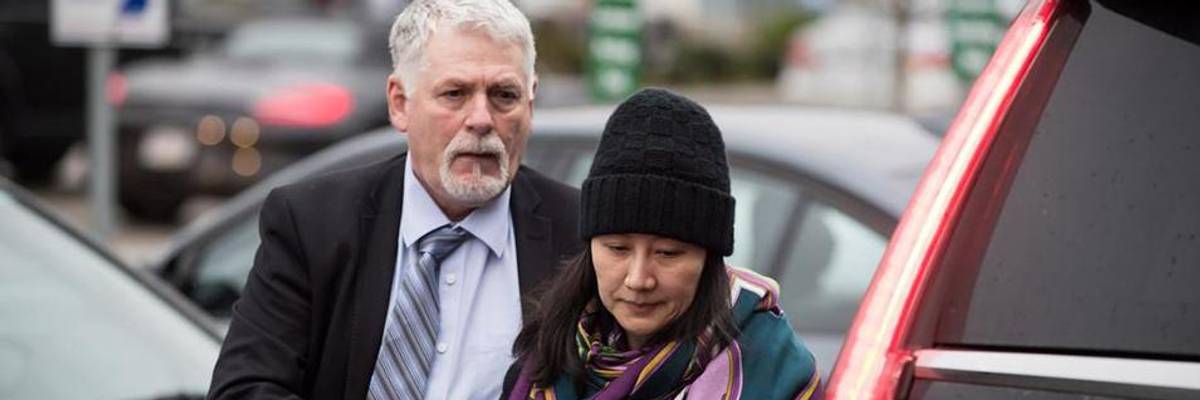
Huawei chief financial officer Meng Wanzhou, right, is escorted by a member of her private security detail while arriving at a parole office, in Vancouver, on Dec. 12. (DARRYL DYCK / THE CANADIAN PRESS)
The phrase "rule of law" has a nice, lofty ring to it, so it's not surprising that Prime Minister Justin Trudeau is invoking it to defend Canada's detention of a Chinese business executive.
But while one can imagine many reasons why Canada decided to co-operate with the U.S. request to extradite Meng Wanzhou, it's doubtful that the desire to uphold the "rule of law" was one of them.
In fact, what Canada is really doing is lending support to rogue and reckless behaviour by the Trump administration.
The phrase "rule of law" has a nice, lofty ring to it, so it's not surprising that Prime Minister Justin Trudeau is invoking it to defend Canada's detention of a Chinese business executive.
But while one can imagine many reasons why Canada decided to co-operate with the U.S. request to extradite Meng Wanzhou, it's doubtful that the desire to uphold the "rule of law" was one of them.
In fact, what Canada is really doing is lending support to rogue and reckless behaviour by the Trump administration.
The U.S. extradition case is based on allegations that Meng, a senior executive with China's technology giant Huawei,committed fraud as part of a scheme to violate U.S. trade sanctions against Iran.
But Washington's efforts to punish Huawei for trading with Iran are of dubious legality.
The UN Security Council (in Resolution 2231) called on all countries to drop sanctions against Iran as part of the 2015 treaty aimed at limiting Iran from developing nuclear weapons -- a treaty that was welcomed around the world as a chance to reduce the risk of nuclear war.
That treaty, negotiated by the Obama administration, quickly became a target of U.S. Republicans, who were more interested in destroying Iran than in making the world a less perilous place. The treaty was particularly annoying to the wildly insecure Donald Trump who, as president, was keen to take a baseball bat to anything that could be seen as an accomplishment of his predecessor.
In addition to withdrawing from this important nuclear treaty -- which had been endorsed by the UN Security Council as well as Germany and the EU -- the Trump administration decided it has the right to unilaterally punish foreign countries, companies and individuals doing business with Iran (even though the UN treaty permits them to do so).
Washington's actions amount to a kind of international thuggery. U.S. economist Jeffrey Sachs argues they pose a threat to the international rule of law. "The U.S. would certainly not tolerate China or any other country telling American companies with whom they can or cannot trade," he maintains.
Another apparent motive behind the Meng extradition request was Washington's interest in heating up its economic war against China by blocking Huawei from making further inroads into Western markets, where it already threatens the dominance of U.S. technology giants.
Given the questionable lawfulness and suspect motives of the U.S. extradition request, the appropriate Canadian response might have been to simply avoid making the arrest, by resorting to some "creative incompetence," as former Foreign Affairs minister John Manley has suggested.
For that matter, we are not obliged to extradite Meng.
Robert J. Currie, a professor at Dalhousie University's Schulich School of Law, writes that under Canada's Extradition Act, the decision whether to extradite in a case like this "is made not by the courts, but by the federal Minister of Justice." In other words, it's not strictly a legal matter but ultimately a political decision to be made by the Trudeau government.
Currie also points out that Canada has a long history of co-operating with U.S. extradition requests "because such neighbourliness makes for smooth relations."
Now we're getting to the nub of the matter. Trudeau's keenness to co-operate is likely rooted in his desire to try to restore some semblance of neighbourly relations, after the petulant U.S. president went out of his way last June to pick a fight with us.
There's nothing wrong with trying to restore neighbourly feelings -- except that in this case there are a lot of extremely negative consequences, such as China's retaliatory detention of three innocent Canadians, and the major tensions that have now needlessly developed between China and Canada.
At least, Trudeau should drop the pretense that his compliance with the U.S. extradition request springs from a deep commitment to the "rule of law."
If he really cared about that principle he'd be speaking up in defence of the UN treaty, not knuckling under to an administration that recently showed its concept of the "rule of law" by flashing a wink and a nod at the Saudi crown prince after he silenced an outspoken journalist with a bone-saw.
Dear Common Dreams reader, It’s been nearly 30 years since I co-founded Common Dreams with my late wife, Lina Newhouser. We had the radical notion that journalism should serve the public good, not corporate profits. It was clear to us from the outset what it would take to build such a project. No paid advertisements. No corporate sponsors. No millionaire publisher telling us what to think or do. Many people said we wouldn't last a year, but we proved those doubters wrong. Together with a tremendous team of journalists and dedicated staff, we built an independent media outlet free from the constraints of profits and corporate control. Our mission has always been simple: To inform. To inspire. To ignite change for the common good. Building Common Dreams was not easy. Our survival was never guaranteed. When you take on the most powerful forces—Wall Street greed, fossil fuel industry destruction, Big Tech lobbyists, and uber-rich oligarchs who have spent billions upon billions rigging the economy and democracy in their favor—the only bulwark you have is supporters who believe in your work. But here’s the urgent message from me today. It's never been this bad out there. And it's never been this hard to keep us going. At the very moment Common Dreams is most needed, the threats we face are intensifying. We need your support now more than ever. We don't accept corporate advertising and never will. We don't have a paywall because we don't think people should be blocked from critical news based on their ability to pay. Everything we do is funded by the donations of readers like you. When everyone does the little they can afford, we are strong. But if that support retreats or dries up, so do we. Will you donate now to make sure Common Dreams not only survives but thrives? —Craig Brown, Co-founder |
The phrase "rule of law" has a nice, lofty ring to it, so it's not surprising that Prime Minister Justin Trudeau is invoking it to defend Canada's detention of a Chinese business executive.
But while one can imagine many reasons why Canada decided to co-operate with the U.S. request to extradite Meng Wanzhou, it's doubtful that the desire to uphold the "rule of law" was one of them.
In fact, what Canada is really doing is lending support to rogue and reckless behaviour by the Trump administration.
The U.S. extradition case is based on allegations that Meng, a senior executive with China's technology giant Huawei,committed fraud as part of a scheme to violate U.S. trade sanctions against Iran.
But Washington's efforts to punish Huawei for trading with Iran are of dubious legality.
The UN Security Council (in Resolution 2231) called on all countries to drop sanctions against Iran as part of the 2015 treaty aimed at limiting Iran from developing nuclear weapons -- a treaty that was welcomed around the world as a chance to reduce the risk of nuclear war.
That treaty, negotiated by the Obama administration, quickly became a target of U.S. Republicans, who were more interested in destroying Iran than in making the world a less perilous place. The treaty was particularly annoying to the wildly insecure Donald Trump who, as president, was keen to take a baseball bat to anything that could be seen as an accomplishment of his predecessor.
In addition to withdrawing from this important nuclear treaty -- which had been endorsed by the UN Security Council as well as Germany and the EU -- the Trump administration decided it has the right to unilaterally punish foreign countries, companies and individuals doing business with Iran (even though the UN treaty permits them to do so).
Washington's actions amount to a kind of international thuggery. U.S. economist Jeffrey Sachs argues they pose a threat to the international rule of law. "The U.S. would certainly not tolerate China or any other country telling American companies with whom they can or cannot trade," he maintains.
Another apparent motive behind the Meng extradition request was Washington's interest in heating up its economic war against China by blocking Huawei from making further inroads into Western markets, where it already threatens the dominance of U.S. technology giants.
Given the questionable lawfulness and suspect motives of the U.S. extradition request, the appropriate Canadian response might have been to simply avoid making the arrest, by resorting to some "creative incompetence," as former Foreign Affairs minister John Manley has suggested.
For that matter, we are not obliged to extradite Meng.
Robert J. Currie, a professor at Dalhousie University's Schulich School of Law, writes that under Canada's Extradition Act, the decision whether to extradite in a case like this "is made not by the courts, but by the federal Minister of Justice." In other words, it's not strictly a legal matter but ultimately a political decision to be made by the Trudeau government.
Currie also points out that Canada has a long history of co-operating with U.S. extradition requests "because such neighbourliness makes for smooth relations."
Now we're getting to the nub of the matter. Trudeau's keenness to co-operate is likely rooted in his desire to try to restore some semblance of neighbourly relations, after the petulant U.S. president went out of his way last June to pick a fight with us.
There's nothing wrong with trying to restore neighbourly feelings -- except that in this case there are a lot of extremely negative consequences, such as China's retaliatory detention of three innocent Canadians, and the major tensions that have now needlessly developed between China and Canada.
At least, Trudeau should drop the pretense that his compliance with the U.S. extradition request springs from a deep commitment to the "rule of law."
If he really cared about that principle he'd be speaking up in defence of the UN treaty, not knuckling under to an administration that recently showed its concept of the "rule of law" by flashing a wink and a nod at the Saudi crown prince after he silenced an outspoken journalist with a bone-saw.
The phrase "rule of law" has a nice, lofty ring to it, so it's not surprising that Prime Minister Justin Trudeau is invoking it to defend Canada's detention of a Chinese business executive.
But while one can imagine many reasons why Canada decided to co-operate with the U.S. request to extradite Meng Wanzhou, it's doubtful that the desire to uphold the "rule of law" was one of them.
In fact, what Canada is really doing is lending support to rogue and reckless behaviour by the Trump administration.
The U.S. extradition case is based on allegations that Meng, a senior executive with China's technology giant Huawei,committed fraud as part of a scheme to violate U.S. trade sanctions against Iran.
But Washington's efforts to punish Huawei for trading with Iran are of dubious legality.
The UN Security Council (in Resolution 2231) called on all countries to drop sanctions against Iran as part of the 2015 treaty aimed at limiting Iran from developing nuclear weapons -- a treaty that was welcomed around the world as a chance to reduce the risk of nuclear war.
That treaty, negotiated by the Obama administration, quickly became a target of U.S. Republicans, who were more interested in destroying Iran than in making the world a less perilous place. The treaty was particularly annoying to the wildly insecure Donald Trump who, as president, was keen to take a baseball bat to anything that could be seen as an accomplishment of his predecessor.
In addition to withdrawing from this important nuclear treaty -- which had been endorsed by the UN Security Council as well as Germany and the EU -- the Trump administration decided it has the right to unilaterally punish foreign countries, companies and individuals doing business with Iran (even though the UN treaty permits them to do so).
Washington's actions amount to a kind of international thuggery. U.S. economist Jeffrey Sachs argues they pose a threat to the international rule of law. "The U.S. would certainly not tolerate China or any other country telling American companies with whom they can or cannot trade," he maintains.
Another apparent motive behind the Meng extradition request was Washington's interest in heating up its economic war against China by blocking Huawei from making further inroads into Western markets, where it already threatens the dominance of U.S. technology giants.
Given the questionable lawfulness and suspect motives of the U.S. extradition request, the appropriate Canadian response might have been to simply avoid making the arrest, by resorting to some "creative incompetence," as former Foreign Affairs minister John Manley has suggested.
For that matter, we are not obliged to extradite Meng.
Robert J. Currie, a professor at Dalhousie University's Schulich School of Law, writes that under Canada's Extradition Act, the decision whether to extradite in a case like this "is made not by the courts, but by the federal Minister of Justice." In other words, it's not strictly a legal matter but ultimately a political decision to be made by the Trudeau government.
Currie also points out that Canada has a long history of co-operating with U.S. extradition requests "because such neighbourliness makes for smooth relations."
Now we're getting to the nub of the matter. Trudeau's keenness to co-operate is likely rooted in his desire to try to restore some semblance of neighbourly relations, after the petulant U.S. president went out of his way last June to pick a fight with us.
There's nothing wrong with trying to restore neighbourly feelings -- except that in this case there are a lot of extremely negative consequences, such as China's retaliatory detention of three innocent Canadians, and the major tensions that have now needlessly developed between China and Canada.
At least, Trudeau should drop the pretense that his compliance with the U.S. extradition request springs from a deep commitment to the "rule of law."
If he really cared about that principle he'd be speaking up in defence of the UN treaty, not knuckling under to an administration that recently showed its concept of the "rule of law" by flashing a wink and a nod at the Saudi crown prince after he silenced an outspoken journalist with a bone-saw.