SUBSCRIBE TO OUR FREE NEWSLETTER
Daily news & progressive opinion—funded by the people, not the corporations—delivered straight to your inbox.
5
#000000
#FFFFFF
To donate by check, phone, or other method, see our More Ways to Give page.
Daily news & progressive opinion—funded by the people, not the corporations—delivered straight to your inbox.

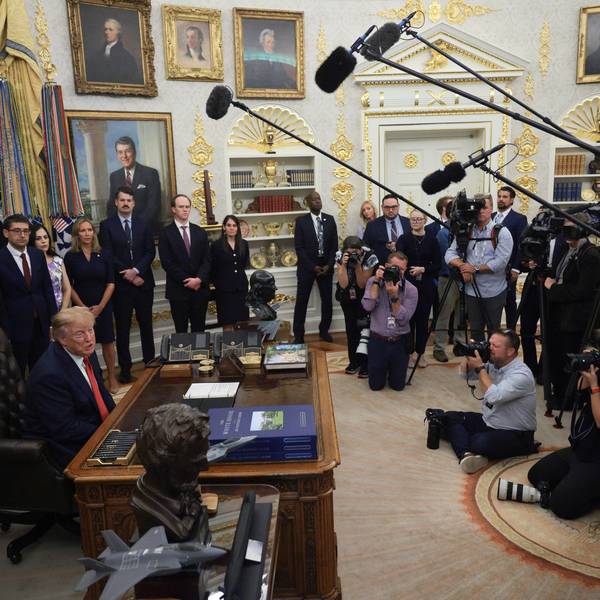
U.S. President Donald Trump speaks to the media on November 17, 2018 in Washington, D.C. (Photo: Jim Lo Scalzo-Pool/Getty Images)
The "rule of law" distinguishes democracies from dictatorships. It's based on three fundamental principles. Trump is violating every one of them.
The first is that no person is above the law, not even a president. Which means a president cannot stop an investigation into his alleged illegal acts.
Yet in recent weeks Trump fired Attorney General Jeff Sessions, who at least had possessed enough integrity to recuse himself from special counsel Robert Mueller's investigation into Trump's possible collusion with Russia in the 2016 election. Trump replaced Sessions with an inexperienced loyalist hack, Matthew G. Whitaker, whose only distinction to date has been loud and public condemnation of that investigation. As a conservative legal commentator on CNN, Whitaker even suggested that a clever attorney general could secretly starve the investigation of funds.
There's no question why Trump appointed Whitaker. When asked by the Daily Caller, Trump made it clear: "As far as I'm concerned this is an investigation that should have never been brought. It should have never been had.... It's an illegal investigation."
The second principle of the rule of law is that a president cannot prosecute political opponents or critics. Decisions about whom to prosecute for alleged criminal wrongdoing must be made by prosecutors who are independent of politics.
Yet Trump has pushed the Justice Department to bring charges against Hillary Clinton, his 2016 rival, for using a private email server when she was Secretary of State, in alleged violation of the Presidential Records Act.
During his campaign, Trump led crowds in chanting "lock her up," called Clinton "crooked Hillary," and threatened to prosecute her if he was elected president.
After taking office, according to The New York Times, Trump told White House counsel Donald McGahn he wanted the Justice Department to prosecute Clinton. McGahn responded that Trump didn't have the authority to do so, and such action might even lead to impeachment.
Yet Trump has continued to press Justice Department officials--including Whitaker, when he served as Sessions's chief of staff--about the status of Clinton-related investigations.
Never mind that Trump's senior adviser and daughter, Ivanka Trump sent hundreds messages on her private email server to government employees and aides that detailed government business, policies, and proposals. Or that other Trump officials have used their private email to conduct official business as well.
Breaking the rule of law doesn't require consistency. It requires only a thirst for power at whatever cost.
The third principle of the rule of law is that a president must be respectful of the independence of the judiciary.
Yet Trump has done the opposite, openly ridiculing judges who disagree with him in order to fuel public distrust of them--as he did when he called the judge who issued the first federal ruling against his travel ban a "so-called" judge.
Last week Trump referred derisively to the judge who put a hold on Trump's plan for refusing to consider asylum applications an "Obama judge," and railed against the entire ninth circuit. "You go the 9th Circuit and it's a disgrace," he said. He also issued a subtle threat: "It's not going to happen like this anymore."
In an unprecedented public rebuke of a sitting president, John Roberts, the Chief Justice of the Supreme Court, condemned Trump's attack. "We do not have Obama judges or Trump judges, Bush judges or Clinton judges," Roberts said. "What we have is an extraordinary group of dedicated judges doing their level best to do equal right to those appearing before them. That independent judiciary is something we should all be thankful for."
Trump immediately shot back: "Sorry Chief Justice John Roberts, but you do indeed have 'Obama judges,' and they have a much different point of view than the people who are charged with the safety of our country." This was followed by another Trump threat: "Much talk over dividing up the 9th Circuit into 2 or 3 Circuits. Too big!"
Almost a half-century ago, another president violated these three basic principles of the rule of law. Richard Nixon tried to obstruct the Watergate investigation, pushed the Justice Department to prosecute his political enemies, and took on the judiciary.
But America wouldn't allow it. The nation rose up in outrage. Nixon resigned before Congress impeached him.
The question is whether this generation of Americans will have the strength and wisdom to do the same.
Dear Common Dreams reader, It’s been nearly 30 years since I co-founded Common Dreams with my late wife, Lina Newhouser. We had the radical notion that journalism should serve the public good, not corporate profits. It was clear to us from the outset what it would take to build such a project. No paid advertisements. No corporate sponsors. No millionaire publisher telling us what to think or do. Many people said we wouldn't last a year, but we proved those doubters wrong. Together with a tremendous team of journalists and dedicated staff, we built an independent media outlet free from the constraints of profits and corporate control. Our mission has always been simple: To inform. To inspire. To ignite change for the common good. Building Common Dreams was not easy. Our survival was never guaranteed. When you take on the most powerful forces—Wall Street greed, fossil fuel industry destruction, Big Tech lobbyists, and uber-rich oligarchs who have spent billions upon billions rigging the economy and democracy in their favor—the only bulwark you have is supporters who believe in your work. But here’s the urgent message from me today. It's never been this bad out there. And it's never been this hard to keep us going. At the very moment Common Dreams is most needed, the threats we face are intensifying. We need your support now more than ever. We don't accept corporate advertising and never will. We don't have a paywall because we don't think people should be blocked from critical news based on their ability to pay. Everything we do is funded by the donations of readers like you. When everyone does the little they can afford, we are strong. But if that support retreats or dries up, so do we. Will you donate now to make sure Common Dreams not only survives but thrives? —Craig Brown, Co-founder |
The "rule of law" distinguishes democracies from dictatorships. It's based on three fundamental principles. Trump is violating every one of them.
The first is that no person is above the law, not even a president. Which means a president cannot stop an investigation into his alleged illegal acts.
Yet in recent weeks Trump fired Attorney General Jeff Sessions, who at least had possessed enough integrity to recuse himself from special counsel Robert Mueller's investigation into Trump's possible collusion with Russia in the 2016 election. Trump replaced Sessions with an inexperienced loyalist hack, Matthew G. Whitaker, whose only distinction to date has been loud and public condemnation of that investigation. As a conservative legal commentator on CNN, Whitaker even suggested that a clever attorney general could secretly starve the investigation of funds.
There's no question why Trump appointed Whitaker. When asked by the Daily Caller, Trump made it clear: "As far as I'm concerned this is an investigation that should have never been brought. It should have never been had.... It's an illegal investigation."
The second principle of the rule of law is that a president cannot prosecute political opponents or critics. Decisions about whom to prosecute for alleged criminal wrongdoing must be made by prosecutors who are independent of politics.
Yet Trump has pushed the Justice Department to bring charges against Hillary Clinton, his 2016 rival, for using a private email server when she was Secretary of State, in alleged violation of the Presidential Records Act.
During his campaign, Trump led crowds in chanting "lock her up," called Clinton "crooked Hillary," and threatened to prosecute her if he was elected president.
After taking office, according to The New York Times, Trump told White House counsel Donald McGahn he wanted the Justice Department to prosecute Clinton. McGahn responded that Trump didn't have the authority to do so, and such action might even lead to impeachment.
Yet Trump has continued to press Justice Department officials--including Whitaker, when he served as Sessions's chief of staff--about the status of Clinton-related investigations.
Never mind that Trump's senior adviser and daughter, Ivanka Trump sent hundreds messages on her private email server to government employees and aides that detailed government business, policies, and proposals. Or that other Trump officials have used their private email to conduct official business as well.
Breaking the rule of law doesn't require consistency. It requires only a thirst for power at whatever cost.
The third principle of the rule of law is that a president must be respectful of the independence of the judiciary.
Yet Trump has done the opposite, openly ridiculing judges who disagree with him in order to fuel public distrust of them--as he did when he called the judge who issued the first federal ruling against his travel ban a "so-called" judge.
Last week Trump referred derisively to the judge who put a hold on Trump's plan for refusing to consider asylum applications an "Obama judge," and railed against the entire ninth circuit. "You go the 9th Circuit and it's a disgrace," he said. He also issued a subtle threat: "It's not going to happen like this anymore."
In an unprecedented public rebuke of a sitting president, John Roberts, the Chief Justice of the Supreme Court, condemned Trump's attack. "We do not have Obama judges or Trump judges, Bush judges or Clinton judges," Roberts said. "What we have is an extraordinary group of dedicated judges doing their level best to do equal right to those appearing before them. That independent judiciary is something we should all be thankful for."
Trump immediately shot back: "Sorry Chief Justice John Roberts, but you do indeed have 'Obama judges,' and they have a much different point of view than the people who are charged with the safety of our country." This was followed by another Trump threat: "Much talk over dividing up the 9th Circuit into 2 or 3 Circuits. Too big!"
Almost a half-century ago, another president violated these three basic principles of the rule of law. Richard Nixon tried to obstruct the Watergate investigation, pushed the Justice Department to prosecute his political enemies, and took on the judiciary.
But America wouldn't allow it. The nation rose up in outrage. Nixon resigned before Congress impeached him.
The question is whether this generation of Americans will have the strength and wisdom to do the same.
The "rule of law" distinguishes democracies from dictatorships. It's based on three fundamental principles. Trump is violating every one of them.
The first is that no person is above the law, not even a president. Which means a president cannot stop an investigation into his alleged illegal acts.
Yet in recent weeks Trump fired Attorney General Jeff Sessions, who at least had possessed enough integrity to recuse himself from special counsel Robert Mueller's investigation into Trump's possible collusion with Russia in the 2016 election. Trump replaced Sessions with an inexperienced loyalist hack, Matthew G. Whitaker, whose only distinction to date has been loud and public condemnation of that investigation. As a conservative legal commentator on CNN, Whitaker even suggested that a clever attorney general could secretly starve the investigation of funds.
There's no question why Trump appointed Whitaker. When asked by the Daily Caller, Trump made it clear: "As far as I'm concerned this is an investigation that should have never been brought. It should have never been had.... It's an illegal investigation."
The second principle of the rule of law is that a president cannot prosecute political opponents or critics. Decisions about whom to prosecute for alleged criminal wrongdoing must be made by prosecutors who are independent of politics.
Yet Trump has pushed the Justice Department to bring charges against Hillary Clinton, his 2016 rival, for using a private email server when she was Secretary of State, in alleged violation of the Presidential Records Act.
During his campaign, Trump led crowds in chanting "lock her up," called Clinton "crooked Hillary," and threatened to prosecute her if he was elected president.
After taking office, according to The New York Times, Trump told White House counsel Donald McGahn he wanted the Justice Department to prosecute Clinton. McGahn responded that Trump didn't have the authority to do so, and such action might even lead to impeachment.
Yet Trump has continued to press Justice Department officials--including Whitaker, when he served as Sessions's chief of staff--about the status of Clinton-related investigations.
Never mind that Trump's senior adviser and daughter, Ivanka Trump sent hundreds messages on her private email server to government employees and aides that detailed government business, policies, and proposals. Or that other Trump officials have used their private email to conduct official business as well.
Breaking the rule of law doesn't require consistency. It requires only a thirst for power at whatever cost.
The third principle of the rule of law is that a president must be respectful of the independence of the judiciary.
Yet Trump has done the opposite, openly ridiculing judges who disagree with him in order to fuel public distrust of them--as he did when he called the judge who issued the first federal ruling against his travel ban a "so-called" judge.
Last week Trump referred derisively to the judge who put a hold on Trump's plan for refusing to consider asylum applications an "Obama judge," and railed against the entire ninth circuit. "You go the 9th Circuit and it's a disgrace," he said. He also issued a subtle threat: "It's not going to happen like this anymore."
In an unprecedented public rebuke of a sitting president, John Roberts, the Chief Justice of the Supreme Court, condemned Trump's attack. "We do not have Obama judges or Trump judges, Bush judges or Clinton judges," Roberts said. "What we have is an extraordinary group of dedicated judges doing their level best to do equal right to those appearing before them. That independent judiciary is something we should all be thankful for."
Trump immediately shot back: "Sorry Chief Justice John Roberts, but you do indeed have 'Obama judges,' and they have a much different point of view than the people who are charged with the safety of our country." This was followed by another Trump threat: "Much talk over dividing up the 9th Circuit into 2 or 3 Circuits. Too big!"
Almost a half-century ago, another president violated these three basic principles of the rule of law. Richard Nixon tried to obstruct the Watergate investigation, pushed the Justice Department to prosecute his political enemies, and took on the judiciary.
But America wouldn't allow it. The nation rose up in outrage. Nixon resigned before Congress impeached him.
The question is whether this generation of Americans will have the strength and wisdom to do the same.