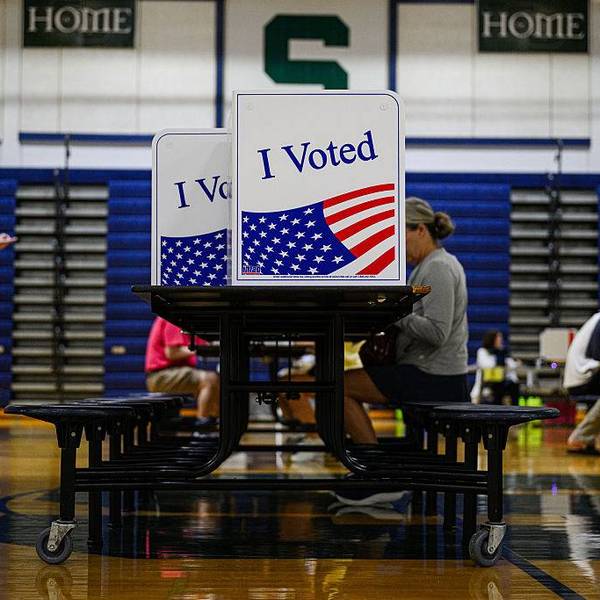

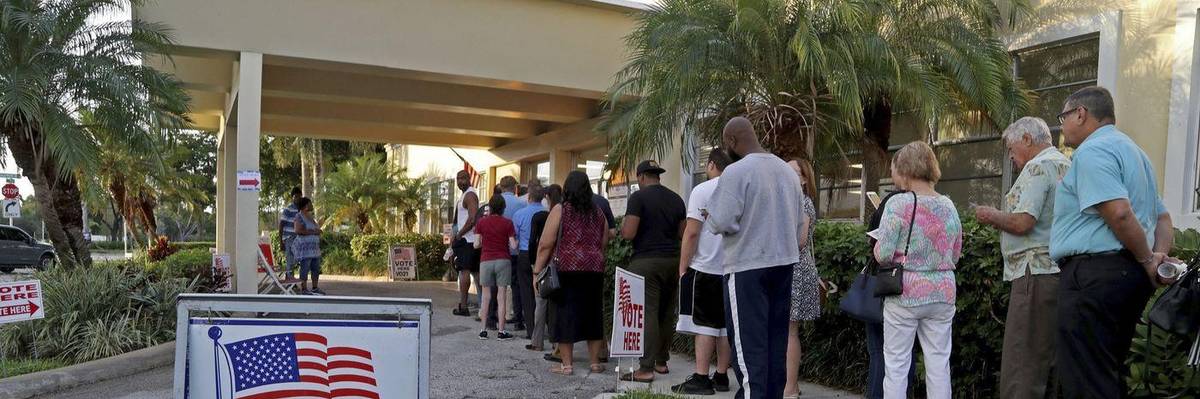
Voters line up as the polls open at David Park Community Center in Hollywood, Fla., on Nov. 6. (Photo: Susan Stocker / Associated Press)
Excited About the Big Voter Turnout in the 2018 Midterms? Don't Be
Yes, more than 116 million voted, but almost 120 million didn’t
Our democracy just won the trophy for Most Improved: The 49.4% voter turnout this month was higher than any midterm election in a century. But once we finish patting ourselves on the back, we need to look at the numbers again to take stock of what's missing: half of the eligible voters in the United States.
We're never going to see 100% voter turnout. But when half of the electorate is abstaining, we install elected officials who don't necessarily represent the majority opinion. We can't "vote the bums out" if we don't vote.
When half of the electorate is abstaining, we install elected officials who don't necessarily represent the majority opinion.
Writ large, the electoral choices were pretty stark. Would President Trump continue to govern with little check on his actions? Would the U.S. save health coverage for preexisting conditions? Stop imprisoning migrants seeking asylum? Take action on climate change or gun violence? More than half of eligible voters didn't record an opinion.
In California, where same-day registration makes it easy to cast a ballot, voters were weighing in on housing costs, water infrastructure, the governorship and congressional representatives. Still, of the 25.6 million Californians eligible to vote, 13 million sat on the sidelines.
Texas had a budding Democratic superstar challenging a former GOP presidential candidate in a $90 million Senate race. Outreach efforts were Herculean. The Beto O'Rourke campaign knocked on nearly 2 million doors and made more than 8.5 million phone calls to potential voters. O'Rourke told Rolling Stone, "What we are doing is the bar-none largest grassroots registration, and contact, and conversation, and turnout operation that you've seen in the state of Texas. Ever." And yet, with 46.1% turnout, almost 10 million eligible Texans did not vote.
In Florida, where contests for governor and senator were so close they ended in a recount, turnout was better: 54.3%. Still, 6.9 million voters abstained.
Smarting from 2016, Rock the Vote, Vote.org, and other nonprofits and PACs used texts, social media, clever campaigns and partnerships to disseminate information about how to register and vote. Celebrities amplified the message to young people. Taylor Swift took a stand on social media. Rihanna wrote on Instagram, "Who is awake this morning? And who's woke? Cause today is an extremely crucial day to the future of America!!! Today is the last day in 14 states to REGISTER TO VOTE..." Voting became cool, but still two-thirds of those 18 to 29 didn't heed the call.
Increasing turnout among young people is a conundrum: Research shows those contacted directly by candidates or other outreach campaigns are more likely to vote, but campaigns understandably focus their efforts on likely voters, not first-timers. Two-thirds of this age group were never contacted, according to researchers at Tufts University.
Outreach to the Latino community did a little better. The Democratic Congressional Campaign Committee spent $30 million on reaching Latino voters this cycle. Voto Latino and other groups helped register voters. Univision, the largest media company serving the U.S. Spanish-speaking audience, launched Vota Conmigo (Vote With Me). Early voting figures showed Latino voter participation up 174% compared with 2014 midterms, according to the DCCC. A quarter of those voters in 2018 said they were participating in a midterm election for the first time. It's a step.
It doesn't make sense to simply blame apathetic citizens. In a Pew Research Center survey a month before this election, 91% of respondents said voting was important. At the same time, only 73% said it was convenient and 70% said it was straightforward. And sure enough, those concerns played out across the country. Some states don't allow early voting. Precincts were closed in some urban areas, or closed early, or ran out of ballots, or gave voters a hard time when their signatures weren't an exact match. Machines were broken. Wait times could be hours long. Some potential voters were misinformed or confused about state-by-state ID requirements.
There is more work to do to make voting more accessible. The states with the highest turnout included two predominantly vote-by-mail states -- Colorado (61.9%) and Oregon (61.3%) -- so convenience certainly makes a difference. But even in perennial high-turnout Minnesota (64.3% this year), 1.4 million people out of 4 million eligible didn't vote.
The United States has long professed the merits of democracy around the world, but we need to do better ourselves. Truly, we should aspire to rank among the top in turnout in the field of developed countries run by democracy. Belgium delivered 90% turnout in its last election (but voting is compulsory there). Sweden (where voting is optional) had a turnout this year of 87%.
Of course, those countries are many, many times smaller than the U.S., and their populations are more homogeneous. But having 80% or more eligible voters cast a ballot is a reasonable goal for us. For the U.S. to deserve a Democracy trophy, and not just Most Improved, we must aim higher. Yes, more than 116 million voted, but almost 120 million didn't.
An Urgent Message From Our Co-Founder
Dear Common Dreams reader, It’s been nearly 30 years since I co-founded Common Dreams with my late wife, Lina Newhouser. We had the radical notion that journalism should serve the public good, not corporate profits. It was clear to us from the outset what it would take to build such a project. No paid advertisements. No corporate sponsors. No millionaire publisher telling us what to think or do. Many people said we wouldn't last a year, but we proved those doubters wrong. Together with a tremendous team of journalists and dedicated staff, we built an independent media outlet free from the constraints of profits and corporate control. Our mission has always been simple: To inform. To inspire. To ignite change for the common good. Building Common Dreams was not easy. Our survival was never guaranteed. When you take on the most powerful forces—Wall Street greed, fossil fuel industry destruction, Big Tech lobbyists, and uber-rich oligarchs who have spent billions upon billions rigging the economy and democracy in their favor—the only bulwark you have is supporters who believe in your work. But here’s the urgent message from me today. It's never been this bad out there. And it's never been this hard to keep us going. At the very moment Common Dreams is most needed, the threats we face are intensifying. We need your support now more than ever. We don't accept corporate advertising and never will. We don't have a paywall because we don't think people should be blocked from critical news based on their ability to pay. Everything we do is funded by the donations of readers like you. When everyone does the little they can afford, we are strong. But if that support retreats or dries up, so do we. Will you donate now to make sure Common Dreams not only survives but thrives? —Craig Brown, Co-founder |
Our democracy just won the trophy for Most Improved: The 49.4% voter turnout this month was higher than any midterm election in a century. But once we finish patting ourselves on the back, we need to look at the numbers again to take stock of what's missing: half of the eligible voters in the United States.
We're never going to see 100% voter turnout. But when half of the electorate is abstaining, we install elected officials who don't necessarily represent the majority opinion. We can't "vote the bums out" if we don't vote.
When half of the electorate is abstaining, we install elected officials who don't necessarily represent the majority opinion.
Writ large, the electoral choices were pretty stark. Would President Trump continue to govern with little check on his actions? Would the U.S. save health coverage for preexisting conditions? Stop imprisoning migrants seeking asylum? Take action on climate change or gun violence? More than half of eligible voters didn't record an opinion.
In California, where same-day registration makes it easy to cast a ballot, voters were weighing in on housing costs, water infrastructure, the governorship and congressional representatives. Still, of the 25.6 million Californians eligible to vote, 13 million sat on the sidelines.
Texas had a budding Democratic superstar challenging a former GOP presidential candidate in a $90 million Senate race. Outreach efforts were Herculean. The Beto O'Rourke campaign knocked on nearly 2 million doors and made more than 8.5 million phone calls to potential voters. O'Rourke told Rolling Stone, "What we are doing is the bar-none largest grassroots registration, and contact, and conversation, and turnout operation that you've seen in the state of Texas. Ever." And yet, with 46.1% turnout, almost 10 million eligible Texans did not vote.
In Florida, where contests for governor and senator were so close they ended in a recount, turnout was better: 54.3%. Still, 6.9 million voters abstained.
Smarting from 2016, Rock the Vote, Vote.org, and other nonprofits and PACs used texts, social media, clever campaigns and partnerships to disseminate information about how to register and vote. Celebrities amplified the message to young people. Taylor Swift took a stand on social media. Rihanna wrote on Instagram, "Who is awake this morning? And who's woke? Cause today is an extremely crucial day to the future of America!!! Today is the last day in 14 states to REGISTER TO VOTE..." Voting became cool, but still two-thirds of those 18 to 29 didn't heed the call.
Increasing turnout among young people is a conundrum: Research shows those contacted directly by candidates or other outreach campaigns are more likely to vote, but campaigns understandably focus their efforts on likely voters, not first-timers. Two-thirds of this age group were never contacted, according to researchers at Tufts University.
Outreach to the Latino community did a little better. The Democratic Congressional Campaign Committee spent $30 million on reaching Latino voters this cycle. Voto Latino and other groups helped register voters. Univision, the largest media company serving the U.S. Spanish-speaking audience, launched Vota Conmigo (Vote With Me). Early voting figures showed Latino voter participation up 174% compared with 2014 midterms, according to the DCCC. A quarter of those voters in 2018 said they were participating in a midterm election for the first time. It's a step.
It doesn't make sense to simply blame apathetic citizens. In a Pew Research Center survey a month before this election, 91% of respondents said voting was important. At the same time, only 73% said it was convenient and 70% said it was straightforward. And sure enough, those concerns played out across the country. Some states don't allow early voting. Precincts were closed in some urban areas, or closed early, or ran out of ballots, or gave voters a hard time when their signatures weren't an exact match. Machines were broken. Wait times could be hours long. Some potential voters were misinformed or confused about state-by-state ID requirements.
There is more work to do to make voting more accessible. The states with the highest turnout included two predominantly vote-by-mail states -- Colorado (61.9%) and Oregon (61.3%) -- so convenience certainly makes a difference. But even in perennial high-turnout Minnesota (64.3% this year), 1.4 million people out of 4 million eligible didn't vote.
The United States has long professed the merits of democracy around the world, but we need to do better ourselves. Truly, we should aspire to rank among the top in turnout in the field of developed countries run by democracy. Belgium delivered 90% turnout in its last election (but voting is compulsory there). Sweden (where voting is optional) had a turnout this year of 87%.
Of course, those countries are many, many times smaller than the U.S., and their populations are more homogeneous. But having 80% or more eligible voters cast a ballot is a reasonable goal for us. For the U.S. to deserve a Democracy trophy, and not just Most Improved, we must aim higher. Yes, more than 116 million voted, but almost 120 million didn't.
Our democracy just won the trophy for Most Improved: The 49.4% voter turnout this month was higher than any midterm election in a century. But once we finish patting ourselves on the back, we need to look at the numbers again to take stock of what's missing: half of the eligible voters in the United States.
We're never going to see 100% voter turnout. But when half of the electorate is abstaining, we install elected officials who don't necessarily represent the majority opinion. We can't "vote the bums out" if we don't vote.
When half of the electorate is abstaining, we install elected officials who don't necessarily represent the majority opinion.
Writ large, the electoral choices were pretty stark. Would President Trump continue to govern with little check on his actions? Would the U.S. save health coverage for preexisting conditions? Stop imprisoning migrants seeking asylum? Take action on climate change or gun violence? More than half of eligible voters didn't record an opinion.
In California, where same-day registration makes it easy to cast a ballot, voters were weighing in on housing costs, water infrastructure, the governorship and congressional representatives. Still, of the 25.6 million Californians eligible to vote, 13 million sat on the sidelines.
Texas had a budding Democratic superstar challenging a former GOP presidential candidate in a $90 million Senate race. Outreach efforts were Herculean. The Beto O'Rourke campaign knocked on nearly 2 million doors and made more than 8.5 million phone calls to potential voters. O'Rourke told Rolling Stone, "What we are doing is the bar-none largest grassroots registration, and contact, and conversation, and turnout operation that you've seen in the state of Texas. Ever." And yet, with 46.1% turnout, almost 10 million eligible Texans did not vote.
In Florida, where contests for governor and senator were so close they ended in a recount, turnout was better: 54.3%. Still, 6.9 million voters abstained.
Smarting from 2016, Rock the Vote, Vote.org, and other nonprofits and PACs used texts, social media, clever campaigns and partnerships to disseminate information about how to register and vote. Celebrities amplified the message to young people. Taylor Swift took a stand on social media. Rihanna wrote on Instagram, "Who is awake this morning? And who's woke? Cause today is an extremely crucial day to the future of America!!! Today is the last day in 14 states to REGISTER TO VOTE..." Voting became cool, but still two-thirds of those 18 to 29 didn't heed the call.
Increasing turnout among young people is a conundrum: Research shows those contacted directly by candidates or other outreach campaigns are more likely to vote, but campaigns understandably focus their efforts on likely voters, not first-timers. Two-thirds of this age group were never contacted, according to researchers at Tufts University.
Outreach to the Latino community did a little better. The Democratic Congressional Campaign Committee spent $30 million on reaching Latino voters this cycle. Voto Latino and other groups helped register voters. Univision, the largest media company serving the U.S. Spanish-speaking audience, launched Vota Conmigo (Vote With Me). Early voting figures showed Latino voter participation up 174% compared with 2014 midterms, according to the DCCC. A quarter of those voters in 2018 said they were participating in a midterm election for the first time. It's a step.
It doesn't make sense to simply blame apathetic citizens. In a Pew Research Center survey a month before this election, 91% of respondents said voting was important. At the same time, only 73% said it was convenient and 70% said it was straightforward. And sure enough, those concerns played out across the country. Some states don't allow early voting. Precincts were closed in some urban areas, or closed early, or ran out of ballots, or gave voters a hard time when their signatures weren't an exact match. Machines were broken. Wait times could be hours long. Some potential voters were misinformed or confused about state-by-state ID requirements.
There is more work to do to make voting more accessible. The states with the highest turnout included two predominantly vote-by-mail states -- Colorado (61.9%) and Oregon (61.3%) -- so convenience certainly makes a difference. But even in perennial high-turnout Minnesota (64.3% this year), 1.4 million people out of 4 million eligible didn't vote.
The United States has long professed the merits of democracy around the world, but we need to do better ourselves. Truly, we should aspire to rank among the top in turnout in the field of developed countries run by democracy. Belgium delivered 90% turnout in its last election (but voting is compulsory there). Sweden (where voting is optional) had a turnout this year of 87%.
Of course, those countries are many, many times smaller than the U.S., and their populations are more homogeneous. But having 80% or more eligible voters cast a ballot is a reasonable goal for us. For the U.S. to deserve a Democracy trophy, and not just Most Improved, we must aim higher. Yes, more than 116 million voted, but almost 120 million didn't.