SUBSCRIBE TO OUR FREE NEWSLETTER
Daily news & progressive opinion—funded by the people, not the corporations—delivered straight to your inbox.
5
#000000
#FFFFFF
To donate by check, phone, or other method, see our More Ways to Give page.
Daily news & progressive opinion—funded by the people, not the corporations—delivered straight to your inbox.
Our understanding of the links between food systems and climate change is growing, but public awareness of the importance of this relationship is not widespread.
Whether you're a student in Osaka, Japan, tucking into a bento box of salted fish and edamame, a University professor in Dakar munching on Senegalese yassa, or an American steelworker unwrapping a hamburger, chances are you sit down several times a day to a plate of food, no matter who or where you are. You may not be aware of all the ways your choices at mealtimes are affecting the climate, but they are, and greatly.
Our understanding of the links between food systems and climate change is growing, but public awareness of the importance of this relationship is not widespread. Even people who accept that anthropogenic climate change is occurring are more likely to think first about home energy or focus on transportation. Fewer people consider the impact of the dinner on their plates, but the connections between climate change and food systems are deep and wide-ranging--the food choices we make; the ways we grow, raise, transport, process, store, prepare, and serve food; how we manage food waste. The Center for Ecoliteracy is making great strides toward shifting this awareness.
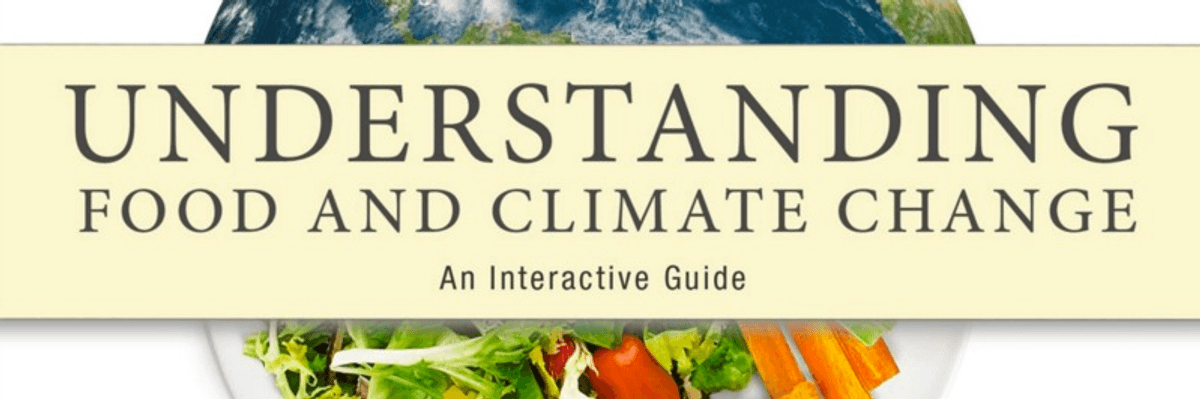
The Center for Ecoliteracy recently released a suite of free digital resources with two parts: a collection of essays, and an interactive guide that offers videos, original animations, interactive pages, photography, and sample activities to help explore the relationships between food and climate change. The suite is generating broad interest among students, educators, campaigners, environmental advocacy organizations, and food producers. The resources serve as a primer on the principles of ecology as well as an inquiry on what it means to think in terms of systems and relationships when it comes to our personal lifestyle choices and the impact they have on a changing planet.
Using systems thinking, the guide makes surprising connections between seemingly unrelated topics. For example, drastically reduced snowpack becomes a threat to beer marketing slogans the world over. Why? Because Olympia Beer's "It's the water" or Zephyrhills' "Pure water. Great beer" are rendered cruelly ironic if that water is no longer available. Something as mundane as fish sticks could vanish if a warming Bering Sea causes zooplankton stock to plummet. That's because Alaska pollock--without which there would be no "fish" in fish sticks--feed mainly on the rapidly disappearing zooplankton.
Despite the playful tone, there is substantial depth and breadth to the information contained in these free resources. An Interactive Guide gives a robust overview of critical topics such as food systems, ocean health, extreme weather, temperature change, food waste, water management, and climate change adaptation and mitigation (all on a responsive interface), while A Systems Perspective brings readers up to speed on systems theory, the greenhouse effect, the carbon cycle, soil microbiome, agroecology, livestock emissions, greenhouse gases, and more theoretical topics such as climate justice in food production and the capacity of public policy to build healthy soil.
The authors of An Interactive Guide, Center for Ecoliteracy creative director Karen Brown and science educator Margo Crabtree, want to personalize climate change for young people while making learning about the relationships between food and our environment fun. The guides are aimed at grades 6-12 with the goal to increase understanding by connecting daily experiences and practices of students and schools to these issues. Connections are made to diet and food waste--including through the lens of school meals--as well as learning in the classroom and the garden.
Young people today have to face the reality of a changing climate thanks to our legacy of a consumer economy and blatant disregard of environmental limits, and they are vulnerable to the impact of decisions made by past and current policymakers. They have both the most to gain and the most to lose. What can we do to support them in developing powerful responses? People take action when they believe they can effect change. Food uniquely offers the potential for personalizing climate change and helping young people imagine promising strategies for mitigating and adapting to climate risks. It inspires hope.
The Center for Ecoliteracy's intention in publishing this free suite of digital resources is to foster a deeper understanding of climate change and inspire planet-friendly choices about how you eat, shop, grow, and prepare foods. Join us in viewing the rest of these resources in their web version for all computers and tablets here and here. Understanding Food and Climate Change is also available as a free iBook for Mac and iPad users here.
Dear Common Dreams reader, It’s been nearly 30 years since I co-founded Common Dreams with my late wife, Lina Newhouser. We had the radical notion that journalism should serve the public good, not corporate profits. It was clear to us from the outset what it would take to build such a project. No paid advertisements. No corporate sponsors. No millionaire publisher telling us what to think or do. Many people said we wouldn't last a year, but we proved those doubters wrong. Together with a tremendous team of journalists and dedicated staff, we built an independent media outlet free from the constraints of profits and corporate control. Our mission has always been simple: To inform. To inspire. To ignite change for the common good. Building Common Dreams was not easy. Our survival was never guaranteed. When you take on the most powerful forces—Wall Street greed, fossil fuel industry destruction, Big Tech lobbyists, and uber-rich oligarchs who have spent billions upon billions rigging the economy and democracy in their favor—the only bulwark you have is supporters who believe in your work. But here’s the urgent message from me today. It's never been this bad out there. And it's never been this hard to keep us going. At the very moment Common Dreams is most needed, the threats we face are intensifying. We need your support now more than ever. We don't accept corporate advertising and never will. We don't have a paywall because we don't think people should be blocked from critical news based on their ability to pay. Everything we do is funded by the donations of readers like you. When everyone does the little they can afford, we are strong. But if that support retreats or dries up, so do we. Will you donate now to make sure Common Dreams not only survives but thrives? —Craig Brown, Co-founder |
Whether you're a student in Osaka, Japan, tucking into a bento box of salted fish and edamame, a University professor in Dakar munching on Senegalese yassa, or an American steelworker unwrapping a hamburger, chances are you sit down several times a day to a plate of food, no matter who or where you are. You may not be aware of all the ways your choices at mealtimes are affecting the climate, but they are, and greatly.
Our understanding of the links between food systems and climate change is growing, but public awareness of the importance of this relationship is not widespread. Even people who accept that anthropogenic climate change is occurring are more likely to think first about home energy or focus on transportation. Fewer people consider the impact of the dinner on their plates, but the connections between climate change and food systems are deep and wide-ranging--the food choices we make; the ways we grow, raise, transport, process, store, prepare, and serve food; how we manage food waste. The Center for Ecoliteracy is making great strides toward shifting this awareness.
The Center for Ecoliteracy recently released a suite of free digital resources with two parts: a collection of essays, and an interactive guide that offers videos, original animations, interactive pages, photography, and sample activities to help explore the relationships between food and climate change. The suite is generating broad interest among students, educators, campaigners, environmental advocacy organizations, and food producers. The resources serve as a primer on the principles of ecology as well as an inquiry on what it means to think in terms of systems and relationships when it comes to our personal lifestyle choices and the impact they have on a changing planet.
Using systems thinking, the guide makes surprising connections between seemingly unrelated topics. For example, drastically reduced snowpack becomes a threat to beer marketing slogans the world over. Why? Because Olympia Beer's "It's the water" or Zephyrhills' "Pure water. Great beer" are rendered cruelly ironic if that water is no longer available. Something as mundane as fish sticks could vanish if a warming Bering Sea causes zooplankton stock to plummet. That's because Alaska pollock--without which there would be no "fish" in fish sticks--feed mainly on the rapidly disappearing zooplankton.
Despite the playful tone, there is substantial depth and breadth to the information contained in these free resources. An Interactive Guide gives a robust overview of critical topics such as food systems, ocean health, extreme weather, temperature change, food waste, water management, and climate change adaptation and mitigation (all on a responsive interface), while A Systems Perspective brings readers up to speed on systems theory, the greenhouse effect, the carbon cycle, soil microbiome, agroecology, livestock emissions, greenhouse gases, and more theoretical topics such as climate justice in food production and the capacity of public policy to build healthy soil.
The authors of An Interactive Guide, Center for Ecoliteracy creative director Karen Brown and science educator Margo Crabtree, want to personalize climate change for young people while making learning about the relationships between food and our environment fun. The guides are aimed at grades 6-12 with the goal to increase understanding by connecting daily experiences and practices of students and schools to these issues. Connections are made to diet and food waste--including through the lens of school meals--as well as learning in the classroom and the garden.
Young people today have to face the reality of a changing climate thanks to our legacy of a consumer economy and blatant disregard of environmental limits, and they are vulnerable to the impact of decisions made by past and current policymakers. They have both the most to gain and the most to lose. What can we do to support them in developing powerful responses? People take action when they believe they can effect change. Food uniquely offers the potential for personalizing climate change and helping young people imagine promising strategies for mitigating and adapting to climate risks. It inspires hope.
The Center for Ecoliteracy's intention in publishing this free suite of digital resources is to foster a deeper understanding of climate change and inspire planet-friendly choices about how you eat, shop, grow, and prepare foods. Join us in viewing the rest of these resources in their web version for all computers and tablets here and here. Understanding Food and Climate Change is also available as a free iBook for Mac and iPad users here.
Whether you're a student in Osaka, Japan, tucking into a bento box of salted fish and edamame, a University professor in Dakar munching on Senegalese yassa, or an American steelworker unwrapping a hamburger, chances are you sit down several times a day to a plate of food, no matter who or where you are. You may not be aware of all the ways your choices at mealtimes are affecting the climate, but they are, and greatly.
Our understanding of the links between food systems and climate change is growing, but public awareness of the importance of this relationship is not widespread. Even people who accept that anthropogenic climate change is occurring are more likely to think first about home energy or focus on transportation. Fewer people consider the impact of the dinner on their plates, but the connections between climate change and food systems are deep and wide-ranging--the food choices we make; the ways we grow, raise, transport, process, store, prepare, and serve food; how we manage food waste. The Center for Ecoliteracy is making great strides toward shifting this awareness.
The Center for Ecoliteracy recently released a suite of free digital resources with two parts: a collection of essays, and an interactive guide that offers videos, original animations, interactive pages, photography, and sample activities to help explore the relationships between food and climate change. The suite is generating broad interest among students, educators, campaigners, environmental advocacy organizations, and food producers. The resources serve as a primer on the principles of ecology as well as an inquiry on what it means to think in terms of systems and relationships when it comes to our personal lifestyle choices and the impact they have on a changing planet.
Using systems thinking, the guide makes surprising connections between seemingly unrelated topics. For example, drastically reduced snowpack becomes a threat to beer marketing slogans the world over. Why? Because Olympia Beer's "It's the water" or Zephyrhills' "Pure water. Great beer" are rendered cruelly ironic if that water is no longer available. Something as mundane as fish sticks could vanish if a warming Bering Sea causes zooplankton stock to plummet. That's because Alaska pollock--without which there would be no "fish" in fish sticks--feed mainly on the rapidly disappearing zooplankton.
Despite the playful tone, there is substantial depth and breadth to the information contained in these free resources. An Interactive Guide gives a robust overview of critical topics such as food systems, ocean health, extreme weather, temperature change, food waste, water management, and climate change adaptation and mitigation (all on a responsive interface), while A Systems Perspective brings readers up to speed on systems theory, the greenhouse effect, the carbon cycle, soil microbiome, agroecology, livestock emissions, greenhouse gases, and more theoretical topics such as climate justice in food production and the capacity of public policy to build healthy soil.
The authors of An Interactive Guide, Center for Ecoliteracy creative director Karen Brown and science educator Margo Crabtree, want to personalize climate change for young people while making learning about the relationships between food and our environment fun. The guides are aimed at grades 6-12 with the goal to increase understanding by connecting daily experiences and practices of students and schools to these issues. Connections are made to diet and food waste--including through the lens of school meals--as well as learning in the classroom and the garden.
Young people today have to face the reality of a changing climate thanks to our legacy of a consumer economy and blatant disregard of environmental limits, and they are vulnerable to the impact of decisions made by past and current policymakers. They have both the most to gain and the most to lose. What can we do to support them in developing powerful responses? People take action when they believe they can effect change. Food uniquely offers the potential for personalizing climate change and helping young people imagine promising strategies for mitigating and adapting to climate risks. It inspires hope.
The Center for Ecoliteracy's intention in publishing this free suite of digital resources is to foster a deeper understanding of climate change and inspire planet-friendly choices about how you eat, shop, grow, and prepare foods. Join us in viewing the rest of these resources in their web version for all computers and tablets here and here. Understanding Food and Climate Change is also available as a free iBook for Mac and iPad users here.