SUBSCRIBE TO OUR FREE NEWSLETTER
Daily news & progressive opinion—funded by the people, not the corporations—delivered straight to your inbox.
5
#000000
#FFFFFF
To donate by check, phone, or other method, see our More Ways to Give page.
Daily news & progressive opinion—funded by the people, not the corporations—delivered straight to your inbox.
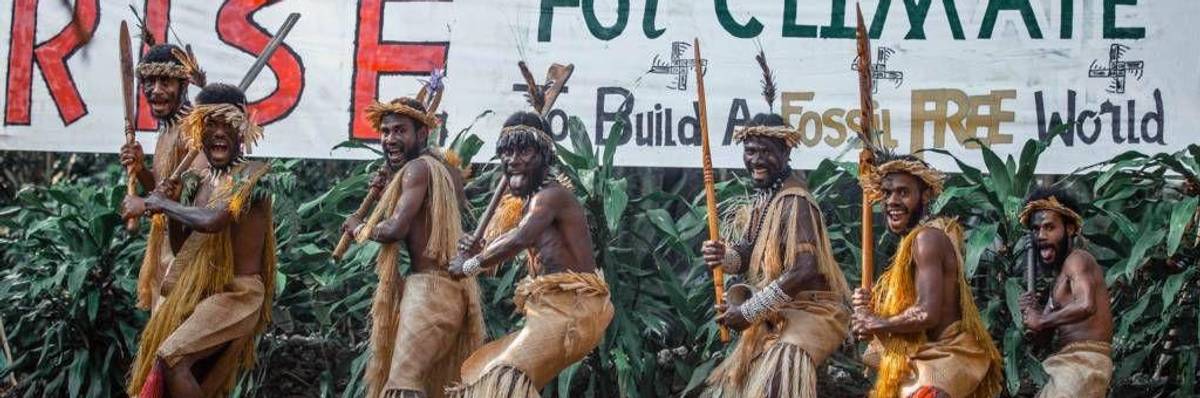
Across the globe, over 250,000 people took part in what was labelled as #RiseforClimate marches, protests and celebrations on 7 continents on Saturday. There were nearly 1,000 events in more than 90 countries.
The day of action kicked off with the sun rising over the Pacific islands, with activists across the region holding up small "kikonang" coconut leaf windmills as a symbol on the need to transition to renewable energy as soon as possible.
Isso Nihmei, Vanuatu Coordinator of the Pacific Climate Warriors, said: "We rise for our elders past. We rise for our people present. We rise for a fast and fair transition to a fossil free world."
Meanwhile, in Sydney, a #RiseForClimate tall ship sailed past the iconic Opera House into the Harbour, just one march of forty or so events and actions across the country. Over in Asia, women's rights groups, farmers and environmentalists marched in Bangkok just outside of the UN additional session of climate talks. Events were also held in the India, Indonesia, Philippines and Thailand.
Lamai Manakarn, Activist and Representative in Pattani, Southern Border Provinces of Thailand Network, said: "Global Warming is already affecting our livelihoods in the Southern border provinces of Thailand. We cannot afford even a single coal-fired power plant to be built. We are rising to stop coal and call for renewable and sustainable sources of energy."
Tens of thousands took part in actions across the African continent, including Egypt, Sierra Leone, Senegal, Ghana, Congo, Nigeria, Kenya, Tanzania, Botswana and South Africa. One of the biggest rallies was in in Kampala in Uganda, where 25,000 students and parents took part in a massive rally.
There were also protests and marches across Central Asia and Europe. In France over 150,000 mobilised across the country with 50,000 marching in Paris alone. As part of the resistance against the oil industry in Paris, a hundred people undertook an inclusive performance to liberate the Musee du Louvre from its links with Total. In Copenhagen, some 15,000 marched demanding climate action.
Likewise across Brazil, Colombia, Peru, and others countries across Latin America, there were marches too. There was even a small event in Antarctica, where astrobiologist Cyprien Verseux was photographed with a banner saying, simply: Rise for Climate.
In the USA, protesters did not disappoint. Organizers were hoping for the largest climate march in the West Coast's history and they got it - with over 30,000 people participating in the march.
As I had previously blogged about, a large theme of the Californian march was to try and persuade Governor Jerry Brown to phase out oil and gas drilling in the state. Footage shows marchers singing: "Jerry Brown, keep it in the ground. Jerry Brown, keep it in the ground."
The focus of attention will now shift to the Global Climate Action Summit, which opens on Wednesday in California, which Jerry Brown is co-hosting. Nearly 5,000 delegates are expected, some of whom will be activists determined to make their message heard.
Annie Leonard, the Executive Director of Greenpeace USA, told the San Francisco Chronicle that "a loud, diverse and impressive turnout" of activists, who have been "talking, planning and having training in nonviolent civil disobedience" for months would be turning up.
The Brown's Last Chance campaign was to counter the "risk of enshrining the model that you can be perceived as a climate leader even as you permit new oil and gas drilling wells."
"This is his moment to be a history-making, climate change transformative leader," Leonard said. "We are ready to protest him or celebrate him -- it's up to him."
Dear Common Dreams reader, It’s been nearly 30 years since I co-founded Common Dreams with my late wife, Lina Newhouser. We had the radical notion that journalism should serve the public good, not corporate profits. It was clear to us from the outset what it would take to build such a project. No paid advertisements. No corporate sponsors. No millionaire publisher telling us what to think or do. Many people said we wouldn't last a year, but we proved those doubters wrong. Together with a tremendous team of journalists and dedicated staff, we built an independent media outlet free from the constraints of profits and corporate control. Our mission has always been simple: To inform. To inspire. To ignite change for the common good. Building Common Dreams was not easy. Our survival was never guaranteed. When you take on the most powerful forces—Wall Street greed, fossil fuel industry destruction, Big Tech lobbyists, and uber-rich oligarchs who have spent billions upon billions rigging the economy and democracy in their favor—the only bulwark you have is supporters who believe in your work. But here’s the urgent message from me today. It's never been this bad out there. And it's never been this hard to keep us going. At the very moment Common Dreams is most needed, the threats we face are intensifying. We need your support now more than ever. We don't accept corporate advertising and never will. We don't have a paywall because we don't think people should be blocked from critical news based on their ability to pay. Everything we do is funded by the donations of readers like you. When everyone does the little they can afford, we are strong. But if that support retreats or dries up, so do we. Will you donate now to make sure Common Dreams not only survives but thrives? —Craig Brown, Co-founder |
Across the globe, over 250,000 people took part in what was labelled as #RiseforClimate marches, protests and celebrations on 7 continents on Saturday. There were nearly 1,000 events in more than 90 countries.
The day of action kicked off with the sun rising over the Pacific islands, with activists across the region holding up small "kikonang" coconut leaf windmills as a symbol on the need to transition to renewable energy as soon as possible.
Isso Nihmei, Vanuatu Coordinator of the Pacific Climate Warriors, said: "We rise for our elders past. We rise for our people present. We rise for a fast and fair transition to a fossil free world."
Meanwhile, in Sydney, a #RiseForClimate tall ship sailed past the iconic Opera House into the Harbour, just one march of forty or so events and actions across the country. Over in Asia, women's rights groups, farmers and environmentalists marched in Bangkok just outside of the UN additional session of climate talks. Events were also held in the India, Indonesia, Philippines and Thailand.
Lamai Manakarn, Activist and Representative in Pattani, Southern Border Provinces of Thailand Network, said: "Global Warming is already affecting our livelihoods in the Southern border provinces of Thailand. We cannot afford even a single coal-fired power plant to be built. We are rising to stop coal and call for renewable and sustainable sources of energy."
Tens of thousands took part in actions across the African continent, including Egypt, Sierra Leone, Senegal, Ghana, Congo, Nigeria, Kenya, Tanzania, Botswana and South Africa. One of the biggest rallies was in in Kampala in Uganda, where 25,000 students and parents took part in a massive rally.
There were also protests and marches across Central Asia and Europe. In France over 150,000 mobilised across the country with 50,000 marching in Paris alone. As part of the resistance against the oil industry in Paris, a hundred people undertook an inclusive performance to liberate the Musee du Louvre from its links with Total. In Copenhagen, some 15,000 marched demanding climate action.
Likewise across Brazil, Colombia, Peru, and others countries across Latin America, there were marches too. There was even a small event in Antarctica, where astrobiologist Cyprien Verseux was photographed with a banner saying, simply: Rise for Climate.
In the USA, protesters did not disappoint. Organizers were hoping for the largest climate march in the West Coast's history and they got it - with over 30,000 people participating in the march.
As I had previously blogged about, a large theme of the Californian march was to try and persuade Governor Jerry Brown to phase out oil and gas drilling in the state. Footage shows marchers singing: "Jerry Brown, keep it in the ground. Jerry Brown, keep it in the ground."
The focus of attention will now shift to the Global Climate Action Summit, which opens on Wednesday in California, which Jerry Brown is co-hosting. Nearly 5,000 delegates are expected, some of whom will be activists determined to make their message heard.
Annie Leonard, the Executive Director of Greenpeace USA, told the San Francisco Chronicle that "a loud, diverse and impressive turnout" of activists, who have been "talking, planning and having training in nonviolent civil disobedience" for months would be turning up.
The Brown's Last Chance campaign was to counter the "risk of enshrining the model that you can be perceived as a climate leader even as you permit new oil and gas drilling wells."
"This is his moment to be a history-making, climate change transformative leader," Leonard said. "We are ready to protest him or celebrate him -- it's up to him."
Across the globe, over 250,000 people took part in what was labelled as #RiseforClimate marches, protests and celebrations on 7 continents on Saturday. There were nearly 1,000 events in more than 90 countries.
The day of action kicked off with the sun rising over the Pacific islands, with activists across the region holding up small "kikonang" coconut leaf windmills as a symbol on the need to transition to renewable energy as soon as possible.
Isso Nihmei, Vanuatu Coordinator of the Pacific Climate Warriors, said: "We rise for our elders past. We rise for our people present. We rise for a fast and fair transition to a fossil free world."
Meanwhile, in Sydney, a #RiseForClimate tall ship sailed past the iconic Opera House into the Harbour, just one march of forty or so events and actions across the country. Over in Asia, women's rights groups, farmers and environmentalists marched in Bangkok just outside of the UN additional session of climate talks. Events were also held in the India, Indonesia, Philippines and Thailand.
Lamai Manakarn, Activist and Representative in Pattani, Southern Border Provinces of Thailand Network, said: "Global Warming is already affecting our livelihoods in the Southern border provinces of Thailand. We cannot afford even a single coal-fired power plant to be built. We are rising to stop coal and call for renewable and sustainable sources of energy."
Tens of thousands took part in actions across the African continent, including Egypt, Sierra Leone, Senegal, Ghana, Congo, Nigeria, Kenya, Tanzania, Botswana and South Africa. One of the biggest rallies was in in Kampala in Uganda, where 25,000 students and parents took part in a massive rally.
There were also protests and marches across Central Asia and Europe. In France over 150,000 mobilised across the country with 50,000 marching in Paris alone. As part of the resistance against the oil industry in Paris, a hundred people undertook an inclusive performance to liberate the Musee du Louvre from its links with Total. In Copenhagen, some 15,000 marched demanding climate action.
Likewise across Brazil, Colombia, Peru, and others countries across Latin America, there were marches too. There was even a small event in Antarctica, where astrobiologist Cyprien Verseux was photographed with a banner saying, simply: Rise for Climate.
In the USA, protesters did not disappoint. Organizers were hoping for the largest climate march in the West Coast's history and they got it - with over 30,000 people participating in the march.
As I had previously blogged about, a large theme of the Californian march was to try and persuade Governor Jerry Brown to phase out oil and gas drilling in the state. Footage shows marchers singing: "Jerry Brown, keep it in the ground. Jerry Brown, keep it in the ground."
The focus of attention will now shift to the Global Climate Action Summit, which opens on Wednesday in California, which Jerry Brown is co-hosting. Nearly 5,000 delegates are expected, some of whom will be activists determined to make their message heard.
Annie Leonard, the Executive Director of Greenpeace USA, told the San Francisco Chronicle that "a loud, diverse and impressive turnout" of activists, who have been "talking, planning and having training in nonviolent civil disobedience" for months would be turning up.
The Brown's Last Chance campaign was to counter the "risk of enshrining the model that you can be perceived as a climate leader even as you permit new oil and gas drilling wells."
"This is his moment to be a history-making, climate change transformative leader," Leonard said. "We are ready to protest him or celebrate him -- it's up to him."