SUBSCRIBE TO OUR FREE NEWSLETTER
Daily news & progressive opinion—funded by the people, not the corporations—delivered straight to your inbox.
5
#000000
#FFFFFF
To donate by check, phone, or other method, see our More Ways to Give page.
Daily news & progressive opinion—funded by the people, not the corporations—delivered straight to your inbox.
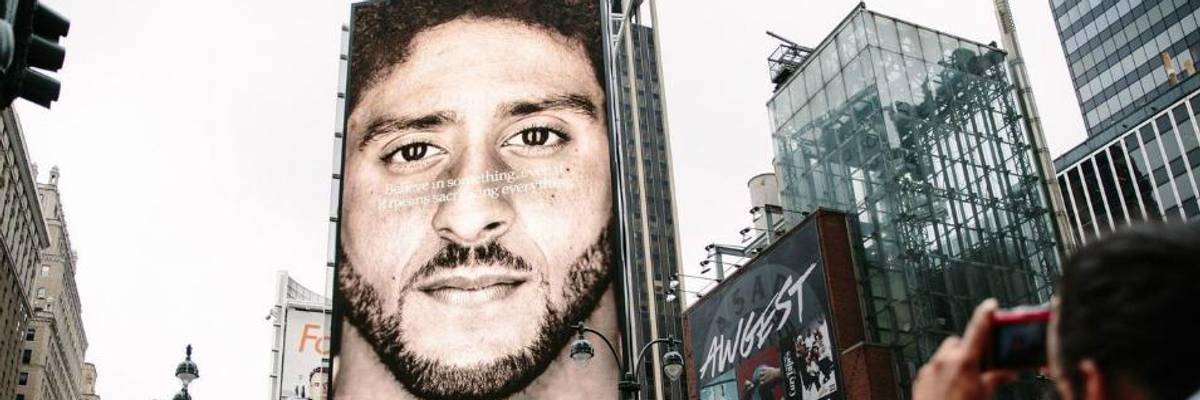
Colin Kaepernick's status as a global cultural icon of resistance has never seemed more secure. After two years of being seen as a symbol of radical dissent, and after one season of being shut out of the National Football League for daring to use the national anthem as a vehicle to protest police violence and racial inequity, he has reemerged this week with an explosive impact, as the face--and voice--of the 30th anniversary of Nike's "Just Do It" campaign.
The campaign is genius when it comes to commerce, but commodifying rebellion contains pitfalls about which Kaepernick and his legions of admirers should be aware.
There are black-and-white billboards that show his face and the simple slogan, "Believe in something. Even if it means sacrificing everything" up in Times Square and San Francisco's Union Square. A slickly produced TV ad uses the quarterback's voice, speaking over a series of inspirational images of athletic achievement, ending with him saying the same phrase.
A video of the ad went viral as soon as it dropped last week, producing an incalculable amount of free advertising for Nike and proving that in our social media landscape, the opposite of love is not hate but indifference.
Every post of someone rejoicing over the campaign, saying they would buy more Nike gear to show their support, or burning their sneakers because they don't like Kaepernick, only further cements his in-your-face legend and implants in people's minds the ubiquitous swoosh. Nike took its support for rebellion a step further by buying airtime to debut the commercial during the NFL's Thursday night opening game, in the forum that is expressly trying to put Kaepernick and flag controversies behind it.
The campaign is genius when it comes to commerce, but commodifying rebellion contains pitfalls about which Kaepernick and his legions of admirers should be aware.
The corporation projecting Kaepernick's voice, after his studious avoidance of interviews and sound bites, has a decades-long record of taking rebel athletes, marketing their appeal, but stripping their rebellion of all content.
In the 1980s, Nike took a young filmmaker named Spike Lee and used his filmmaking prowess to project Michael Jordan's new line of Air Jordan sneakers. Nike told us that John McEnroe was a Rebel With a Cause, without ever telling us exactly what that cause happened to be. Nike gave us Tiger Woods as some kind of political trailblazer, even though the actual Tiger Woods wanted no part of the political responsibility that came with his politicized brand.
When you watch Kaepernick's Nike commercial, hear his voice and words, it is bracing. He has said so little recently, beyond the occasional tweet, even as President Trump and his minions used the Kaepernick protest--NFL players kneeling when "The Star Spangled Banner" was sung on game days--as a punching bag. While others appeared on CNN and the Sunday news shows to defend the right to protest, he remained silent, content to pursue a lawsuit against the NFL for collusion.
But now we are hearing him through Nike's corporate messaging, expressing words someone wrote--was it Kaepernick?--about believing in yourself, pursuing a passion. That's a beautiful message but not altogether different from what any athlete might say. There is nothing in the ad about police violence or systemic racism or any of the issues that animated Kaepernick's actions in the first place.
Nike is appealing to a restive, even radical youth market far more likely to see athletes like LeBron James, Serena Williams, and Kaepernick as heroes than villains. Nike calculates that it doesn't need older football fans who think Kaepernick is un-American. It knows it can profit on its stars' role in the zeitgeist, their edginess. But there is a pernicious motive behind the radical chic.
For decades, Nike has been criticized for corporate behavior that couldn't be more at odds with its idealist, rebellious messaging. It's not a company sacrificing for good.
For decades, Nike has been criticized for corporate behavior that couldn't be more at odds with its idealist, rebellious messaging. It's not a company sacrificing for good. A U.S. organization, United Students Against Sweatshops, has been a constant thorn in its side because of its labor practices in China and Southeast Asia. USAS tours workers from Nike factories on college campuses and organizes athletes to demand an end to sweatshops or their schools will break ties with the shoe behemoth.
Women who worked at Nike have described an internal sexist atmosphere that was "toxic." In April, the New York Times published an expose and high-profile executives exited.
Nike founder Phil Knight underwrites candidates from the very Republican Party that has been demonizing Colin Kaepernick.
In addition to delivering a stirring message, Nike is using the man and the voice, his charitable giving and admirable works as a fig leaf for its own malfeasance.
None of this is to criticize Kaepernick for taking Nike's money. He has every right to earn a living, especially since the NFL, whether it's collusion or not, hasn't allowed him to pursue his craft.
Nike's co-opting of Kaepernick's "resistance" may broaden its appeal, but his testimony shouldn't get lost in a sea of commerce. Otherwise, the message will get strangled by the same swoosh that's bringing Kaepernick's voice back to life.
Dear Common Dreams reader, It’s been nearly 30 years since I co-founded Common Dreams with my late wife, Lina Newhouser. We had the radical notion that journalism should serve the public good, not corporate profits. It was clear to us from the outset what it would take to build such a project. No paid advertisements. No corporate sponsors. No millionaire publisher telling us what to think or do. Many people said we wouldn't last a year, but we proved those doubters wrong. Together with a tremendous team of journalists and dedicated staff, we built an independent media outlet free from the constraints of profits and corporate control. Our mission has always been simple: To inform. To inspire. To ignite change for the common good. Building Common Dreams was not easy. Our survival was never guaranteed. When you take on the most powerful forces—Wall Street greed, fossil fuel industry destruction, Big Tech lobbyists, and uber-rich oligarchs who have spent billions upon billions rigging the economy and democracy in their favor—the only bulwark you have is supporters who believe in your work. But here’s the urgent message from me today. It's never been this bad out there. And it's never been this hard to keep us going. At the very moment Common Dreams is most needed, the threats we face are intensifying. We need your support now more than ever. We don't accept corporate advertising and never will. We don't have a paywall because we don't think people should be blocked from critical news based on their ability to pay. Everything we do is funded by the donations of readers like you. When everyone does the little they can afford, we are strong. But if that support retreats or dries up, so do we. Will you donate now to make sure Common Dreams not only survives but thrives? —Craig Brown, Co-founder |
Colin Kaepernick's status as a global cultural icon of resistance has never seemed more secure. After two years of being seen as a symbol of radical dissent, and after one season of being shut out of the National Football League for daring to use the national anthem as a vehicle to protest police violence and racial inequity, he has reemerged this week with an explosive impact, as the face--and voice--of the 30th anniversary of Nike's "Just Do It" campaign.
The campaign is genius when it comes to commerce, but commodifying rebellion contains pitfalls about which Kaepernick and his legions of admirers should be aware.
There are black-and-white billboards that show his face and the simple slogan, "Believe in something. Even if it means sacrificing everything" up in Times Square and San Francisco's Union Square. A slickly produced TV ad uses the quarterback's voice, speaking over a series of inspirational images of athletic achievement, ending with him saying the same phrase.
A video of the ad went viral as soon as it dropped last week, producing an incalculable amount of free advertising for Nike and proving that in our social media landscape, the opposite of love is not hate but indifference.
Every post of someone rejoicing over the campaign, saying they would buy more Nike gear to show their support, or burning their sneakers because they don't like Kaepernick, only further cements his in-your-face legend and implants in people's minds the ubiquitous swoosh. Nike took its support for rebellion a step further by buying airtime to debut the commercial during the NFL's Thursday night opening game, in the forum that is expressly trying to put Kaepernick and flag controversies behind it.
The campaign is genius when it comes to commerce, but commodifying rebellion contains pitfalls about which Kaepernick and his legions of admirers should be aware.
The corporation projecting Kaepernick's voice, after his studious avoidance of interviews and sound bites, has a decades-long record of taking rebel athletes, marketing their appeal, but stripping their rebellion of all content.
In the 1980s, Nike took a young filmmaker named Spike Lee and used his filmmaking prowess to project Michael Jordan's new line of Air Jordan sneakers. Nike told us that John McEnroe was a Rebel With a Cause, without ever telling us exactly what that cause happened to be. Nike gave us Tiger Woods as some kind of political trailblazer, even though the actual Tiger Woods wanted no part of the political responsibility that came with his politicized brand.
When you watch Kaepernick's Nike commercial, hear his voice and words, it is bracing. He has said so little recently, beyond the occasional tweet, even as President Trump and his minions used the Kaepernick protest--NFL players kneeling when "The Star Spangled Banner" was sung on game days--as a punching bag. While others appeared on CNN and the Sunday news shows to defend the right to protest, he remained silent, content to pursue a lawsuit against the NFL for collusion.
But now we are hearing him through Nike's corporate messaging, expressing words someone wrote--was it Kaepernick?--about believing in yourself, pursuing a passion. That's a beautiful message but not altogether different from what any athlete might say. There is nothing in the ad about police violence or systemic racism or any of the issues that animated Kaepernick's actions in the first place.
Nike is appealing to a restive, even radical youth market far more likely to see athletes like LeBron James, Serena Williams, and Kaepernick as heroes than villains. Nike calculates that it doesn't need older football fans who think Kaepernick is un-American. It knows it can profit on its stars' role in the zeitgeist, their edginess. But there is a pernicious motive behind the radical chic.
For decades, Nike has been criticized for corporate behavior that couldn't be more at odds with its idealist, rebellious messaging. It's not a company sacrificing for good.
For decades, Nike has been criticized for corporate behavior that couldn't be more at odds with its idealist, rebellious messaging. It's not a company sacrificing for good. A U.S. organization, United Students Against Sweatshops, has been a constant thorn in its side because of its labor practices in China and Southeast Asia. USAS tours workers from Nike factories on college campuses and organizes athletes to demand an end to sweatshops or their schools will break ties with the shoe behemoth.
Women who worked at Nike have described an internal sexist atmosphere that was "toxic." In April, the New York Times published an expose and high-profile executives exited.
Nike founder Phil Knight underwrites candidates from the very Republican Party that has been demonizing Colin Kaepernick.
In addition to delivering a stirring message, Nike is using the man and the voice, his charitable giving and admirable works as a fig leaf for its own malfeasance.
None of this is to criticize Kaepernick for taking Nike's money. He has every right to earn a living, especially since the NFL, whether it's collusion or not, hasn't allowed him to pursue his craft.
Nike's co-opting of Kaepernick's "resistance" may broaden its appeal, but his testimony shouldn't get lost in a sea of commerce. Otherwise, the message will get strangled by the same swoosh that's bringing Kaepernick's voice back to life.
Colin Kaepernick's status as a global cultural icon of resistance has never seemed more secure. After two years of being seen as a symbol of radical dissent, and after one season of being shut out of the National Football League for daring to use the national anthem as a vehicle to protest police violence and racial inequity, he has reemerged this week with an explosive impact, as the face--and voice--of the 30th anniversary of Nike's "Just Do It" campaign.
The campaign is genius when it comes to commerce, but commodifying rebellion contains pitfalls about which Kaepernick and his legions of admirers should be aware.
There are black-and-white billboards that show his face and the simple slogan, "Believe in something. Even if it means sacrificing everything" up in Times Square and San Francisco's Union Square. A slickly produced TV ad uses the quarterback's voice, speaking over a series of inspirational images of athletic achievement, ending with him saying the same phrase.
A video of the ad went viral as soon as it dropped last week, producing an incalculable amount of free advertising for Nike and proving that in our social media landscape, the opposite of love is not hate but indifference.
Every post of someone rejoicing over the campaign, saying they would buy more Nike gear to show their support, or burning their sneakers because they don't like Kaepernick, only further cements his in-your-face legend and implants in people's minds the ubiquitous swoosh. Nike took its support for rebellion a step further by buying airtime to debut the commercial during the NFL's Thursday night opening game, in the forum that is expressly trying to put Kaepernick and flag controversies behind it.
The campaign is genius when it comes to commerce, but commodifying rebellion contains pitfalls about which Kaepernick and his legions of admirers should be aware.
The corporation projecting Kaepernick's voice, after his studious avoidance of interviews and sound bites, has a decades-long record of taking rebel athletes, marketing their appeal, but stripping their rebellion of all content.
In the 1980s, Nike took a young filmmaker named Spike Lee and used his filmmaking prowess to project Michael Jordan's new line of Air Jordan sneakers. Nike told us that John McEnroe was a Rebel With a Cause, without ever telling us exactly what that cause happened to be. Nike gave us Tiger Woods as some kind of political trailblazer, even though the actual Tiger Woods wanted no part of the political responsibility that came with his politicized brand.
When you watch Kaepernick's Nike commercial, hear his voice and words, it is bracing. He has said so little recently, beyond the occasional tweet, even as President Trump and his minions used the Kaepernick protest--NFL players kneeling when "The Star Spangled Banner" was sung on game days--as a punching bag. While others appeared on CNN and the Sunday news shows to defend the right to protest, he remained silent, content to pursue a lawsuit against the NFL for collusion.
But now we are hearing him through Nike's corporate messaging, expressing words someone wrote--was it Kaepernick?--about believing in yourself, pursuing a passion. That's a beautiful message but not altogether different from what any athlete might say. There is nothing in the ad about police violence or systemic racism or any of the issues that animated Kaepernick's actions in the first place.
Nike is appealing to a restive, even radical youth market far more likely to see athletes like LeBron James, Serena Williams, and Kaepernick as heroes than villains. Nike calculates that it doesn't need older football fans who think Kaepernick is un-American. It knows it can profit on its stars' role in the zeitgeist, their edginess. But there is a pernicious motive behind the radical chic.
For decades, Nike has been criticized for corporate behavior that couldn't be more at odds with its idealist, rebellious messaging. It's not a company sacrificing for good.
For decades, Nike has been criticized for corporate behavior that couldn't be more at odds with its idealist, rebellious messaging. It's not a company sacrificing for good. A U.S. organization, United Students Against Sweatshops, has been a constant thorn in its side because of its labor practices in China and Southeast Asia. USAS tours workers from Nike factories on college campuses and organizes athletes to demand an end to sweatshops or their schools will break ties with the shoe behemoth.
Women who worked at Nike have described an internal sexist atmosphere that was "toxic." In April, the New York Times published an expose and high-profile executives exited.
Nike founder Phil Knight underwrites candidates from the very Republican Party that has been demonizing Colin Kaepernick.
In addition to delivering a stirring message, Nike is using the man and the voice, his charitable giving and admirable works as a fig leaf for its own malfeasance.
None of this is to criticize Kaepernick for taking Nike's money. He has every right to earn a living, especially since the NFL, whether it's collusion or not, hasn't allowed him to pursue his craft.
Nike's co-opting of Kaepernick's "resistance" may broaden its appeal, but his testimony shouldn't get lost in a sea of commerce. Otherwise, the message will get strangled by the same swoosh that's bringing Kaepernick's voice back to life.