SUBSCRIBE TO OUR FREE NEWSLETTER
Daily news & progressive opinion—funded by the people, not the corporations—delivered straight to your inbox.
5
#000000
#FFFFFF
To donate by check, phone, or other method, see our More Ways to Give page.
Daily news & progressive opinion—funded by the people, not the corporations—delivered straight to your inbox.
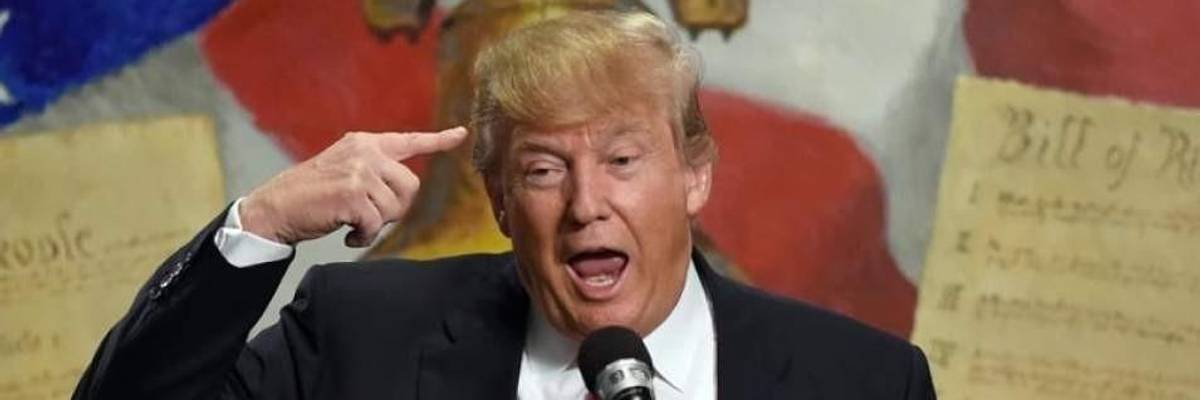
Maybe it's time we acknowledge the fact that the people whom Trump is habitually addressing with his signature, "Fuck you" is us. (Photo: AFP/Timothy A. Clary)
"Unlike the Europeans, Americans have never hated the rich, only envied them."--Gore Vidal
There was a sociology experiment conducted some years ago to illustrate "class distinctions." Of course, it's always been taken as a matter of faith that we egalitarian Americans, unlike our snooty British cousins with their monarchs and powdered wigs, take pride in being a "classless" society. While that makes for a tidy, self-aggrandizing fable, we all know it's not true.
This was the experiment. Using two cars as props--one a shiny new Cadillac, the other a rusted-out Ford station wagon with chrome missing, and broken tail light--they measured the amount of time it took for a driver to begin honking at the car in front of them when the traffic light turned green.
The results were revealing but not surprising. The experimenters found that the overwhelming majority of drivers began honking at the "poor" car almost immediately. Indeed, only a few seconds elapsed before the drivers began honking impatiently at the beat-up Ford. By contrast, the motorists waited, on average, more than twice as long before politely honking at the "rich" car.
Here is another experiment, this one a bit more open to interpretation. The venue was an informal real estate seminar. After lecturing the class (approximately 30 students) for an hour, the seminar leader passed out a quiz, and asked the class to answer the questions as best they could. She urged them not to look up the answers in their booklets, and then left the room.
During these seminars, two male students were used as props. They stood out from the rest of the class by (1) sitting in the front row, visible to all, and (2) by asking questions. In Scenario A, the student doing the asking was poorly dressed, poorly groomed, coarse, and inarticulate. In Scenario B, the student was well-groomed, well-dressed (he wore a coat and tie), handsome, and exceedingly well-spoken.
Both of the student "props" were instructed to begin leafing through the booklet, searching for answers, the moment the seminar leader left the room. The experimenters were curious to know which student, A or B, exerted the most influence on his classmates.
Maybe it's time we acknowledge the fact that the people whom Trump is habitually addressing with his signature, "Fuck you" is us. It's the American public. Not only is it us, but we were his intended target all along.
Again, the results were revealing but not entirely surprising. Whenever the unkempt Student A began openly cheating, two or three other students could be depended upon to follow suit. The results were consistent. Two or three others would began cheating as soon as they saw him do it.
But when the "refined" Student B, opened his booklet and began hunting for answers, six or seven others invariably did the same thing. The results were consistent. More than twice as many students were persuaded to cheat when they saw it being done by someone they "respected."
Granted, it's a flimsy premise, but I think the argument can be made that the dynamics illustrated in the preceding experiments go a long way toward explaining how Donald Trump got elected president. In a word, we tend to "respect" the wrong people.
An acquaintance of mine, an executive with a Fortune 200 company, told me that the reason he was voting for Trump was because Trump was so rich and independent, "he didn't have to answer to anyone." By "anyone" it was clear he meant special interest groups, the very groups that have, in his view, resulted in the paralyzing political gridlock we now witness.
Perhaps thinking it would help us bond as men, he resorted to crude locker room vernacular. He said that Donald Trump possessed what is referred to as "fuck you" money. Which is to say, Trump is so wealthy and independent, he can say, "Fuck you" to any person, organization, or country, and get away with it.
Although I haven't seen this fellow since the election, I'm curious where he stands today. While I can understand why some naive pilgrim--someone unfamiliar with Trump's bullying, lying, and near pathological insecurity--might choose to vote for a "political outsider," I cannot fathom how anyone could continue to support this preposterous man-child.
Maybe it's time we acknowledge the obvious. Maybe it's time we acknowledge the fact that the people whom Trump is habitually addressing with his signature, "Fuck you" is us. It's the American public. Not only is it us, but we were his intended target all along. Viewed solely on "degree of difficulty," it was a classic takedown.
Dear Common Dreams reader, It’s been nearly 30 years since I co-founded Common Dreams with my late wife, Lina Newhouser. We had the radical notion that journalism should serve the public good, not corporate profits. It was clear to us from the outset what it would take to build such a project. No paid advertisements. No corporate sponsors. No millionaire publisher telling us what to think or do. Many people said we wouldn't last a year, but we proved those doubters wrong. Together with a tremendous team of journalists and dedicated staff, we built an independent media outlet free from the constraints of profits and corporate control. Our mission has always been simple: To inform. To inspire. To ignite change for the common good. Building Common Dreams was not easy. Our survival was never guaranteed. When you take on the most powerful forces—Wall Street greed, fossil fuel industry destruction, Big Tech lobbyists, and uber-rich oligarchs who have spent billions upon billions rigging the economy and democracy in their favor—the only bulwark you have is supporters who believe in your work. But here’s the urgent message from me today. It's never been this bad out there. And it's never been this hard to keep us going. At the very moment Common Dreams is most needed, the threats we face are intensifying. We need your support now more than ever. We don't accept corporate advertising and never will. We don't have a paywall because we don't think people should be blocked from critical news based on their ability to pay. Everything we do is funded by the donations of readers like you. When everyone does the little they can afford, we are strong. But if that support retreats or dries up, so do we. Will you donate now to make sure Common Dreams not only survives but thrives? —Craig Brown, Co-founder |
"Unlike the Europeans, Americans have never hated the rich, only envied them."--Gore Vidal
There was a sociology experiment conducted some years ago to illustrate "class distinctions." Of course, it's always been taken as a matter of faith that we egalitarian Americans, unlike our snooty British cousins with their monarchs and powdered wigs, take pride in being a "classless" society. While that makes for a tidy, self-aggrandizing fable, we all know it's not true.
This was the experiment. Using two cars as props--one a shiny new Cadillac, the other a rusted-out Ford station wagon with chrome missing, and broken tail light--they measured the amount of time it took for a driver to begin honking at the car in front of them when the traffic light turned green.
The results were revealing but not surprising. The experimenters found that the overwhelming majority of drivers began honking at the "poor" car almost immediately. Indeed, only a few seconds elapsed before the drivers began honking impatiently at the beat-up Ford. By contrast, the motorists waited, on average, more than twice as long before politely honking at the "rich" car.
Here is another experiment, this one a bit more open to interpretation. The venue was an informal real estate seminar. After lecturing the class (approximately 30 students) for an hour, the seminar leader passed out a quiz, and asked the class to answer the questions as best they could. She urged them not to look up the answers in their booklets, and then left the room.
During these seminars, two male students were used as props. They stood out from the rest of the class by (1) sitting in the front row, visible to all, and (2) by asking questions. In Scenario A, the student doing the asking was poorly dressed, poorly groomed, coarse, and inarticulate. In Scenario B, the student was well-groomed, well-dressed (he wore a coat and tie), handsome, and exceedingly well-spoken.
Both of the student "props" were instructed to begin leafing through the booklet, searching for answers, the moment the seminar leader left the room. The experimenters were curious to know which student, A or B, exerted the most influence on his classmates.
Maybe it's time we acknowledge the fact that the people whom Trump is habitually addressing with his signature, "Fuck you" is us. It's the American public. Not only is it us, but we were his intended target all along.
Again, the results were revealing but not entirely surprising. Whenever the unkempt Student A began openly cheating, two or three other students could be depended upon to follow suit. The results were consistent. Two or three others would began cheating as soon as they saw him do it.
But when the "refined" Student B, opened his booklet and began hunting for answers, six or seven others invariably did the same thing. The results were consistent. More than twice as many students were persuaded to cheat when they saw it being done by someone they "respected."
Granted, it's a flimsy premise, but I think the argument can be made that the dynamics illustrated in the preceding experiments go a long way toward explaining how Donald Trump got elected president. In a word, we tend to "respect" the wrong people.
An acquaintance of mine, an executive with a Fortune 200 company, told me that the reason he was voting for Trump was because Trump was so rich and independent, "he didn't have to answer to anyone." By "anyone" it was clear he meant special interest groups, the very groups that have, in his view, resulted in the paralyzing political gridlock we now witness.
Perhaps thinking it would help us bond as men, he resorted to crude locker room vernacular. He said that Donald Trump possessed what is referred to as "fuck you" money. Which is to say, Trump is so wealthy and independent, he can say, "Fuck you" to any person, organization, or country, and get away with it.
Although I haven't seen this fellow since the election, I'm curious where he stands today. While I can understand why some naive pilgrim--someone unfamiliar with Trump's bullying, lying, and near pathological insecurity--might choose to vote for a "political outsider," I cannot fathom how anyone could continue to support this preposterous man-child.
Maybe it's time we acknowledge the obvious. Maybe it's time we acknowledge the fact that the people whom Trump is habitually addressing with his signature, "Fuck you" is us. It's the American public. Not only is it us, but we were his intended target all along. Viewed solely on "degree of difficulty," it was a classic takedown.
"Unlike the Europeans, Americans have never hated the rich, only envied them."--Gore Vidal
There was a sociology experiment conducted some years ago to illustrate "class distinctions." Of course, it's always been taken as a matter of faith that we egalitarian Americans, unlike our snooty British cousins with their monarchs and powdered wigs, take pride in being a "classless" society. While that makes for a tidy, self-aggrandizing fable, we all know it's not true.
This was the experiment. Using two cars as props--one a shiny new Cadillac, the other a rusted-out Ford station wagon with chrome missing, and broken tail light--they measured the amount of time it took for a driver to begin honking at the car in front of them when the traffic light turned green.
The results were revealing but not surprising. The experimenters found that the overwhelming majority of drivers began honking at the "poor" car almost immediately. Indeed, only a few seconds elapsed before the drivers began honking impatiently at the beat-up Ford. By contrast, the motorists waited, on average, more than twice as long before politely honking at the "rich" car.
Here is another experiment, this one a bit more open to interpretation. The venue was an informal real estate seminar. After lecturing the class (approximately 30 students) for an hour, the seminar leader passed out a quiz, and asked the class to answer the questions as best they could. She urged them not to look up the answers in their booklets, and then left the room.
During these seminars, two male students were used as props. They stood out from the rest of the class by (1) sitting in the front row, visible to all, and (2) by asking questions. In Scenario A, the student doing the asking was poorly dressed, poorly groomed, coarse, and inarticulate. In Scenario B, the student was well-groomed, well-dressed (he wore a coat and tie), handsome, and exceedingly well-spoken.
Both of the student "props" were instructed to begin leafing through the booklet, searching for answers, the moment the seminar leader left the room. The experimenters were curious to know which student, A or B, exerted the most influence on his classmates.
Maybe it's time we acknowledge the fact that the people whom Trump is habitually addressing with his signature, "Fuck you" is us. It's the American public. Not only is it us, but we were his intended target all along.
Again, the results were revealing but not entirely surprising. Whenever the unkempt Student A began openly cheating, two or three other students could be depended upon to follow suit. The results were consistent. Two or three others would began cheating as soon as they saw him do it.
But when the "refined" Student B, opened his booklet and began hunting for answers, six or seven others invariably did the same thing. The results were consistent. More than twice as many students were persuaded to cheat when they saw it being done by someone they "respected."
Granted, it's a flimsy premise, but I think the argument can be made that the dynamics illustrated in the preceding experiments go a long way toward explaining how Donald Trump got elected president. In a word, we tend to "respect" the wrong people.
An acquaintance of mine, an executive with a Fortune 200 company, told me that the reason he was voting for Trump was because Trump was so rich and independent, "he didn't have to answer to anyone." By "anyone" it was clear he meant special interest groups, the very groups that have, in his view, resulted in the paralyzing political gridlock we now witness.
Perhaps thinking it would help us bond as men, he resorted to crude locker room vernacular. He said that Donald Trump possessed what is referred to as "fuck you" money. Which is to say, Trump is so wealthy and independent, he can say, "Fuck you" to any person, organization, or country, and get away with it.
Although I haven't seen this fellow since the election, I'm curious where he stands today. While I can understand why some naive pilgrim--someone unfamiliar with Trump's bullying, lying, and near pathological insecurity--might choose to vote for a "political outsider," I cannot fathom how anyone could continue to support this preposterous man-child.
Maybe it's time we acknowledge the obvious. Maybe it's time we acknowledge the fact that the people whom Trump is habitually addressing with his signature, "Fuck you" is us. It's the American public. Not only is it us, but we were his intended target all along. Viewed solely on "degree of difficulty," it was a classic takedown.