SUBSCRIBE TO OUR FREE NEWSLETTER
Daily news & progressive opinion—funded by the people, not the corporations—delivered straight to your inbox.
5
#000000
#FFFFFF
To donate by check, phone, or other method, see our More Ways to Give page.
Daily news & progressive opinion—funded by the people, not the corporations—delivered straight to your inbox.
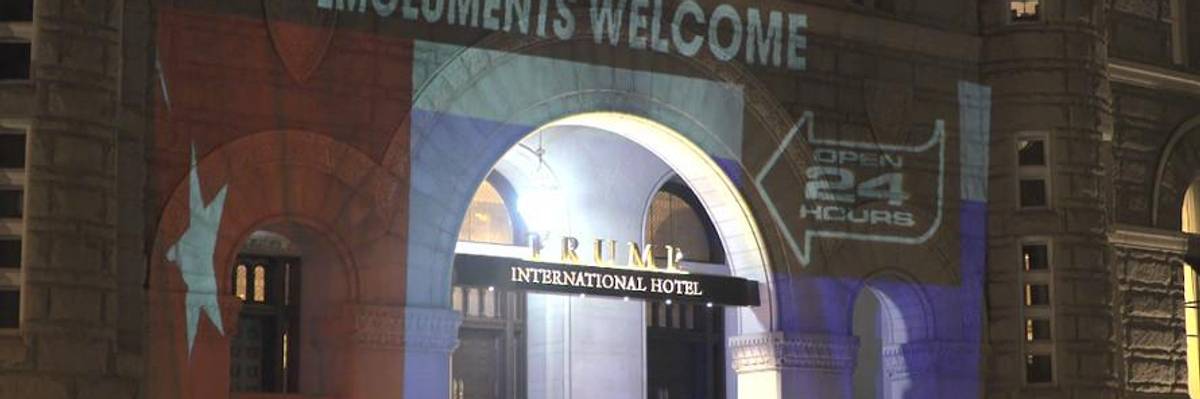
Artist and activist Robin Bell projected the words "Emoluments Welcome" on the facade of the Trump International Hotel in Washington in May 2017.(Photo: Robin Bell)
Conservatives, we are constantly told, believe in strict adherence to the Constitution based primarily on the text and secondarily on the views of the Founding Fathers. If conservatives really were "originalists," they would be the first to say that Donald Trump is exactly the kind of president who ought to be impeached.
Unique among presidents, Trump has divided loyalties. He has entangled his business interests with his official duties, creating the impression, if not the reality, that his own financial interest -- not his duty as president -- guides his thoughts and actions
The Founding Fathers, savvy students of history and human nature, were highly attuned to the risks of public corruption -- actual or perceived -- and inserted language into the Articles of Confederation and later into the Constitution to guard against such human frailties. They wanted to make sure that anyone who held a public office would serve only one master: the American people.
For the Founders, public corruption wasn't just a theoretical danger. They viewed it as the primary threat to their independence. Living in a small, fledgling country, the Americans feared that the European powers would seize control of the American democracy by flattering and bribing our officials.
The kings and princes of Europe were masters of the art. The British king had corrupted Parliament by providing titles and sinecures, a major contributor to the split between the colonies and Britain. The true history of the 1670 Treaty of Dover had just been published, which revealed that King Louis XIV of France had bribed Charles II of England with a secret pension, a beautiful and beloved French mistress, and a promise of protection. In exchange, Charles had agreed to convert to Catholicism and to join Louis in his costly and fruitless war against the Dutch, his former ally.
It seems the Founding Fathers had Donald Trump (or someone very like him) in mind when they wrote those clauses into the Constitution. They were concerned about our government officials being corrupted by foreign or domestic powers. Alexander Hamilton argued in Federalist Paper #73 that the domestic emoluments clause was designed to keep the president independent and incorruptible.
"In the main," Hamilton argued, "it will be found that a power over a man's support is power over his will."
With the emolument ban in place, "they can neither weaken his fortitude by operating on his necessities, nor corrupt his integrity by appealing to his avarice," Hamilton wrote.
The key passage in the Constitution is Article I, Section 9: "No Title of Nobility shall be granted by the United States: And no Person holding any Office of Profit or Trust under them, shall, without the Consent of the Congress, accept of any present, Emolument, Office, or Title, of any kind whatever, from any King, Prince, or foreign State."
The point of this clause is to prevent any foreign power from gaining influence over the U.S. government by providing gifts, titles, jobs or other benefits to its officials.
Article II, Section 1 specifically limits the president and does not allow Congress to approve exceptions: "The President shall, at stated Times, receive for his Services, a Compensation, which shall neither be encreased nor diminished during the Period for which he shall have been elected, and he shall not receive within that Period any other Emolument from the United States, or any of them."
The point of this clause is to prevent the Congress or any of the states from gaining undue influence over the president by lining his pockets.
Note that these prohibitions don't require a legal finding of bribery. The Constitution doesn't say payments are OK as long as there's no quid pro quo. Such "emoluments" are unconstitutional, full stop.
Trump has been hit with lawsuits alleging that he is violating those two constitutional provisions. One of the lawsuits is moving forward, bad news for this utterly corrupt administration.
The facts of the case are clear: Foreign and state officials do patronize his businesses with the express purpose of currying his favor (also known as "stay to play"). Trump is soliciting business from foreign officials and U.S. politicians. The emoluments he receives from them is significant and important to his business. Congress has not been asked for its consent, nor has it been granted. State government officials have also patronized his hotel. The federal government has also granted Trump an "advantage" by approving the continuation of the lease for his hotel at the Old Post Office despite the clear wording in the lease that "no elected official" shall benefit from it.
The only real point of dispute between Trump's defenders and his critics is over the meaning of the word "emolument." Trump's lawyers say "emolument" means only the money that is earned for holding an office (and not for renting a room or granting a lease). His critics say "emolument" means any profit, advantage, gain or benefit.
Recently, Federal District Judge Peter J. Messitte sided with Trump's critics as to the legal meaning of "emoluments," and ruled that a lawsuit alleging violations of the emolument clauses could proceed.
It's interesting that Messitte's ruling relies heavily (but not exclusively) on an "originalist" approach. He notes in his opinion that the preponderance of the evidence shows that the common meaning in 1787 of the word "emolument" was any "profit," "gain" or "advantage." Nearly all dictionaries of the day followed this definition, and many authors and politicians at that time also used that definition. Trump's alternative definition has almost no contemporaneous support, the judge ruled.
Messitte's ruling may be overturned, of course. There is considerable pressure on Republican office holders, as well as conservative jurists, to ignore the stench of corruption stemming from Trump's ownership of a large and complex business that does business with governments near and far.
The Founding Fathers could well imagine that a foreign or domestic power would try to corrupt the president. But they could not imagine that the constitutional system they created would ever permit the president to corrupt the Congress or the courts. Let's hope they weren't wrong about us.
Edmund Randolph, governor of Virginia, delegate to the Philadelphia convention and first attorney general of the United States, said during the ratification debate that the president "is restrained from receiving any present or emolument whatever. It is impossible to guard better against corruption."
And if the president does so, "he may be impeached," Randolph declared with no reservations.
The Founding Fathers, in other words, would have impeached Trump in a New York minute.
Dear Common Dreams reader, It’s been nearly 30 years since I co-founded Common Dreams with my late wife, Lina Newhouser. We had the radical notion that journalism should serve the public good, not corporate profits. It was clear to us from the outset what it would take to build such a project. No paid advertisements. No corporate sponsors. No millionaire publisher telling us what to think or do. Many people said we wouldn't last a year, but we proved those doubters wrong. Together with a tremendous team of journalists and dedicated staff, we built an independent media outlet free from the constraints of profits and corporate control. Our mission has always been simple: To inform. To inspire. To ignite change for the common good. Building Common Dreams was not easy. Our survival was never guaranteed. When you take on the most powerful forces—Wall Street greed, fossil fuel industry destruction, Big Tech lobbyists, and uber-rich oligarchs who have spent billions upon billions rigging the economy and democracy in their favor—the only bulwark you have is supporters who believe in your work. But here’s the urgent message from me today. It's never been this bad out there. And it's never been this hard to keep us going. At the very moment Common Dreams is most needed, the threats we face are intensifying. We need your support now more than ever. We don't accept corporate advertising and never will. We don't have a paywall because we don't think people should be blocked from critical news based on their ability to pay. Everything we do is funded by the donations of readers like you. When everyone does the little they can afford, we are strong. But if that support retreats or dries up, so do we. Will you donate now to make sure Common Dreams not only survives but thrives? —Craig Brown, Co-founder |
Conservatives, we are constantly told, believe in strict adherence to the Constitution based primarily on the text and secondarily on the views of the Founding Fathers. If conservatives really were "originalists," they would be the first to say that Donald Trump is exactly the kind of president who ought to be impeached.
Unique among presidents, Trump has divided loyalties. He has entangled his business interests with his official duties, creating the impression, if not the reality, that his own financial interest -- not his duty as president -- guides his thoughts and actions
The Founding Fathers, savvy students of history and human nature, were highly attuned to the risks of public corruption -- actual or perceived -- and inserted language into the Articles of Confederation and later into the Constitution to guard against such human frailties. They wanted to make sure that anyone who held a public office would serve only one master: the American people.
For the Founders, public corruption wasn't just a theoretical danger. They viewed it as the primary threat to their independence. Living in a small, fledgling country, the Americans feared that the European powers would seize control of the American democracy by flattering and bribing our officials.
The kings and princes of Europe were masters of the art. The British king had corrupted Parliament by providing titles and sinecures, a major contributor to the split between the colonies and Britain. The true history of the 1670 Treaty of Dover had just been published, which revealed that King Louis XIV of France had bribed Charles II of England with a secret pension, a beautiful and beloved French mistress, and a promise of protection. In exchange, Charles had agreed to convert to Catholicism and to join Louis in his costly and fruitless war against the Dutch, his former ally.
It seems the Founding Fathers had Donald Trump (or someone very like him) in mind when they wrote those clauses into the Constitution. They were concerned about our government officials being corrupted by foreign or domestic powers. Alexander Hamilton argued in Federalist Paper #73 that the domestic emoluments clause was designed to keep the president independent and incorruptible.
"In the main," Hamilton argued, "it will be found that a power over a man's support is power over his will."
With the emolument ban in place, "they can neither weaken his fortitude by operating on his necessities, nor corrupt his integrity by appealing to his avarice," Hamilton wrote.
The key passage in the Constitution is Article I, Section 9: "No Title of Nobility shall be granted by the United States: And no Person holding any Office of Profit or Trust under them, shall, without the Consent of the Congress, accept of any present, Emolument, Office, or Title, of any kind whatever, from any King, Prince, or foreign State."
The point of this clause is to prevent any foreign power from gaining influence over the U.S. government by providing gifts, titles, jobs or other benefits to its officials.
Article II, Section 1 specifically limits the president and does not allow Congress to approve exceptions: "The President shall, at stated Times, receive for his Services, a Compensation, which shall neither be encreased nor diminished during the Period for which he shall have been elected, and he shall not receive within that Period any other Emolument from the United States, or any of them."
The point of this clause is to prevent the Congress or any of the states from gaining undue influence over the president by lining his pockets.
Note that these prohibitions don't require a legal finding of bribery. The Constitution doesn't say payments are OK as long as there's no quid pro quo. Such "emoluments" are unconstitutional, full stop.
Trump has been hit with lawsuits alleging that he is violating those two constitutional provisions. One of the lawsuits is moving forward, bad news for this utterly corrupt administration.
The facts of the case are clear: Foreign and state officials do patronize his businesses with the express purpose of currying his favor (also known as "stay to play"). Trump is soliciting business from foreign officials and U.S. politicians. The emoluments he receives from them is significant and important to his business. Congress has not been asked for its consent, nor has it been granted. State government officials have also patronized his hotel. The federal government has also granted Trump an "advantage" by approving the continuation of the lease for his hotel at the Old Post Office despite the clear wording in the lease that "no elected official" shall benefit from it.
The only real point of dispute between Trump's defenders and his critics is over the meaning of the word "emolument." Trump's lawyers say "emolument" means only the money that is earned for holding an office (and not for renting a room or granting a lease). His critics say "emolument" means any profit, advantage, gain or benefit.
Recently, Federal District Judge Peter J. Messitte sided with Trump's critics as to the legal meaning of "emoluments," and ruled that a lawsuit alleging violations of the emolument clauses could proceed.
It's interesting that Messitte's ruling relies heavily (but not exclusively) on an "originalist" approach. He notes in his opinion that the preponderance of the evidence shows that the common meaning in 1787 of the word "emolument" was any "profit," "gain" or "advantage." Nearly all dictionaries of the day followed this definition, and many authors and politicians at that time also used that definition. Trump's alternative definition has almost no contemporaneous support, the judge ruled.
Messitte's ruling may be overturned, of course. There is considerable pressure on Republican office holders, as well as conservative jurists, to ignore the stench of corruption stemming from Trump's ownership of a large and complex business that does business with governments near and far.
The Founding Fathers could well imagine that a foreign or domestic power would try to corrupt the president. But they could not imagine that the constitutional system they created would ever permit the president to corrupt the Congress or the courts. Let's hope they weren't wrong about us.
Edmund Randolph, governor of Virginia, delegate to the Philadelphia convention and first attorney general of the United States, said during the ratification debate that the president "is restrained from receiving any present or emolument whatever. It is impossible to guard better against corruption."
And if the president does so, "he may be impeached," Randolph declared with no reservations.
The Founding Fathers, in other words, would have impeached Trump in a New York minute.
Conservatives, we are constantly told, believe in strict adherence to the Constitution based primarily on the text and secondarily on the views of the Founding Fathers. If conservatives really were "originalists," they would be the first to say that Donald Trump is exactly the kind of president who ought to be impeached.
Unique among presidents, Trump has divided loyalties. He has entangled his business interests with his official duties, creating the impression, if not the reality, that his own financial interest -- not his duty as president -- guides his thoughts and actions
The Founding Fathers, savvy students of history and human nature, were highly attuned to the risks of public corruption -- actual or perceived -- and inserted language into the Articles of Confederation and later into the Constitution to guard against such human frailties. They wanted to make sure that anyone who held a public office would serve only one master: the American people.
For the Founders, public corruption wasn't just a theoretical danger. They viewed it as the primary threat to their independence. Living in a small, fledgling country, the Americans feared that the European powers would seize control of the American democracy by flattering and bribing our officials.
The kings and princes of Europe were masters of the art. The British king had corrupted Parliament by providing titles and sinecures, a major contributor to the split between the colonies and Britain. The true history of the 1670 Treaty of Dover had just been published, which revealed that King Louis XIV of France had bribed Charles II of England with a secret pension, a beautiful and beloved French mistress, and a promise of protection. In exchange, Charles had agreed to convert to Catholicism and to join Louis in his costly and fruitless war against the Dutch, his former ally.
It seems the Founding Fathers had Donald Trump (or someone very like him) in mind when they wrote those clauses into the Constitution. They were concerned about our government officials being corrupted by foreign or domestic powers. Alexander Hamilton argued in Federalist Paper #73 that the domestic emoluments clause was designed to keep the president independent and incorruptible.
"In the main," Hamilton argued, "it will be found that a power over a man's support is power over his will."
With the emolument ban in place, "they can neither weaken his fortitude by operating on his necessities, nor corrupt his integrity by appealing to his avarice," Hamilton wrote.
The key passage in the Constitution is Article I, Section 9: "No Title of Nobility shall be granted by the United States: And no Person holding any Office of Profit or Trust under them, shall, without the Consent of the Congress, accept of any present, Emolument, Office, or Title, of any kind whatever, from any King, Prince, or foreign State."
The point of this clause is to prevent any foreign power from gaining influence over the U.S. government by providing gifts, titles, jobs or other benefits to its officials.
Article II, Section 1 specifically limits the president and does not allow Congress to approve exceptions: "The President shall, at stated Times, receive for his Services, a Compensation, which shall neither be encreased nor diminished during the Period for which he shall have been elected, and he shall not receive within that Period any other Emolument from the United States, or any of them."
The point of this clause is to prevent the Congress or any of the states from gaining undue influence over the president by lining his pockets.
Note that these prohibitions don't require a legal finding of bribery. The Constitution doesn't say payments are OK as long as there's no quid pro quo. Such "emoluments" are unconstitutional, full stop.
Trump has been hit with lawsuits alleging that he is violating those two constitutional provisions. One of the lawsuits is moving forward, bad news for this utterly corrupt administration.
The facts of the case are clear: Foreign and state officials do patronize his businesses with the express purpose of currying his favor (also known as "stay to play"). Trump is soliciting business from foreign officials and U.S. politicians. The emoluments he receives from them is significant and important to his business. Congress has not been asked for its consent, nor has it been granted. State government officials have also patronized his hotel. The federal government has also granted Trump an "advantage" by approving the continuation of the lease for his hotel at the Old Post Office despite the clear wording in the lease that "no elected official" shall benefit from it.
The only real point of dispute between Trump's defenders and his critics is over the meaning of the word "emolument." Trump's lawyers say "emolument" means only the money that is earned for holding an office (and not for renting a room or granting a lease). His critics say "emolument" means any profit, advantage, gain or benefit.
Recently, Federal District Judge Peter J. Messitte sided with Trump's critics as to the legal meaning of "emoluments," and ruled that a lawsuit alleging violations of the emolument clauses could proceed.
It's interesting that Messitte's ruling relies heavily (but not exclusively) on an "originalist" approach. He notes in his opinion that the preponderance of the evidence shows that the common meaning in 1787 of the word "emolument" was any "profit," "gain" or "advantage." Nearly all dictionaries of the day followed this definition, and many authors and politicians at that time also used that definition. Trump's alternative definition has almost no contemporaneous support, the judge ruled.
Messitte's ruling may be overturned, of course. There is considerable pressure on Republican office holders, as well as conservative jurists, to ignore the stench of corruption stemming from Trump's ownership of a large and complex business that does business with governments near and far.
The Founding Fathers could well imagine that a foreign or domestic power would try to corrupt the president. But they could not imagine that the constitutional system they created would ever permit the president to corrupt the Congress or the courts. Let's hope they weren't wrong about us.
Edmund Randolph, governor of Virginia, delegate to the Philadelphia convention and first attorney general of the United States, said during the ratification debate that the president "is restrained from receiving any present or emolument whatever. It is impossible to guard better against corruption."
And if the president does so, "he may be impeached," Randolph declared with no reservations.
The Founding Fathers, in other words, would have impeached Trump in a New York minute.