SUBSCRIBE TO OUR FREE NEWSLETTER
Daily news & progressive opinion—funded by the people, not the corporations—delivered straight to your inbox.
5
#000000
#FFFFFF
To donate by check, phone, or other method, see our More Ways to Give page.
Daily news & progressive opinion—funded by the people, not the corporations—delivered straight to your inbox.
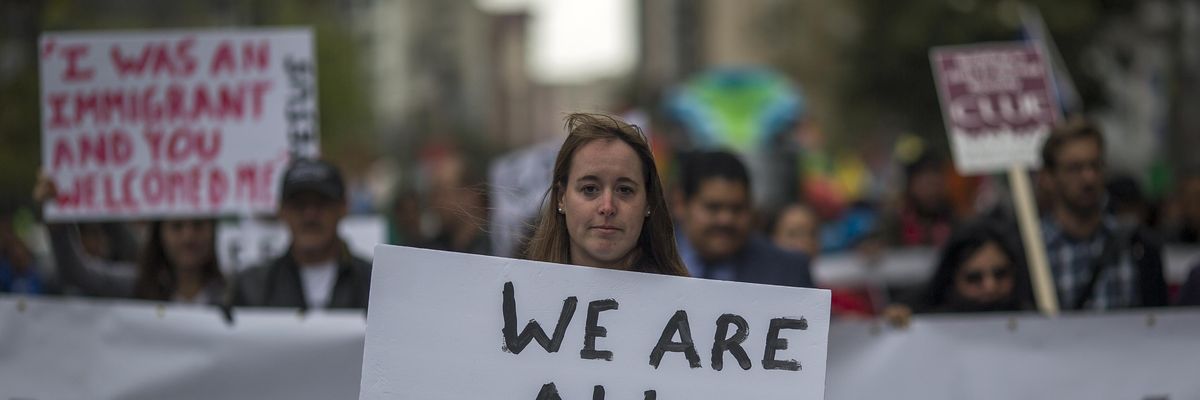
People march and rally on May Day, on May 1, 2018 in Los Angeles, California. Numerous May Day, or International Workers Day, marches are taking place in the greater Los Angeles area, and in cities across the nation. (Photo: David McNew/Getty Images)
Clara spends her days cleaning Miami office buildings on her hands and knees. Most days her back screams with pain, but the 47-year-old mother of a teenage son keeps working. She knows that her family depends on the union wages and benefits that she brings home. While Clara worries about her son getting into college and whether her car will make it to work, she does not have to worry that her employer will steal her wages, that she will lose her job for reporting sexual harassment, or that she could have her hours cut due to favoritism or prejudice.
That's because she has a union job that provides protection against the worst abuses many immigrant workers face. Clara and 400 of her Miami co-workers fought to join their union, 32BJ of the Service Employees International Union, even though it entailed a 17-day hunger strike.
Immigrant workers like Clara and the unions that protect them face unprecedented attacks under the Trump administration. The Janus Supreme Court decision, which upended decades of precedent in order to cripple unions, adds to the threats confronting immigrant workers who are already grappling with the horrors of family separations and mass deportations. As so many institutions have failed or outright scapegoated them--including Congress, the White House, their employers, local law enforcement, and ICE--immigrant workers have come to rely more than ever on unions and grassroots organizations to protect the few rights they cling to.
Unions like 32BJ, which represents tens of thousands of building-service workers, many of them immigrants, up and down the East Coast, and organizations like United We Dream, which represents hundreds of thousands of Dreamers, understand all too well the double jeopardy in which President Trump and the Supreme Court have placed immigrant workers. We know that when Trump killed the Deferred Action for Childhood Arrivals (DACA) program and Temporary Protected Status (TPS) for immigrants from many countries, he not only put more than one million people at risk of deportation, he also took away their ability to work, provide for their families, and live a life of dignity out of the shadows. We know that Supreme Court decisions have weakened workers' rights to class-action lawsuits, even as the administration has issued a number of anti-union executive orders and stacked the National Labor Relations Board with anti-worker members.
American labor has always been a movement in which immigrants, often in the most thankless and dangerous jobs, have played leading roles--often stopping the race to the bottom that employers entered them in. The young immigrant women who worked in the clothing and garment industries of New York and other cities in the early 20th century--not least, those who died in the Triangle Shirtwaist Fire--paved the way for the reforms that led in time to the New Deal, minimum-wage laws, the eight-hour day, and the weekend.
In more recent times, from the grape strikes of the 1960s to the Justice for Janitors movement of the past quarter-century, immigrant workers have made significant gains by organizing into unions. The momentum keeps growing. Most recently, immigrant airport workers in New York have joined with 32BJ SEIU and are on a path to an historic wage raise to $19 that benefits all workers, immigrants and non-immigrants alike. The same drive and fortitude that led these immigrant workers to risk everything for a better life for their family by coming here led them on a path to a wage raise that was unimaginable just a decade ago.
The organizing among immigrant workers continues. There is hope that we can stem the tide that threatens our core American values. We're seeing inspiring popular movements spreading like wildfire, new allies speaking up, and political leaders who are willing to tell the truth and stand for justice.
The Trump administration has waged war on the values that most Americans share: that hard work should be honored, that justice is for all, and that human dignity comes before political ideology and profit, and families belong together. We must resist the attacks on the most vulnerable among us--and the organizations that protect them--in order to truly live up to the promise of America.
Dear Common Dreams reader, It’s been nearly 30 years since I co-founded Common Dreams with my late wife, Lina Newhouser. We had the radical notion that journalism should serve the public good, not corporate profits. It was clear to us from the outset what it would take to build such a project. No paid advertisements. No corporate sponsors. No millionaire publisher telling us what to think or do. Many people said we wouldn't last a year, but we proved those doubters wrong. Together with a tremendous team of journalists and dedicated staff, we built an independent media outlet free from the constraints of profits and corporate control. Our mission has always been simple: To inform. To inspire. To ignite change for the common good. Building Common Dreams was not easy. Our survival was never guaranteed. When you take on the most powerful forces—Wall Street greed, fossil fuel industry destruction, Big Tech lobbyists, and uber-rich oligarchs who have spent billions upon billions rigging the economy and democracy in their favor—the only bulwark you have is supporters who believe in your work. But here’s the urgent message from me today. It's never been this bad out there. And it's never been this hard to keep us going. At the very moment Common Dreams is most needed, the threats we face are intensifying. We need your support now more than ever. We don't accept corporate advertising and never will. We don't have a paywall because we don't think people should be blocked from critical news based on their ability to pay. Everything we do is funded by the donations of readers like you. When everyone does the little they can afford, we are strong. But if that support retreats or dries up, so do we. Will you donate now to make sure Common Dreams not only survives but thrives? —Craig Brown, Co-founder |
Clara spends her days cleaning Miami office buildings on her hands and knees. Most days her back screams with pain, but the 47-year-old mother of a teenage son keeps working. She knows that her family depends on the union wages and benefits that she brings home. While Clara worries about her son getting into college and whether her car will make it to work, she does not have to worry that her employer will steal her wages, that she will lose her job for reporting sexual harassment, or that she could have her hours cut due to favoritism or prejudice.
That's because she has a union job that provides protection against the worst abuses many immigrant workers face. Clara and 400 of her Miami co-workers fought to join their union, 32BJ of the Service Employees International Union, even though it entailed a 17-day hunger strike.
Immigrant workers like Clara and the unions that protect them face unprecedented attacks under the Trump administration. The Janus Supreme Court decision, which upended decades of precedent in order to cripple unions, adds to the threats confronting immigrant workers who are already grappling with the horrors of family separations and mass deportations. As so many institutions have failed or outright scapegoated them--including Congress, the White House, their employers, local law enforcement, and ICE--immigrant workers have come to rely more than ever on unions and grassroots organizations to protect the few rights they cling to.
Unions like 32BJ, which represents tens of thousands of building-service workers, many of them immigrants, up and down the East Coast, and organizations like United We Dream, which represents hundreds of thousands of Dreamers, understand all too well the double jeopardy in which President Trump and the Supreme Court have placed immigrant workers. We know that when Trump killed the Deferred Action for Childhood Arrivals (DACA) program and Temporary Protected Status (TPS) for immigrants from many countries, he not only put more than one million people at risk of deportation, he also took away their ability to work, provide for their families, and live a life of dignity out of the shadows. We know that Supreme Court decisions have weakened workers' rights to class-action lawsuits, even as the administration has issued a number of anti-union executive orders and stacked the National Labor Relations Board with anti-worker members.
American labor has always been a movement in which immigrants, often in the most thankless and dangerous jobs, have played leading roles--often stopping the race to the bottom that employers entered them in. The young immigrant women who worked in the clothing and garment industries of New York and other cities in the early 20th century--not least, those who died in the Triangle Shirtwaist Fire--paved the way for the reforms that led in time to the New Deal, minimum-wage laws, the eight-hour day, and the weekend.
In more recent times, from the grape strikes of the 1960s to the Justice for Janitors movement of the past quarter-century, immigrant workers have made significant gains by organizing into unions. The momentum keeps growing. Most recently, immigrant airport workers in New York have joined with 32BJ SEIU and are on a path to an historic wage raise to $19 that benefits all workers, immigrants and non-immigrants alike. The same drive and fortitude that led these immigrant workers to risk everything for a better life for their family by coming here led them on a path to a wage raise that was unimaginable just a decade ago.
The organizing among immigrant workers continues. There is hope that we can stem the tide that threatens our core American values. We're seeing inspiring popular movements spreading like wildfire, new allies speaking up, and political leaders who are willing to tell the truth and stand for justice.
The Trump administration has waged war on the values that most Americans share: that hard work should be honored, that justice is for all, and that human dignity comes before political ideology and profit, and families belong together. We must resist the attacks on the most vulnerable among us--and the organizations that protect them--in order to truly live up to the promise of America.
Clara spends her days cleaning Miami office buildings on her hands and knees. Most days her back screams with pain, but the 47-year-old mother of a teenage son keeps working. She knows that her family depends on the union wages and benefits that she brings home. While Clara worries about her son getting into college and whether her car will make it to work, she does not have to worry that her employer will steal her wages, that she will lose her job for reporting sexual harassment, or that she could have her hours cut due to favoritism or prejudice.
That's because she has a union job that provides protection against the worst abuses many immigrant workers face. Clara and 400 of her Miami co-workers fought to join their union, 32BJ of the Service Employees International Union, even though it entailed a 17-day hunger strike.
Immigrant workers like Clara and the unions that protect them face unprecedented attacks under the Trump administration. The Janus Supreme Court decision, which upended decades of precedent in order to cripple unions, adds to the threats confronting immigrant workers who are already grappling with the horrors of family separations and mass deportations. As so many institutions have failed or outright scapegoated them--including Congress, the White House, their employers, local law enforcement, and ICE--immigrant workers have come to rely more than ever on unions and grassroots organizations to protect the few rights they cling to.
Unions like 32BJ, which represents tens of thousands of building-service workers, many of them immigrants, up and down the East Coast, and organizations like United We Dream, which represents hundreds of thousands of Dreamers, understand all too well the double jeopardy in which President Trump and the Supreme Court have placed immigrant workers. We know that when Trump killed the Deferred Action for Childhood Arrivals (DACA) program and Temporary Protected Status (TPS) for immigrants from many countries, he not only put more than one million people at risk of deportation, he also took away their ability to work, provide for their families, and live a life of dignity out of the shadows. We know that Supreme Court decisions have weakened workers' rights to class-action lawsuits, even as the administration has issued a number of anti-union executive orders and stacked the National Labor Relations Board with anti-worker members.
American labor has always been a movement in which immigrants, often in the most thankless and dangerous jobs, have played leading roles--often stopping the race to the bottom that employers entered them in. The young immigrant women who worked in the clothing and garment industries of New York and other cities in the early 20th century--not least, those who died in the Triangle Shirtwaist Fire--paved the way for the reforms that led in time to the New Deal, minimum-wage laws, the eight-hour day, and the weekend.
In more recent times, from the grape strikes of the 1960s to the Justice for Janitors movement of the past quarter-century, immigrant workers have made significant gains by organizing into unions. The momentum keeps growing. Most recently, immigrant airport workers in New York have joined with 32BJ SEIU and are on a path to an historic wage raise to $19 that benefits all workers, immigrants and non-immigrants alike. The same drive and fortitude that led these immigrant workers to risk everything for a better life for their family by coming here led them on a path to a wage raise that was unimaginable just a decade ago.
The organizing among immigrant workers continues. There is hope that we can stem the tide that threatens our core American values. We're seeing inspiring popular movements spreading like wildfire, new allies speaking up, and political leaders who are willing to tell the truth and stand for justice.
The Trump administration has waged war on the values that most Americans share: that hard work should be honored, that justice is for all, and that human dignity comes before political ideology and profit, and families belong together. We must resist the attacks on the most vulnerable among us--and the organizations that protect them--in order to truly live up to the promise of America.