SUBSCRIBE TO OUR FREE NEWSLETTER
Daily news & progressive opinion—funded by the people, not the corporations—delivered straight to your inbox.
5
#000000
#FFFFFF
To donate by check, phone, or other method, see our More Ways to Give page.
Daily news & progressive opinion—funded by the people, not the corporations—delivered straight to your inbox.
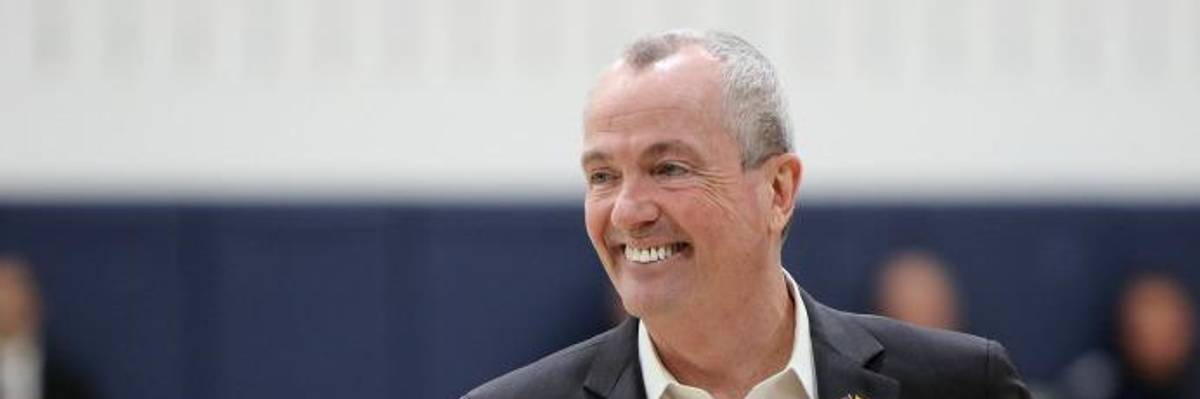
New Jersey Gov. Phil Murphy holds a town hall at Paramus High School on March 14, 2018. (Photo: Governor's Office/ OIT)
In an era of "alternative facts" and absurd promises about huge tax cuts for the wealthy paying for themselves, it's refreshing to encounter an elected representative who is willing to speak a simple truth: You get the government you pay for.
New Jersey Gov. Phil Murphy is battling his Democratic colleagues in the state legislature over this very premise. The legislature is hesitating on Murphy's proposal for a millionaire tax hike, restoring the sales tax to a pre-Gov. Chris Christie rate of 7 percent, and an end to budget gimmicks that made his predecessor's fiscal plans seem more responsible than they were. At stake are investments in public education, transit, affordable child care, and other pillars of economic security. The showdown couldn't be more relevant for antipoverty advocates or anyone interested in a more equitable economy.
The governor's argument is simple: Lawmakers are constitutionally obligated to balance the state budget. If New Jersey residents want to make these fundamental investments--and they do--there must be adequate and sustainable revenues.
So straightforward, and yet ...
Many lawmakers still don't want to raise taxes on the wealthy, in part because they fear it will cause those residents to relocate. However, research shows that millionaires are less likely to leave a state than middle- and working-class families, and tax hikes on wealthy residents have a negligible impact on their moves out of state. Additionally, despite overwhelming popular support for asking the wealthy to pay their fair share, too many Democratic elected officials still worry that they will pay a political price for raising taxes.
But if you don't raise taxes on the wealthy, you're left with ... budget gimmicks. You end up using one-time revenue sources such as draining funds that were earmarked for the Clean Energy Fund, or fuzzy math instead of transparent accounting. People deserve a government that plans for the long-term funding of its core functions and obligations, instead of one that reels from budget crisis to budget crisis, leaving constituents uncertain at best or pessimistic. People also respect a politician who is honest about the trade-offs and implications of budget decisions.
In the case of this budget fight, the stakes couldn't be more clear: New Jersey's millionaires just got an average federal tax cut of $21,700 courtesy of the Trump Tax Scam. In contrast, in the 8 years leading up to Murphy's election, his predecessor cut $9 billion from public schools, which resulted in axing academic and extracurricular programs, teacher layoffs, and increased property taxes for working-class and middle-class families. If the choice is between protecting New Jersey millionaires from a negligible tax increase or restoring funds for public education, health care, transit, and other basic needs, there is a clear answer that is good politics and smart policy.
Despite low national unemployment, people are still rightfully worried about their own family's ability to afford necessities like health care or save for a future home or college education. And while there is positive GDP growth, people know that the rich are getting richer while the rest of us aren't--nearly half of Americans can't afford an unexpected $400 expense. If advocates, policymakers, elected officials, and others want to connect with the American people and address their economic struggles, they need to be straightforward in their message and forward-looking in their policies. Rather than protecting millionaires due to unwarranted fears about a political price, let's be clear about what it will take to fund the government that the people want and deserve.
Dear Common Dreams reader, It’s been nearly 30 years since I co-founded Common Dreams with my late wife, Lina Newhouser. We had the radical notion that journalism should serve the public good, not corporate profits. It was clear to us from the outset what it would take to build such a project. No paid advertisements. No corporate sponsors. No millionaire publisher telling us what to think or do. Many people said we wouldn't last a year, but we proved those doubters wrong. Together with a tremendous team of journalists and dedicated staff, we built an independent media outlet free from the constraints of profits and corporate control. Our mission has always been simple: To inform. To inspire. To ignite change for the common good. Building Common Dreams was not easy. Our survival was never guaranteed. When you take on the most powerful forces—Wall Street greed, fossil fuel industry destruction, Big Tech lobbyists, and uber-rich oligarchs who have spent billions upon billions rigging the economy and democracy in their favor—the only bulwark you have is supporters who believe in your work. But here’s the urgent message from me today. It's never been this bad out there. And it's never been this hard to keep us going. At the very moment Common Dreams is most needed, the threats we face are intensifying. We need your support now more than ever. We don't accept corporate advertising and never will. We don't have a paywall because we don't think people should be blocked from critical news based on their ability to pay. Everything we do is funded by the donations of readers like you. When everyone does the little they can afford, we are strong. But if that support retreats or dries up, so do we. Will you donate now to make sure Common Dreams not only survives but thrives? —Craig Brown, Co-founder |
In an era of "alternative facts" and absurd promises about huge tax cuts for the wealthy paying for themselves, it's refreshing to encounter an elected representative who is willing to speak a simple truth: You get the government you pay for.
New Jersey Gov. Phil Murphy is battling his Democratic colleagues in the state legislature over this very premise. The legislature is hesitating on Murphy's proposal for a millionaire tax hike, restoring the sales tax to a pre-Gov. Chris Christie rate of 7 percent, and an end to budget gimmicks that made his predecessor's fiscal plans seem more responsible than they were. At stake are investments in public education, transit, affordable child care, and other pillars of economic security. The showdown couldn't be more relevant for antipoverty advocates or anyone interested in a more equitable economy.
The governor's argument is simple: Lawmakers are constitutionally obligated to balance the state budget. If New Jersey residents want to make these fundamental investments--and they do--there must be adequate and sustainable revenues.
So straightforward, and yet ...
Many lawmakers still don't want to raise taxes on the wealthy, in part because they fear it will cause those residents to relocate. However, research shows that millionaires are less likely to leave a state than middle- and working-class families, and tax hikes on wealthy residents have a negligible impact on their moves out of state. Additionally, despite overwhelming popular support for asking the wealthy to pay their fair share, too many Democratic elected officials still worry that they will pay a political price for raising taxes.
But if you don't raise taxes on the wealthy, you're left with ... budget gimmicks. You end up using one-time revenue sources such as draining funds that were earmarked for the Clean Energy Fund, or fuzzy math instead of transparent accounting. People deserve a government that plans for the long-term funding of its core functions and obligations, instead of one that reels from budget crisis to budget crisis, leaving constituents uncertain at best or pessimistic. People also respect a politician who is honest about the trade-offs and implications of budget decisions.
In the case of this budget fight, the stakes couldn't be more clear: New Jersey's millionaires just got an average federal tax cut of $21,700 courtesy of the Trump Tax Scam. In contrast, in the 8 years leading up to Murphy's election, his predecessor cut $9 billion from public schools, which resulted in axing academic and extracurricular programs, teacher layoffs, and increased property taxes for working-class and middle-class families. If the choice is between protecting New Jersey millionaires from a negligible tax increase or restoring funds for public education, health care, transit, and other basic needs, there is a clear answer that is good politics and smart policy.
Despite low national unemployment, people are still rightfully worried about their own family's ability to afford necessities like health care or save for a future home or college education. And while there is positive GDP growth, people know that the rich are getting richer while the rest of us aren't--nearly half of Americans can't afford an unexpected $400 expense. If advocates, policymakers, elected officials, and others want to connect with the American people and address their economic struggles, they need to be straightforward in their message and forward-looking in their policies. Rather than protecting millionaires due to unwarranted fears about a political price, let's be clear about what it will take to fund the government that the people want and deserve.
In an era of "alternative facts" and absurd promises about huge tax cuts for the wealthy paying for themselves, it's refreshing to encounter an elected representative who is willing to speak a simple truth: You get the government you pay for.
New Jersey Gov. Phil Murphy is battling his Democratic colleagues in the state legislature over this very premise. The legislature is hesitating on Murphy's proposal for a millionaire tax hike, restoring the sales tax to a pre-Gov. Chris Christie rate of 7 percent, and an end to budget gimmicks that made his predecessor's fiscal plans seem more responsible than they were. At stake are investments in public education, transit, affordable child care, and other pillars of economic security. The showdown couldn't be more relevant for antipoverty advocates or anyone interested in a more equitable economy.
The governor's argument is simple: Lawmakers are constitutionally obligated to balance the state budget. If New Jersey residents want to make these fundamental investments--and they do--there must be adequate and sustainable revenues.
So straightforward, and yet ...
Many lawmakers still don't want to raise taxes on the wealthy, in part because they fear it will cause those residents to relocate. However, research shows that millionaires are less likely to leave a state than middle- and working-class families, and tax hikes on wealthy residents have a negligible impact on their moves out of state. Additionally, despite overwhelming popular support for asking the wealthy to pay their fair share, too many Democratic elected officials still worry that they will pay a political price for raising taxes.
But if you don't raise taxes on the wealthy, you're left with ... budget gimmicks. You end up using one-time revenue sources such as draining funds that were earmarked for the Clean Energy Fund, or fuzzy math instead of transparent accounting. People deserve a government that plans for the long-term funding of its core functions and obligations, instead of one that reels from budget crisis to budget crisis, leaving constituents uncertain at best or pessimistic. People also respect a politician who is honest about the trade-offs and implications of budget decisions.
In the case of this budget fight, the stakes couldn't be more clear: New Jersey's millionaires just got an average federal tax cut of $21,700 courtesy of the Trump Tax Scam. In contrast, in the 8 years leading up to Murphy's election, his predecessor cut $9 billion from public schools, which resulted in axing academic and extracurricular programs, teacher layoffs, and increased property taxes for working-class and middle-class families. If the choice is between protecting New Jersey millionaires from a negligible tax increase or restoring funds for public education, health care, transit, and other basic needs, there is a clear answer that is good politics and smart policy.
Despite low national unemployment, people are still rightfully worried about their own family's ability to afford necessities like health care or save for a future home or college education. And while there is positive GDP growth, people know that the rich are getting richer while the rest of us aren't--nearly half of Americans can't afford an unexpected $400 expense. If advocates, policymakers, elected officials, and others want to connect with the American people and address their economic struggles, they need to be straightforward in their message and forward-looking in their policies. Rather than protecting millionaires due to unwarranted fears about a political price, let's be clear about what it will take to fund the government that the people want and deserve.