SUBSCRIBE TO OUR FREE NEWSLETTER
Daily news & progressive opinion—funded by the people, not the corporations—delivered straight to your inbox.
5
#000000
#FFFFFF
To donate by check, phone, or other method, see our More Ways to Give page.
Daily news & progressive opinion—funded by the people, not the corporations—delivered straight to your inbox.
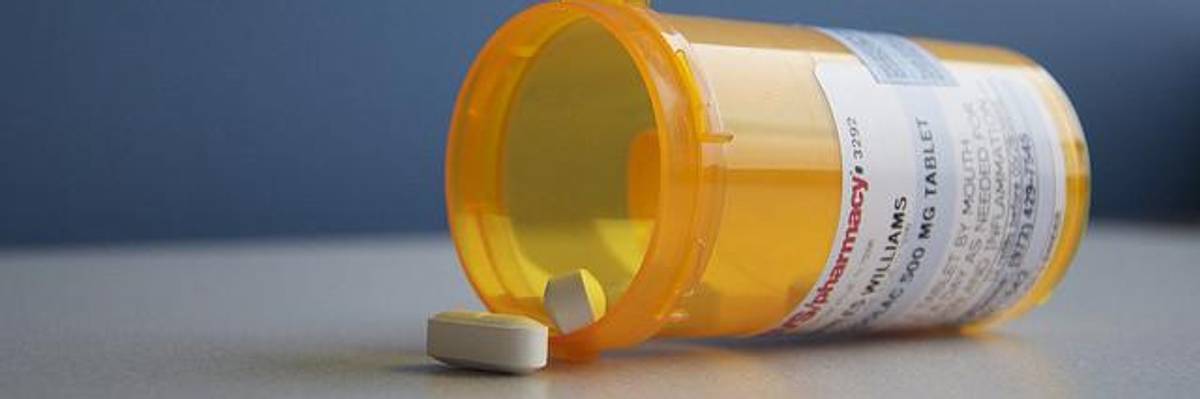
"These companies don't stop at promoting opioids. They also spend big on stopping legislation that would actually help curb opioid use." (Photo: Charles Williams/flikr/cc)
At a recent rally in New Hampshire, Donald Trump called for the death penalty for drug traffickers as part of a plan to combat the opioid epidemic in the United States. At a Pennsylvania rally a few weeks earlier, he called for the same.
Now his administration is taking steps toward making this proposal a reality. Attorney General Jeff Sessions issued a memo on March 21 asking prosecutors to pursue capital punishment for drug traffickers -- a power he has thanks to legislation passed under President Bill Clinton.
Time and again, these punitive policies have proven ineffective at curbing drug deaths. That's partly because amping up the risk factor for traffickers makes the trade all that more lucrative, encouraging more trafficking, not less.
But it's also because these policies don't address the true criminals of the opioid crisis: Big Pharma.
If Trump really wanted to help, he'd put the noose around drug-making and selling giants like Purdue Pharma, McKesson, Insys Therapeutics, Cardinal Health, AmerisourceBergen, and others.
The president knows this, in a way. These companies "contribute massive amounts of money to political people," he said at a press conference in October 2017 -- even calling out Mitch McConnell, who was standing beside him, for taking that money. Pharmaceutical manufacturers were "getting away with murder," Trump complained in the same speech.
The pharmaceutical industry spends more than any other industry on influencing politicians, with two lobbyists for every member of Congress.
For once, he's wasn't wrong.
The pharmaceutical industry spends more than any other industry on influencing politicians, with two lobbyists for every member of Congress. Nine out of ten House members and all but three senators have taken campaign contributions from Big Pharma.
It's not just politicians they shell out for.
Opioid pioneer Purdue Pharma, the creator of OxyContin, bankrolled a campaign to change the prescription habits of doctors who were wary of the substance's addictive properties, going so far as to send doctors on all-expense-paid trips to pain-management seminars. The family that started it all is worth some $13 billion today.
From 2008 to 2012, AmerisourceBergen distributed 118 million opioid pills to West Virginia alone. That's about 65 pills per resident. In that same time frame, 1,728 people in the state suffered opioid overdoses.
McKesson -- the fifth largest company in the U.S., with profits over $192 billion -- contributed 5.8 million pills to just one West Virginia pharmacy.
Meanwhile, five companies contributed more than $9 million to interest groups for things like promoting their painkillers for chronic pain and lobbying to defeat state limits on prescribing opioids.
Insys Therapeutics, a company whose founder was indicted for allegedly bribing doctors to write prescriptions for fentanyl (a substance 50 times stronger than heroin), spent $500,000 to stop marijuana legalization in Arizona in 2016.
These companies don't stop at promoting opioids. They also spend big on stopping legislation that would actually help curb opioid use.
Insys Therapeutics, a company whose founder was indicted for allegedly bribing doctors to write prescriptions for fentanyl (a substance 50 times stronger than heroin), spent $500,000 to stop marijuana legalization in Arizona in 2016.
In response, cities and states from New York City to Ohio are suing pharmaceutical companies for their role in the deaths of tens of thousands of Americans every year. It's time for the federal government to get behind them.
Of course, going after these companies isn't going to eliminate opioid abuse on its own. That will take combating the root social and economic causes that lead to so many deaths of despair.
But it's clear who the real profiteers of the opioid epidemic are. If Trump wanted to get real about curbing incentives for selling opioids, he'd turn away from street dealers and target the real opioid-producing industry.
Dear Common Dreams reader, It’s been nearly 30 years since I co-founded Common Dreams with my late wife, Lina Newhouser. We had the radical notion that journalism should serve the public good, not corporate profits. It was clear to us from the outset what it would take to build such a project. No paid advertisements. No corporate sponsors. No millionaire publisher telling us what to think or do. Many people said we wouldn't last a year, but we proved those doubters wrong. Together with a tremendous team of journalists and dedicated staff, we built an independent media outlet free from the constraints of profits and corporate control. Our mission has always been simple: To inform. To inspire. To ignite change for the common good. Building Common Dreams was not easy. Our survival was never guaranteed. When you take on the most powerful forces—Wall Street greed, fossil fuel industry destruction, Big Tech lobbyists, and uber-rich oligarchs who have spent billions upon billions rigging the economy and democracy in their favor—the only bulwark you have is supporters who believe in your work. But here’s the urgent message from me today. It's never been this bad out there. And it's never been this hard to keep us going. At the very moment Common Dreams is most needed, the threats we face are intensifying. We need your support now more than ever. We don't accept corporate advertising and never will. We don't have a paywall because we don't think people should be blocked from critical news based on their ability to pay. Everything we do is funded by the donations of readers like you. When everyone does the little they can afford, we are strong. But if that support retreats or dries up, so do we. Will you donate now to make sure Common Dreams not only survives but thrives? —Craig Brown, Co-founder |
At a recent rally in New Hampshire, Donald Trump called for the death penalty for drug traffickers as part of a plan to combat the opioid epidemic in the United States. At a Pennsylvania rally a few weeks earlier, he called for the same.
Now his administration is taking steps toward making this proposal a reality. Attorney General Jeff Sessions issued a memo on March 21 asking prosecutors to pursue capital punishment for drug traffickers -- a power he has thanks to legislation passed under President Bill Clinton.
Time and again, these punitive policies have proven ineffective at curbing drug deaths. That's partly because amping up the risk factor for traffickers makes the trade all that more lucrative, encouraging more trafficking, not less.
But it's also because these policies don't address the true criminals of the opioid crisis: Big Pharma.
If Trump really wanted to help, he'd put the noose around drug-making and selling giants like Purdue Pharma, McKesson, Insys Therapeutics, Cardinal Health, AmerisourceBergen, and others.
The president knows this, in a way. These companies "contribute massive amounts of money to political people," he said at a press conference in October 2017 -- even calling out Mitch McConnell, who was standing beside him, for taking that money. Pharmaceutical manufacturers were "getting away with murder," Trump complained in the same speech.
The pharmaceutical industry spends more than any other industry on influencing politicians, with two lobbyists for every member of Congress.
For once, he's wasn't wrong.
The pharmaceutical industry spends more than any other industry on influencing politicians, with two lobbyists for every member of Congress. Nine out of ten House members and all but three senators have taken campaign contributions from Big Pharma.
It's not just politicians they shell out for.
Opioid pioneer Purdue Pharma, the creator of OxyContin, bankrolled a campaign to change the prescription habits of doctors who were wary of the substance's addictive properties, going so far as to send doctors on all-expense-paid trips to pain-management seminars. The family that started it all is worth some $13 billion today.
From 2008 to 2012, AmerisourceBergen distributed 118 million opioid pills to West Virginia alone. That's about 65 pills per resident. In that same time frame, 1,728 people in the state suffered opioid overdoses.
McKesson -- the fifth largest company in the U.S., with profits over $192 billion -- contributed 5.8 million pills to just one West Virginia pharmacy.
Meanwhile, five companies contributed more than $9 million to interest groups for things like promoting their painkillers for chronic pain and lobbying to defeat state limits on prescribing opioids.
Insys Therapeutics, a company whose founder was indicted for allegedly bribing doctors to write prescriptions for fentanyl (a substance 50 times stronger than heroin), spent $500,000 to stop marijuana legalization in Arizona in 2016.
These companies don't stop at promoting opioids. They also spend big on stopping legislation that would actually help curb opioid use.
Insys Therapeutics, a company whose founder was indicted for allegedly bribing doctors to write prescriptions for fentanyl (a substance 50 times stronger than heroin), spent $500,000 to stop marijuana legalization in Arizona in 2016.
In response, cities and states from New York City to Ohio are suing pharmaceutical companies for their role in the deaths of tens of thousands of Americans every year. It's time for the federal government to get behind them.
Of course, going after these companies isn't going to eliminate opioid abuse on its own. That will take combating the root social and economic causes that lead to so many deaths of despair.
But it's clear who the real profiteers of the opioid epidemic are. If Trump wanted to get real about curbing incentives for selling opioids, he'd turn away from street dealers and target the real opioid-producing industry.
At a recent rally in New Hampshire, Donald Trump called for the death penalty for drug traffickers as part of a plan to combat the opioid epidemic in the United States. At a Pennsylvania rally a few weeks earlier, he called for the same.
Now his administration is taking steps toward making this proposal a reality. Attorney General Jeff Sessions issued a memo on March 21 asking prosecutors to pursue capital punishment for drug traffickers -- a power he has thanks to legislation passed under President Bill Clinton.
Time and again, these punitive policies have proven ineffective at curbing drug deaths. That's partly because amping up the risk factor for traffickers makes the trade all that more lucrative, encouraging more trafficking, not less.
But it's also because these policies don't address the true criminals of the opioid crisis: Big Pharma.
If Trump really wanted to help, he'd put the noose around drug-making and selling giants like Purdue Pharma, McKesson, Insys Therapeutics, Cardinal Health, AmerisourceBergen, and others.
The president knows this, in a way. These companies "contribute massive amounts of money to political people," he said at a press conference in October 2017 -- even calling out Mitch McConnell, who was standing beside him, for taking that money. Pharmaceutical manufacturers were "getting away with murder," Trump complained in the same speech.
The pharmaceutical industry spends more than any other industry on influencing politicians, with two lobbyists for every member of Congress.
For once, he's wasn't wrong.
The pharmaceutical industry spends more than any other industry on influencing politicians, with two lobbyists for every member of Congress. Nine out of ten House members and all but three senators have taken campaign contributions from Big Pharma.
It's not just politicians they shell out for.
Opioid pioneer Purdue Pharma, the creator of OxyContin, bankrolled a campaign to change the prescription habits of doctors who were wary of the substance's addictive properties, going so far as to send doctors on all-expense-paid trips to pain-management seminars. The family that started it all is worth some $13 billion today.
From 2008 to 2012, AmerisourceBergen distributed 118 million opioid pills to West Virginia alone. That's about 65 pills per resident. In that same time frame, 1,728 people in the state suffered opioid overdoses.
McKesson -- the fifth largest company in the U.S., with profits over $192 billion -- contributed 5.8 million pills to just one West Virginia pharmacy.
Meanwhile, five companies contributed more than $9 million to interest groups for things like promoting their painkillers for chronic pain and lobbying to defeat state limits on prescribing opioids.
Insys Therapeutics, a company whose founder was indicted for allegedly bribing doctors to write prescriptions for fentanyl (a substance 50 times stronger than heroin), spent $500,000 to stop marijuana legalization in Arizona in 2016.
These companies don't stop at promoting opioids. They also spend big on stopping legislation that would actually help curb opioid use.
Insys Therapeutics, a company whose founder was indicted for allegedly bribing doctors to write prescriptions for fentanyl (a substance 50 times stronger than heroin), spent $500,000 to stop marijuana legalization in Arizona in 2016.
In response, cities and states from New York City to Ohio are suing pharmaceutical companies for their role in the deaths of tens of thousands of Americans every year. It's time for the federal government to get behind them.
Of course, going after these companies isn't going to eliminate opioid abuse on its own. That will take combating the root social and economic causes that lead to so many deaths of despair.
But it's clear who the real profiteers of the opioid epidemic are. If Trump wanted to get real about curbing incentives for selling opioids, he'd turn away from street dealers and target the real opioid-producing industry.