SUBSCRIBE TO OUR FREE NEWSLETTER
Daily news & progressive opinion—funded by the people, not the corporations—delivered straight to your inbox.
5
#000000
#FFFFFF
To donate by check, phone, or other method, see our More Ways to Give page.
Daily news & progressive opinion—funded by the people, not the corporations—delivered straight to your inbox.
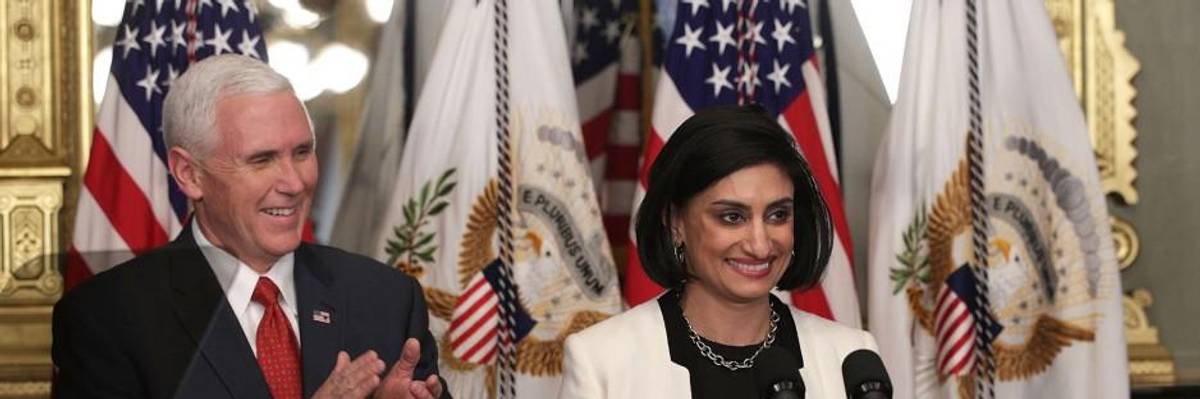
Seema Verma (R) speaks during a swearing-in ceremony, officiated by U.S. Vice President Mike Pence (L), in the Vice President's ceremonial office at Eisenhower Executive Building March 14, 2017 in Washington, DC. Verma has been sworn in to be the administrator of the Centers for Medicare and Medicaid Services for the Trump Administration. (Photo by Alex Wong/Getty Images)
Nashville Public Radio reported over the weekend that the Tennessee legislature is finalizing legislation that would add work requirements to the state's Medicaid program, kicking at least 3,700 Tennessee workers off their health care.
The state's Republican leaders appear to have no qualms about taking health insurance away from Tennesseans who can't find work or get enough hours at their job--even though taking away someone's health insurance isn't going to help them find work any faster, and can actually make it harder to find and keep a job. Instead, debate around the legislation has reportedly centered on how to pay for the new policy. Lawmakers' own estimates put the price tag for enforcing the new work rules at $10,000 per person disenrolled from Medicaid--which advocates note could be more than the new policy saves.
This is where Tennessee's proposal gets really evil. Unwilling to foot the bill for their new policy out of the state's general budget, Republican lawmakers have decided to pay for it with funds from the state's Temporary Assistance for Needy Families (TANF) program--which provides meager cash assistance to very poor families with children.
While news reports, such as the Nashville Public Radio story noted above, make it sound as though Tennessee's TANF program is flush with unused cash due to a "booming economy and historically low unemployment," the real story is much more dire.
Nearly one-quarter of Tennessee children live below the federal poverty line, making it one of the worst states in the nation when it comes to child poverty. But fewer than 1 in 4 poor Tennessee families with children get help from the state's TANF program, which is one of the stingiest in the country. A Tennessee family of three lucky enough to get temporary assistance can expect to receive a maximum of $185 per month--or a little over $6 a day.
Fewer than 1 in 4 poor Tennessee families with children get help from TANF.
Why is Tennessee failing so horrifically to help so many of its poorest children? In part, this failure is the legacy of 1996 "welfare reform," which converted the nation's main source of assistance for poor families--then called Aid to Families with Dependent Children--into TANF, a flat-funded block grant with very little accountability for how the money is spent.
Many states use TANF as a slush fund to close budget gaps, with just 1 in every 4 TANF dollars going to cash assistance for struggling families with kids. But Tennessee has made an Olympic sport out of diverting TANF funds away from poor families in need of help, squirreling away more than $400 million in unspent funds in recent years rather than using the money to help struggling families with kids avoid hunger and homelessness.
Now the state's lawmakers want to use those unspent funds to bankroll the disenrollment of thousands of struggling Tennesseans from Medicaid.
The bill is expected to clear Tennessee's conservative Senate in the coming days and has the support of Gov. Bill Haslam (R), who is expected to sign it into law. If passed, both the state's proposed work rules and their proposed pay-for will require the approval of federal health officials. If the state's scheme gets a thumbs up from the Trump administration, other states will likely follow suit. Kentucky, Indiana, and Arkansas have all received permission from the Trump administration to enact work requirements for Medicaid, following Trump's widely criticized invitation to states earlier this year, and more than a dozen states are actively seeking similar approval. Many--if not all--of these states are looking for ways to pay for the costly bureaucracy required to implement this type of policy.
One would be hard-pressed to cook up a more twisted irony than taking money intended to help poor families with children avoid hunger and hardship and using it instead to take health insurance away from, in some cases, the very same struggling workers and families. But there's a deeper rot at the core of Tennessee's plan that cuts across conservative proposals to slash not just health care but food assistance, housing, and more--both in Congress and in the states. And that's an ideology-fueled willingness to spend whatever it takes to take aid away from struggling workers and families--even when bureaucratic disentitlement costs more than it saves.
Dear Common Dreams reader, It’s been nearly 30 years since I co-founded Common Dreams with my late wife, Lina Newhouser. We had the radical notion that journalism should serve the public good, not corporate profits. It was clear to us from the outset what it would take to build such a project. No paid advertisements. No corporate sponsors. No millionaire publisher telling us what to think or do. Many people said we wouldn't last a year, but we proved those doubters wrong. Together with a tremendous team of journalists and dedicated staff, we built an independent media outlet free from the constraints of profits and corporate control. Our mission has always been simple: To inform. To inspire. To ignite change for the common good. Building Common Dreams was not easy. Our survival was never guaranteed. When you take on the most powerful forces—Wall Street greed, fossil fuel industry destruction, Big Tech lobbyists, and uber-rich oligarchs who have spent billions upon billions rigging the economy and democracy in their favor—the only bulwark you have is supporters who believe in your work. But here’s the urgent message from me today. It's never been this bad out there. And it's never been this hard to keep us going. At the very moment Common Dreams is most needed, the threats we face are intensifying. We need your support now more than ever. We don't accept corporate advertising and never will. We don't have a paywall because we don't think people should be blocked from critical news based on their ability to pay. Everything we do is funded by the donations of readers like you. When everyone does the little they can afford, we are strong. But if that support retreats or dries up, so do we. Will you donate now to make sure Common Dreams not only survives but thrives? —Craig Brown, Co-founder |
Nashville Public Radio reported over the weekend that the Tennessee legislature is finalizing legislation that would add work requirements to the state's Medicaid program, kicking at least 3,700 Tennessee workers off their health care.
The state's Republican leaders appear to have no qualms about taking health insurance away from Tennesseans who can't find work or get enough hours at their job--even though taking away someone's health insurance isn't going to help them find work any faster, and can actually make it harder to find and keep a job. Instead, debate around the legislation has reportedly centered on how to pay for the new policy. Lawmakers' own estimates put the price tag for enforcing the new work rules at $10,000 per person disenrolled from Medicaid--which advocates note could be more than the new policy saves.
This is where Tennessee's proposal gets really evil. Unwilling to foot the bill for their new policy out of the state's general budget, Republican lawmakers have decided to pay for it with funds from the state's Temporary Assistance for Needy Families (TANF) program--which provides meager cash assistance to very poor families with children.
While news reports, such as the Nashville Public Radio story noted above, make it sound as though Tennessee's TANF program is flush with unused cash due to a "booming economy and historically low unemployment," the real story is much more dire.
Nearly one-quarter of Tennessee children live below the federal poverty line, making it one of the worst states in the nation when it comes to child poverty. But fewer than 1 in 4 poor Tennessee families with children get help from the state's TANF program, which is one of the stingiest in the country. A Tennessee family of three lucky enough to get temporary assistance can expect to receive a maximum of $185 per month--or a little over $6 a day.
Fewer than 1 in 4 poor Tennessee families with children get help from TANF.
Why is Tennessee failing so horrifically to help so many of its poorest children? In part, this failure is the legacy of 1996 "welfare reform," which converted the nation's main source of assistance for poor families--then called Aid to Families with Dependent Children--into TANF, a flat-funded block grant with very little accountability for how the money is spent.
Many states use TANF as a slush fund to close budget gaps, with just 1 in every 4 TANF dollars going to cash assistance for struggling families with kids. But Tennessee has made an Olympic sport out of diverting TANF funds away from poor families in need of help, squirreling away more than $400 million in unspent funds in recent years rather than using the money to help struggling families with kids avoid hunger and homelessness.
Now the state's lawmakers want to use those unspent funds to bankroll the disenrollment of thousands of struggling Tennesseans from Medicaid.
The bill is expected to clear Tennessee's conservative Senate in the coming days and has the support of Gov. Bill Haslam (R), who is expected to sign it into law. If passed, both the state's proposed work rules and their proposed pay-for will require the approval of federal health officials. If the state's scheme gets a thumbs up from the Trump administration, other states will likely follow suit. Kentucky, Indiana, and Arkansas have all received permission from the Trump administration to enact work requirements for Medicaid, following Trump's widely criticized invitation to states earlier this year, and more than a dozen states are actively seeking similar approval. Many--if not all--of these states are looking for ways to pay for the costly bureaucracy required to implement this type of policy.
One would be hard-pressed to cook up a more twisted irony than taking money intended to help poor families with children avoid hunger and hardship and using it instead to take health insurance away from, in some cases, the very same struggling workers and families. But there's a deeper rot at the core of Tennessee's plan that cuts across conservative proposals to slash not just health care but food assistance, housing, and more--both in Congress and in the states. And that's an ideology-fueled willingness to spend whatever it takes to take aid away from struggling workers and families--even when bureaucratic disentitlement costs more than it saves.
Nashville Public Radio reported over the weekend that the Tennessee legislature is finalizing legislation that would add work requirements to the state's Medicaid program, kicking at least 3,700 Tennessee workers off their health care.
The state's Republican leaders appear to have no qualms about taking health insurance away from Tennesseans who can't find work or get enough hours at their job--even though taking away someone's health insurance isn't going to help them find work any faster, and can actually make it harder to find and keep a job. Instead, debate around the legislation has reportedly centered on how to pay for the new policy. Lawmakers' own estimates put the price tag for enforcing the new work rules at $10,000 per person disenrolled from Medicaid--which advocates note could be more than the new policy saves.
This is where Tennessee's proposal gets really evil. Unwilling to foot the bill for their new policy out of the state's general budget, Republican lawmakers have decided to pay for it with funds from the state's Temporary Assistance for Needy Families (TANF) program--which provides meager cash assistance to very poor families with children.
While news reports, such as the Nashville Public Radio story noted above, make it sound as though Tennessee's TANF program is flush with unused cash due to a "booming economy and historically low unemployment," the real story is much more dire.
Nearly one-quarter of Tennessee children live below the federal poverty line, making it one of the worst states in the nation when it comes to child poverty. But fewer than 1 in 4 poor Tennessee families with children get help from the state's TANF program, which is one of the stingiest in the country. A Tennessee family of three lucky enough to get temporary assistance can expect to receive a maximum of $185 per month--or a little over $6 a day.
Fewer than 1 in 4 poor Tennessee families with children get help from TANF.
Why is Tennessee failing so horrifically to help so many of its poorest children? In part, this failure is the legacy of 1996 "welfare reform," which converted the nation's main source of assistance for poor families--then called Aid to Families with Dependent Children--into TANF, a flat-funded block grant with very little accountability for how the money is spent.
Many states use TANF as a slush fund to close budget gaps, with just 1 in every 4 TANF dollars going to cash assistance for struggling families with kids. But Tennessee has made an Olympic sport out of diverting TANF funds away from poor families in need of help, squirreling away more than $400 million in unspent funds in recent years rather than using the money to help struggling families with kids avoid hunger and homelessness.
Now the state's lawmakers want to use those unspent funds to bankroll the disenrollment of thousands of struggling Tennesseans from Medicaid.
The bill is expected to clear Tennessee's conservative Senate in the coming days and has the support of Gov. Bill Haslam (R), who is expected to sign it into law. If passed, both the state's proposed work rules and their proposed pay-for will require the approval of federal health officials. If the state's scheme gets a thumbs up from the Trump administration, other states will likely follow suit. Kentucky, Indiana, and Arkansas have all received permission from the Trump administration to enact work requirements for Medicaid, following Trump's widely criticized invitation to states earlier this year, and more than a dozen states are actively seeking similar approval. Many--if not all--of these states are looking for ways to pay for the costly bureaucracy required to implement this type of policy.
One would be hard-pressed to cook up a more twisted irony than taking money intended to help poor families with children avoid hunger and hardship and using it instead to take health insurance away from, in some cases, the very same struggling workers and families. But there's a deeper rot at the core of Tennessee's plan that cuts across conservative proposals to slash not just health care but food assistance, housing, and more--both in Congress and in the states. And that's an ideology-fueled willingness to spend whatever it takes to take aid away from struggling workers and families--even when bureaucratic disentitlement costs more than it saves.