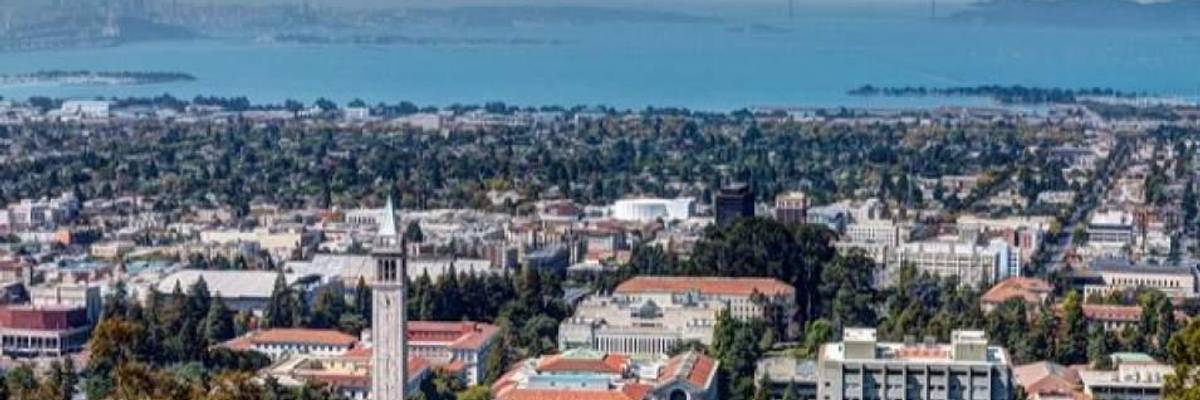
"As part of the Republican tax cut pushed through at the federal level, the wealth threshold of the federal estate tax was doubled for a family from $11 million to $22 million.' (Photo: Mike Procario / Flickr)
Taxing Wealth to Make Public College Free Again
A California campaign is pushing to add an innovative initiative to the November ballot. The plan: make public higher education tuition-free by restoring the estate tax.
Angad Singh Bhalla holds his son, Nanak, in his arms while juggling phone calls at all hours of the day. He is the coordinator of newly formed California College for All campaign. A filmmaker and labor activist, Bhalla has jumped into this campaign with gusto.
For Bhalla, this is more than a movement to make college more accessible. "I was inspired by thousands of young people that turned out for the Sanders campaign. I've been involved in other campaigns before but I'd never seen anything like it."
"I thought, 'We should engage these people.' Things are in motion. We may not have a movement yet, but this is the way."
(Photo: Angad Singh Bhalla)
The state-level College for All campaign is now going into the field, collecting signatures to put the initiative on the ballot for November 2018. The initiative would increase student aid funding at California public colleges and universities by restoring a dedicated tax on estates over $3.5 million.
If approved by California voters in November, it would dramatically increase investment in public higher education while reducing the concentration of wealth and power.
In the last 20 years, the cost of college has gone up over 300 percent at the University of California and within the state university system. Community college is still relatively expensive. They were all virtually tuition-free in the 1970s.
"One lesson from the 2016 campaign is you can only go so far saying "our opponent is a monster," said Bhalla. "You need to have a compelling vision. I think this issue -- college debt and tuition -- will mobilize young voters and boost turnout for 2018. By putting something bold and exciting on the ballot you will pull young people out and have all sorts of impacts. "
"I think it is strategic to pay for 'college for all' with an estate tax. The initiative will levy a tax on the richest 0.2 percent of Californians, about 4,000 multi-millionaires and billionaires, and would assist 2.6 million students."
As part of the Republican tax cut pushed through at the federal level, the wealth threshold of the federal estate tax was doubled for a family from $11 million to $22 million.
"By restoring the California estate tax, we are capturing some of this lost revenue and directing it to something that changes lives in our state," said Bhalla. "The estate tax is a fundamentally fair tax. Why should someone be born with so much unlimited wealth at a time when social opportunity is declining for the large masses of people?
"Education is the ultimate equalizer in terms of the theory of opportunity. Yet we have some people born wealthy and others who are born with very little. We looked at other revenue forms, but this seemed the most fair. If we are able to get on the ballot, I think we will triumph. But we have to get on the ballot."
Now they are pushing to get the signatures on the ballot. They need to collect 585,407 signatures before April 24th. Know anyone who wants to volunteer or contribute? Check out www.collegeforallca.com.
We are at a crossroads
This country and this world are at a monumental crossroads. In a few short weeks, US voters will have an opportunity to beat back the forces of fascism and confront the billionaires who are rigging the economy, our media system, and our democracy, making it increasingly impossible for ordinary people to get by. We’re not just talking about the election. We’re talking about what must be done once these fascist elements are vanquished from power. We need a bolder set of solutions than what either major party has so far been willing to offer and a working-class movement ready to fight like hell for it. Trump didn't emerge from nowhere. The conditions that fueled MAGA authoritarianism were created by decades of radical neoliberal economic policies and a corrupt political system dominated by corporate interests. They slashed taxes on the super-rich, promising that the benefits would trickle down. They said giveaways to the corporate titans would make life more affordable for the rest of us. It was all bullshit. And when a bitter, betrayed populace searches for someone to blame, right-wing demagogues have little trouble finding scapegoats. People know when they're being lied to, but you won't hear any of this from the corporate media. Only independent journalism—powered and funded by people who believe in building a better world—can deliver truly trustworthy daily news. Our Fall Campaign is underway, and we need your help. To power our newsroom through the rest of the year, we need to raise $125,000 by midnight on October 31. So if you share our vision, please contribute whatever you can to sustain our work. |
Angad Singh Bhalla holds his son, Nanak, in his arms while juggling phone calls at all hours of the day. He is the coordinator of newly formed California College for All campaign. A filmmaker and labor activist, Bhalla has jumped into this campaign with gusto.
For Bhalla, this is more than a movement to make college more accessible. "I was inspired by thousands of young people that turned out for the Sanders campaign. I've been involved in other campaigns before but I'd never seen anything like it."
"I thought, 'We should engage these people.' Things are in motion. We may not have a movement yet, but this is the way."
(Photo: Angad Singh Bhalla)
The state-level College for All campaign is now going into the field, collecting signatures to put the initiative on the ballot for November 2018. The initiative would increase student aid funding at California public colleges and universities by restoring a dedicated tax on estates over $3.5 million.
If approved by California voters in November, it would dramatically increase investment in public higher education while reducing the concentration of wealth and power.
In the last 20 years, the cost of college has gone up over 300 percent at the University of California and within the state university system. Community college is still relatively expensive. They were all virtually tuition-free in the 1970s.
"One lesson from the 2016 campaign is you can only go so far saying "our opponent is a monster," said Bhalla. "You need to have a compelling vision. I think this issue -- college debt and tuition -- will mobilize young voters and boost turnout for 2018. By putting something bold and exciting on the ballot you will pull young people out and have all sorts of impacts. "
"I think it is strategic to pay for 'college for all' with an estate tax. The initiative will levy a tax on the richest 0.2 percent of Californians, about 4,000 multi-millionaires and billionaires, and would assist 2.6 million students."
As part of the Republican tax cut pushed through at the federal level, the wealth threshold of the federal estate tax was doubled for a family from $11 million to $22 million.
"By restoring the California estate tax, we are capturing some of this lost revenue and directing it to something that changes lives in our state," said Bhalla. "The estate tax is a fundamentally fair tax. Why should someone be born with so much unlimited wealth at a time when social opportunity is declining for the large masses of people?
"Education is the ultimate equalizer in terms of the theory of opportunity. Yet we have some people born wealthy and others who are born with very little. We looked at other revenue forms, but this seemed the most fair. If we are able to get on the ballot, I think we will triumph. But we have to get on the ballot."
Now they are pushing to get the signatures on the ballot. They need to collect 585,407 signatures before April 24th. Know anyone who wants to volunteer or contribute? Check out www.collegeforallca.com.
Angad Singh Bhalla holds his son, Nanak, in his arms while juggling phone calls at all hours of the day. He is the coordinator of newly formed California College for All campaign. A filmmaker and labor activist, Bhalla has jumped into this campaign with gusto.
For Bhalla, this is more than a movement to make college more accessible. "I was inspired by thousands of young people that turned out for the Sanders campaign. I've been involved in other campaigns before but I'd never seen anything like it."
"I thought, 'We should engage these people.' Things are in motion. We may not have a movement yet, but this is the way."
(Photo: Angad Singh Bhalla)
The state-level College for All campaign is now going into the field, collecting signatures to put the initiative on the ballot for November 2018. The initiative would increase student aid funding at California public colleges and universities by restoring a dedicated tax on estates over $3.5 million.
If approved by California voters in November, it would dramatically increase investment in public higher education while reducing the concentration of wealth and power.
In the last 20 years, the cost of college has gone up over 300 percent at the University of California and within the state university system. Community college is still relatively expensive. They were all virtually tuition-free in the 1970s.
"One lesson from the 2016 campaign is you can only go so far saying "our opponent is a monster," said Bhalla. "You need to have a compelling vision. I think this issue -- college debt and tuition -- will mobilize young voters and boost turnout for 2018. By putting something bold and exciting on the ballot you will pull young people out and have all sorts of impacts. "
"I think it is strategic to pay for 'college for all' with an estate tax. The initiative will levy a tax on the richest 0.2 percent of Californians, about 4,000 multi-millionaires and billionaires, and would assist 2.6 million students."
As part of the Republican tax cut pushed through at the federal level, the wealth threshold of the federal estate tax was doubled for a family from $11 million to $22 million.
"By restoring the California estate tax, we are capturing some of this lost revenue and directing it to something that changes lives in our state," said Bhalla. "The estate tax is a fundamentally fair tax. Why should someone be born with so much unlimited wealth at a time when social opportunity is declining for the large masses of people?
"Education is the ultimate equalizer in terms of the theory of opportunity. Yet we have some people born wealthy and others who are born with very little. We looked at other revenue forms, but this seemed the most fair. If we are able to get on the ballot, I think we will triumph. But we have to get on the ballot."
Now they are pushing to get the signatures on the ballot. They need to collect 585,407 signatures before April 24th. Know anyone who wants to volunteer or contribute? Check out www.collegeforallca.com.