SUBSCRIBE TO OUR FREE NEWSLETTER
Daily news & progressive opinion—funded by the people, not the corporations—delivered straight to your inbox.
5
#000000
#FFFFFF
To donate by check, phone, or other method, see our More Ways to Give page.
Daily news & progressive opinion—funded by the people, not the corporations—delivered straight to your inbox.
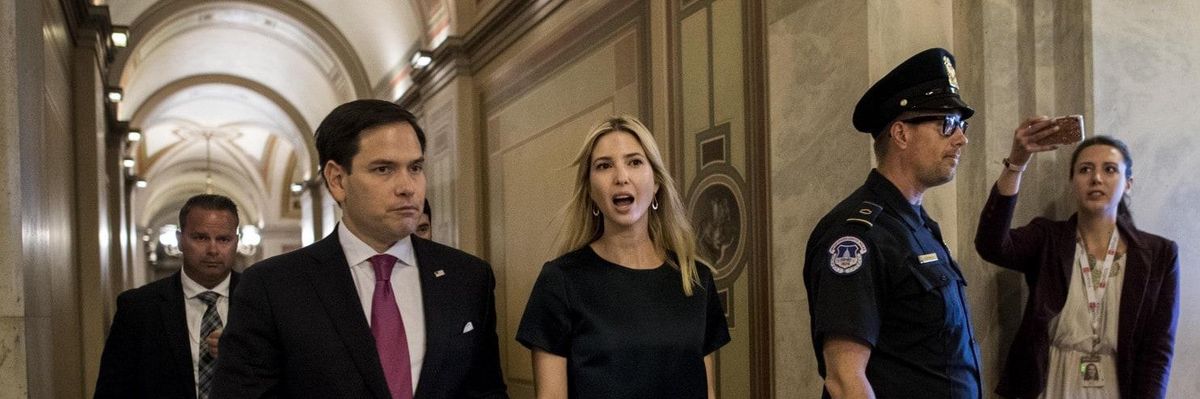
Ivanka Trump with Sen. Marco Rubio (R-Fla.) on Capitol Hill in June 2017. (Melina Mara/The Washington Post)
Early in the fifth century, the theologian Saint Augustine of Hippo noted something about families and society that, in his era, was simply conventional wisdom: "After the city, or political community, comes the world, following the convention that treats the household, city, and world as three successive levels of human society." For the ancients, families were the first and smallest societies, units of cooperation and order within which people learn to get along with others. Together, families formed political communities -- cities, as Augustine put it; and together, those political communities made up the world, which was a society of communities. Peace and order in each domain contributed to the peace and order of the next, and thus society had an interest in fostering functional families, and families an interest in forming functional societies.
What sense it all made! And how strange it is to have completely dismissed the idea in modern thought. Our world is one of individuals making a series of contracts and agreements with one another in hopes of getting the most one can out of the world; the lives of others are none of our business, and ours are none of theirs. Nowhere is this clearer than in conservative policymaking, where family policy is absurdly individualized.
Consider the paid parental leave plan teased in President Trump's State of the Union address, which has now gained traction with Sen. Marco Rubio (R-Fla.) and Ivanka Trump. The plan, described as "a budget-neutral approach to parental leave" by advocates, would allow parents to draw from their Social Security benefits early to fund their parental leave, then require them to delay the collection of retirement benefits by some yet-to-be-calculated period of time. Participation would be strictly voluntary.
It's a highly individualized way of dealing with the facts of family life -- which by their nature are communal issues: Babies and children need caregivers, mothers and fathers need time and money to give care, elderly grandparents and great-grandparents need companionship and assistance. Babies and children learn and grow, adults work and produce, and the elderly help and rest. There is a place for every stage of the life cycle in the grand order of things, and a just state would ideally defer to that natural rhythm. Instead, conservatives' plan would penalize the elderly for their decision to have raised families, all in the interest of making parental leave a self-contained option, no burden to anyone but the parents themselves.
The proposal would penalize bigger families more than smaller ones; couples with more children would face working further into old age before receiving retirement benefits. Moreover, it would likely mean that lower-wage workers would end up putting off retirement longer than wealthier workers with ample company benefits, an especially perverse outcome given that America's poor suffer significantly reduced life expectancies compared with the country's rich. If you're not particularly well-to-do and you want a family, in other words, you'll need to be prepared to pay for it in your old age: your family, your choice, your problem.
It actually is in the best interest of society that people have children, and it would be in society's best interest for them to be provided with the time and means to nurture those children. In their more lucid moments, even tax-slashing, welfare-reforming Republicans recognize as much: House Speaker Paul D. Ryan (R-Wis.) himself observed in December that economies simply don't function unless people have children. Today's infants, lovingly cared for by their parents, will become tomorrow's producers and inventors and administrators, and will, in time, look after their elders in their dotage. That this cycle of life continues unhindered is everyone's business, because our fortunes and futures rest on the arrival of helpless little ones who will one day be our caretakers, in many senses.
It's worth a tax to see that families aren't penalized for bringing forth new generations, and that the elderly have time to rest and look back on their lives with satisfaction. It's worth the support of society at large. It's worth everything.
Dear Common Dreams reader, It’s been nearly 30 years since I co-founded Common Dreams with my late wife, Lina Newhouser. We had the radical notion that journalism should serve the public good, not corporate profits. It was clear to us from the outset what it would take to build such a project. No paid advertisements. No corporate sponsors. No millionaire publisher telling us what to think or do. Many people said we wouldn't last a year, but we proved those doubters wrong. Together with a tremendous team of journalists and dedicated staff, we built an independent media outlet free from the constraints of profits and corporate control. Our mission has always been simple: To inform. To inspire. To ignite change for the common good. Building Common Dreams was not easy. Our survival was never guaranteed. When you take on the most powerful forces—Wall Street greed, fossil fuel industry destruction, Big Tech lobbyists, and uber-rich oligarchs who have spent billions upon billions rigging the economy and democracy in their favor—the only bulwark you have is supporters who believe in your work. But here’s the urgent message from me today. It's never been this bad out there. And it's never been this hard to keep us going. At the very moment Common Dreams is most needed, the threats we face are intensifying. We need your support now more than ever. We don't accept corporate advertising and never will. We don't have a paywall because we don't think people should be blocked from critical news based on their ability to pay. Everything we do is funded by the donations of readers like you. When everyone does the little they can afford, we are strong. But if that support retreats or dries up, so do we. Will you donate now to make sure Common Dreams not only survives but thrives? —Craig Brown, Co-founder |
Early in the fifth century, the theologian Saint Augustine of Hippo noted something about families and society that, in his era, was simply conventional wisdom: "After the city, or political community, comes the world, following the convention that treats the household, city, and world as three successive levels of human society." For the ancients, families were the first and smallest societies, units of cooperation and order within which people learn to get along with others. Together, families formed political communities -- cities, as Augustine put it; and together, those political communities made up the world, which was a society of communities. Peace and order in each domain contributed to the peace and order of the next, and thus society had an interest in fostering functional families, and families an interest in forming functional societies.
What sense it all made! And how strange it is to have completely dismissed the idea in modern thought. Our world is one of individuals making a series of contracts and agreements with one another in hopes of getting the most one can out of the world; the lives of others are none of our business, and ours are none of theirs. Nowhere is this clearer than in conservative policymaking, where family policy is absurdly individualized.
Consider the paid parental leave plan teased in President Trump's State of the Union address, which has now gained traction with Sen. Marco Rubio (R-Fla.) and Ivanka Trump. The plan, described as "a budget-neutral approach to parental leave" by advocates, would allow parents to draw from their Social Security benefits early to fund their parental leave, then require them to delay the collection of retirement benefits by some yet-to-be-calculated period of time. Participation would be strictly voluntary.
It's a highly individualized way of dealing with the facts of family life -- which by their nature are communal issues: Babies and children need caregivers, mothers and fathers need time and money to give care, elderly grandparents and great-grandparents need companionship and assistance. Babies and children learn and grow, adults work and produce, and the elderly help and rest. There is a place for every stage of the life cycle in the grand order of things, and a just state would ideally defer to that natural rhythm. Instead, conservatives' plan would penalize the elderly for their decision to have raised families, all in the interest of making parental leave a self-contained option, no burden to anyone but the parents themselves.
The proposal would penalize bigger families more than smaller ones; couples with more children would face working further into old age before receiving retirement benefits. Moreover, it would likely mean that lower-wage workers would end up putting off retirement longer than wealthier workers with ample company benefits, an especially perverse outcome given that America's poor suffer significantly reduced life expectancies compared with the country's rich. If you're not particularly well-to-do and you want a family, in other words, you'll need to be prepared to pay for it in your old age: your family, your choice, your problem.
It actually is in the best interest of society that people have children, and it would be in society's best interest for them to be provided with the time and means to nurture those children. In their more lucid moments, even tax-slashing, welfare-reforming Republicans recognize as much: House Speaker Paul D. Ryan (R-Wis.) himself observed in December that economies simply don't function unless people have children. Today's infants, lovingly cared for by their parents, will become tomorrow's producers and inventors and administrators, and will, in time, look after their elders in their dotage. That this cycle of life continues unhindered is everyone's business, because our fortunes and futures rest on the arrival of helpless little ones who will one day be our caretakers, in many senses.
It's worth a tax to see that families aren't penalized for bringing forth new generations, and that the elderly have time to rest and look back on their lives with satisfaction. It's worth the support of society at large. It's worth everything.
Early in the fifth century, the theologian Saint Augustine of Hippo noted something about families and society that, in his era, was simply conventional wisdom: "After the city, or political community, comes the world, following the convention that treats the household, city, and world as three successive levels of human society." For the ancients, families were the first and smallest societies, units of cooperation and order within which people learn to get along with others. Together, families formed political communities -- cities, as Augustine put it; and together, those political communities made up the world, which was a society of communities. Peace and order in each domain contributed to the peace and order of the next, and thus society had an interest in fostering functional families, and families an interest in forming functional societies.
What sense it all made! And how strange it is to have completely dismissed the idea in modern thought. Our world is one of individuals making a series of contracts and agreements with one another in hopes of getting the most one can out of the world; the lives of others are none of our business, and ours are none of theirs. Nowhere is this clearer than in conservative policymaking, where family policy is absurdly individualized.
Consider the paid parental leave plan teased in President Trump's State of the Union address, which has now gained traction with Sen. Marco Rubio (R-Fla.) and Ivanka Trump. The plan, described as "a budget-neutral approach to parental leave" by advocates, would allow parents to draw from their Social Security benefits early to fund their parental leave, then require them to delay the collection of retirement benefits by some yet-to-be-calculated period of time. Participation would be strictly voluntary.
It's a highly individualized way of dealing with the facts of family life -- which by their nature are communal issues: Babies and children need caregivers, mothers and fathers need time and money to give care, elderly grandparents and great-grandparents need companionship and assistance. Babies and children learn and grow, adults work and produce, and the elderly help and rest. There is a place for every stage of the life cycle in the grand order of things, and a just state would ideally defer to that natural rhythm. Instead, conservatives' plan would penalize the elderly for their decision to have raised families, all in the interest of making parental leave a self-contained option, no burden to anyone but the parents themselves.
The proposal would penalize bigger families more than smaller ones; couples with more children would face working further into old age before receiving retirement benefits. Moreover, it would likely mean that lower-wage workers would end up putting off retirement longer than wealthier workers with ample company benefits, an especially perverse outcome given that America's poor suffer significantly reduced life expectancies compared with the country's rich. If you're not particularly well-to-do and you want a family, in other words, you'll need to be prepared to pay for it in your old age: your family, your choice, your problem.
It actually is in the best interest of society that people have children, and it would be in society's best interest for them to be provided with the time and means to nurture those children. In their more lucid moments, even tax-slashing, welfare-reforming Republicans recognize as much: House Speaker Paul D. Ryan (R-Wis.) himself observed in December that economies simply don't function unless people have children. Today's infants, lovingly cared for by their parents, will become tomorrow's producers and inventors and administrators, and will, in time, look after their elders in their dotage. That this cycle of life continues unhindered is everyone's business, because our fortunes and futures rest on the arrival of helpless little ones who will one day be our caretakers, in many senses.
It's worth a tax to see that families aren't penalized for bringing forth new generations, and that the elderly have time to rest and look back on their lives with satisfaction. It's worth the support of society at large. It's worth everything.