

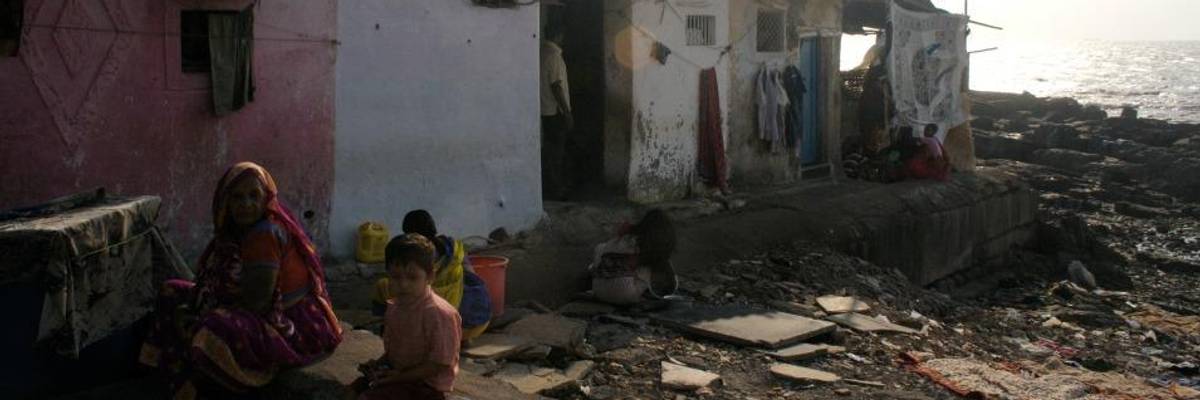
Only 9 percent of total global income in 2016 went to those who need it most--the poorest 50 percent of the world's population, composed of 3.8 billion people. (Photo: Jeremy Higgs/Flickr/cc)
When Economic Growth Indicates Failure
For the well-being of most everyone—including the rich—equality is more important than growth.
Nothing can be duller than listening to an economist or other policy expert pontificate endlessly on such metrics as gross domestic product, stock market prices, employment, and consumer confidence. Most of all they talk about GDP: Rising GDP is good; falling GDP is bad. But as a measure of economic activity, GDP is what it says it is: a gross number. It doesn't measure how money and wealth circulates through a system, what use it is put to, how the rewards of its use are distributed. It just counts how much comes out of the spigot at the end of the pipe. This completely avoids taking into account what may be the most important indicator of economic health: equality.
Epidemiological studies demonstrate that equality is essential to a host of physical, mental, and social health outcomes. Societies that are more equal have lower rates of infant mortality, homicide, imprisonment, teenage motherhood, and other indicators of economic dysfunction. People in those countries also have higher life expectancies, levels of literacy, math proficiency, social trust, social mobility, and other positive signs of a healthy society.
This research suggests that for most countries economic performance on equality is far more important to the well-being of their citizens than GDP growth. Indeed, in our currently overstressed world, in which humans are consuming at a rate 1.7 times what Earth can sustain, our real need is for less consumption and more equity. For the well-being of most everyone--including the rich--equality is more important than growth.
So how is the global economy doing on equality? An international team of over 100 economists from more than 70 countries recently issued the 2018 World Inequality Report on global income and wealth distribution from 1980 to 2016.
The overall distribution and trends are alarming.
Only 9 percent of total global income in 2016 went to those who need it most--the poorest 50 percent of the world's population, composed of 3.8 billion people. Their share of the total growth in income was just half the increase enjoyed by the richest 1 percent. And among the 1 percent, half of their total increase was concentrated in the richest tenth of that elite tier.
In other words, the more you had, the more you got. Between 1980 and 2016, the global average rate of individual income growth was 60 percent. But that average includes the fact that the richest 10 percent of the world's people gleaned an average 70 percent increase, and the top 1 percent saw their income grow by an average of 101 percent. But even that significantly overstates the income growth experienced by the "lower" end of those 1 percenters, because it includes the gains of the top 0.1 percent, who saw their incomes grow by 133 percent, the top 0.01 percent (185 percent increase), and the top 0.001 percent, whose incomes increased a whopping 235 percent.
Comparing average increases in income obscures the implications of these numbers for inequality. If you are among the poorest of the poor living on an income of a dollar a day, a 60 percent increase gets you an extra 60 cents a day, but a hedge fund CEO with an annual pay, including bonuses of $100 million, would get an extra $60 million per year. If everyone got the same percentage increase each year (and they do not), inequality's ills only grow. Given current income gaps and the actual rates of salary increases, which skew toward the richest of the rich, inequality is growing at a blinding rate.
As long as GDP grows faster than population, total income also rises. In a pure market economy, if production rises, it is only in response to the demand of those who get the extra income. Without action by government, there will be no response to the needs for food, housing, medical care, transportation, and other needs of those whose incomes languish. Contrary to popular belief, without strong and effective government intervention to assure an equitable distribution of income and wealth, growing GDP will only exacerbate the ravages of poverty.
Using GDP growth as society's defining economic goal must rank among the stupidest policy choices human societies have ever made. Economic growth is increasing the power of a tiny oligarchy to game the system to make themselves even richer as they destroy the middle class and confine ever more of the world's people to lives of desperation and servitude.
Our economic priority at this point in human history must be to organize ourselves to meet the essential material needs of all people in ways that fulfill us spiritually and heal the Earth. To make the appropriate policy choices we must understand the sources of our current dysfunction and redirect our economies to achieve an equitable sharing of income and wealth.
An Urgent Message From Our Co-Founder
Dear Common Dreams reader, It’s been nearly 30 years since I co-founded Common Dreams with my late wife, Lina Newhouser. We had the radical notion that journalism should serve the public good, not corporate profits. It was clear to us from the outset what it would take to build such a project. No paid advertisements. No corporate sponsors. No millionaire publisher telling us what to think or do. Many people said we wouldn't last a year, but we proved those doubters wrong. Together with a tremendous team of journalists and dedicated staff, we built an independent media outlet free from the constraints of profits and corporate control. Our mission has always been simple: To inform. To inspire. To ignite change for the common good. Building Common Dreams was not easy. Our survival was never guaranteed. When you take on the most powerful forces—Wall Street greed, fossil fuel industry destruction, Big Tech lobbyists, and uber-rich oligarchs who have spent billions upon billions rigging the economy and democracy in their favor—the only bulwark you have is supporters who believe in your work. But here’s the urgent message from me today. It's never been this bad out there. And it's never been this hard to keep us going. At the very moment Common Dreams is most needed, the threats we face are intensifying. We need your support now more than ever. We don't accept corporate advertising and never will. We don't have a paywall because we don't think people should be blocked from critical news based on their ability to pay. Everything we do is funded by the donations of readers like you. When everyone does the little they can afford, we are strong. But if that support retreats or dries up, so do we. Will you donate now to make sure Common Dreams not only survives but thrives? —Craig Brown, Co-founder |
Nothing can be duller than listening to an economist or other policy expert pontificate endlessly on such metrics as gross domestic product, stock market prices, employment, and consumer confidence. Most of all they talk about GDP: Rising GDP is good; falling GDP is bad. But as a measure of economic activity, GDP is what it says it is: a gross number. It doesn't measure how money and wealth circulates through a system, what use it is put to, how the rewards of its use are distributed. It just counts how much comes out of the spigot at the end of the pipe. This completely avoids taking into account what may be the most important indicator of economic health: equality.
Epidemiological studies demonstrate that equality is essential to a host of physical, mental, and social health outcomes. Societies that are more equal have lower rates of infant mortality, homicide, imprisonment, teenage motherhood, and other indicators of economic dysfunction. People in those countries also have higher life expectancies, levels of literacy, math proficiency, social trust, social mobility, and other positive signs of a healthy society.
This research suggests that for most countries economic performance on equality is far more important to the well-being of their citizens than GDP growth. Indeed, in our currently overstressed world, in which humans are consuming at a rate 1.7 times what Earth can sustain, our real need is for less consumption and more equity. For the well-being of most everyone--including the rich--equality is more important than growth.
So how is the global economy doing on equality? An international team of over 100 economists from more than 70 countries recently issued the 2018 World Inequality Report on global income and wealth distribution from 1980 to 2016.
The overall distribution and trends are alarming.
Only 9 percent of total global income in 2016 went to those who need it most--the poorest 50 percent of the world's population, composed of 3.8 billion people. Their share of the total growth in income was just half the increase enjoyed by the richest 1 percent. And among the 1 percent, half of their total increase was concentrated in the richest tenth of that elite tier.
In other words, the more you had, the more you got. Between 1980 and 2016, the global average rate of individual income growth was 60 percent. But that average includes the fact that the richest 10 percent of the world's people gleaned an average 70 percent increase, and the top 1 percent saw their income grow by an average of 101 percent. But even that significantly overstates the income growth experienced by the "lower" end of those 1 percenters, because it includes the gains of the top 0.1 percent, who saw their incomes grow by 133 percent, the top 0.01 percent (185 percent increase), and the top 0.001 percent, whose incomes increased a whopping 235 percent.
Comparing average increases in income obscures the implications of these numbers for inequality. If you are among the poorest of the poor living on an income of a dollar a day, a 60 percent increase gets you an extra 60 cents a day, but a hedge fund CEO with an annual pay, including bonuses of $100 million, would get an extra $60 million per year. If everyone got the same percentage increase each year (and they do not), inequality's ills only grow. Given current income gaps and the actual rates of salary increases, which skew toward the richest of the rich, inequality is growing at a blinding rate.
As long as GDP grows faster than population, total income also rises. In a pure market economy, if production rises, it is only in response to the demand of those who get the extra income. Without action by government, there will be no response to the needs for food, housing, medical care, transportation, and other needs of those whose incomes languish. Contrary to popular belief, without strong and effective government intervention to assure an equitable distribution of income and wealth, growing GDP will only exacerbate the ravages of poverty.
Using GDP growth as society's defining economic goal must rank among the stupidest policy choices human societies have ever made. Economic growth is increasing the power of a tiny oligarchy to game the system to make themselves even richer as they destroy the middle class and confine ever more of the world's people to lives of desperation and servitude.
Our economic priority at this point in human history must be to organize ourselves to meet the essential material needs of all people in ways that fulfill us spiritually and heal the Earth. To make the appropriate policy choices we must understand the sources of our current dysfunction and redirect our economies to achieve an equitable sharing of income and wealth.
Nothing can be duller than listening to an economist or other policy expert pontificate endlessly on such metrics as gross domestic product, stock market prices, employment, and consumer confidence. Most of all they talk about GDP: Rising GDP is good; falling GDP is bad. But as a measure of economic activity, GDP is what it says it is: a gross number. It doesn't measure how money and wealth circulates through a system, what use it is put to, how the rewards of its use are distributed. It just counts how much comes out of the spigot at the end of the pipe. This completely avoids taking into account what may be the most important indicator of economic health: equality.
Epidemiological studies demonstrate that equality is essential to a host of physical, mental, and social health outcomes. Societies that are more equal have lower rates of infant mortality, homicide, imprisonment, teenage motherhood, and other indicators of economic dysfunction. People in those countries also have higher life expectancies, levels of literacy, math proficiency, social trust, social mobility, and other positive signs of a healthy society.
This research suggests that for most countries economic performance on equality is far more important to the well-being of their citizens than GDP growth. Indeed, in our currently overstressed world, in which humans are consuming at a rate 1.7 times what Earth can sustain, our real need is for less consumption and more equity. For the well-being of most everyone--including the rich--equality is more important than growth.
So how is the global economy doing on equality? An international team of over 100 economists from more than 70 countries recently issued the 2018 World Inequality Report on global income and wealth distribution from 1980 to 2016.
The overall distribution and trends are alarming.
Only 9 percent of total global income in 2016 went to those who need it most--the poorest 50 percent of the world's population, composed of 3.8 billion people. Their share of the total growth in income was just half the increase enjoyed by the richest 1 percent. And among the 1 percent, half of their total increase was concentrated in the richest tenth of that elite tier.
In other words, the more you had, the more you got. Between 1980 and 2016, the global average rate of individual income growth was 60 percent. But that average includes the fact that the richest 10 percent of the world's people gleaned an average 70 percent increase, and the top 1 percent saw their income grow by an average of 101 percent. But even that significantly overstates the income growth experienced by the "lower" end of those 1 percenters, because it includes the gains of the top 0.1 percent, who saw their incomes grow by 133 percent, the top 0.01 percent (185 percent increase), and the top 0.001 percent, whose incomes increased a whopping 235 percent.
Comparing average increases in income obscures the implications of these numbers for inequality. If you are among the poorest of the poor living on an income of a dollar a day, a 60 percent increase gets you an extra 60 cents a day, but a hedge fund CEO with an annual pay, including bonuses of $100 million, would get an extra $60 million per year. If everyone got the same percentage increase each year (and they do not), inequality's ills only grow. Given current income gaps and the actual rates of salary increases, which skew toward the richest of the rich, inequality is growing at a blinding rate.
As long as GDP grows faster than population, total income also rises. In a pure market economy, if production rises, it is only in response to the demand of those who get the extra income. Without action by government, there will be no response to the needs for food, housing, medical care, transportation, and other needs of those whose incomes languish. Contrary to popular belief, without strong and effective government intervention to assure an equitable distribution of income and wealth, growing GDP will only exacerbate the ravages of poverty.
Using GDP growth as society's defining economic goal must rank among the stupidest policy choices human societies have ever made. Economic growth is increasing the power of a tiny oligarchy to game the system to make themselves even richer as they destroy the middle class and confine ever more of the world's people to lives of desperation and servitude.
Our economic priority at this point in human history must be to organize ourselves to meet the essential material needs of all people in ways that fulfill us spiritually and heal the Earth. To make the appropriate policy choices we must understand the sources of our current dysfunction and redirect our economies to achieve an equitable sharing of income and wealth.