SUBSCRIBE TO OUR FREE NEWSLETTER
Daily news & progressive opinion—funded by the people, not the corporations—delivered straight to your inbox.
5
#000000
#FFFFFF
To donate by check, phone, or other method, see our More Ways to Give page.
Daily news & progressive opinion—funded by the people, not the corporations—delivered straight to your inbox.
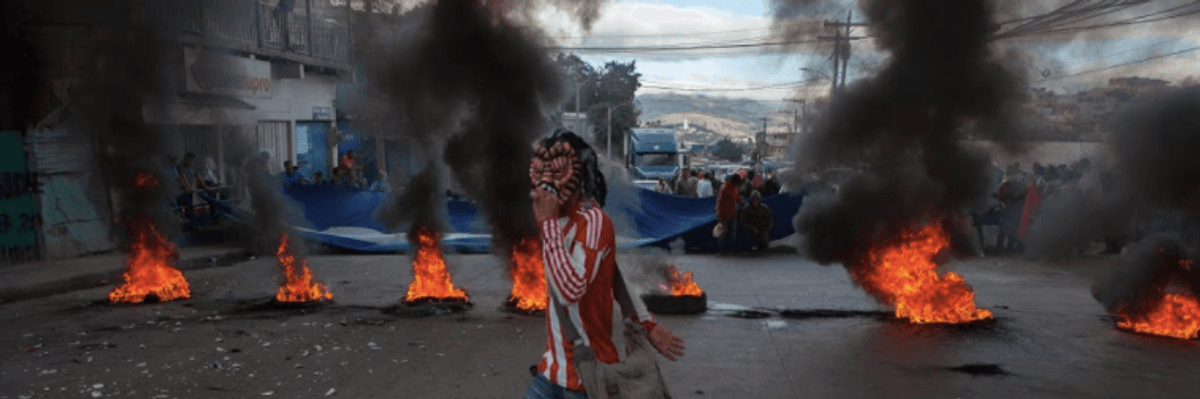
A protester walks by a barricade of burning tires in the neighborhood of Villanueva in Tegucigalpa, Honduras on December 15, 2017. (Photo: Jeff Abbott)
The current political and constitutional crisis in Honduras is poised to continue following a short lull in protests for the holiday season.
Early in the evening on December 17, the Tribunal Supremo Electoral issued the results of the recount of more than 5,000 polling stations. They declared that a careful recount of the ballots showed incumbent president Juan Orlando Hernandez of the Partido Nacional as the country's next president.
The observer mission from European Union, which oversaw the electoral process, issued a statement to the press supporting the recount. But observers from the Organization of the American States decried the recount. The group's secretary general, Luis Almagro, said in a statement:
"Deliberate human intrusions in the computer system, intentional elimination of digital traces, the impossibility of knowing the number of opportunities in which the system was violated, pouches of votes open or lacking votes, the extreme statistical improbability with respect to participation levels within the same department, recently printed ballots and additional irregularities, added to the narrow difference of votes between the two most voted candidates, make it impossible to determine with the necessary certainty the winner."
As the Organization of the American States called the election process into question, the United States released a short statement acknowledging and congratulating Orlando Hernandez for winning the election. Days later, on December 22, the U.S. State Department officially recognized his re-election.
Yet the disenfranchised population of Honduras maintains their willingness to fight the illegal election. The TSE announcement was met by continued protests that led up to the holiday vacations. But according to activists, the protests will continue into the new year.
"The people remain mobilized," Jesus Garza, a political and human rights analyst, told The Progressive. "This is not going to end."
Just days before the TSE announcement, protesters carried out a nationwide protest, where they blocked highways with barricades of burning tires.
"People in many parts of the country took nearly every highway in the country," Meicke Bautizo, a twenty-seven-year-old activist and human rights defender and resident of Villanueva, told The Progressive. In total, over eighty points key highways were blocked as part of the protest.
Protesters arrived early to establish their barricade of burning tires. Tensions between the protesters and the Honduran state security were high, as the Honduran military arrived and opened fired on small group of protesters.
"There were only about fifteen of us when I arrived," Bautizo recalls. "We quickly took the road, burning garbage. The military arrived with weapons in their hands and fired in the air, so we ran. But we returned to re-establish the barricade."
By 9 a.m., the heightened tensions boiled over into a street battle between protesters and the military as the national police bombarded the protesters with tear gas in an effort to clear the road. But the people returned, and encircled the members of the military.
As the protesters attempted to maintain their barricade, a small group of protesters broke off and began throwing rocks at the military forces. The battle was led onto the highway while the other group of protesters maintained the roadblock. One soldier was injured and two protesters were briefly detained amidst the clouds of tear gas and flying rocks.
Similar street battles were carried out at other barricades across the country. In colonia El Carrizal of Tegucigalpa protesters burned a military truck during the blockade of the highway.
Protesters once again took to the streets on December 18 following the TSE announcement to denounce Orlando Hernandez and what they consider to be a fraudulent election. They blocked highways across the country, leading to more clashes with the military and police. Yet in the northern community of Pimienta Cortes, protesters managed to disarm the police during clashes.
"The people have lost their fear of the rifles," Garza told The Progressive. "Across the country, the protesters are facing down the police and military."
Garza notes that this northern part of the country are among the most mobilized against the administration of Orlando Hernandez. This has occurred in part due to the work of labor organizing in the area.
"There is more social consciousness in the northern part of the country," Garza says. "This part of the country where the majority of industry is in the country, so as a result there is more labor activism in this part. This is also the part of the country that has seen the most repression."
According to the list of deaths since November 29 published by the human rights organization Comite de Familiares de Detenidos Desaparecidos en Honduras, at least nine of the seventeen documented deaths caused by the Honduran security forces have been in the northern part of the country.
Faced with the growing unrest, the Honduran government has further sought to discredit the movement against Orlando Hernandez by trying to argue that the violence at the barricades is being carried out by gang members.
"Members of the gangs participated in the taking of the roads," said Ricardo Alvarez, the Honduran vice president at a press conference on December 15. "They carried out acts of violence under the instructions of Manuel Zelaya and the candidate Salvador Nasralla."
In the same press conference, state officials accused the opposition of carrying out intimidation of voters during the election, and of distributing AK-47s amongst the gangs to generate terror.
The Honduran security forces have been carrying out a campaign against gang activity in conjunction with the militaries of Guatemala and El Salvador in order to rid the region of organized crime. The argument that the protests are infiltrated by gang members would permit the Honduran security forces to ratchet-up the repression.
The rhetoric of the state and the growing intensity of the protests has led many to fear that Honduras is heading toward a civil war.
"The situation of a popular insurrection is already given," Garza says. "The situation has gotten out of the hand of the military, as well as for leadership of the Alianza."
In response to the indications of electoral fraud, the OAS has called for a new round of elections. As Almagro wrote in his statement, "The only possible way for the victor to be the people of Honduras is a new call for general elections, within the framework of the strictest respect for the rule of law, with the guarantees of a TSE that enjoys the technical capacity and confidence of both the citizens and political parties."
Dear Common Dreams reader, It’s been nearly 30 years since I co-founded Common Dreams with my late wife, Lina Newhouser. We had the radical notion that journalism should serve the public good, not corporate profits. It was clear to us from the outset what it would take to build such a project. No paid advertisements. No corporate sponsors. No millionaire publisher telling us what to think or do. Many people said we wouldn't last a year, but we proved those doubters wrong. Together with a tremendous team of journalists and dedicated staff, we built an independent media outlet free from the constraints of profits and corporate control. Our mission has always been simple: To inform. To inspire. To ignite change for the common good. Building Common Dreams was not easy. Our survival was never guaranteed. When you take on the most powerful forces—Wall Street greed, fossil fuel industry destruction, Big Tech lobbyists, and uber-rich oligarchs who have spent billions upon billions rigging the economy and democracy in their favor—the only bulwark you have is supporters who believe in your work. But here’s the urgent message from me today. It's never been this bad out there. And it's never been this hard to keep us going. At the very moment Common Dreams is most needed, the threats we face are intensifying. We need your support now more than ever. We don't accept corporate advertising and never will. We don't have a paywall because we don't think people should be blocked from critical news based on their ability to pay. Everything we do is funded by the donations of readers like you. When everyone does the little they can afford, we are strong. But if that support retreats or dries up, so do we. Will you donate now to make sure Common Dreams not only survives but thrives? —Craig Brown, Co-founder |
The current political and constitutional crisis in Honduras is poised to continue following a short lull in protests for the holiday season.
Early in the evening on December 17, the Tribunal Supremo Electoral issued the results of the recount of more than 5,000 polling stations. They declared that a careful recount of the ballots showed incumbent president Juan Orlando Hernandez of the Partido Nacional as the country's next president.
The observer mission from European Union, which oversaw the electoral process, issued a statement to the press supporting the recount. But observers from the Organization of the American States decried the recount. The group's secretary general, Luis Almagro, said in a statement:
"Deliberate human intrusions in the computer system, intentional elimination of digital traces, the impossibility of knowing the number of opportunities in which the system was violated, pouches of votes open or lacking votes, the extreme statistical improbability with respect to participation levels within the same department, recently printed ballots and additional irregularities, added to the narrow difference of votes between the two most voted candidates, make it impossible to determine with the necessary certainty the winner."
As the Organization of the American States called the election process into question, the United States released a short statement acknowledging and congratulating Orlando Hernandez for winning the election. Days later, on December 22, the U.S. State Department officially recognized his re-election.
Yet the disenfranchised population of Honduras maintains their willingness to fight the illegal election. The TSE announcement was met by continued protests that led up to the holiday vacations. But according to activists, the protests will continue into the new year.
"The people remain mobilized," Jesus Garza, a political and human rights analyst, told The Progressive. "This is not going to end."
Just days before the TSE announcement, protesters carried out a nationwide protest, where they blocked highways with barricades of burning tires.
"People in many parts of the country took nearly every highway in the country," Meicke Bautizo, a twenty-seven-year-old activist and human rights defender and resident of Villanueva, told The Progressive. In total, over eighty points key highways were blocked as part of the protest.
Protesters arrived early to establish their barricade of burning tires. Tensions between the protesters and the Honduran state security were high, as the Honduran military arrived and opened fired on small group of protesters.
"There were only about fifteen of us when I arrived," Bautizo recalls. "We quickly took the road, burning garbage. The military arrived with weapons in their hands and fired in the air, so we ran. But we returned to re-establish the barricade."
By 9 a.m., the heightened tensions boiled over into a street battle between protesters and the military as the national police bombarded the protesters with tear gas in an effort to clear the road. But the people returned, and encircled the members of the military.
As the protesters attempted to maintain their barricade, a small group of protesters broke off and began throwing rocks at the military forces. The battle was led onto the highway while the other group of protesters maintained the roadblock. One soldier was injured and two protesters were briefly detained amidst the clouds of tear gas and flying rocks.
Similar street battles were carried out at other barricades across the country. In colonia El Carrizal of Tegucigalpa protesters burned a military truck during the blockade of the highway.
Protesters once again took to the streets on December 18 following the TSE announcement to denounce Orlando Hernandez and what they consider to be a fraudulent election. They blocked highways across the country, leading to more clashes with the military and police. Yet in the northern community of Pimienta Cortes, protesters managed to disarm the police during clashes.
"The people have lost their fear of the rifles," Garza told The Progressive. "Across the country, the protesters are facing down the police and military."
Garza notes that this northern part of the country are among the most mobilized against the administration of Orlando Hernandez. This has occurred in part due to the work of labor organizing in the area.
"There is more social consciousness in the northern part of the country," Garza says. "This part of the country where the majority of industry is in the country, so as a result there is more labor activism in this part. This is also the part of the country that has seen the most repression."
According to the list of deaths since November 29 published by the human rights organization Comite de Familiares de Detenidos Desaparecidos en Honduras, at least nine of the seventeen documented deaths caused by the Honduran security forces have been in the northern part of the country.
Faced with the growing unrest, the Honduran government has further sought to discredit the movement against Orlando Hernandez by trying to argue that the violence at the barricades is being carried out by gang members.
"Members of the gangs participated in the taking of the roads," said Ricardo Alvarez, the Honduran vice president at a press conference on December 15. "They carried out acts of violence under the instructions of Manuel Zelaya and the candidate Salvador Nasralla."
In the same press conference, state officials accused the opposition of carrying out intimidation of voters during the election, and of distributing AK-47s amongst the gangs to generate terror.
The Honduran security forces have been carrying out a campaign against gang activity in conjunction with the militaries of Guatemala and El Salvador in order to rid the region of organized crime. The argument that the protests are infiltrated by gang members would permit the Honduran security forces to ratchet-up the repression.
The rhetoric of the state and the growing intensity of the protests has led many to fear that Honduras is heading toward a civil war.
"The situation of a popular insurrection is already given," Garza says. "The situation has gotten out of the hand of the military, as well as for leadership of the Alianza."
In response to the indications of electoral fraud, the OAS has called for a new round of elections. As Almagro wrote in his statement, "The only possible way for the victor to be the people of Honduras is a new call for general elections, within the framework of the strictest respect for the rule of law, with the guarantees of a TSE that enjoys the technical capacity and confidence of both the citizens and political parties."
The current political and constitutional crisis in Honduras is poised to continue following a short lull in protests for the holiday season.
Early in the evening on December 17, the Tribunal Supremo Electoral issued the results of the recount of more than 5,000 polling stations. They declared that a careful recount of the ballots showed incumbent president Juan Orlando Hernandez of the Partido Nacional as the country's next president.
The observer mission from European Union, which oversaw the electoral process, issued a statement to the press supporting the recount. But observers from the Organization of the American States decried the recount. The group's secretary general, Luis Almagro, said in a statement:
"Deliberate human intrusions in the computer system, intentional elimination of digital traces, the impossibility of knowing the number of opportunities in which the system was violated, pouches of votes open or lacking votes, the extreme statistical improbability with respect to participation levels within the same department, recently printed ballots and additional irregularities, added to the narrow difference of votes between the two most voted candidates, make it impossible to determine with the necessary certainty the winner."
As the Organization of the American States called the election process into question, the United States released a short statement acknowledging and congratulating Orlando Hernandez for winning the election. Days later, on December 22, the U.S. State Department officially recognized his re-election.
Yet the disenfranchised population of Honduras maintains their willingness to fight the illegal election. The TSE announcement was met by continued protests that led up to the holiday vacations. But according to activists, the protests will continue into the new year.
"The people remain mobilized," Jesus Garza, a political and human rights analyst, told The Progressive. "This is not going to end."
Just days before the TSE announcement, protesters carried out a nationwide protest, where they blocked highways with barricades of burning tires.
"People in many parts of the country took nearly every highway in the country," Meicke Bautizo, a twenty-seven-year-old activist and human rights defender and resident of Villanueva, told The Progressive. In total, over eighty points key highways were blocked as part of the protest.
Protesters arrived early to establish their barricade of burning tires. Tensions between the protesters and the Honduran state security were high, as the Honduran military arrived and opened fired on small group of protesters.
"There were only about fifteen of us when I arrived," Bautizo recalls. "We quickly took the road, burning garbage. The military arrived with weapons in their hands and fired in the air, so we ran. But we returned to re-establish the barricade."
By 9 a.m., the heightened tensions boiled over into a street battle between protesters and the military as the national police bombarded the protesters with tear gas in an effort to clear the road. But the people returned, and encircled the members of the military.
As the protesters attempted to maintain their barricade, a small group of protesters broke off and began throwing rocks at the military forces. The battle was led onto the highway while the other group of protesters maintained the roadblock. One soldier was injured and two protesters were briefly detained amidst the clouds of tear gas and flying rocks.
Similar street battles were carried out at other barricades across the country. In colonia El Carrizal of Tegucigalpa protesters burned a military truck during the blockade of the highway.
Protesters once again took to the streets on December 18 following the TSE announcement to denounce Orlando Hernandez and what they consider to be a fraudulent election. They blocked highways across the country, leading to more clashes with the military and police. Yet in the northern community of Pimienta Cortes, protesters managed to disarm the police during clashes.
"The people have lost their fear of the rifles," Garza told The Progressive. "Across the country, the protesters are facing down the police and military."
Garza notes that this northern part of the country are among the most mobilized against the administration of Orlando Hernandez. This has occurred in part due to the work of labor organizing in the area.
"There is more social consciousness in the northern part of the country," Garza says. "This part of the country where the majority of industry is in the country, so as a result there is more labor activism in this part. This is also the part of the country that has seen the most repression."
According to the list of deaths since November 29 published by the human rights organization Comite de Familiares de Detenidos Desaparecidos en Honduras, at least nine of the seventeen documented deaths caused by the Honduran security forces have been in the northern part of the country.
Faced with the growing unrest, the Honduran government has further sought to discredit the movement against Orlando Hernandez by trying to argue that the violence at the barricades is being carried out by gang members.
"Members of the gangs participated in the taking of the roads," said Ricardo Alvarez, the Honduran vice president at a press conference on December 15. "They carried out acts of violence under the instructions of Manuel Zelaya and the candidate Salvador Nasralla."
In the same press conference, state officials accused the opposition of carrying out intimidation of voters during the election, and of distributing AK-47s amongst the gangs to generate terror.
The Honduran security forces have been carrying out a campaign against gang activity in conjunction with the militaries of Guatemala and El Salvador in order to rid the region of organized crime. The argument that the protests are infiltrated by gang members would permit the Honduran security forces to ratchet-up the repression.
The rhetoric of the state and the growing intensity of the protests has led many to fear that Honduras is heading toward a civil war.
"The situation of a popular insurrection is already given," Garza says. "The situation has gotten out of the hand of the military, as well as for leadership of the Alianza."
In response to the indications of electoral fraud, the OAS has called for a new round of elections. As Almagro wrote in his statement, "The only possible way for the victor to be the people of Honduras is a new call for general elections, within the framework of the strictest respect for the rule of law, with the guarantees of a TSE that enjoys the technical capacity and confidence of both the citizens and political parties."