SUBSCRIBE TO OUR FREE NEWSLETTER
Daily news & progressive opinion—funded by the people, not the corporations—delivered straight to your inbox.
5
#000000
#FFFFFF
To donate by check, phone, or other method, see our More Ways to Give page.
Daily news & progressive opinion—funded by the people, not the corporations—delivered straight to your inbox.
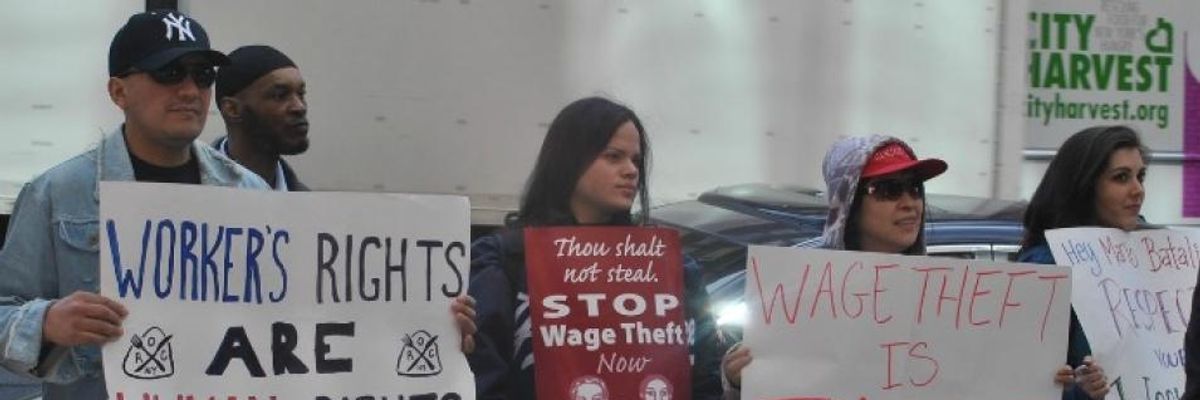
"Immigrant workers are particularly vulnerable to wage theft and unsafe working conditions because employers realize they will be reluctant to report violations out of fear of being reported to immigration authorities."(Photo: Unitarian Universalist Service Committee/flickr/cc)
Wage theft, whichcosts America's low-wage workers an estimated $50 billion each year, comes in different forms. An employer could keep customer tips instead of paying them out to workers, force employees to work off the clock without compensation, or illegally deduct the cost of uniforms or work tools from employees' paycheck.
Chances are that you know someone who has experienced wage theft. Every year, millions of workers, many of them undocumented immigrants afraid to speak out, suffer from wage theft when employers or companies do not pay them what they are owed.
In fact, more than two-thirds of low-wage workers experienced wage theft in their previous workweeks in New York City, Chicago, and Los Angeles, according to a 2009 study by the National Employment Law Project (NELP). In New York alone, the state's Department of Labor in 2014 recovered $30 million in wages for 27,000 claimants - most likely a fraction of the actual wages stolen from hard-working New Yorkers that year.
Immigrant workers are particularly vulnerable to wage theft and unsafe working conditions because employers realize they will be reluctant to report violations out of fear of being reported to immigration authorities.
Their fear is justified. This past year, officers from Immigration and Custom Enforcement (ICE) have shown up at labor dispute proceedings in California in what appear to be cases of employer retaliation against workers speaking out against labor violations. ICE has also contacted California state officials to ask for details about ongoing investigations into labor violations at several construction sites in Los Angeles. And although undocumented immigrants are often eligible for workers' compensation, employers' insurance companies are now reporting undocumented workers to ICE or arresting them for insurance fraud when they get hurt on the job.
This is unacceptable -- and also illegal. Workers should feel confident that their claims will be investigated, and that law-breaking employers will be held accountable, without fearing they will lose their jobs, or worse, be torn from their families and deported. Moreover, law-abiding companies should not have to compete with those that lower costs by cheating and endangering vulnerable workers.
It is more important than ever that community organizations stand up for low-wage workers, especially immigrants, to make sure their rights at work are honored. Over the last decade, workers, advocates and community leaders can claim many achievements in combating wage theft in cities and states across the country. Campaigns have organized direct actions against employers and industries, fought for stronger legal protections, and won increasing funding for enforcement.
For example, Maryland passed a Wage Lien law in 2013, allowing workers who have been victims of wage theft to file a lien on their employer's property. California enacted a comprehensive wage theft prevention law in 2015 to prevent companies from evading liability for wage theft by changing name or ownership, and requiring offenders with outstanding judgments to post a bond in order to continue operating, following strong anti-retaliation laws enacted in 2013 that add strong penalties for employers who use unfair immigration-related practices to retaliate and instill fear in undocumented workers.
New York City's Fast Food Worker Empowerment Bill, passed this Spring, will allow workers in the fast food industry to build, through voluntary financial contributions deducted from their paychecks, a strong organization through which they can enforce workplace laws in the violation-prone fast food industry.
Despite these advances, we need more proactive investigations of high-risk industries, better tools to go after law-breaking employers, and more resources to inform workers of their rights and help them pursue justice.
That's why the Center for Popular Democracy supports organizations and worker-leaders across the country in standing up for workers and immigrants. As part of that effort, we have created a toolkit to help organizations join the fight against wage theft and hold companies accountable.
The toolkit, called "A Practical Guide to Combating Wage Theft: Lessons from the Field," offers a framework for developing winning worker-led campaigns. Drawing lessons from victories around the country, the Guide includes tips for building strong and diverse coalitions, enacting wage theft legislation at the city and state level, and developing a powerful communications strategy that names and shames bad actors.
We hope the toolkit inspires worker advocates to take bold action -- like directly confronting employers that cheat workers; and to demand innovative policy solutions -- such as deputizing employees to file suit to recover penalties, to supplement the government's limited enforcement resources.
By following some of the strategies outlined in our toolkit, we can fight back against rampant wage theft and allow our immigrant workers to feel safe in their jobs and communities.
Dear Common Dreams reader, It’s been nearly 30 years since I co-founded Common Dreams with my late wife, Lina Newhouser. We had the radical notion that journalism should serve the public good, not corporate profits. It was clear to us from the outset what it would take to build such a project. No paid advertisements. No corporate sponsors. No millionaire publisher telling us what to think or do. Many people said we wouldn't last a year, but we proved those doubters wrong. Together with a tremendous team of journalists and dedicated staff, we built an independent media outlet free from the constraints of profits and corporate control. Our mission has always been simple: To inform. To inspire. To ignite change for the common good. Building Common Dreams was not easy. Our survival was never guaranteed. When you take on the most powerful forces—Wall Street greed, fossil fuel industry destruction, Big Tech lobbyists, and uber-rich oligarchs who have spent billions upon billions rigging the economy and democracy in their favor—the only bulwark you have is supporters who believe in your work. But here’s the urgent message from me today. It's never been this bad out there. And it's never been this hard to keep us going. At the very moment Common Dreams is most needed, the threats we face are intensifying. We need your support now more than ever. We don't accept corporate advertising and never will. We don't have a paywall because we don't think people should be blocked from critical news based on their ability to pay. Everything we do is funded by the donations of readers like you. When everyone does the little they can afford, we are strong. But if that support retreats or dries up, so do we. Will you donate now to make sure Common Dreams not only survives but thrives? —Craig Brown, Co-founder |
Wage theft, whichcosts America's low-wage workers an estimated $50 billion each year, comes in different forms. An employer could keep customer tips instead of paying them out to workers, force employees to work off the clock without compensation, or illegally deduct the cost of uniforms or work tools from employees' paycheck.
Chances are that you know someone who has experienced wage theft. Every year, millions of workers, many of them undocumented immigrants afraid to speak out, suffer from wage theft when employers or companies do not pay them what they are owed.
In fact, more than two-thirds of low-wage workers experienced wage theft in their previous workweeks in New York City, Chicago, and Los Angeles, according to a 2009 study by the National Employment Law Project (NELP). In New York alone, the state's Department of Labor in 2014 recovered $30 million in wages for 27,000 claimants - most likely a fraction of the actual wages stolen from hard-working New Yorkers that year.
Immigrant workers are particularly vulnerable to wage theft and unsafe working conditions because employers realize they will be reluctant to report violations out of fear of being reported to immigration authorities.
Their fear is justified. This past year, officers from Immigration and Custom Enforcement (ICE) have shown up at labor dispute proceedings in California in what appear to be cases of employer retaliation against workers speaking out against labor violations. ICE has also contacted California state officials to ask for details about ongoing investigations into labor violations at several construction sites in Los Angeles. And although undocumented immigrants are often eligible for workers' compensation, employers' insurance companies are now reporting undocumented workers to ICE or arresting them for insurance fraud when they get hurt on the job.
This is unacceptable -- and also illegal. Workers should feel confident that their claims will be investigated, and that law-breaking employers will be held accountable, without fearing they will lose their jobs, or worse, be torn from their families and deported. Moreover, law-abiding companies should not have to compete with those that lower costs by cheating and endangering vulnerable workers.
It is more important than ever that community organizations stand up for low-wage workers, especially immigrants, to make sure their rights at work are honored. Over the last decade, workers, advocates and community leaders can claim many achievements in combating wage theft in cities and states across the country. Campaigns have organized direct actions against employers and industries, fought for stronger legal protections, and won increasing funding for enforcement.
For example, Maryland passed a Wage Lien law in 2013, allowing workers who have been victims of wage theft to file a lien on their employer's property. California enacted a comprehensive wage theft prevention law in 2015 to prevent companies from evading liability for wage theft by changing name or ownership, and requiring offenders with outstanding judgments to post a bond in order to continue operating, following strong anti-retaliation laws enacted in 2013 that add strong penalties for employers who use unfair immigration-related practices to retaliate and instill fear in undocumented workers.
New York City's Fast Food Worker Empowerment Bill, passed this Spring, will allow workers in the fast food industry to build, through voluntary financial contributions deducted from their paychecks, a strong organization through which they can enforce workplace laws in the violation-prone fast food industry.
Despite these advances, we need more proactive investigations of high-risk industries, better tools to go after law-breaking employers, and more resources to inform workers of their rights and help them pursue justice.
That's why the Center for Popular Democracy supports organizations and worker-leaders across the country in standing up for workers and immigrants. As part of that effort, we have created a toolkit to help organizations join the fight against wage theft and hold companies accountable.
The toolkit, called "A Practical Guide to Combating Wage Theft: Lessons from the Field," offers a framework for developing winning worker-led campaigns. Drawing lessons from victories around the country, the Guide includes tips for building strong and diverse coalitions, enacting wage theft legislation at the city and state level, and developing a powerful communications strategy that names and shames bad actors.
We hope the toolkit inspires worker advocates to take bold action -- like directly confronting employers that cheat workers; and to demand innovative policy solutions -- such as deputizing employees to file suit to recover penalties, to supplement the government's limited enforcement resources.
By following some of the strategies outlined in our toolkit, we can fight back against rampant wage theft and allow our immigrant workers to feel safe in their jobs and communities.
Wage theft, whichcosts America's low-wage workers an estimated $50 billion each year, comes in different forms. An employer could keep customer tips instead of paying them out to workers, force employees to work off the clock without compensation, or illegally deduct the cost of uniforms or work tools from employees' paycheck.
Chances are that you know someone who has experienced wage theft. Every year, millions of workers, many of them undocumented immigrants afraid to speak out, suffer from wage theft when employers or companies do not pay them what they are owed.
In fact, more than two-thirds of low-wage workers experienced wage theft in their previous workweeks in New York City, Chicago, and Los Angeles, according to a 2009 study by the National Employment Law Project (NELP). In New York alone, the state's Department of Labor in 2014 recovered $30 million in wages for 27,000 claimants - most likely a fraction of the actual wages stolen from hard-working New Yorkers that year.
Immigrant workers are particularly vulnerable to wage theft and unsafe working conditions because employers realize they will be reluctant to report violations out of fear of being reported to immigration authorities.
Their fear is justified. This past year, officers from Immigration and Custom Enforcement (ICE) have shown up at labor dispute proceedings in California in what appear to be cases of employer retaliation against workers speaking out against labor violations. ICE has also contacted California state officials to ask for details about ongoing investigations into labor violations at several construction sites in Los Angeles. And although undocumented immigrants are often eligible for workers' compensation, employers' insurance companies are now reporting undocumented workers to ICE or arresting them for insurance fraud when they get hurt on the job.
This is unacceptable -- and also illegal. Workers should feel confident that their claims will be investigated, and that law-breaking employers will be held accountable, without fearing they will lose their jobs, or worse, be torn from their families and deported. Moreover, law-abiding companies should not have to compete with those that lower costs by cheating and endangering vulnerable workers.
It is more important than ever that community organizations stand up for low-wage workers, especially immigrants, to make sure their rights at work are honored. Over the last decade, workers, advocates and community leaders can claim many achievements in combating wage theft in cities and states across the country. Campaigns have organized direct actions against employers and industries, fought for stronger legal protections, and won increasing funding for enforcement.
For example, Maryland passed a Wage Lien law in 2013, allowing workers who have been victims of wage theft to file a lien on their employer's property. California enacted a comprehensive wage theft prevention law in 2015 to prevent companies from evading liability for wage theft by changing name or ownership, and requiring offenders with outstanding judgments to post a bond in order to continue operating, following strong anti-retaliation laws enacted in 2013 that add strong penalties for employers who use unfair immigration-related practices to retaliate and instill fear in undocumented workers.
New York City's Fast Food Worker Empowerment Bill, passed this Spring, will allow workers in the fast food industry to build, through voluntary financial contributions deducted from their paychecks, a strong organization through which they can enforce workplace laws in the violation-prone fast food industry.
Despite these advances, we need more proactive investigations of high-risk industries, better tools to go after law-breaking employers, and more resources to inform workers of their rights and help them pursue justice.
That's why the Center for Popular Democracy supports organizations and worker-leaders across the country in standing up for workers and immigrants. As part of that effort, we have created a toolkit to help organizations join the fight against wage theft and hold companies accountable.
The toolkit, called "A Practical Guide to Combating Wage Theft: Lessons from the Field," offers a framework for developing winning worker-led campaigns. Drawing lessons from victories around the country, the Guide includes tips for building strong and diverse coalitions, enacting wage theft legislation at the city and state level, and developing a powerful communications strategy that names and shames bad actors.
We hope the toolkit inspires worker advocates to take bold action -- like directly confronting employers that cheat workers; and to demand innovative policy solutions -- such as deputizing employees to file suit to recover penalties, to supplement the government's limited enforcement resources.
By following some of the strategies outlined in our toolkit, we can fight back against rampant wage theft and allow our immigrant workers to feel safe in their jobs and communities.