SUBSCRIBE TO OUR FREE NEWSLETTER
Daily news & progressive opinion—funded by the people, not the corporations—delivered straight to your inbox.
5
#000000
#FFFFFF
To donate by check, phone, or other method, see our More Ways to Give page.
Daily news & progressive opinion—funded by the people, not the corporations—delivered straight to your inbox.
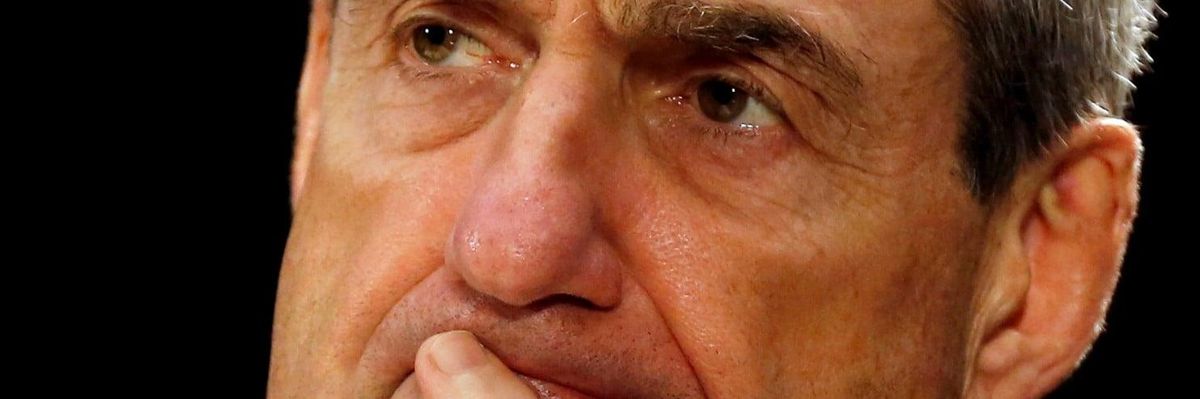
Robert S. Mueller III on Capitol Hill. (Larry Downing/Reuters)
Special counsel Robert S. Mueller III is a mythic presence in Washington. He is everywhere and nowhere: As the world revolves around him, he continues to elude the press and the public. Even the location of his office remains unknown.
Compare this with the president, who cannot help but make himself the center of attention in any situation and who blurts out his every thought on Twitter. Mueller's investigation into Russian interference in the 2016 election is a black box. The Trump White House is the leakiest in memory. Where Trump is loud, Mueller is quiet. Where Trump is brash, Mueller is careful. Trump is the builder of the gilding-encrusted, marble-clad tower. The architecture with which Mueller is most identified is the drab, utilitarian J. Edgar Hoover Building.
In the American imagination, Mueller is more than Trump's adversary or the man who happens to be investigating him. He's the president's mythic opposite -- the anti-Trump.
That opposition runs deeper than discordant personal styles. With his long government career, Mueller is the embodiment of the "deep state" derided by the president's defenders. But another way to describe the deep state is as a network of government institutions staffed by devoted public servants. Trump's presidency has distinguished itself by a marked lack of respect for those institutions, whether through neglect, derision or outright attempts at what former White House adviser Stephen K. Bannon termed "the deconstruction of the administrative state." More profoundly, Trump's disregard for the usual checks on executive power calls into question whether the president will leave his office and the government as a whole irretrievably broken.
Mueller, in contrast, stands for the strength of those institutions -- not just because of his own public service but also because his investigation now concerns Trump's breach of institutional integrity in dismissing then-FBI Director James B. Comey. This is a major source of Mueller's appeal to Trump's critics. We don't just hope that Mueller's investigation will expose whatever wrongdoing took place. We want him to reestablish the order that has been lost. It's a demand for justice in the sense described by the philosopher Immanuel Kant: We punish a crime not only to assert that the act was wrong but also to reaffirm the existence of the moral system disregarded by the criminal.
Trump's disrespect for institutions is also a disrespect for the moral systems they represent. His repeated efforts to interfere with the independence of the Justice Department are a declaration that right and wrong, legal and illegal are whatever he says they are. This stance is an outgrowth of his flexible relationship with truth -- his willingness to say anything and contradict himself moments later, with no expectation of consequence. Mueller is an avatar of our hope that justice and meaning will reassert themselves against Trumpian insincerity.
The trouble, of course, is that Mueller cannot and will not save us.
There's no way of knowing how long his investigation will take and what it will turn up. It could be years before the probe is completed. It could be that Mueller's team finds no evidence of criminal misconduct on the part of the president himself. And because the special counsel has no obligation to report his conclusions to the public -- indeed, the special-counsel regulations do not give him the power to do so without the approval of Deputy Attorney General Rod J. Rosenstein -- we may never know what he uncovers.
More profoundly, it is a mistake to conflate whatever legal wrongdoing the president and those around him may have engaged in with Trump's even more profound failures of morality and leadership. The horror of much of his behavior is that it may be well within the law and presidential authority -- and yet entirely unacceptable. This is true both for his more egregious actions, such as his dismissal of Comey, and his less consequential but still discomfiting behavior, such as his inability to display the bare minimum of empathy for hurricane-devastated Puerto Rico. When viewed in the context of Trump's other actions, Comey's firing may raise the question of obstruction of justice. But on its own, it's no more illegal or unconstitutional for the president to fire the FBI director than it is for him to toss paper towels to hurricane victims.
It is comforting to reduce the mess of our politics to a clash between the opposing deities of Mueller and Trump. But doing so is also a way to avoid grappling with more difficult problems: What does it mean to have a president who behaves this way? What forces carried him into office, and how do we as a country address them? These are not questions that an official investigation can answer. Ultimately, we imagine Mueller as a white knight because it's easier than taking responsibility for confronting this presidency ourselves.
Dear Common Dreams reader, It’s been nearly 30 years since I co-founded Common Dreams with my late wife, Lina Newhouser. We had the radical notion that journalism should serve the public good, not corporate profits. It was clear to us from the outset what it would take to build such a project. No paid advertisements. No corporate sponsors. No millionaire publisher telling us what to think or do. Many people said we wouldn't last a year, but we proved those doubters wrong. Together with a tremendous team of journalists and dedicated staff, we built an independent media outlet free from the constraints of profits and corporate control. Our mission has always been simple: To inform. To inspire. To ignite change for the common good. Building Common Dreams was not easy. Our survival was never guaranteed. When you take on the most powerful forces—Wall Street greed, fossil fuel industry destruction, Big Tech lobbyists, and uber-rich oligarchs who have spent billions upon billions rigging the economy and democracy in their favor—the only bulwark you have is supporters who believe in your work. But here’s the urgent message from me today. It's never been this bad out there. And it's never been this hard to keep us going. At the very moment Common Dreams is most needed, the threats we face are intensifying. We need your support now more than ever. We don't accept corporate advertising and never will. We don't have a paywall because we don't think people should be blocked from critical news based on their ability to pay. Everything we do is funded by the donations of readers like you. When everyone does the little they can afford, we are strong. But if that support retreats or dries up, so do we. Will you donate now to make sure Common Dreams not only survives but thrives? —Craig Brown, Co-founder |
Special counsel Robert S. Mueller III is a mythic presence in Washington. He is everywhere and nowhere: As the world revolves around him, he continues to elude the press and the public. Even the location of his office remains unknown.
Compare this with the president, who cannot help but make himself the center of attention in any situation and who blurts out his every thought on Twitter. Mueller's investigation into Russian interference in the 2016 election is a black box. The Trump White House is the leakiest in memory. Where Trump is loud, Mueller is quiet. Where Trump is brash, Mueller is careful. Trump is the builder of the gilding-encrusted, marble-clad tower. The architecture with which Mueller is most identified is the drab, utilitarian J. Edgar Hoover Building.
In the American imagination, Mueller is more than Trump's adversary or the man who happens to be investigating him. He's the president's mythic opposite -- the anti-Trump.
That opposition runs deeper than discordant personal styles. With his long government career, Mueller is the embodiment of the "deep state" derided by the president's defenders. But another way to describe the deep state is as a network of government institutions staffed by devoted public servants. Trump's presidency has distinguished itself by a marked lack of respect for those institutions, whether through neglect, derision or outright attempts at what former White House adviser Stephen K. Bannon termed "the deconstruction of the administrative state." More profoundly, Trump's disregard for the usual checks on executive power calls into question whether the president will leave his office and the government as a whole irretrievably broken.
Mueller, in contrast, stands for the strength of those institutions -- not just because of his own public service but also because his investigation now concerns Trump's breach of institutional integrity in dismissing then-FBI Director James B. Comey. This is a major source of Mueller's appeal to Trump's critics. We don't just hope that Mueller's investigation will expose whatever wrongdoing took place. We want him to reestablish the order that has been lost. It's a demand for justice in the sense described by the philosopher Immanuel Kant: We punish a crime not only to assert that the act was wrong but also to reaffirm the existence of the moral system disregarded by the criminal.
Trump's disrespect for institutions is also a disrespect for the moral systems they represent. His repeated efforts to interfere with the independence of the Justice Department are a declaration that right and wrong, legal and illegal are whatever he says they are. This stance is an outgrowth of his flexible relationship with truth -- his willingness to say anything and contradict himself moments later, with no expectation of consequence. Mueller is an avatar of our hope that justice and meaning will reassert themselves against Trumpian insincerity.
The trouble, of course, is that Mueller cannot and will not save us.
There's no way of knowing how long his investigation will take and what it will turn up. It could be years before the probe is completed. It could be that Mueller's team finds no evidence of criminal misconduct on the part of the president himself. And because the special counsel has no obligation to report his conclusions to the public -- indeed, the special-counsel regulations do not give him the power to do so without the approval of Deputy Attorney General Rod J. Rosenstein -- we may never know what he uncovers.
More profoundly, it is a mistake to conflate whatever legal wrongdoing the president and those around him may have engaged in with Trump's even more profound failures of morality and leadership. The horror of much of his behavior is that it may be well within the law and presidential authority -- and yet entirely unacceptable. This is true both for his more egregious actions, such as his dismissal of Comey, and his less consequential but still discomfiting behavior, such as his inability to display the bare minimum of empathy for hurricane-devastated Puerto Rico. When viewed in the context of Trump's other actions, Comey's firing may raise the question of obstruction of justice. But on its own, it's no more illegal or unconstitutional for the president to fire the FBI director than it is for him to toss paper towels to hurricane victims.
It is comforting to reduce the mess of our politics to a clash between the opposing deities of Mueller and Trump. But doing so is also a way to avoid grappling with more difficult problems: What does it mean to have a president who behaves this way? What forces carried him into office, and how do we as a country address them? These are not questions that an official investigation can answer. Ultimately, we imagine Mueller as a white knight because it's easier than taking responsibility for confronting this presidency ourselves.
Special counsel Robert S. Mueller III is a mythic presence in Washington. He is everywhere and nowhere: As the world revolves around him, he continues to elude the press and the public. Even the location of his office remains unknown.
Compare this with the president, who cannot help but make himself the center of attention in any situation and who blurts out his every thought on Twitter. Mueller's investigation into Russian interference in the 2016 election is a black box. The Trump White House is the leakiest in memory. Where Trump is loud, Mueller is quiet. Where Trump is brash, Mueller is careful. Trump is the builder of the gilding-encrusted, marble-clad tower. The architecture with which Mueller is most identified is the drab, utilitarian J. Edgar Hoover Building.
In the American imagination, Mueller is more than Trump's adversary or the man who happens to be investigating him. He's the president's mythic opposite -- the anti-Trump.
That opposition runs deeper than discordant personal styles. With his long government career, Mueller is the embodiment of the "deep state" derided by the president's defenders. But another way to describe the deep state is as a network of government institutions staffed by devoted public servants. Trump's presidency has distinguished itself by a marked lack of respect for those institutions, whether through neglect, derision or outright attempts at what former White House adviser Stephen K. Bannon termed "the deconstruction of the administrative state." More profoundly, Trump's disregard for the usual checks on executive power calls into question whether the president will leave his office and the government as a whole irretrievably broken.
Mueller, in contrast, stands for the strength of those institutions -- not just because of his own public service but also because his investigation now concerns Trump's breach of institutional integrity in dismissing then-FBI Director James B. Comey. This is a major source of Mueller's appeal to Trump's critics. We don't just hope that Mueller's investigation will expose whatever wrongdoing took place. We want him to reestablish the order that has been lost. It's a demand for justice in the sense described by the philosopher Immanuel Kant: We punish a crime not only to assert that the act was wrong but also to reaffirm the existence of the moral system disregarded by the criminal.
Trump's disrespect for institutions is also a disrespect for the moral systems they represent. His repeated efforts to interfere with the independence of the Justice Department are a declaration that right and wrong, legal and illegal are whatever he says they are. This stance is an outgrowth of his flexible relationship with truth -- his willingness to say anything and contradict himself moments later, with no expectation of consequence. Mueller is an avatar of our hope that justice and meaning will reassert themselves against Trumpian insincerity.
The trouble, of course, is that Mueller cannot and will not save us.
There's no way of knowing how long his investigation will take and what it will turn up. It could be years before the probe is completed. It could be that Mueller's team finds no evidence of criminal misconduct on the part of the president himself. And because the special counsel has no obligation to report his conclusions to the public -- indeed, the special-counsel regulations do not give him the power to do so without the approval of Deputy Attorney General Rod J. Rosenstein -- we may never know what he uncovers.
More profoundly, it is a mistake to conflate whatever legal wrongdoing the president and those around him may have engaged in with Trump's even more profound failures of morality and leadership. The horror of much of his behavior is that it may be well within the law and presidential authority -- and yet entirely unacceptable. This is true both for his more egregious actions, such as his dismissal of Comey, and his less consequential but still discomfiting behavior, such as his inability to display the bare minimum of empathy for hurricane-devastated Puerto Rico. When viewed in the context of Trump's other actions, Comey's firing may raise the question of obstruction of justice. But on its own, it's no more illegal or unconstitutional for the president to fire the FBI director than it is for him to toss paper towels to hurricane victims.
It is comforting to reduce the mess of our politics to a clash between the opposing deities of Mueller and Trump. But doing so is also a way to avoid grappling with more difficult problems: What does it mean to have a president who behaves this way? What forces carried him into office, and how do we as a country address them? These are not questions that an official investigation can answer. Ultimately, we imagine Mueller as a white knight because it's easier than taking responsibility for confronting this presidency ourselves.