SUBSCRIBE TO OUR FREE NEWSLETTER
Daily news & progressive opinion—funded by the people, not the corporations—delivered straight to your inbox.
5
#000000
#FFFFFF
To donate by check, phone, or other method, see our More Ways to Give page.
Daily news & progressive opinion—funded by the people, not the corporations—delivered straight to your inbox.
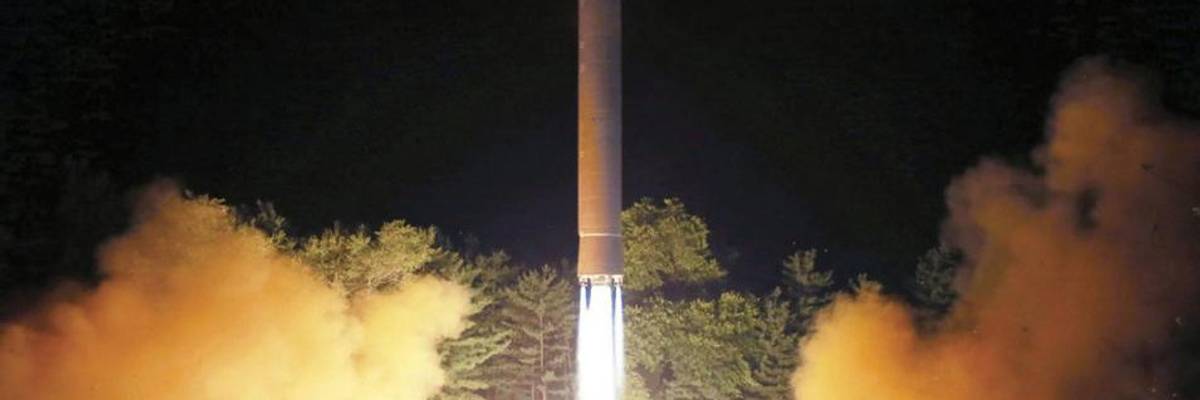
As North Korea boasted in July that it had launched an intercontinental ballistic missile capable of carrying a nuclear warhead, it's more important than ever that Canada play a leadership role in pushing for nuclear disarmament, Linda McQuaig argues. (Korean Central News Agency/The Associated Press)
So insistent was Canada in pushing for nuclear disarmament that we became known among top NATO generals as the "nuclear nag."
Make no mistake -- that was meant as an insult. But it gives me a shiver of pride to think that Canada was smeared because of our insistence on challenging NATO's top brass over its determination to keep the world armed to the teeth with nuclear weapons.
There have been impressive moments in our history when Canada, under previous Liberal governments, asserted itself as a feisty middle power by supporting, even occasionally leading, the push to get nuclear disarmament onto the global agenda, which makes the retreat by our current Liberal government all the more disappointing.
It's certainly tragic that Canada's once-brave resolve on the nuclear front should wither at such a critical moment. Not only does the world find its fate in the hands of arguably the two most infantile men ever to control nuclear weapons, as North Korea's Kim Jong Un and his U.S. counterpart play a game of nuclear chicken, but the world's nations have just come together as never before in an effort to dismantle the globe's nuclear arsenal.
This unprecedented action, the first such breakthrough in the 70-year effort to avert a nuclear war, happened at the United Nations last month. After months of talks, two-thirds of the UN's 192 nations agreed to a 10-page treaty aimed at ultimately destroying all nuclear weapons and prohibiting the creation of new ones.
Canada was not among those nations, having boycotted the process, as demanded by Washington. (In a letter last fall, the U.S. insisted NATO countries boycott the talks, and almost all complied.)
Canada argued that, with no nuclear powers at the table, the talks were pointless.
So why do the majority of the world's nations keep yammering on about something that, admittedly, does seem hard to imagine happening?
Perhaps it's just a perverse desire to live. There's also the precedent of how similar big-power resistance was overcome, enabling the signing of international treaties banning biological and chemical weapons, cluster bombs and landmines. Today, anyone harbouring or using such weapons is treated as a pariah.
Yet nuclear weapons, the most deadly and world-ending of armaments, are somehow regarded as legitimate (at least for our side to have). NATO documents describe them as "essential." Imagine a NATO general saying that about chemical weapons!
Canada played a particularly impressive role in achieving a global ban on landmines. Despite initial opposition from the five permanent members of the UN Security Council, then Canadian foreign affairs minister Lloyd Axworthy took extraordinary measures, creating a parallel set of international negotiations that became known as the "Ottawa process." Through sheer effort, ingenuity and close co-operation with popular movements, that led to the global ban in 1999.
Ottawa also acted boldly in challenging the NATO leadership over its staunch pro-nuclear stance, obliging it to carry out a review in 2000.
Canada showed resolve again in 2002 when it broke rank with Washington and NATO by voting in support of a UN disarmament resolution advanced by a group of middle powers. In 2003, Canada took this gutsy action again, this time prompting seven NATO countries to follow its lead, and again in 2005, with fourteen NATO nations coming on board.
"It took bravery for Canada to do this," notes Douglas Roche, who served as Canadian ambassador for disarmament in the 1980s.
For that matter, a spirited refusal to accept the nuclear status quo was behind Pierre Trudeau's one-man peace mission to the world's nuclear capitals in 1983.
Roche said that former Soviet leader Mikhail Gorbachev once told him that Pierre Trudeau's anti-nuclear efforts helped set the climate for the 1986 Reykjavik summit where Gorbachev and Ronald Reagan famously contemplated the complete abolition of nuclear weapons.
"In my professional experience," Roche said, "I have always found that Canada had influence, particularly in building the global security agenda, beyond our population size."
Unfortunately, Justin Trudeau decided not to support the current push for a UN treaty banning nuclear weapons, perhaps out of fear of annoying Washington.
Still, it's not too late -- now that it's negotiated, countries will begin signing the treaty Sept. 20.
Memo to Justin: As head of an influential nation, you could play a vital leadership role in the global struggle to abolish nuclear weapons and outlaw them forever. It's an action the world desperately needs, now more than ever. A side benefit would be exceeding expectations about filling your father's shoes.
This country and this world are at a monumental crossroads. US voters have an opportunity to beat back the forces of fascism and confront the billionaires who are rigging the economy, our media system, and our democracy, making it increasingly impossible for ordinary people to get by. We’re not just talking about the election. We’re talking about what must be done once these fascist elements are vanquished from power. We need a bolder set of solutions than what either major party has so far been willing to offer and a working-class movement ready to fight like hell for it. Trump didn't emerge from nowhere. The conditions that fueled MAGA authoritarianism were created by decades of radical neoliberal economic policies and a corrupt political system dominated by corporate interests. They slashed taxes on the super-rich, promising that the benefits would trickle down. They said giveaways to the corporate titans would make life more affordable for the rest of us. It was all bullshit. And when a bitter, betrayed populace searches for someone to blame, right-wing demagogues have little trouble finding scapegoats. People know when they're being lied to, but you won't hear any of this from the corporate media. Only independent journalism—powered and funded by people who believe in building a better world—can deliver truly trustworthy daily news. If you share our vision, please contribute whatever you can to sustain our work. |
So insistent was Canada in pushing for nuclear disarmament that we became known among top NATO generals as the "nuclear nag."
Make no mistake -- that was meant as an insult. But it gives me a shiver of pride to think that Canada was smeared because of our insistence on challenging NATO's top brass over its determination to keep the world armed to the teeth with nuclear weapons.
There have been impressive moments in our history when Canada, under previous Liberal governments, asserted itself as a feisty middle power by supporting, even occasionally leading, the push to get nuclear disarmament onto the global agenda, which makes the retreat by our current Liberal government all the more disappointing.
It's certainly tragic that Canada's once-brave resolve on the nuclear front should wither at such a critical moment. Not only does the world find its fate in the hands of arguably the two most infantile men ever to control nuclear weapons, as North Korea's Kim Jong Un and his U.S. counterpart play a game of nuclear chicken, but the world's nations have just come together as never before in an effort to dismantle the globe's nuclear arsenal.
This unprecedented action, the first such breakthrough in the 70-year effort to avert a nuclear war, happened at the United Nations last month. After months of talks, two-thirds of the UN's 192 nations agreed to a 10-page treaty aimed at ultimately destroying all nuclear weapons and prohibiting the creation of new ones.
Canada was not among those nations, having boycotted the process, as demanded by Washington. (In a letter last fall, the U.S. insisted NATO countries boycott the talks, and almost all complied.)
Canada argued that, with no nuclear powers at the table, the talks were pointless.
So why do the majority of the world's nations keep yammering on about something that, admittedly, does seem hard to imagine happening?
Perhaps it's just a perverse desire to live. There's also the precedent of how similar big-power resistance was overcome, enabling the signing of international treaties banning biological and chemical weapons, cluster bombs and landmines. Today, anyone harbouring or using such weapons is treated as a pariah.
Yet nuclear weapons, the most deadly and world-ending of armaments, are somehow regarded as legitimate (at least for our side to have). NATO documents describe them as "essential." Imagine a NATO general saying that about chemical weapons!
Canada played a particularly impressive role in achieving a global ban on landmines. Despite initial opposition from the five permanent members of the UN Security Council, then Canadian foreign affairs minister Lloyd Axworthy took extraordinary measures, creating a parallel set of international negotiations that became known as the "Ottawa process." Through sheer effort, ingenuity and close co-operation with popular movements, that led to the global ban in 1999.
Ottawa also acted boldly in challenging the NATO leadership over its staunch pro-nuclear stance, obliging it to carry out a review in 2000.
Canada showed resolve again in 2002 when it broke rank with Washington and NATO by voting in support of a UN disarmament resolution advanced by a group of middle powers. In 2003, Canada took this gutsy action again, this time prompting seven NATO countries to follow its lead, and again in 2005, with fourteen NATO nations coming on board.
"It took bravery for Canada to do this," notes Douglas Roche, who served as Canadian ambassador for disarmament in the 1980s.
For that matter, a spirited refusal to accept the nuclear status quo was behind Pierre Trudeau's one-man peace mission to the world's nuclear capitals in 1983.
Roche said that former Soviet leader Mikhail Gorbachev once told him that Pierre Trudeau's anti-nuclear efforts helped set the climate for the 1986 Reykjavik summit where Gorbachev and Ronald Reagan famously contemplated the complete abolition of nuclear weapons.
"In my professional experience," Roche said, "I have always found that Canada had influence, particularly in building the global security agenda, beyond our population size."
Unfortunately, Justin Trudeau decided not to support the current push for a UN treaty banning nuclear weapons, perhaps out of fear of annoying Washington.
Still, it's not too late -- now that it's negotiated, countries will begin signing the treaty Sept. 20.
Memo to Justin: As head of an influential nation, you could play a vital leadership role in the global struggle to abolish nuclear weapons and outlaw them forever. It's an action the world desperately needs, now more than ever. A side benefit would be exceeding expectations about filling your father's shoes.