SUBSCRIBE TO OUR FREE NEWSLETTER
Daily news & progressive opinion—funded by the people, not the corporations—delivered straight to your inbox.
5
#000000
#FFFFFF
To donate by check, phone, or other method, see our More Ways to Give page.
Daily news & progressive opinion—funded by the people, not the corporations—delivered straight to your inbox.
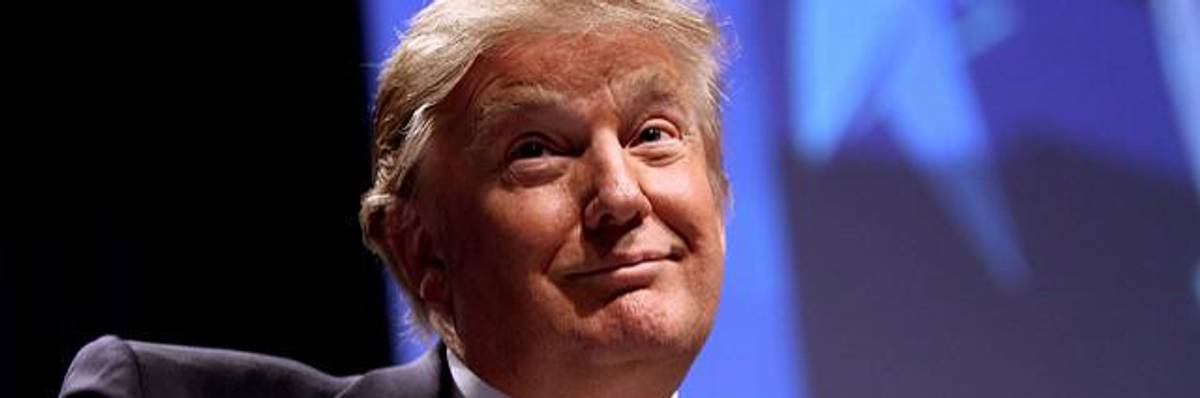
California Rep. Jackie Speier tweeted last week that Trump "is showing signs of erratic behavior and mental instability that place the country in grave danger." (Photo: Gage Skidmore/Flickr/CC)
How unstable and divorced from reality is President Trump? We've reached the point where the nation has the right and the need to know.
We're not accustomed to asking such questions about our presidents. We don't know how to even begin inquiring into a president's mental health, so we rationalize aberrant behavior as being part of some subtle strategy. We say that Trump is cleverly playing to his base, or employing the "madman theory" of foreign relations, or simply being unpredictable to gain an advantage by keeping everyone off balance.
How unstable and divorced from reality is President Trump? We've reached the point where the nation has the right and the need to know.
We're not accustomed to asking such questions about our presidents. We don't know how to even begin inquiring into a president's mental health, so we rationalize aberrant behavior as being part of some subtle strategy. We say that Trump is cleverly playing to his base, or employing the "madman theory" of foreign relations, or simply being unpredictable to gain an advantage by keeping everyone off balance.
But if Trump were really playing three-dimensional chess, presumably he'd be getting things done. His approval ratings would be rising rather than falling. Allies in Congress would be expressing admiration rather than increasing dismay.
Sen. Bob Corker (R-Tenn.) hit a nerve Thursday when he said that Trump "has not yet been able to demonstrate the stability nor some of the competence" needed in a president. That indictment was significant because Corker, who chairs the Foreign Relations Committee, is a respected Capitol Hill veteran who chooses his words carefully -- and who thus far has been willing to give Trump a chance. Corker said he feared that "our nation is going to go through great peril" and called for "radical change" at the White House.
Democrats have been slightly more plain-spoken. Rep. Adam B. Schiff told CNN on Sunday that "I certainly think that there's an issue with the president's capability." And fellow California Rep. Jackie Speier tweeted last week that Trump "is showing signs of erratic behavior and mental instability that place the country in grave danger."
Speier went so far as to call for action under the 25th Amendment, which allows the vice president and the Cabinet to relieve the president of his "powers and duties" if he is unable to discharge them.
Trump's performance last week following the Charlottesville incident was indeed alarming, the problem being not just what he said but how he said it. After initially blaming the violence -- which led to the death of 32-year-old Heather Heyer -- on "many sides," Trump reversed course and specifically condemned neo-Nazis and the Ku Klux Klan -- but looked like the reluctant star of a hostage video. Then the next day, Trump went back to blaming "both sides" in what can only be called an angry, red-faced rant.
We should assume that the ugliness we heard from Trump about Charlottesville reflects his true feelings. And we can conclude that he failed to grasp how jarring those sentiments would sound to most Americans' ears.
Anyone can have a bad day. But according to many published reports, Trump often erupts into rage -- especially when he sees something he doesn't like on the cable news shows he is said to watch compulsively.
In his Twitter postings, he increasingly lashes out in ways that are counterproductive. I can see some method behind his incessant ranting about "fake news," which may actually help him with his political base. But why attack Senate Majority Leader Mitch McConnell (R-Ky.) whose help the president needs if he is to get legislation passed or nominees approved? Why campaign against Sen. Jeff Flake (R-Ariz.), who has been a frequent critic but ended up supporting Trump on health care? Is Trump unable to imagine how other GOP senators -- whose votes he needs if he is to get anything done -- are going to react?
I have spoken with people who have known Trump for decades and who say he has changed. He exhibits less self-awareness, these longtime acquaintances say, and less capacity for sustained focus. Indeed, it is instructive to compare television interviews of Trump recorded years ago with those conducted now. To this layman's eyes and ears, there seems to have been deterioration.
I am not professionally qualified to assess the president's mental health; psychiatrists and psychologists who have the proper credentials and experience to do so are silenced by ethical rules. The stakes are so high, however, that the officials who work alongside Trump and observe him closely bear a tremendous responsibility. There is a huge difference between sounding as unhinged as North Korea's Kim Jong Un and actually being that unstable.
It is of some comfort that Trump is surrounded by levelheaded military men -- Defense Secretary Jim Mattis, national security adviser H.R. McMaster and Chief of Staff John Kelly -- who are unlikely to do anything rash. But no one elected them.
It is uncomfortable to talk about the president's mental health. But at this point it is irresponsible not to.
Dear Common Dreams reader, It’s been nearly 30 years since I co-founded Common Dreams with my late wife, Lina Newhouser. We had the radical notion that journalism should serve the public good, not corporate profits. It was clear to us from the outset what it would take to build such a project. No paid advertisements. No corporate sponsors. No millionaire publisher telling us what to think or do. Many people said we wouldn't last a year, but we proved those doubters wrong. Together with a tremendous team of journalists and dedicated staff, we built an independent media outlet free from the constraints of profits and corporate control. Our mission has always been simple: To inform. To inspire. To ignite change for the common good. Building Common Dreams was not easy. Our survival was never guaranteed. When you take on the most powerful forces—Wall Street greed, fossil fuel industry destruction, Big Tech lobbyists, and uber-rich oligarchs who have spent billions upon billions rigging the economy and democracy in their favor—the only bulwark you have is supporters who believe in your work. But here’s the urgent message from me today. It's never been this bad out there. And it's never been this hard to keep us going. At the very moment Common Dreams is most needed, the threats we face are intensifying. We need your support now more than ever. We don't accept corporate advertising and never will. We don't have a paywall because we don't think people should be blocked from critical news based on their ability to pay. Everything we do is funded by the donations of readers like you. When everyone does the little they can afford, we are strong. But if that support retreats or dries up, so do we. Will you donate now to make sure Common Dreams not only survives but thrives? —Craig Brown, Co-founder |
How unstable and divorced from reality is President Trump? We've reached the point where the nation has the right and the need to know.
We're not accustomed to asking such questions about our presidents. We don't know how to even begin inquiring into a president's mental health, so we rationalize aberrant behavior as being part of some subtle strategy. We say that Trump is cleverly playing to his base, or employing the "madman theory" of foreign relations, or simply being unpredictable to gain an advantage by keeping everyone off balance.
But if Trump were really playing three-dimensional chess, presumably he'd be getting things done. His approval ratings would be rising rather than falling. Allies in Congress would be expressing admiration rather than increasing dismay.
Sen. Bob Corker (R-Tenn.) hit a nerve Thursday when he said that Trump "has not yet been able to demonstrate the stability nor some of the competence" needed in a president. That indictment was significant because Corker, who chairs the Foreign Relations Committee, is a respected Capitol Hill veteran who chooses his words carefully -- and who thus far has been willing to give Trump a chance. Corker said he feared that "our nation is going to go through great peril" and called for "radical change" at the White House.
Democrats have been slightly more plain-spoken. Rep. Adam B. Schiff told CNN on Sunday that "I certainly think that there's an issue with the president's capability." And fellow California Rep. Jackie Speier tweeted last week that Trump "is showing signs of erratic behavior and mental instability that place the country in grave danger."
Speier went so far as to call for action under the 25th Amendment, which allows the vice president and the Cabinet to relieve the president of his "powers and duties" if he is unable to discharge them.
Trump's performance last week following the Charlottesville incident was indeed alarming, the problem being not just what he said but how he said it. After initially blaming the violence -- which led to the death of 32-year-old Heather Heyer -- on "many sides," Trump reversed course and specifically condemned neo-Nazis and the Ku Klux Klan -- but looked like the reluctant star of a hostage video. Then the next day, Trump went back to blaming "both sides" in what can only be called an angry, red-faced rant.
We should assume that the ugliness we heard from Trump about Charlottesville reflects his true feelings. And we can conclude that he failed to grasp how jarring those sentiments would sound to most Americans' ears.
Anyone can have a bad day. But according to many published reports, Trump often erupts into rage -- especially when he sees something he doesn't like on the cable news shows he is said to watch compulsively.
In his Twitter postings, he increasingly lashes out in ways that are counterproductive. I can see some method behind his incessant ranting about "fake news," which may actually help him with his political base. But why attack Senate Majority Leader Mitch McConnell (R-Ky.) whose help the president needs if he is to get legislation passed or nominees approved? Why campaign against Sen. Jeff Flake (R-Ariz.), who has been a frequent critic but ended up supporting Trump on health care? Is Trump unable to imagine how other GOP senators -- whose votes he needs if he is to get anything done -- are going to react?
I have spoken with people who have known Trump for decades and who say he has changed. He exhibits less self-awareness, these longtime acquaintances say, and less capacity for sustained focus. Indeed, it is instructive to compare television interviews of Trump recorded years ago with those conducted now. To this layman's eyes and ears, there seems to have been deterioration.
I am not professionally qualified to assess the president's mental health; psychiatrists and psychologists who have the proper credentials and experience to do so are silenced by ethical rules. The stakes are so high, however, that the officials who work alongside Trump and observe him closely bear a tremendous responsibility. There is a huge difference between sounding as unhinged as North Korea's Kim Jong Un and actually being that unstable.
It is of some comfort that Trump is surrounded by levelheaded military men -- Defense Secretary Jim Mattis, national security adviser H.R. McMaster and Chief of Staff John Kelly -- who are unlikely to do anything rash. But no one elected them.
It is uncomfortable to talk about the president's mental health. But at this point it is irresponsible not to.
How unstable and divorced from reality is President Trump? We've reached the point where the nation has the right and the need to know.
We're not accustomed to asking such questions about our presidents. We don't know how to even begin inquiring into a president's mental health, so we rationalize aberrant behavior as being part of some subtle strategy. We say that Trump is cleverly playing to his base, or employing the "madman theory" of foreign relations, or simply being unpredictable to gain an advantage by keeping everyone off balance.
But if Trump were really playing three-dimensional chess, presumably he'd be getting things done. His approval ratings would be rising rather than falling. Allies in Congress would be expressing admiration rather than increasing dismay.
Sen. Bob Corker (R-Tenn.) hit a nerve Thursday when he said that Trump "has not yet been able to demonstrate the stability nor some of the competence" needed in a president. That indictment was significant because Corker, who chairs the Foreign Relations Committee, is a respected Capitol Hill veteran who chooses his words carefully -- and who thus far has been willing to give Trump a chance. Corker said he feared that "our nation is going to go through great peril" and called for "radical change" at the White House.
Democrats have been slightly more plain-spoken. Rep. Adam B. Schiff told CNN on Sunday that "I certainly think that there's an issue with the president's capability." And fellow California Rep. Jackie Speier tweeted last week that Trump "is showing signs of erratic behavior and mental instability that place the country in grave danger."
Speier went so far as to call for action under the 25th Amendment, which allows the vice president and the Cabinet to relieve the president of his "powers and duties" if he is unable to discharge them.
Trump's performance last week following the Charlottesville incident was indeed alarming, the problem being not just what he said but how he said it. After initially blaming the violence -- which led to the death of 32-year-old Heather Heyer -- on "many sides," Trump reversed course and specifically condemned neo-Nazis and the Ku Klux Klan -- but looked like the reluctant star of a hostage video. Then the next day, Trump went back to blaming "both sides" in what can only be called an angry, red-faced rant.
We should assume that the ugliness we heard from Trump about Charlottesville reflects his true feelings. And we can conclude that he failed to grasp how jarring those sentiments would sound to most Americans' ears.
Anyone can have a bad day. But according to many published reports, Trump often erupts into rage -- especially when he sees something he doesn't like on the cable news shows he is said to watch compulsively.
In his Twitter postings, he increasingly lashes out in ways that are counterproductive. I can see some method behind his incessant ranting about "fake news," which may actually help him with his political base. But why attack Senate Majority Leader Mitch McConnell (R-Ky.) whose help the president needs if he is to get legislation passed or nominees approved? Why campaign against Sen. Jeff Flake (R-Ariz.), who has been a frequent critic but ended up supporting Trump on health care? Is Trump unable to imagine how other GOP senators -- whose votes he needs if he is to get anything done -- are going to react?
I have spoken with people who have known Trump for decades and who say he has changed. He exhibits less self-awareness, these longtime acquaintances say, and less capacity for sustained focus. Indeed, it is instructive to compare television interviews of Trump recorded years ago with those conducted now. To this layman's eyes and ears, there seems to have been deterioration.
I am not professionally qualified to assess the president's mental health; psychiatrists and psychologists who have the proper credentials and experience to do so are silenced by ethical rules. The stakes are so high, however, that the officials who work alongside Trump and observe him closely bear a tremendous responsibility. There is a huge difference between sounding as unhinged as North Korea's Kim Jong Un and actually being that unstable.
It is of some comfort that Trump is surrounded by levelheaded military men -- Defense Secretary Jim Mattis, national security adviser H.R. McMaster and Chief of Staff John Kelly -- who are unlikely to do anything rash. But no one elected them.
It is uncomfortable to talk about the president's mental health. But at this point it is irresponsible not to.