SUBSCRIBE TO OUR FREE NEWSLETTER
Daily news & progressive opinion—funded by the people, not the corporations—delivered straight to your inbox.
5
#000000
#FFFFFF
To donate by check, phone, or other method, see our More Ways to Give page.
Daily news & progressive opinion—funded by the people, not the corporations—delivered straight to your inbox.
It'd be great if we were all self-made men, like Citizen Trump.
Of course, his self-making, like that of many wealthy people, is based in large part on a wealthy parent giving him a ton of money. Why work for a living when you can just hang around drinking single malt until daddy dies and leaves you his money?
It'd be great if we were all self-made men, like Citizen Trump.
Of course, his self-making, like that of many wealthy people, is based in large part on a wealthy parent giving him a ton of money. Why work for a living when you can just hang around drinking single malt until daddy dies and leaves you his money?
Trump's papa left an estate valued at between $100 and $300 million in 1999. A nice start for a career in real estate for Don and his siblings.
Getting All the Monies
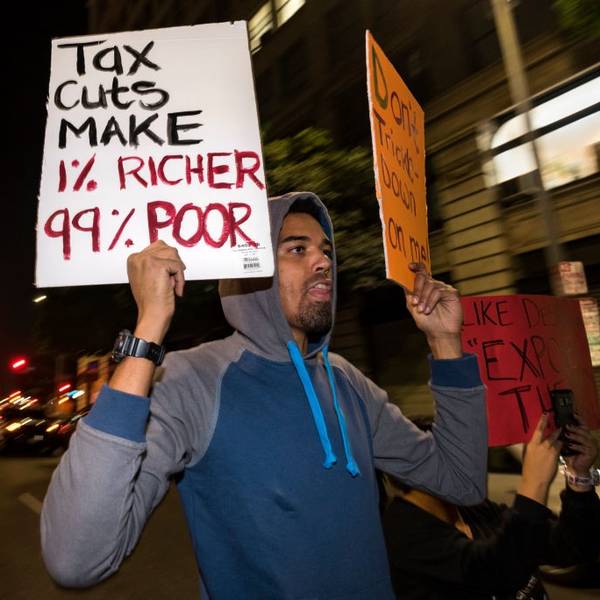
Now the idea that parents should be able to leave their money to their kids is all A-OK. That the hyper-wealthy can do it with little or no significant tax is not OK. It is one of the prime drivers of future economic inequality in the U.S. Absent a change in the law that will happen when pigs fly into a snowy hell, rich kids will only get richer, and then pass on their buckaroos to their heirs. They'll have all the monies.
In the words of one economist, even though the American dream is pulling yourself up by your bootstraps, we've made ample room in it for people whose boots are handed down.
How Estate Taxes Work
The first $5.43 million per heir is fully exempt from any tax. Spread the money around to siblings, spouses, kids and grandkids, and you can shield a bundle from tax easily. In fact, that system means 99.8 percent of all estates owe no estate tax at all. There is no reason the exemption has to be $5.43 million except to favor the wealthy, and there should be an overall cap on how much can be shielded from tax to prevent fake families from splitting things all up.
For the small number of estates actually subject to some taxes, those taxes of course are due only on the portion of an estate's value that exceeds the exemption level. So, a $6 million estate would owe estate taxes on only $570,000. Except that heirs can often shield a larger portion of the estate from taxation through deductions, loopholes and discounts written into the tax code. So, while the on-paper tax rate for estates is 40 percent, most pay about 16 percent in reality.
It's Complicated
As an example of the complexity of estate planning-tax avoiding available to the rich, consider the grantor retained annuity trust. The estate owner puts money into a trust designed to repay the estate the initial amount plus interest at a rate set by the Treasury, typically over two years. If the investment -- typically stock -- rises in value any more than the Treasury rate, the gain goes to an heir tax-free. If the investment doesn't rise in value, the full amount still goes back to the estate. Such techniques have been described as a "heads I win, tails we tie" bet.
A Reasonable Idea
If inheritances could be taxed reasonably, enough money would trickle down the legs of the rich that some societal benefits would accrue.
Unfortunately, all three Republicans in the presidential race promise to abolish the estate tax altogether. Hillary and Bernie offer only weak promises of reform, focused on rolling the tax back to its (higher) 2009 levels. But they'll need Congressional approval for that, so, no.
It will be no surprise that American estate taxes are well below average among the countries in the Organization for Economic Co-Operation and Development.
I know, I know, math and numbers are hard. So here it is in very simple words: by not fairly taxing the estates of the wealthy, we are locking in our staggering economic inequality for future generations.
FUN FACT: The wealthiest ten percent of Americans takes home about half of all income. The richest 0.1 percent holds 22 percent of the country's wealth.
Dear Common Dreams reader, It’s been nearly 30 years since I co-founded Common Dreams with my late wife, Lina Newhouser. We had the radical notion that journalism should serve the public good, not corporate profits. It was clear to us from the outset what it would take to build such a project. No paid advertisements. No corporate sponsors. No millionaire publisher telling us what to think or do. Many people said we wouldn't last a year, but we proved those doubters wrong. Together with a tremendous team of journalists and dedicated staff, we built an independent media outlet free from the constraints of profits and corporate control. Our mission has always been simple: To inform. To inspire. To ignite change for the common good. Building Common Dreams was not easy. Our survival was never guaranteed. When you take on the most powerful forces—Wall Street greed, fossil fuel industry destruction, Big Tech lobbyists, and uber-rich oligarchs who have spent billions upon billions rigging the economy and democracy in their favor—the only bulwark you have is supporters who believe in your work. But here’s the urgent message from me today. It's never been this bad out there. And it's never been this hard to keep us going. At the very moment Common Dreams is most needed, the threats we face are intensifying. We need your support now more than ever. We don't accept corporate advertising and never will. We don't have a paywall because we don't think people should be blocked from critical news based on their ability to pay. Everything we do is funded by the donations of readers like you. When everyone does the little they can afford, we are strong. But if that support retreats or dries up, so do we. Will you donate now to make sure Common Dreams not only survives but thrives? —Craig Brown, Co-founder |
It'd be great if we were all self-made men, like Citizen Trump.
Of course, his self-making, like that of many wealthy people, is based in large part on a wealthy parent giving him a ton of money. Why work for a living when you can just hang around drinking single malt until daddy dies and leaves you his money?
Trump's papa left an estate valued at between $100 and $300 million in 1999. A nice start for a career in real estate for Don and his siblings.
Getting All the Monies
Now the idea that parents should be able to leave their money to their kids is all A-OK. That the hyper-wealthy can do it with little or no significant tax is not OK. It is one of the prime drivers of future economic inequality in the U.S. Absent a change in the law that will happen when pigs fly into a snowy hell, rich kids will only get richer, and then pass on their buckaroos to their heirs. They'll have all the monies.
In the words of one economist, even though the American dream is pulling yourself up by your bootstraps, we've made ample room in it for people whose boots are handed down.
How Estate Taxes Work
The first $5.43 million per heir is fully exempt from any tax. Spread the money around to siblings, spouses, kids and grandkids, and you can shield a bundle from tax easily. In fact, that system means 99.8 percent of all estates owe no estate tax at all. There is no reason the exemption has to be $5.43 million except to favor the wealthy, and there should be an overall cap on how much can be shielded from tax to prevent fake families from splitting things all up.
For the small number of estates actually subject to some taxes, those taxes of course are due only on the portion of an estate's value that exceeds the exemption level. So, a $6 million estate would owe estate taxes on only $570,000. Except that heirs can often shield a larger portion of the estate from taxation through deductions, loopholes and discounts written into the tax code. So, while the on-paper tax rate for estates is 40 percent, most pay about 16 percent in reality.
It's Complicated
As an example of the complexity of estate planning-tax avoiding available to the rich, consider the grantor retained annuity trust. The estate owner puts money into a trust designed to repay the estate the initial amount plus interest at a rate set by the Treasury, typically over two years. If the investment -- typically stock -- rises in value any more than the Treasury rate, the gain goes to an heir tax-free. If the investment doesn't rise in value, the full amount still goes back to the estate. Such techniques have been described as a "heads I win, tails we tie" bet.
A Reasonable Idea
If inheritances could be taxed reasonably, enough money would trickle down the legs of the rich that some societal benefits would accrue.
Unfortunately, all three Republicans in the presidential race promise to abolish the estate tax altogether. Hillary and Bernie offer only weak promises of reform, focused on rolling the tax back to its (higher) 2009 levels. But they'll need Congressional approval for that, so, no.
It will be no surprise that American estate taxes are well below average among the countries in the Organization for Economic Co-Operation and Development.
I know, I know, math and numbers are hard. So here it is in very simple words: by not fairly taxing the estates of the wealthy, we are locking in our staggering economic inequality for future generations.
FUN FACT: The wealthiest ten percent of Americans takes home about half of all income. The richest 0.1 percent holds 22 percent of the country's wealth.
It'd be great if we were all self-made men, like Citizen Trump.
Of course, his self-making, like that of many wealthy people, is based in large part on a wealthy parent giving him a ton of money. Why work for a living when you can just hang around drinking single malt until daddy dies and leaves you his money?
Trump's papa left an estate valued at between $100 and $300 million in 1999. A nice start for a career in real estate for Don and his siblings.
Getting All the Monies
Now the idea that parents should be able to leave their money to their kids is all A-OK. That the hyper-wealthy can do it with little or no significant tax is not OK. It is one of the prime drivers of future economic inequality in the U.S. Absent a change in the law that will happen when pigs fly into a snowy hell, rich kids will only get richer, and then pass on their buckaroos to their heirs. They'll have all the monies.
In the words of one economist, even though the American dream is pulling yourself up by your bootstraps, we've made ample room in it for people whose boots are handed down.
How Estate Taxes Work
The first $5.43 million per heir is fully exempt from any tax. Spread the money around to siblings, spouses, kids and grandkids, and you can shield a bundle from tax easily. In fact, that system means 99.8 percent of all estates owe no estate tax at all. There is no reason the exemption has to be $5.43 million except to favor the wealthy, and there should be an overall cap on how much can be shielded from tax to prevent fake families from splitting things all up.
For the small number of estates actually subject to some taxes, those taxes of course are due only on the portion of an estate's value that exceeds the exemption level. So, a $6 million estate would owe estate taxes on only $570,000. Except that heirs can often shield a larger portion of the estate from taxation through deductions, loopholes and discounts written into the tax code. So, while the on-paper tax rate for estates is 40 percent, most pay about 16 percent in reality.
It's Complicated
As an example of the complexity of estate planning-tax avoiding available to the rich, consider the grantor retained annuity trust. The estate owner puts money into a trust designed to repay the estate the initial amount plus interest at a rate set by the Treasury, typically over two years. If the investment -- typically stock -- rises in value any more than the Treasury rate, the gain goes to an heir tax-free. If the investment doesn't rise in value, the full amount still goes back to the estate. Such techniques have been described as a "heads I win, tails we tie" bet.
A Reasonable Idea
If inheritances could be taxed reasonably, enough money would trickle down the legs of the rich that some societal benefits would accrue.
Unfortunately, all three Republicans in the presidential race promise to abolish the estate tax altogether. Hillary and Bernie offer only weak promises of reform, focused on rolling the tax back to its (higher) 2009 levels. But they'll need Congressional approval for that, so, no.
It will be no surprise that American estate taxes are well below average among the countries in the Organization for Economic Co-Operation and Development.
I know, I know, math and numbers are hard. So here it is in very simple words: by not fairly taxing the estates of the wealthy, we are locking in our staggering economic inequality for future generations.
FUN FACT: The wealthiest ten percent of Americans takes home about half of all income. The richest 0.1 percent holds 22 percent of the country's wealth.