




SUBSCRIBE TO OUR FREE NEWSLETTER
Daily news & progressive opinion—funded by the people, not the corporations—delivered straight to your inbox.
5
#000000
#FFFFFF
To donate by check, phone, or other method, see our More Ways to Give page.
Daily news & progressive opinion—funded by the people, not the corporations—delivered straight to your inbox.
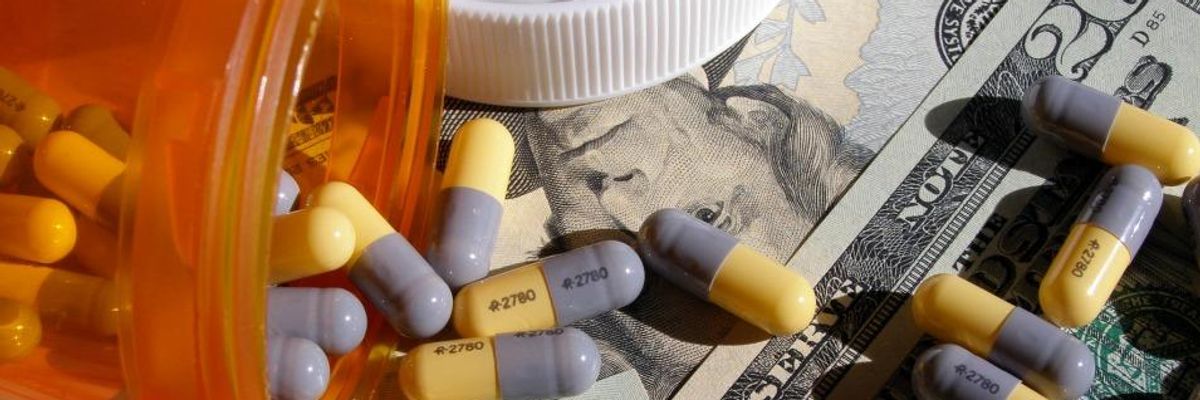
"Take a peek at the unique PR campaign now being run by the pharmaceutical industry," Hightower writes. (Photo: StockMonkeys.com)
If you wonder why Congress critters keep ignoring what the people want them to do -- while doing things that people don't want them doing -- take a peek at the unique PR campaign now being run by the pharmaceutical industry.
The public is dismayed and disgusted by the flagrant greed of drugmakers that are shamefully zooming the prices of medicines into the stratosphere, turning necessities into unaffordable luxuries. As a result, there's a growing demand for Congress to take action to stop the industry's out-of-control price gouging.
To counter this, drug companies have launched a massive advertising campaign. They're running ads on radio, in print, and on Facebook and Twitter painting themselves as the good guys.
Yet you probably haven't seen or heard any of them. That's because drug chieftains don't care what you and I think. Moreover, they know they couldn't possibly persuade us to let them keep jacking up their prices.
Instead, their "public" relations effort has made the odd and seemingly counterproductive move of sidestepping the actual public to narrowly target a very tiny audience.
As Celgene executive Bob Hugin arrogantly put it: "We've identified 7,000 Americans who matter." The other 330 million of us, apparently, are nobodies.
"We're focusing on those in policy positions," Hugin sniffed, "to fight structural issues." By that, he means convincing Congress not to reform the present pricing structure of monopolistic drugmakers, whose guiding corporate ethic is "bleed 'em for all they've got."
So this is a surreptitious PR campaign meant to reach only the eyes and ears of policy elites. The goal is to have Congress -- once again -- ignore what the people want it to do, thus allowing the corporate few "who matter" to keep fleecing the rest of us.
Donald Trump’s attacks on democracy, justice, and a free press are escalating — putting everything we stand for at risk. We believe a better world is possible, but we can’t get there without your support. Common Dreams stands apart. We answer only to you — our readers, activists, and changemakers — not to billionaires or corporations. Our independence allows us to cover the vital stories that others won’t, spotlighting movements for peace, equality, and human rights. Right now, our work faces unprecedented challenges. Misinformation is spreading, journalists are under attack, and financial pressures are mounting. As a reader-supported, nonprofit newsroom, your support is crucial to keep this journalism alive. Whatever you can give — $10, $25, or $100 — helps us stay strong and responsive when the world needs us most. Together, we’ll continue to build the independent, courageous journalism our movement relies on. Thank you for being part of this community. |
If you wonder why Congress critters keep ignoring what the people want them to do -- while doing things that people don't want them doing -- take a peek at the unique PR campaign now being run by the pharmaceutical industry.
The public is dismayed and disgusted by the flagrant greed of drugmakers that are shamefully zooming the prices of medicines into the stratosphere, turning necessities into unaffordable luxuries. As a result, there's a growing demand for Congress to take action to stop the industry's out-of-control price gouging.
To counter this, drug companies have launched a massive advertising campaign. They're running ads on radio, in print, and on Facebook and Twitter painting themselves as the good guys.
Yet you probably haven't seen or heard any of them. That's because drug chieftains don't care what you and I think. Moreover, they know they couldn't possibly persuade us to let them keep jacking up their prices.
Instead, their "public" relations effort has made the odd and seemingly counterproductive move of sidestepping the actual public to narrowly target a very tiny audience.
As Celgene executive Bob Hugin arrogantly put it: "We've identified 7,000 Americans who matter." The other 330 million of us, apparently, are nobodies.
"We're focusing on those in policy positions," Hugin sniffed, "to fight structural issues." By that, he means convincing Congress not to reform the present pricing structure of monopolistic drugmakers, whose guiding corporate ethic is "bleed 'em for all they've got."
So this is a surreptitious PR campaign meant to reach only the eyes and ears of policy elites. The goal is to have Congress -- once again -- ignore what the people want it to do, thus allowing the corporate few "who matter" to keep fleecing the rest of us.
If you wonder why Congress critters keep ignoring what the people want them to do -- while doing things that people don't want them doing -- take a peek at the unique PR campaign now being run by the pharmaceutical industry.
The public is dismayed and disgusted by the flagrant greed of drugmakers that are shamefully zooming the prices of medicines into the stratosphere, turning necessities into unaffordable luxuries. As a result, there's a growing demand for Congress to take action to stop the industry's out-of-control price gouging.
To counter this, drug companies have launched a massive advertising campaign. They're running ads on radio, in print, and on Facebook and Twitter painting themselves as the good guys.
Yet you probably haven't seen or heard any of them. That's because drug chieftains don't care what you and I think. Moreover, they know they couldn't possibly persuade us to let them keep jacking up their prices.
Instead, their "public" relations effort has made the odd and seemingly counterproductive move of sidestepping the actual public to narrowly target a very tiny audience.
As Celgene executive Bob Hugin arrogantly put it: "We've identified 7,000 Americans who matter." The other 330 million of us, apparently, are nobodies.
"We're focusing on those in policy positions," Hugin sniffed, "to fight structural issues." By that, he means convincing Congress not to reform the present pricing structure of monopolistic drugmakers, whose guiding corporate ethic is "bleed 'em for all they've got."
So this is a surreptitious PR campaign meant to reach only the eyes and ears of policy elites. The goal is to have Congress -- once again -- ignore what the people want it to do, thus allowing the corporate few "who matter" to keep fleecing the rest of us.