SUBSCRIBE TO OUR FREE NEWSLETTER
Daily news & progressive opinion—funded by the people, not the corporations—delivered straight to your inbox.
5
#000000
#FFFFFF
To donate by check, phone, or other method, see our More Ways to Give page.
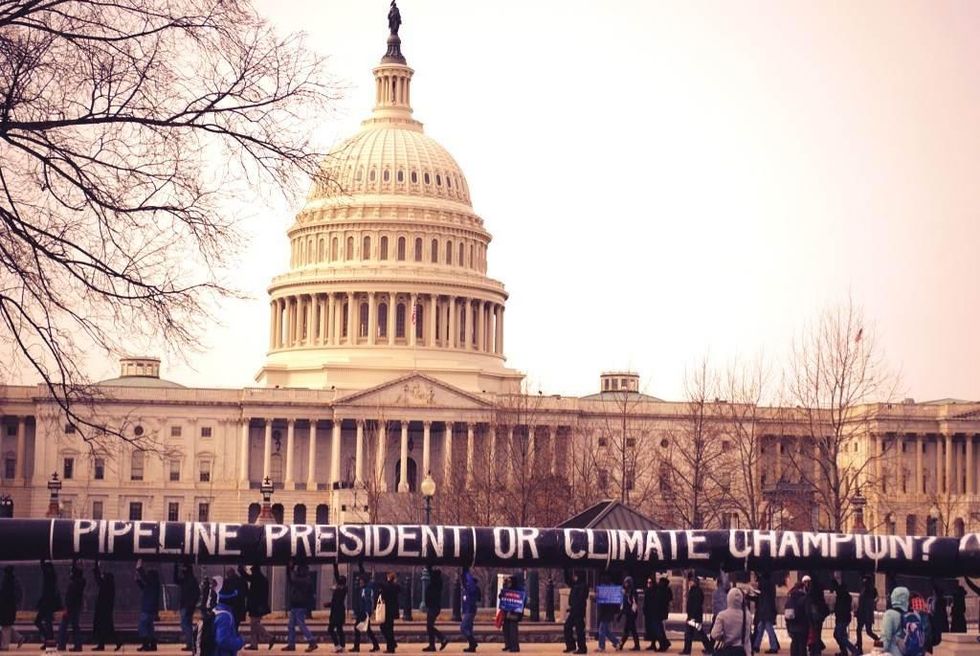
Just days after a U.S. State Department review determined that ERM, an oil industry contractor and dues-paying member of the American Petroleum Institute, was capable of an unbiased review of the Keystone XL oil pipeline, hundreds of youth activists will be risking arrest outside the White House as part of XL Dissent. Their objective is to secure a rejection of the climate-killing Keystone XL tar sands pipeline and to hold President Obama accountable for his campaign promise to safeguard climate stability by "end(ing) the tyranny of oil."
The stakes are high for both Obama's Democratic Party and for these young people. Many commentators are quick to point out a well-worn political calculus: millennials helped elect Obama, and his party's success relies on their continued support (youth delivered 80 electoral votes for Obama in 2012, enough to swing the election in his favor). Indeed, many core XL Dissent student organizers cast their first votes for Obama in 2012. One student organizer took a year off college to work on his campaign. She'll be risking arrest this Sunday.
Clearly, there's a lot more at stake for the XL Dissenters than midterm vote counts. As the students are quick to point out, their very future is on the line. According to Evan Bell (Tufts '15), the prospect of Obama approving Keystone XL "horrifies me. I'm afraid the climate won't support me, won't support my children." President Obama and D.C. policymakers need to take a hard look at who police will arrest this Sunday. Many of them were too young to vote in the 2012 election. Some of those arrested will still be in high school. XL Dissent should give Obama pause, and force the president to consider who loses if Big Oil wins. He should see his own daughters in the faces of those who are arrested at his doorstep this weekend.
There's a watershed quality to XL Dissent. While opposition to Keystone XL has been spurred by grassroots and indigenous resistance (see Tar Sands Blockade, Ogalala Sioux and others), national environmental organizations have played a major role in coordinating D.C. movement gatherings. XL Dissent is different, then, because it was conceived and organized from below, by the students themselves. As Evan Bell told me, "Every decision, message point, and recruitment effort has been led by a young person."
What's more, these students are on a more radical footing than beltway organizations. Aly Johnson-Kurts (Smith '16) told me "civil disobedience is necessary because of huge corporate power. The inside game isn't going to work."
More and more, these young people are placing their hope in distributed networks of resistance, rather than in a president who ran on hope as a platform. They're hovering in a space between fear, anger, and radical hope. They know their futures are on the line and feel more accountable to each other and frontline communities than elected politicians. "We're building a culture of resistance," Evan Bell told me.
Thank goodness for XL Dissent. I know where my climate hope lies: with the dissenters. Go to www.xldissent.org to read about the action, donate, and see the faces of the XL Disent. And be sure to follow the action this Sunday.
PS - One way to back up the students risking arrest at XL Dissent this weekend is to pledge to match their commitment. Sign the Keystone XL Pledge of Resistance and join the civil disobedience movement to stop the pipeline.
Just days after a U.S. State Department review determined that ERM, an oil industry contractor and dues-paying member of the American Petroleum Institute, was capable of an unbiased review of the Keystone XL oil pipeline, hundreds of youth activists will be risking arrest outside the White House as part of XL Dissent. Their objective is to secure a rejection of the climate-killing Keystone XL tar sands pipeline and to hold President Obama accountable for his campaign promise to safeguard climate stability by "end(ing) the tyranny of oil."
The stakes are high for both Obama's Democratic Party and for these young people. Many commentators are quick to point out a well-worn political calculus: millennials helped elect Obama, and his party's success relies on their continued support (youth delivered 80 electoral votes for Obama in 2012, enough to swing the election in his favor). Indeed, many core XL Dissent student organizers cast their first votes for Obama in 2012. One student organizer took a year off college to work on his campaign. She'll be risking arrest this Sunday.
Clearly, there's a lot more at stake for the XL Dissenters than midterm vote counts. As the students are quick to point out, their very future is on the line. According to Evan Bell (Tufts '15), the prospect of Obama approving Keystone XL "horrifies me. I'm afraid the climate won't support me, won't support my children." President Obama and D.C. policymakers need to take a hard look at who police will arrest this Sunday. Many of them were too young to vote in the 2012 election. Some of those arrested will still be in high school. XL Dissent should give Obama pause, and force the president to consider who loses if Big Oil wins. He should see his own daughters in the faces of those who are arrested at his doorstep this weekend.
There's a watershed quality to XL Dissent. While opposition to Keystone XL has been spurred by grassroots and indigenous resistance (see Tar Sands Blockade, Ogalala Sioux and others), national environmental organizations have played a major role in coordinating D.C. movement gatherings. XL Dissent is different, then, because it was conceived and organized from below, by the students themselves. As Evan Bell told me, "Every decision, message point, and recruitment effort has been led by a young person."
What's more, these students are on a more radical footing than beltway organizations. Aly Johnson-Kurts (Smith '16) told me "civil disobedience is necessary because of huge corporate power. The inside game isn't going to work."
More and more, these young people are placing their hope in distributed networks of resistance, rather than in a president who ran on hope as a platform. They're hovering in a space between fear, anger, and radical hope. They know their futures are on the line and feel more accountable to each other and frontline communities than elected politicians. "We're building a culture of resistance," Evan Bell told me.
Thank goodness for XL Dissent. I know where my climate hope lies: with the dissenters. Go to www.xldissent.org to read about the action, donate, and see the faces of the XL Disent. And be sure to follow the action this Sunday.
PS - One way to back up the students risking arrest at XL Dissent this weekend is to pledge to match their commitment. Sign the Keystone XL Pledge of Resistance and join the civil disobedience movement to stop the pipeline.
Just days after a U.S. State Department review determined that ERM, an oil industry contractor and dues-paying member of the American Petroleum Institute, was capable of an unbiased review of the Keystone XL oil pipeline, hundreds of youth activists will be risking arrest outside the White House as part of XL Dissent. Their objective is to secure a rejection of the climate-killing Keystone XL tar sands pipeline and to hold President Obama accountable for his campaign promise to safeguard climate stability by "end(ing) the tyranny of oil."
The stakes are high for both Obama's Democratic Party and for these young people. Many commentators are quick to point out a well-worn political calculus: millennials helped elect Obama, and his party's success relies on their continued support (youth delivered 80 electoral votes for Obama in 2012, enough to swing the election in his favor). Indeed, many core XL Dissent student organizers cast their first votes for Obama in 2012. One student organizer took a year off college to work on his campaign. She'll be risking arrest this Sunday.
Clearly, there's a lot more at stake for the XL Dissenters than midterm vote counts. As the students are quick to point out, their very future is on the line. According to Evan Bell (Tufts '15), the prospect of Obama approving Keystone XL "horrifies me. I'm afraid the climate won't support me, won't support my children." President Obama and D.C. policymakers need to take a hard look at who police will arrest this Sunday. Many of them were too young to vote in the 2012 election. Some of those arrested will still be in high school. XL Dissent should give Obama pause, and force the president to consider who loses if Big Oil wins. He should see his own daughters in the faces of those who are arrested at his doorstep this weekend.
There's a watershed quality to XL Dissent. While opposition to Keystone XL has been spurred by grassroots and indigenous resistance (see Tar Sands Blockade, Ogalala Sioux and others), national environmental organizations have played a major role in coordinating D.C. movement gatherings. XL Dissent is different, then, because it was conceived and organized from below, by the students themselves. As Evan Bell told me, "Every decision, message point, and recruitment effort has been led by a young person."
What's more, these students are on a more radical footing than beltway organizations. Aly Johnson-Kurts (Smith '16) told me "civil disobedience is necessary because of huge corporate power. The inside game isn't going to work."
More and more, these young people are placing their hope in distributed networks of resistance, rather than in a president who ran on hope as a platform. They're hovering in a space between fear, anger, and radical hope. They know their futures are on the line and feel more accountable to each other and frontline communities than elected politicians. "We're building a culture of resistance," Evan Bell told me.
Thank goodness for XL Dissent. I know where my climate hope lies: with the dissenters. Go to www.xldissent.org to read about the action, donate, and see the faces of the XL Disent. And be sure to follow the action this Sunday.
PS - One way to back up the students risking arrest at XL Dissent this weekend is to pledge to match their commitment. Sign the Keystone XL Pledge of Resistance and join the civil disobedience movement to stop the pipeline.