RECOMMENDED...
'Climate Crisis Madness': Philippines Demand Action at UN Climate Talks in Warsaw
'Can humanity rise to this occasion?' asks lead negotiator from nation struggling in aftermath of deadly, record-setting typhoon
Nov 11, 2013

"To anyone who continues to deny the reality that is climate change, I dare you to get off your ivory tower and away from the comfort of you armchair," Sano said.
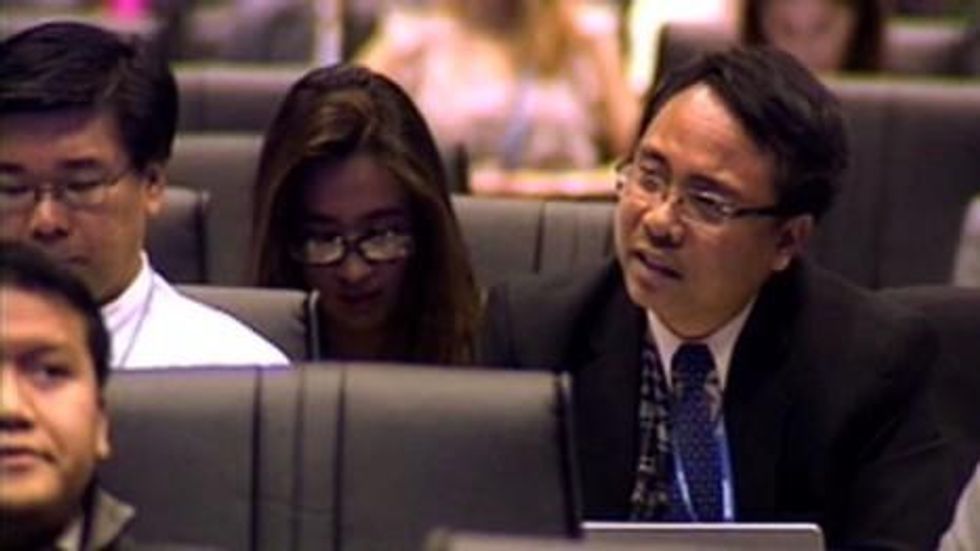
The negotiator spoke emotionally about the devastation that the typhoon had caused across the Philippines, and then made the direct link to the climate crisis.
"What my country is going through as a result of this extreme climate event is madness." Yeb Sano, Philippines lead negotiator
"The science has given us a picture that has become much more in focus," he said. "The IPCC report on climate change and extreme events underscored the risks associated with changes in the patterns as well as frequency of extreme weather events. Science tells us that simply, climate change will mean more intense tropical storms. As the Earth warms up, that would include the oceans. The energy that is stored in the waters off the Philippines will increase the intensity of typhoons and the trend we now see is that more destructive storms will be the new norm."
"What my country is going through as a result of this extreme climate event is madness," he continued. "The climate crisis is madness."
"We can take drastic action now to ensure that we prevent a future where super typhoons are a way of life. Because we refuse, as a nation, to accept a future where super typhoons like Haiyan become a fact of life. We refuse to accept that running away from storms, evacuating our families, suffering the devastation and misery, having to count our dead, become a way of life. We simply refuse to."
Sano continued to emphasize the need for immediate action to reduce emissions and deliver the financing necessary for developing countries to adapt to the impacts of climate change and cut their own emissions and pursue sustainable development. Then, he went off the script -- and raised the stakes for the entire negotiations here in Warsaw.
Addressing a representative from the Polish government, who acts as President for the Conference of the Parties, or COP19, as the negotiations are known, Sabo said, "In solidarity with my countrymen who are struggling to find food back home and with my brother who has not had food for the last three days, in all due respect Mr. President, and I mean no disrespect for your kind hospitality, I will now commence a voluntary fasting for the climate. This means I will voluntarily refrain from eating food during this COP until a meaningful outcome is in sight."
Sano concluded, "Let Poland, let Warsaw, be remembered as the place where we truly cared to stop this madness. Can humanity rise to this occasion? Mr. President, I still believe we can."
No one came to Warsaw expecting a major breakthrough, but Typhoon Haiyan, and Sano's emotional appeal for action, have raised the intensity of the negotiations. The new tone may help push developed countries to put some real financial commitments on the table, as well as commit to deliver plans for meaningful greenhouse gas reductions by next September's climate leadership summit hosted by UN Secretary Ban Ki Moon.
The new sense of urgency after Haiyan has also intensified concerns about the pernicious role that the fossil fuel industry is playing in these negotiations. The Polish government not only opened up COP19 to corporate sponsorship, they also are co-sponsoring with the World Coal Association a side-conference to talk about the role of coal in solving climate change (hint: there isn't one).
If anything, the Polish government's decision to cozy up so closely to coal during the conference has only served to shine a spotlight on the industry's role in fueling the climate crisis, along with the fragile state of the industry's future. It's not just activists who are calling for an end to coal, after all: major banks, pension funds, and investors are already switching their funds away from coal companies.
Yeb Sano's speech this afternoon helped raise the stakes for the talks here in Warsaw (as well, it should be noted, for his own delegation). Hopefully, world leaders will find the courage to stand up to the fossil fuel industry and take meaningful steps forward.

An Urgent Message From Our Co-Founder
Dear Common Dreams reader, It’s been nearly 30 years since I co-founded Common Dreams with my late wife, Lina Newhouser. We had the radical notion that journalism should serve the public good, not corporate profits. It was clear to us from the outset what it would take to build such a project. No paid advertisements. No corporate sponsors. No millionaire publisher telling us what to think or do. Many people said we wouldn't last a year, but we proved those doubters wrong. Together with a tremendous team of journalists and dedicated staff, we built an independent media outlet free from the constraints of profits and corporate control. Our mission has always been simple: To inform. To inspire. To ignite change for the common good. Building Common Dreams was not easy. Our survival was never guaranteed. When you take on the most powerful forces—Wall Street greed, fossil fuel industry destruction, Big Tech lobbyists, and uber-rich oligarchs who have spent billions upon billions rigging the economy and democracy in their favor—the only bulwark you have is supporters who believe in your work. But here’s the urgent message from me today. It's never been this bad out there. And it's never been this hard to keep us going. At the very moment Common Dreams is most needed, the threats we face are intensifying. We need your support now more than ever. We don't accept corporate advertising and never will. We don't have a paywall because we don't think people should be blocked from critical news based on their ability to pay. Everything we do is funded by the donations of readers like you. When everyone does the little they can afford, we are strong. But if that support retreats or dries up, so do we. Will you donate now to make sure Common Dreams not only survives but thrives? —Craig Brown, Co-founder |
Our work is licensed under Creative Commons (CC BY-NC-ND 3.0). Feel free to republish and share widely.

"To anyone who continues to deny the reality that is climate change, I dare you to get off your ivory tower and away from the comfort of you armchair," Sano said.
The negotiator spoke emotionally about the devastation that the typhoon had caused across the Philippines, and then made the direct link to the climate crisis.
"What my country is going through as a result of this extreme climate event is madness." Yeb Sano, Philippines lead negotiator
"The science has given us a picture that has become much more in focus," he said. "The IPCC report on climate change and extreme events underscored the risks associated with changes in the patterns as well as frequency of extreme weather events. Science tells us that simply, climate change will mean more intense tropical storms. As the Earth warms up, that would include the oceans. The energy that is stored in the waters off the Philippines will increase the intensity of typhoons and the trend we now see is that more destructive storms will be the new norm."
"What my country is going through as a result of this extreme climate event is madness," he continued. "The climate crisis is madness."
"We can take drastic action now to ensure that we prevent a future where super typhoons are a way of life. Because we refuse, as a nation, to accept a future where super typhoons like Haiyan become a fact of life. We refuse to accept that running away from storms, evacuating our families, suffering the devastation and misery, having to count our dead, become a way of life. We simply refuse to."
Sano continued to emphasize the need for immediate action to reduce emissions and deliver the financing necessary for developing countries to adapt to the impacts of climate change and cut their own emissions and pursue sustainable development. Then, he went off the script -- and raised the stakes for the entire negotiations here in Warsaw.
Addressing a representative from the Polish government, who acts as President for the Conference of the Parties, or COP19, as the negotiations are known, Sabo said, "In solidarity with my countrymen who are struggling to find food back home and with my brother who has not had food for the last three days, in all due respect Mr. President, and I mean no disrespect for your kind hospitality, I will now commence a voluntary fasting for the climate. This means I will voluntarily refrain from eating food during this COP until a meaningful outcome is in sight."
Sano concluded, "Let Poland, let Warsaw, be remembered as the place where we truly cared to stop this madness. Can humanity rise to this occasion? Mr. President, I still believe we can."
No one came to Warsaw expecting a major breakthrough, but Typhoon Haiyan, and Sano's emotional appeal for action, have raised the intensity of the negotiations. The new tone may help push developed countries to put some real financial commitments on the table, as well as commit to deliver plans for meaningful greenhouse gas reductions by next September's climate leadership summit hosted by UN Secretary Ban Ki Moon.
The new sense of urgency after Haiyan has also intensified concerns about the pernicious role that the fossil fuel industry is playing in these negotiations. The Polish government not only opened up COP19 to corporate sponsorship, they also are co-sponsoring with the World Coal Association a side-conference to talk about the role of coal in solving climate change (hint: there isn't one).
If anything, the Polish government's decision to cozy up so closely to coal during the conference has only served to shine a spotlight on the industry's role in fueling the climate crisis, along with the fragile state of the industry's future. It's not just activists who are calling for an end to coal, after all: major banks, pension funds, and investors are already switching their funds away from coal companies.
Yeb Sano's speech this afternoon helped raise the stakes for the talks here in Warsaw (as well, it should be noted, for his own delegation). Hopefully, world leaders will find the courage to stand up to the fossil fuel industry and take meaningful steps forward.

"To anyone who continues to deny the reality that is climate change, I dare you to get off your ivory tower and away from the comfort of you armchair," Sano said.
The negotiator spoke emotionally about the devastation that the typhoon had caused across the Philippines, and then made the direct link to the climate crisis.
"What my country is going through as a result of this extreme climate event is madness." Yeb Sano, Philippines lead negotiator
"The science has given us a picture that has become much more in focus," he said. "The IPCC report on climate change and extreme events underscored the risks associated with changes in the patterns as well as frequency of extreme weather events. Science tells us that simply, climate change will mean more intense tropical storms. As the Earth warms up, that would include the oceans. The energy that is stored in the waters off the Philippines will increase the intensity of typhoons and the trend we now see is that more destructive storms will be the new norm."
"What my country is going through as a result of this extreme climate event is madness," he continued. "The climate crisis is madness."
"We can take drastic action now to ensure that we prevent a future where super typhoons are a way of life. Because we refuse, as a nation, to accept a future where super typhoons like Haiyan become a fact of life. We refuse to accept that running away from storms, evacuating our families, suffering the devastation and misery, having to count our dead, become a way of life. We simply refuse to."
Sano continued to emphasize the need for immediate action to reduce emissions and deliver the financing necessary for developing countries to adapt to the impacts of climate change and cut their own emissions and pursue sustainable development. Then, he went off the script -- and raised the stakes for the entire negotiations here in Warsaw.
Addressing a representative from the Polish government, who acts as President for the Conference of the Parties, or COP19, as the negotiations are known, Sabo said, "In solidarity with my countrymen who are struggling to find food back home and with my brother who has not had food for the last three days, in all due respect Mr. President, and I mean no disrespect for your kind hospitality, I will now commence a voluntary fasting for the climate. This means I will voluntarily refrain from eating food during this COP until a meaningful outcome is in sight."
Sano concluded, "Let Poland, let Warsaw, be remembered as the place where we truly cared to stop this madness. Can humanity rise to this occasion? Mr. President, I still believe we can."
No one came to Warsaw expecting a major breakthrough, but Typhoon Haiyan, and Sano's emotional appeal for action, have raised the intensity of the negotiations. The new tone may help push developed countries to put some real financial commitments on the table, as well as commit to deliver plans for meaningful greenhouse gas reductions by next September's climate leadership summit hosted by UN Secretary Ban Ki Moon.
The new sense of urgency after Haiyan has also intensified concerns about the pernicious role that the fossil fuel industry is playing in these negotiations. The Polish government not only opened up COP19 to corporate sponsorship, they also are co-sponsoring with the World Coal Association a side-conference to talk about the role of coal in solving climate change (hint: there isn't one).
If anything, the Polish government's decision to cozy up so closely to coal during the conference has only served to shine a spotlight on the industry's role in fueling the climate crisis, along with the fragile state of the industry's future. It's not just activists who are calling for an end to coal, after all: major banks, pension funds, and investors are already switching their funds away from coal companies.
Yeb Sano's speech this afternoon helped raise the stakes for the talks here in Warsaw (as well, it should be noted, for his own delegation). Hopefully, world leaders will find the courage to stand up to the fossil fuel industry and take meaningful steps forward.
We've had enough. The 1% own and operate the corporate media. They are doing everything they can to defend the status quo, squash dissent and protect the wealthy and the powerful. The Common Dreams media model is different. We cover the news that matters to the 99%. Our mission? To inform. To inspire. To ignite change for the common good. How? Nonprofit. Independent. Reader-supported. Free to read. Free to republish. Free to share. With no advertising. No paywalls. No selling of your data. Thousands of small donations fund our newsroom and allow us to continue publishing. Can you chip in? We can't do it without you. Thank you.