SUBSCRIBE TO OUR FREE NEWSLETTER
Daily news & progressive opinion—funded by the people, not the corporations—delivered straight to your inbox.
5
#000000
#FFFFFF
To donate by check, phone, or other method, see our More Ways to Give page.
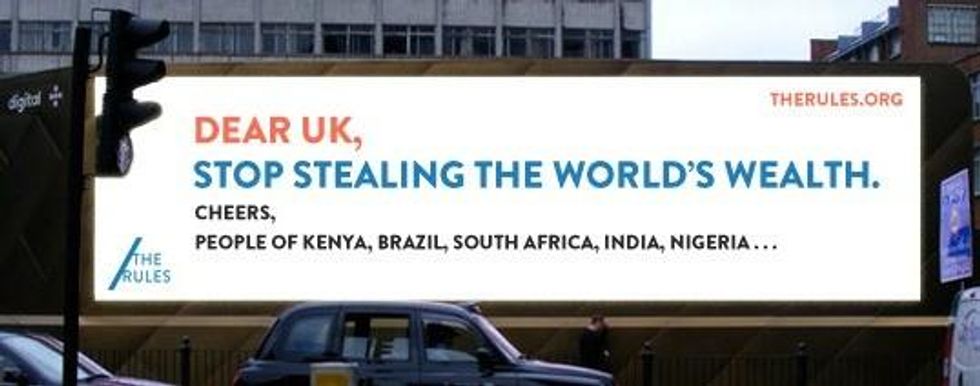
But there's a more important story here that the British MPs and world media are largely missing. In fact, the only ones who haven't missed it are Google themselves. Matt Brittin, Google's UK Chief, hit a very important nail on the head when he said, to Channel 4 News this week, " [Google] plays by the rules set by politicians."
Leaving aside his motivation to shift the blame, the man is not wrong. The rules of the international tax system do not just let this happen, they actively encourage it.
Tax theft is endemic all over the world. It is organised through an intricate system of tax havens; the PR around it is astonishingly good, as evidenced by the fact that most people have no idea of its scale and can get distracted by the misdeeds of a few bad apples rather than seeing the barrel they came in; and one of the most vibrant and important hubs - the City of London - is sitting right under the noses of the British politicians who are today decrying the corporations who use it.
Tax havens exist solely to help the rich avoid national taxes. They give them a way to opt out of the social contract. Multinationals happily extract profits from countries and then team up with tax havens to avoid paying their share of taxes that make the countries profitable for them in the first place. Without things like the rule of law, and economic and political stability, the market for most products would flounder. All these things cost, and when people steal taxes they are essentially saying, everyone but us should pay.
Somewhere between $21 and $32 trillion is hidden behind the vast walls of tax haven secrecy.
The scale of the theft is staggering. Somewhere between $21 and $32 trillion is hidden behind the vast walls of tax haven secrecy. That's the equivalent of one third of all global annual income. Somewhere between 60 and 70% of all international trade flows through them so that profits can be siphoned off untaxed.
The scale alone means tax havens have a material impact on levels of global inequality and poverty. But more insidious is what they actively facilitate. Tax havens are in the background of practically every instance of large-scale corruption and economic crime of the last thirty years. Every corrupt leader, every major arms dealer and drug cartel, as well as most multinational corporations rely on their 'discretion' to do business. It's a morality-blind service industry for the ultra-rich. Forget the 1% - this industry exists largely for the pleasure and benefit of the 0.02%; the 10 million people who 'own' the bulk of the $21trillion hidden.
This theft cuts deepest in the poorest countries in the world, that struggle to pay for basic services like education, healthcare, strong justice systems - all the things that make societies more equal and fair.
So as we revel in the shaming of a few bad guys, we should remember that this episode has done nothing more than highlight the symptoms of an endemic global disease. We should be very suspicious of the British Finance Minister, George Osbourne's seemingly helpful decision to put PS150m into the British tax collection authority to help catch corporate theft of this kind. This is the man who, just this year, actively undercut EU efforts to tackle tax havens by signing a bilateral deal with Switzerland that protects the secrecy of tax thieves for a one-off cost of the payment of some back taxes. So before we congratulate him for adding a few sticking plasters with one hand, we should demand answers to why he's feeding the disease with the other.
As we revel in the shaming of a few bad guys, we should remember that this episode has done nothing more than highlight the symptoms of an endemic global disease.
If decision makers are serious about tax havens, they should look to the system behind the headlines. For British MPs, that means looking down the road at the City of London and asking questions like, why does the City of London have special exemptions from the Freedom of Information Act? For others, especially the leaders of poorer countries, that means standing together and demanding change at the international level.
Perhaps most importantly, people can start demanding change themselves. Can we really rely on business leaders and politicians to bite the hand that so often feeds them? And as long as one tax haven exists, there will be a place for the corrupt and the greedy to hide the money they steal, so picking them off one by one is never going to work. The only thing to do is change the rules that let all of them exist. The first step is to see the bigger picture.
This post is also appearing on New Left Project today.
But there's a more important story here that the British MPs and world media are largely missing. In fact, the only ones who haven't missed it are Google themselves. Matt Brittin, Google's UK Chief, hit a very important nail on the head when he said, to Channel 4 News this week, " [Google] plays by the rules set by politicians."
Leaving aside his motivation to shift the blame, the man is not wrong. The rules of the international tax system do not just let this happen, they actively encourage it.
Tax theft is endemic all over the world. It is organised through an intricate system of tax havens; the PR around it is astonishingly good, as evidenced by the fact that most people have no idea of its scale and can get distracted by the misdeeds of a few bad apples rather than seeing the barrel they came in; and one of the most vibrant and important hubs - the City of London - is sitting right under the noses of the British politicians who are today decrying the corporations who use it.
Tax havens exist solely to help the rich avoid national taxes. They give them a way to opt out of the social contract. Multinationals happily extract profits from countries and then team up with tax havens to avoid paying their share of taxes that make the countries profitable for them in the first place. Without things like the rule of law, and economic and political stability, the market for most products would flounder. All these things cost, and when people steal taxes they are essentially saying, everyone but us should pay.
Somewhere between $21 and $32 trillion is hidden behind the vast walls of tax haven secrecy.
The scale of the theft is staggering. Somewhere between $21 and $32 trillion is hidden behind the vast walls of tax haven secrecy. That's the equivalent of one third of all global annual income. Somewhere between 60 and 70% of all international trade flows through them so that profits can be siphoned off untaxed.
The scale alone means tax havens have a material impact on levels of global inequality and poverty. But more insidious is what they actively facilitate. Tax havens are in the background of practically every instance of large-scale corruption and economic crime of the last thirty years. Every corrupt leader, every major arms dealer and drug cartel, as well as most multinational corporations rely on their 'discretion' to do business. It's a morality-blind service industry for the ultra-rich. Forget the 1% - this industry exists largely for the pleasure and benefit of the 0.02%; the 10 million people who 'own' the bulk of the $21trillion hidden.
This theft cuts deepest in the poorest countries in the world, that struggle to pay for basic services like education, healthcare, strong justice systems - all the things that make societies more equal and fair.
So as we revel in the shaming of a few bad guys, we should remember that this episode has done nothing more than highlight the symptoms of an endemic global disease. We should be very suspicious of the British Finance Minister, George Osbourne's seemingly helpful decision to put PS150m into the British tax collection authority to help catch corporate theft of this kind. This is the man who, just this year, actively undercut EU efforts to tackle tax havens by signing a bilateral deal with Switzerland that protects the secrecy of tax thieves for a one-off cost of the payment of some back taxes. So before we congratulate him for adding a few sticking plasters with one hand, we should demand answers to why he's feeding the disease with the other.
As we revel in the shaming of a few bad guys, we should remember that this episode has done nothing more than highlight the symptoms of an endemic global disease.
If decision makers are serious about tax havens, they should look to the system behind the headlines. For British MPs, that means looking down the road at the City of London and asking questions like, why does the City of London have special exemptions from the Freedom of Information Act? For others, especially the leaders of poorer countries, that means standing together and demanding change at the international level.
Perhaps most importantly, people can start demanding change themselves. Can we really rely on business leaders and politicians to bite the hand that so often feeds them? And as long as one tax haven exists, there will be a place for the corrupt and the greedy to hide the money they steal, so picking them off one by one is never going to work. The only thing to do is change the rules that let all of them exist. The first step is to see the bigger picture.
This post is also appearing on New Left Project today.
But there's a more important story here that the British MPs and world media are largely missing. In fact, the only ones who haven't missed it are Google themselves. Matt Brittin, Google's UK Chief, hit a very important nail on the head when he said, to Channel 4 News this week, " [Google] plays by the rules set by politicians."
Leaving aside his motivation to shift the blame, the man is not wrong. The rules of the international tax system do not just let this happen, they actively encourage it.
Tax theft is endemic all over the world. It is organised through an intricate system of tax havens; the PR around it is astonishingly good, as evidenced by the fact that most people have no idea of its scale and can get distracted by the misdeeds of a few bad apples rather than seeing the barrel they came in; and one of the most vibrant and important hubs - the City of London - is sitting right under the noses of the British politicians who are today decrying the corporations who use it.
Tax havens exist solely to help the rich avoid national taxes. They give them a way to opt out of the social contract. Multinationals happily extract profits from countries and then team up with tax havens to avoid paying their share of taxes that make the countries profitable for them in the first place. Without things like the rule of law, and economic and political stability, the market for most products would flounder. All these things cost, and when people steal taxes they are essentially saying, everyone but us should pay.
Somewhere between $21 and $32 trillion is hidden behind the vast walls of tax haven secrecy.
The scale of the theft is staggering. Somewhere between $21 and $32 trillion is hidden behind the vast walls of tax haven secrecy. That's the equivalent of one third of all global annual income. Somewhere between 60 and 70% of all international trade flows through them so that profits can be siphoned off untaxed.
The scale alone means tax havens have a material impact on levels of global inequality and poverty. But more insidious is what they actively facilitate. Tax havens are in the background of practically every instance of large-scale corruption and economic crime of the last thirty years. Every corrupt leader, every major arms dealer and drug cartel, as well as most multinational corporations rely on their 'discretion' to do business. It's a morality-blind service industry for the ultra-rich. Forget the 1% - this industry exists largely for the pleasure and benefit of the 0.02%; the 10 million people who 'own' the bulk of the $21trillion hidden.
This theft cuts deepest in the poorest countries in the world, that struggle to pay for basic services like education, healthcare, strong justice systems - all the things that make societies more equal and fair.
So as we revel in the shaming of a few bad guys, we should remember that this episode has done nothing more than highlight the symptoms of an endemic global disease. We should be very suspicious of the British Finance Minister, George Osbourne's seemingly helpful decision to put PS150m into the British tax collection authority to help catch corporate theft of this kind. This is the man who, just this year, actively undercut EU efforts to tackle tax havens by signing a bilateral deal with Switzerland that protects the secrecy of tax thieves for a one-off cost of the payment of some back taxes. So before we congratulate him for adding a few sticking plasters with one hand, we should demand answers to why he's feeding the disease with the other.
As we revel in the shaming of a few bad guys, we should remember that this episode has done nothing more than highlight the symptoms of an endemic global disease.
If decision makers are serious about tax havens, they should look to the system behind the headlines. For British MPs, that means looking down the road at the City of London and asking questions like, why does the City of London have special exemptions from the Freedom of Information Act? For others, especially the leaders of poorer countries, that means standing together and demanding change at the international level.
Perhaps most importantly, people can start demanding change themselves. Can we really rely on business leaders and politicians to bite the hand that so often feeds them? And as long as one tax haven exists, there will be a place for the corrupt and the greedy to hide the money they steal, so picking them off one by one is never going to work. The only thing to do is change the rules that let all of them exist. The first step is to see the bigger picture.
This post is also appearing on New Left Project today.