SUBSCRIBE TO OUR FREE NEWSLETTER
Daily news & progressive opinion—funded by the people, not the corporations—delivered straight to your inbox.
5
#000000
#FFFFFF
To donate by check, phone, or other method, see our More Ways to Give page.
Even though I was more or less in favor of it for reasons of health and hygiene, it was nonetheless a surprise how swiftly and irrevocably the ban against smoking tobacco went into effect. On Monday, we were all smoking in our homes and offices, mindlessly chugging away on those deadly cancer sticks, and by Friday, we were being told we could never smoke indoors again.
Another surprise was the success of bottled water. Never in our wildest dreams would we have thought that beverage companies could convince price-conscious consumers to voluntarily pay for something they could otherwise get for free, particularly after scientific tests have shown that municipal water is, in fact, freer of bacteria than so-called "mountain spring" water. It just proves how effective an advertising campaign can be.
But perhaps the biggest surprise of all has been the ubiquity of tattoos. If you had asked me in 1980 what the chances were of a good portion of the American population--men and women, young and old--walking around in 2010 covered in tattoos, I would have answered "Zero."
I knew a woman who tattooed the date of her son's birth on her forearm. When I asked why she did it, she said it was because she loved her son and wanted to "commemorate" his birth. Because I love my daughter, but didn't feel obliged to engrave the date of her birth on my body, I facetiously asked the woman if she was afraid she'd forget his birthday if she didn't write it down. It was a dumb joke. She wasn't amused.
According to the guy down at the donut shop, there are three possible explanations for the popularity of tattoos: Aesthetics, Imitation, and Exhibitionism.
Aesthetics makes perfect sense. A woman may think a large, red and blue flower on her shoulder adds to her overall attractiveness, makes her seem more feminine, and a man may genuinely believe that a fierce skull wearing a top hat makes him appear more masculine or menacing. There's no accounting for tastes.
And imitation may simply reflect the powerful influence of peer pressure, something we're all aware of and, if we're honest with ourselves, something we've all succumbed to. When the high school student body president gets a tattoo on his/her arm, 200 classmates are going to want to get tattoos on their arms. So maybe that's the explanation. Tattoos are viral.
As for exhibitionism, we can only hope that's not the answer. We can only hope that a "Hey, look at me!" mentality hasn't reached critical mass. "Hey, look at my design, look at my symbol, look at my message!" Don't judge me by who I am, folks; judge me by what I have printed on me.
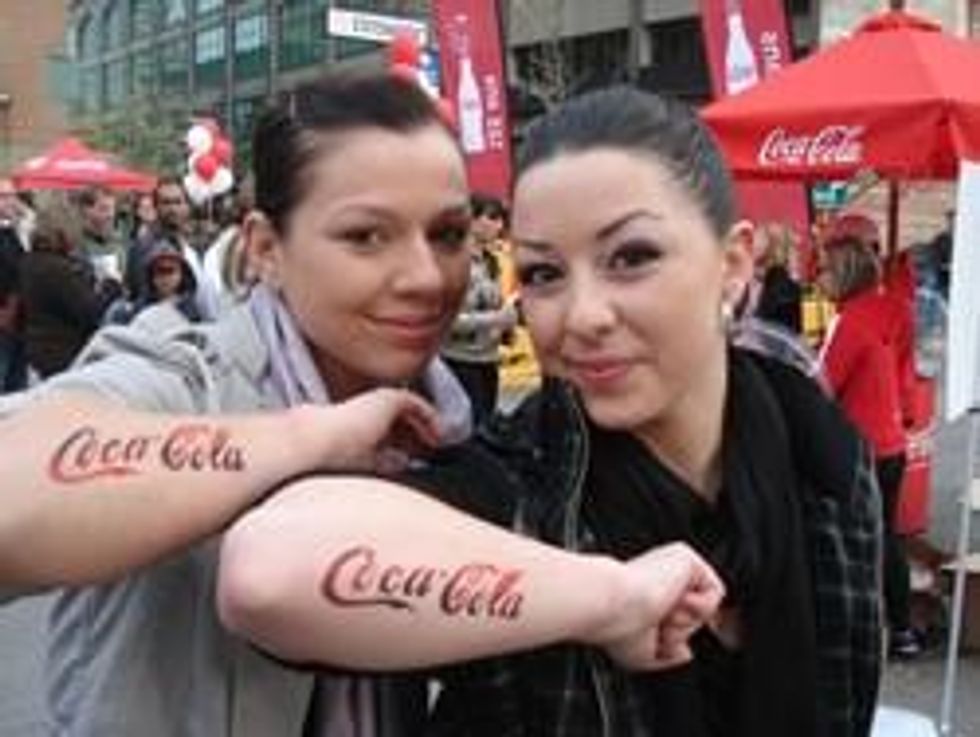
We used to have personalized T-shirts. Now we have personalized skin. Given the dominant role that commerce now plays in our society, this is my prediction for the future: A company will pay us good money to have "Drink Coke" printed on our necks.
Even though I was more or less in favor of it for reasons of health and hygiene, it was nonetheless a surprise how swiftly and irrevocably the ban against smoking tobacco went into effect. On Monday, we were all smoking in our homes and offices, mindlessly chugging away on those deadly cancer sticks, and by Friday, we were being told we could never smoke indoors again.
Another surprise was the success of bottled water. Never in our wildest dreams would we have thought that beverage companies could convince price-conscious consumers to voluntarily pay for something they could otherwise get for free, particularly after scientific tests have shown that municipal water is, in fact, freer of bacteria than so-called "mountain spring" water. It just proves how effective an advertising campaign can be.
But perhaps the biggest surprise of all has been the ubiquity of tattoos. If you had asked me in 1980 what the chances were of a good portion of the American population--men and women, young and old--walking around in 2010 covered in tattoos, I would have answered "Zero."
I knew a woman who tattooed the date of her son's birth on her forearm. When I asked why she did it, she said it was because she loved her son and wanted to "commemorate" his birth. Because I love my daughter, but didn't feel obliged to engrave the date of her birth on my body, I facetiously asked the woman if she was afraid she'd forget his birthday if she didn't write it down. It was a dumb joke. She wasn't amused.
According to the guy down at the donut shop, there are three possible explanations for the popularity of tattoos: Aesthetics, Imitation, and Exhibitionism.
Aesthetics makes perfect sense. A woman may think a large, red and blue flower on her shoulder adds to her overall attractiveness, makes her seem more feminine, and a man may genuinely believe that a fierce skull wearing a top hat makes him appear more masculine or menacing. There's no accounting for tastes.
And imitation may simply reflect the powerful influence of peer pressure, something we're all aware of and, if we're honest with ourselves, something we've all succumbed to. When the high school student body president gets a tattoo on his/her arm, 200 classmates are going to want to get tattoos on their arms. So maybe that's the explanation. Tattoos are viral.
As for exhibitionism, we can only hope that's not the answer. We can only hope that a "Hey, look at me!" mentality hasn't reached critical mass. "Hey, look at my design, look at my symbol, look at my message!" Don't judge me by who I am, folks; judge me by what I have printed on me.
We used to have personalized T-shirts. Now we have personalized skin. Given the dominant role that commerce now plays in our society, this is my prediction for the future: A company will pay us good money to have "Drink Coke" printed on our necks.
Even though I was more or less in favor of it for reasons of health and hygiene, it was nonetheless a surprise how swiftly and irrevocably the ban against smoking tobacco went into effect. On Monday, we were all smoking in our homes and offices, mindlessly chugging away on those deadly cancer sticks, and by Friday, we were being told we could never smoke indoors again.
Another surprise was the success of bottled water. Never in our wildest dreams would we have thought that beverage companies could convince price-conscious consumers to voluntarily pay for something they could otherwise get for free, particularly after scientific tests have shown that municipal water is, in fact, freer of bacteria than so-called "mountain spring" water. It just proves how effective an advertising campaign can be.
But perhaps the biggest surprise of all has been the ubiquity of tattoos. If you had asked me in 1980 what the chances were of a good portion of the American population--men and women, young and old--walking around in 2010 covered in tattoos, I would have answered "Zero."
I knew a woman who tattooed the date of her son's birth on her forearm. When I asked why she did it, she said it was because she loved her son and wanted to "commemorate" his birth. Because I love my daughter, but didn't feel obliged to engrave the date of her birth on my body, I facetiously asked the woman if she was afraid she'd forget his birthday if she didn't write it down. It was a dumb joke. She wasn't amused.
According to the guy down at the donut shop, there are three possible explanations for the popularity of tattoos: Aesthetics, Imitation, and Exhibitionism.
Aesthetics makes perfect sense. A woman may think a large, red and blue flower on her shoulder adds to her overall attractiveness, makes her seem more feminine, and a man may genuinely believe that a fierce skull wearing a top hat makes him appear more masculine or menacing. There's no accounting for tastes.
And imitation may simply reflect the powerful influence of peer pressure, something we're all aware of and, if we're honest with ourselves, something we've all succumbed to. When the high school student body president gets a tattoo on his/her arm, 200 classmates are going to want to get tattoos on their arms. So maybe that's the explanation. Tattoos are viral.
As for exhibitionism, we can only hope that's not the answer. We can only hope that a "Hey, look at me!" mentality hasn't reached critical mass. "Hey, look at my design, look at my symbol, look at my message!" Don't judge me by who I am, folks; judge me by what I have printed on me.
We used to have personalized T-shirts. Now we have personalized skin. Given the dominant role that commerce now plays in our society, this is my prediction for the future: A company will pay us good money to have "Drink Coke" printed on our necks.