SUBSCRIBE TO OUR FREE NEWSLETTER
Daily news & progressive opinion—funded by the people, not the corporations—delivered straight to your inbox.
5
#000000
#FFFFFF
To donate by check, phone, or other method, see our More Ways to Give page.
Daily news & progressive opinion—funded by the people, not the corporations—delivered straight to your inbox.
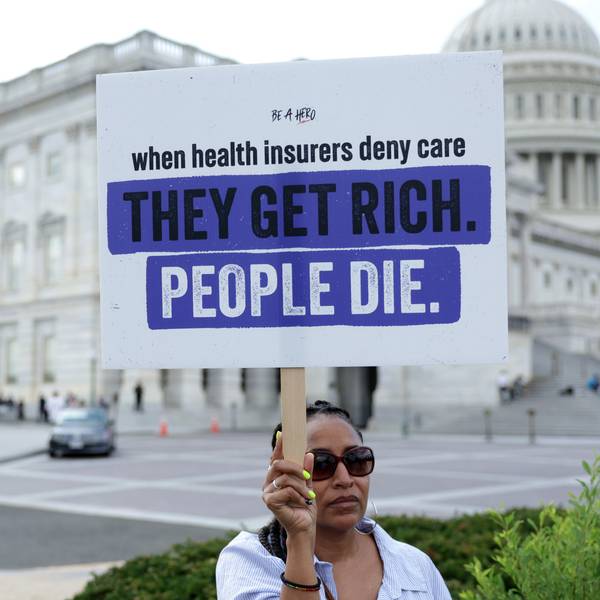
Patients find it very difficult to tell in our dysfunctional healthcare system in the U.S. whether we are being cared for as people or being worked over for profit potential. It's frustrating and painful to hear ourselves referred to as consumers or customers rather than patients. Rest assured that when someone labels us as things rather than human beings, it's more than a difference in terminology; it's a big, bold statement on exactly where and how we fit.
Patients find it very difficult to tell in our dysfunctional healthcare system in the U.S. whether we are being cared for as people or being worked over for profit potential. It's frustrating and painful to hear ourselves referred to as consumers or customers rather than patients. Rest assured that when someone labels us as things rather than human beings, it's more than a difference in terminology; it's a big, bold statement on exactly where and how we fit.
Watching our nurses' work in Maine to oppose the for-profit takeover of kidney dialysis services illustrates just one area in which human beings who are dependent for their lives are at the mercy of those who are dependent on profit. Wealth over health.
As I have worked with the advocates who support a progressively financed, single standard of high quality care for all under a Medicare for all for life model, I have sometimes noticed that it can be difficult to discern the ultimate motivations of some providers who were tortured not so much by the inhumanity of the system but by their own inability to break through that inhumanity and make money to meet their own obligations. I suspect even when we get to a truly universal model, those kinds of providers will work to protect themselves and their revenue streams more than they will work to make sure patients are treated as human beings. Wealth over health.
We're continuing our Medicare for all for life bus tour in California this week, and we look forward to seeing patients - human beings--come to our screenings and our town halls meetings in Glendale tonight, South Los Angeles on Tuesday, Santa Monica on Wednesday, and West Covina on Thursday. Hilda Sarkisyan (the late Nataline Sarkisyan's mom) will be with us in Glendale, and three of the subjects of Michael Moore's 2007 documentary film, SiCKO, will join us on Thursday - Reggie Cervantes, Dawnelle Keys and me. Health over wealth.
But back home in Maryland, my hubby, went to the neurologist who has been treating him for issues that trouble him, including diminished memory and headaches. He forgot an appointment last week, so the very first thing he was asked as he checked in was if he had the $25 they wanted to collect from him for forgetting that appointment. He said no he didn't. The secretary went away for a moment. Then when he was called into the office to see the doctor, the doctor's first question was not to ask him how he was. The doctor said, "I understand you refused to pay the $25 you owe me."
My husband explained that he did not refuse to do so, then asked, "Is this supposed to be about your wealth or my health?" The doctor grew angrier and advised my husband, after having him perform a couple of assessments of his neurological status -- undoubtedly so he could bill Medicare and Humana for the visit today -- that he no longer wished to treat him. My husband was fired as a patient. Wealth over health.
Are we patients? Are we consumers? Are we human beings? Are we customers? If we are to heal this system, we'll have to define ourselves clearly. I, for one, am a patient. What say you?
Dear Common Dreams reader, It’s been nearly 30 years since I co-founded Common Dreams with my late wife, Lina Newhouser. We had the radical notion that journalism should serve the public good, not corporate profits. It was clear to us from the outset what it would take to build such a project. No paid advertisements. No corporate sponsors. No millionaire publisher telling us what to think or do. Many people said we wouldn't last a year, but we proved those doubters wrong. Together with a tremendous team of journalists and dedicated staff, we built an independent media outlet free from the constraints of profits and corporate control. Our mission has always been simple: To inform. To inspire. To ignite change for the common good. Building Common Dreams was not easy. Our survival was never guaranteed. When you take on the most powerful forces—Wall Street greed, fossil fuel industry destruction, Big Tech lobbyists, and uber-rich oligarchs who have spent billions upon billions rigging the economy and democracy in their favor—the only bulwark you have is supporters who believe in your work. But here’s the urgent message from me today. It's never been this bad out there. And it's never been this hard to keep us going. At the very moment Common Dreams is most needed, the threats we face are intensifying. We need your support now more than ever. We don't accept corporate advertising and never will. We don't have a paywall because we don't think people should be blocked from critical news based on their ability to pay. Everything we do is funded by the donations of readers like you. When everyone does the little they can afford, we are strong. But if that support retreats or dries up, so do we. Will you donate now to make sure Common Dreams not only survives but thrives? —Craig Brown, Co-founder |
Patients find it very difficult to tell in our dysfunctional healthcare system in the U.S. whether we are being cared for as people or being worked over for profit potential. It's frustrating and painful to hear ourselves referred to as consumers or customers rather than patients. Rest assured that when someone labels us as things rather than human beings, it's more than a difference in terminology; it's a big, bold statement on exactly where and how we fit.
Watching our nurses' work in Maine to oppose the for-profit takeover of kidney dialysis services illustrates just one area in which human beings who are dependent for their lives are at the mercy of those who are dependent on profit. Wealth over health.
As I have worked with the advocates who support a progressively financed, single standard of high quality care for all under a Medicare for all for life model, I have sometimes noticed that it can be difficult to discern the ultimate motivations of some providers who were tortured not so much by the inhumanity of the system but by their own inability to break through that inhumanity and make money to meet their own obligations. I suspect even when we get to a truly universal model, those kinds of providers will work to protect themselves and their revenue streams more than they will work to make sure patients are treated as human beings. Wealth over health.
We're continuing our Medicare for all for life bus tour in California this week, and we look forward to seeing patients - human beings--come to our screenings and our town halls meetings in Glendale tonight, South Los Angeles on Tuesday, Santa Monica on Wednesday, and West Covina on Thursday. Hilda Sarkisyan (the late Nataline Sarkisyan's mom) will be with us in Glendale, and three of the subjects of Michael Moore's 2007 documentary film, SiCKO, will join us on Thursday - Reggie Cervantes, Dawnelle Keys and me. Health over wealth.
But back home in Maryland, my hubby, went to the neurologist who has been treating him for issues that trouble him, including diminished memory and headaches. He forgot an appointment last week, so the very first thing he was asked as he checked in was if he had the $25 they wanted to collect from him for forgetting that appointment. He said no he didn't. The secretary went away for a moment. Then when he was called into the office to see the doctor, the doctor's first question was not to ask him how he was. The doctor said, "I understand you refused to pay the $25 you owe me."
My husband explained that he did not refuse to do so, then asked, "Is this supposed to be about your wealth or my health?" The doctor grew angrier and advised my husband, after having him perform a couple of assessments of his neurological status -- undoubtedly so he could bill Medicare and Humana for the visit today -- that he no longer wished to treat him. My husband was fired as a patient. Wealth over health.
Are we patients? Are we consumers? Are we human beings? Are we customers? If we are to heal this system, we'll have to define ourselves clearly. I, for one, am a patient. What say you?
Patients find it very difficult to tell in our dysfunctional healthcare system in the U.S. whether we are being cared for as people or being worked over for profit potential. It's frustrating and painful to hear ourselves referred to as consumers or customers rather than patients. Rest assured that when someone labels us as things rather than human beings, it's more than a difference in terminology; it's a big, bold statement on exactly where and how we fit.
Watching our nurses' work in Maine to oppose the for-profit takeover of kidney dialysis services illustrates just one area in which human beings who are dependent for their lives are at the mercy of those who are dependent on profit. Wealth over health.
As I have worked with the advocates who support a progressively financed, single standard of high quality care for all under a Medicare for all for life model, I have sometimes noticed that it can be difficult to discern the ultimate motivations of some providers who were tortured not so much by the inhumanity of the system but by their own inability to break through that inhumanity and make money to meet their own obligations. I suspect even when we get to a truly universal model, those kinds of providers will work to protect themselves and their revenue streams more than they will work to make sure patients are treated as human beings. Wealth over health.
We're continuing our Medicare for all for life bus tour in California this week, and we look forward to seeing patients - human beings--come to our screenings and our town halls meetings in Glendale tonight, South Los Angeles on Tuesday, Santa Monica on Wednesday, and West Covina on Thursday. Hilda Sarkisyan (the late Nataline Sarkisyan's mom) will be with us in Glendale, and three of the subjects of Michael Moore's 2007 documentary film, SiCKO, will join us on Thursday - Reggie Cervantes, Dawnelle Keys and me. Health over wealth.
But back home in Maryland, my hubby, went to the neurologist who has been treating him for issues that trouble him, including diminished memory and headaches. He forgot an appointment last week, so the very first thing he was asked as he checked in was if he had the $25 they wanted to collect from him for forgetting that appointment. He said no he didn't. The secretary went away for a moment. Then when he was called into the office to see the doctor, the doctor's first question was not to ask him how he was. The doctor said, "I understand you refused to pay the $25 you owe me."
My husband explained that he did not refuse to do so, then asked, "Is this supposed to be about your wealth or my health?" The doctor grew angrier and advised my husband, after having him perform a couple of assessments of his neurological status -- undoubtedly so he could bill Medicare and Humana for the visit today -- that he no longer wished to treat him. My husband was fired as a patient. Wealth over health.
Are we patients? Are we consumers? Are we human beings? Are we customers? If we are to heal this system, we'll have to define ourselves clearly. I, for one, am a patient. What say you?