SUBSCRIBE TO OUR FREE NEWSLETTER
Daily news & progressive opinion—funded by the people, not the corporations—delivered straight to your inbox.
5
#000000
#FFFFFF
To donate by check, phone, or other method, see our More Ways to Give page.


Daily news & progressive opinion—funded by the people, not the corporations—delivered straight to your inbox.
The 1992 Rio Earth summit established "sustainable development" firmly in the global political lexicon - even though the term meant, and continues to mean, different things to different people. For Stephan Schmidheiny, a CEO who was appointed chief adviser for business and industry at the summit and subsequently set up the World Business Council on Sustainable Development, it apparently means continuing with business as usual: in February, he was sentenced to 16 years in prison for the deaths of thousands of workers at his asbestos-cement factory.

As the Rio+20 anniversary conference approaches, a battle rages over the definition of another term: "green economy". "A green economy in the context of sustainable development and poverty eradication" is a key conference theme. It sounds good, but what does it mean?
According to one of the official preparatory documents (pdf): "Several delegations proposed the valuing of ecosystem services and internalising of environmental externalities as key elements of a green economy, as well as green accounting (pdf); while some delegations cautioned against further marketisation of nature's services."
The jargon masks some diametrically opposing views. On one side, many northern governments are saying we trash the natural world because we don't value it properly. So far, so good. But they go on to confuse "value" with "price", which is where it all starts to break down. They argue that to conserve or protect the resources and functions we need from nature, we need to ascribe a financial value to them and bring them into the market. Then we will pay the proper price for nature and stop destroying it.
The UK government is a big advocate of this approach, having bought heavily into the recommendations of a report on the subject by a team led by the former Deutsche Bank employee Pavan Sukhdev. It has gone as far as publishing a white paper that commits to pushing the agenda, both in the UK and on the international stage.
A market-based approach to dealing with natural resources is not an entirely new concept. The idea behind the UN's Reducing Emissions from Deforestation and Forest Degradation programme (Redd), for example, is that if the carbon stored in forests is valued and quantified, forests will be seen as more valuable standing than they would be cut down.
The co-option of the term 'green economy' to mean commodifying and marketizing nature is made worse because it is in danger of dominating the Rio+20 summit at the expense of some of the really positive policies being proposed. These include ending massive subsidies for fossil fuels and other dirty industries, supporting greener industries instead, and moving away from taxing social goods (such as labour) towards taxing social bads (such as pollution).
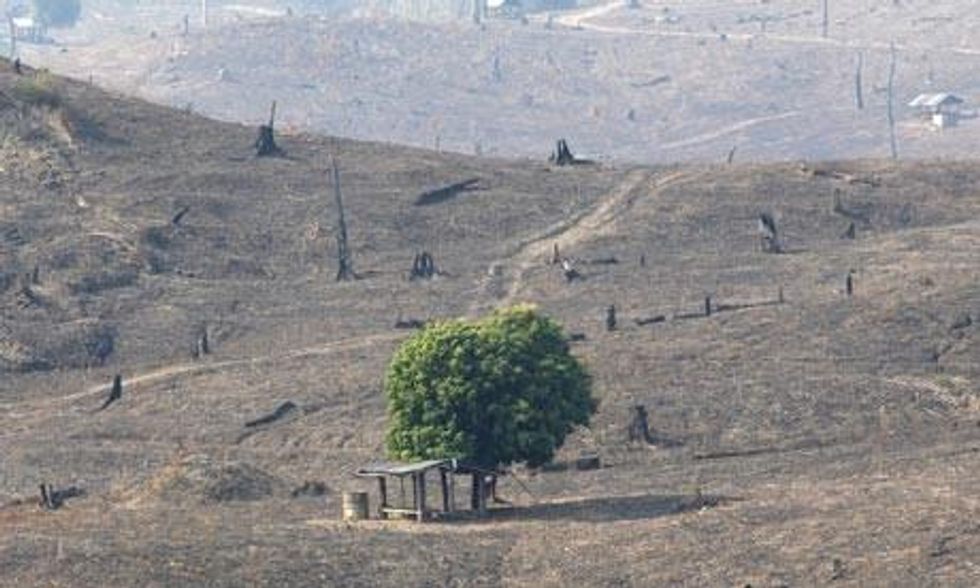
But by allowing companies to "offset" their logging by planting tree plantations, Redd has opened the door to the legal destruction of rainforests. It has also led to the confiscation of land from people who often do not have formal ownership deeds to the land they have used in common for generations. For example, in Uganda more than 22,000 people were evicted from their land, allegedly at gunpoint, to allow the New Forests Company, a UK firm, to plant trees to earn carbon credits.
Yet the UK and other governments would have us expand this approach to protecting biodiversity, the delivery of fresh water, and any other areas where there might be a profit to be made from nature. The result would be the further privatisation of essential elements of our planet to which we all share rights and have responsibilities.
The co-option of the term green economy to mean commodifying and marketising nature is made worse because it is in danger of dominating the Rio+20 summit at the expense of some of the really positive policies being proposed. These include ending massive subsidies for fossil fuels and other dirty industries, supporting greener industries instead, and moving away from taxing social goods (such as labour) towards taxing social bads (such as pollution).
But in the longer term, a real green economy would need to overcome even thornier issues. We need to change our consumption and production patterns and end the obsession with economic growth, looking instead at other indicators of a healthily functioning society.
It is perhaps no surprise that discussions on these issues, the most difficult questions, will largely be taking place not on the conference floor but beforehand, at a very different sort of gathering. At the People's summit, citizens from all over Brazil and beyond will be meeting to discuss the sort of world they want and work out how we might get there. Powerful and incredibly inspiring ideas and experiences, like food and energy sovereignty - the right of peoples to choose their own food and energy systems, rather than having them determined by global markets - will be shared and worked towards.
One of Rio+20's straplines is: "The future we want." But it will be at the People's summit that social, environmental, workers', women's and other movements will evolve their bold, brave ideas and take the next steps towards the kind of future I want.

Dear Common Dreams reader, It’s been nearly 30 years since I co-founded Common Dreams with my late wife, Lina Newhouser. We had the radical notion that journalism should serve the public good, not corporate profits. It was clear to us from the outset what it would take to build such a project. No paid advertisements. No corporate sponsors. No millionaire publisher telling us what to think or do. Many people said we wouldn't last a year, but we proved those doubters wrong. Together with a tremendous team of journalists and dedicated staff, we built an independent media outlet free from the constraints of profits and corporate control. Our mission has always been simple: To inform. To inspire. To ignite change for the common good. Building Common Dreams was not easy. Our survival was never guaranteed. When you take on the most powerful forces—Wall Street greed, fossil fuel industry destruction, Big Tech lobbyists, and uber-rich oligarchs who have spent billions upon billions rigging the economy and democracy in their favor—the only bulwark you have is supporters who believe in your work. But here’s the urgent message from me today. It's never been this bad out there. And it's never been this hard to keep us going. At the very moment Common Dreams is most needed, the threats we face are intensifying. We need your support now more than ever. We don't accept corporate advertising and never will. We don't have a paywall because we don't think people should be blocked from critical news based on their ability to pay. Everything we do is funded by the donations of readers like you. When everyone does the little they can afford, we are strong. But if that support retreats or dries up, so do we. Will you donate now to make sure Common Dreams not only survives but thrives? —Craig Brown, Co-founder |
The 1992 Rio Earth summit established "sustainable development" firmly in the global political lexicon - even though the term meant, and continues to mean, different things to different people. For Stephan Schmidheiny, a CEO who was appointed chief adviser for business and industry at the summit and subsequently set up the World Business Council on Sustainable Development, it apparently means continuing with business as usual: in February, he was sentenced to 16 years in prison for the deaths of thousands of workers at his asbestos-cement factory.

As the Rio+20 anniversary conference approaches, a battle rages over the definition of another term: "green economy". "A green economy in the context of sustainable development and poverty eradication" is a key conference theme. It sounds good, but what does it mean?
According to one of the official preparatory documents (pdf): "Several delegations proposed the valuing of ecosystem services and internalising of environmental externalities as key elements of a green economy, as well as green accounting (pdf); while some delegations cautioned against further marketisation of nature's services."
The jargon masks some diametrically opposing views. On one side, many northern governments are saying we trash the natural world because we don't value it properly. So far, so good. But they go on to confuse "value" with "price", which is where it all starts to break down. They argue that to conserve or protect the resources and functions we need from nature, we need to ascribe a financial value to them and bring them into the market. Then we will pay the proper price for nature and stop destroying it.
The UK government is a big advocate of this approach, having bought heavily into the recommendations of a report on the subject by a team led by the former Deutsche Bank employee Pavan Sukhdev. It has gone as far as publishing a white paper that commits to pushing the agenda, both in the UK and on the international stage.
A market-based approach to dealing with natural resources is not an entirely new concept. The idea behind the UN's Reducing Emissions from Deforestation and Forest Degradation programme (Redd), for example, is that if the carbon stored in forests is valued and quantified, forests will be seen as more valuable standing than they would be cut down.
The co-option of the term 'green economy' to mean commodifying and marketizing nature is made worse because it is in danger of dominating the Rio+20 summit at the expense of some of the really positive policies being proposed. These include ending massive subsidies for fossil fuels and other dirty industries, supporting greener industries instead, and moving away from taxing social goods (such as labour) towards taxing social bads (such as pollution).
But by allowing companies to "offset" their logging by planting tree plantations, Redd has opened the door to the legal destruction of rainforests. It has also led to the confiscation of land from people who often do not have formal ownership deeds to the land they have used in common for generations. For example, in Uganda more than 22,000 people were evicted from their land, allegedly at gunpoint, to allow the New Forests Company, a UK firm, to plant trees to earn carbon credits.
Yet the UK and other governments would have us expand this approach to protecting biodiversity, the delivery of fresh water, and any other areas where there might be a profit to be made from nature. The result would be the further privatisation of essential elements of our planet to which we all share rights and have responsibilities.
The co-option of the term green economy to mean commodifying and marketising nature is made worse because it is in danger of dominating the Rio+20 summit at the expense of some of the really positive policies being proposed. These include ending massive subsidies for fossil fuels and other dirty industries, supporting greener industries instead, and moving away from taxing social goods (such as labour) towards taxing social bads (such as pollution).
But in the longer term, a real green economy would need to overcome even thornier issues. We need to change our consumption and production patterns and end the obsession with economic growth, looking instead at other indicators of a healthily functioning society.
It is perhaps no surprise that discussions on these issues, the most difficult questions, will largely be taking place not on the conference floor but beforehand, at a very different sort of gathering. At the People's summit, citizens from all over Brazil and beyond will be meeting to discuss the sort of world they want and work out how we might get there. Powerful and incredibly inspiring ideas and experiences, like food and energy sovereignty - the right of peoples to choose their own food and energy systems, rather than having them determined by global markets - will be shared and worked towards.
One of Rio+20's straplines is: "The future we want." But it will be at the People's summit that social, environmental, workers', women's and other movements will evolve their bold, brave ideas and take the next steps towards the kind of future I want.

The 1992 Rio Earth summit established "sustainable development" firmly in the global political lexicon - even though the term meant, and continues to mean, different things to different people. For Stephan Schmidheiny, a CEO who was appointed chief adviser for business and industry at the summit and subsequently set up the World Business Council on Sustainable Development, it apparently means continuing with business as usual: in February, he was sentenced to 16 years in prison for the deaths of thousands of workers at his asbestos-cement factory.

As the Rio+20 anniversary conference approaches, a battle rages over the definition of another term: "green economy". "A green economy in the context of sustainable development and poverty eradication" is a key conference theme. It sounds good, but what does it mean?
According to one of the official preparatory documents (pdf): "Several delegations proposed the valuing of ecosystem services and internalising of environmental externalities as key elements of a green economy, as well as green accounting (pdf); while some delegations cautioned against further marketisation of nature's services."
The jargon masks some diametrically opposing views. On one side, many northern governments are saying we trash the natural world because we don't value it properly. So far, so good. But they go on to confuse "value" with "price", which is where it all starts to break down. They argue that to conserve or protect the resources and functions we need from nature, we need to ascribe a financial value to them and bring them into the market. Then we will pay the proper price for nature and stop destroying it.
The UK government is a big advocate of this approach, having bought heavily into the recommendations of a report on the subject by a team led by the former Deutsche Bank employee Pavan Sukhdev. It has gone as far as publishing a white paper that commits to pushing the agenda, both in the UK and on the international stage.
A market-based approach to dealing with natural resources is not an entirely new concept. The idea behind the UN's Reducing Emissions from Deforestation and Forest Degradation programme (Redd), for example, is that if the carbon stored in forests is valued and quantified, forests will be seen as more valuable standing than they would be cut down.
The co-option of the term 'green economy' to mean commodifying and marketizing nature is made worse because it is in danger of dominating the Rio+20 summit at the expense of some of the really positive policies being proposed. These include ending massive subsidies for fossil fuels and other dirty industries, supporting greener industries instead, and moving away from taxing social goods (such as labour) towards taxing social bads (such as pollution).
But by allowing companies to "offset" their logging by planting tree plantations, Redd has opened the door to the legal destruction of rainforests. It has also led to the confiscation of land from people who often do not have formal ownership deeds to the land they have used in common for generations. For example, in Uganda more than 22,000 people were evicted from their land, allegedly at gunpoint, to allow the New Forests Company, a UK firm, to plant trees to earn carbon credits.
Yet the UK and other governments would have us expand this approach to protecting biodiversity, the delivery of fresh water, and any other areas where there might be a profit to be made from nature. The result would be the further privatisation of essential elements of our planet to which we all share rights and have responsibilities.
The co-option of the term green economy to mean commodifying and marketising nature is made worse because it is in danger of dominating the Rio+20 summit at the expense of some of the really positive policies being proposed. These include ending massive subsidies for fossil fuels and other dirty industries, supporting greener industries instead, and moving away from taxing social goods (such as labour) towards taxing social bads (such as pollution).
But in the longer term, a real green economy would need to overcome even thornier issues. We need to change our consumption and production patterns and end the obsession with economic growth, looking instead at other indicators of a healthily functioning society.
It is perhaps no surprise that discussions on these issues, the most difficult questions, will largely be taking place not on the conference floor but beforehand, at a very different sort of gathering. At the People's summit, citizens from all over Brazil and beyond will be meeting to discuss the sort of world they want and work out how we might get there. Powerful and incredibly inspiring ideas and experiences, like food and energy sovereignty - the right of peoples to choose their own food and energy systems, rather than having them determined by global markets - will be shared and worked towards.
One of Rio+20's straplines is: "The future we want." But it will be at the People's summit that social, environmental, workers', women's and other movements will evolve their bold, brave ideas and take the next steps towards the kind of future I want.