SUBSCRIBE TO OUR FREE NEWSLETTER
Daily news & progressive opinion—funded by the people, not the corporations—delivered straight to your inbox.
5
#000000
#FFFFFF
To donate by check, phone, or other method, see our More Ways to Give page.
Most states in the union have laws against "gouging." Broadly speaking, gouging is defined as the practice of arbitrarily raising prices on necessary goods, such as milk, bottled water, baby food, baby formula, bread, etc., in response to civil emergencies (riots, martial law) or natural disasters (earthquakes, floods, tornadoes).
For example, an anti-gouging law would prohibit the owner of a neighborhood convenience store, in the wake of a massive earthquake, from tripling or quadrupling the price of drinking water. This consumer-protection device is one more instance of a benevolent government's vital role in regulating the so-called "free market." What could be fairer?
However, there are market fanatics out there who abhor these anti-gouging laws. One of their arguments is the reliable, time-honored appeal to the "slippery-slope." This argument maintains that if we allow the government to interfere with the sacrosanct Law of Supply and Demand, if we give it the power to approve or disapprove of a sticker price, the next step will be rigid restrictions on how much profit we're entitled to make, and the next step after that will be transforming us from the Land of Opportunity into a communist state.
Another argument is that, even in a grave emergency--say, in the aftermath of a major earthquake, with roads buckled, buildings collapsed, gas lines and water mains broken--the free market, in its genius, can be counted upon to automatically make the necessary "corrections," because competing stores will adjust their prices accordingly, in order to attract customers (as if "comparison shopping" will continue unimpeded).
But this gouging issue transcends retail commerce. The case can be made that what's been happening in the collective bargaining process over the last couple of decades (actually going all the way back to the Reagan administration) is a form of gouging--not in the statutory sense, of course, where laws are being broken, but in the sense of businesses taking unfair advantage of a customer's distress (with the "customer" in this case being the American worker).
Management's embrace of the aggressive, take-it-or-leave-it approach to contract negotiations is tantamount to a neighborhood store ripping us off by quadrupling the price of baby food following an earthquake. To the objections of an outraged consumer, the greedy store owner replies, "If you don't want the baby food, don't buy it." To the objections of the labor union representing the employees, the greedy company replies, "If you don't like working here--if you're unhappy here--quit."
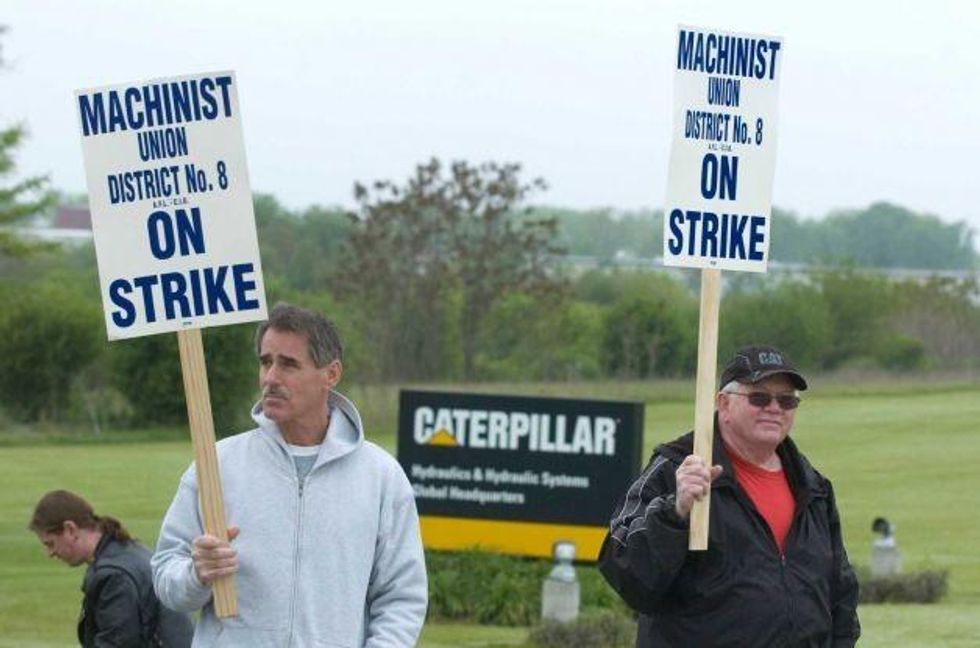
A perfect example of this scorched-earth policy can be seen at the Caterpillar plant in Joliet, Illinois, where, just a few days ago, on May 1, more than 700 Caterpillar employees (members of the International Association of Machinists) went on strike to protest a substandard contract being forced down their throats.
Why would a healthy company do that? Why would a healthy company choose to grind a loyal, efficient workforce into the ground? For the same reason a store owner, in the absence of anti-gouging legislation, charges $5.00 for a bottle of water that, only a day earlier, had sold for $1.25. Because they can.
It's certainly not a question of being able to "afford" a decent contract. Caterpillar is the world's largest maker of mining and construction equipment, diesel engines, and industrial gas turbines. They are enjoying record profits. In 2011, the company generated more than $60 billion in revenue, and in the first quarter of 2012 has already made $1.5 billion in profits. So successful are they, CEO Doug Oberhelman was granted a 60-percent compensation increase in 2011, putting him a shade under $17 million.
Again, why is this highly profitable company squeezing their workers? Why are they playing hardball? Short answer: Because they can. Because--with jobs scarce, with the economy fragile, with fear still in the air--they believe they have the workers on the run. And it's happening all across the country as more and more corporations are waking up to the realization that now is the opportune time to gouge the worker.
Those Joliet IAM members have the right idea, and they deserve our admiration. The only way to induce a stubborn company to bargain in good faith is by denying them the opportunity to earn that money and make those profits, and the only way to do that is by employees withholding their labor. Shut 'em all down.
Most states in the union have laws against "gouging." Broadly speaking, gouging is defined as the practice of arbitrarily raising prices on necessary goods, such as milk, bottled water, baby food, baby formula, bread, etc., in response to civil emergencies (riots, martial law) or natural disasters (earthquakes, floods, tornadoes).
For example, an anti-gouging law would prohibit the owner of a neighborhood convenience store, in the wake of a massive earthquake, from tripling or quadrupling the price of drinking water. This consumer-protection device is one more instance of a benevolent government's vital role in regulating the so-called "free market." What could be fairer?
However, there are market fanatics out there who abhor these anti-gouging laws. One of their arguments is the reliable, time-honored appeal to the "slippery-slope." This argument maintains that if we allow the government to interfere with the sacrosanct Law of Supply and Demand, if we give it the power to approve or disapprove of a sticker price, the next step will be rigid restrictions on how much profit we're entitled to make, and the next step after that will be transforming us from the Land of Opportunity into a communist state.
Another argument is that, even in a grave emergency--say, in the aftermath of a major earthquake, with roads buckled, buildings collapsed, gas lines and water mains broken--the free market, in its genius, can be counted upon to automatically make the necessary "corrections," because competing stores will adjust their prices accordingly, in order to attract customers (as if "comparison shopping" will continue unimpeded).
But this gouging issue transcends retail commerce. The case can be made that what's been happening in the collective bargaining process over the last couple of decades (actually going all the way back to the Reagan administration) is a form of gouging--not in the statutory sense, of course, where laws are being broken, but in the sense of businesses taking unfair advantage of a customer's distress (with the "customer" in this case being the American worker).
Management's embrace of the aggressive, take-it-or-leave-it approach to contract negotiations is tantamount to a neighborhood store ripping us off by quadrupling the price of baby food following an earthquake. To the objections of an outraged consumer, the greedy store owner replies, "If you don't want the baby food, don't buy it." To the objections of the labor union representing the employees, the greedy company replies, "If you don't like working here--if you're unhappy here--quit."
A perfect example of this scorched-earth policy can be seen at the Caterpillar plant in Joliet, Illinois, where, just a few days ago, on May 1, more than 700 Caterpillar employees (members of the International Association of Machinists) went on strike to protest a substandard contract being forced down their throats.
Why would a healthy company do that? Why would a healthy company choose to grind a loyal, efficient workforce into the ground? For the same reason a store owner, in the absence of anti-gouging legislation, charges $5.00 for a bottle of water that, only a day earlier, had sold for $1.25. Because they can.
It's certainly not a question of being able to "afford" a decent contract. Caterpillar is the world's largest maker of mining and construction equipment, diesel engines, and industrial gas turbines. They are enjoying record profits. In 2011, the company generated more than $60 billion in revenue, and in the first quarter of 2012 has already made $1.5 billion in profits. So successful are they, CEO Doug Oberhelman was granted a 60-percent compensation increase in 2011, putting him a shade under $17 million.
Again, why is this highly profitable company squeezing their workers? Why are they playing hardball? Short answer: Because they can. Because--with jobs scarce, with the economy fragile, with fear still in the air--they believe they have the workers on the run. And it's happening all across the country as more and more corporations are waking up to the realization that now is the opportune time to gouge the worker.
Those Joliet IAM members have the right idea, and they deserve our admiration. The only way to induce a stubborn company to bargain in good faith is by denying them the opportunity to earn that money and make those profits, and the only way to do that is by employees withholding their labor. Shut 'em all down.
Most states in the union have laws against "gouging." Broadly speaking, gouging is defined as the practice of arbitrarily raising prices on necessary goods, such as milk, bottled water, baby food, baby formula, bread, etc., in response to civil emergencies (riots, martial law) or natural disasters (earthquakes, floods, tornadoes).
For example, an anti-gouging law would prohibit the owner of a neighborhood convenience store, in the wake of a massive earthquake, from tripling or quadrupling the price of drinking water. This consumer-protection device is one more instance of a benevolent government's vital role in regulating the so-called "free market." What could be fairer?
However, there are market fanatics out there who abhor these anti-gouging laws. One of their arguments is the reliable, time-honored appeal to the "slippery-slope." This argument maintains that if we allow the government to interfere with the sacrosanct Law of Supply and Demand, if we give it the power to approve or disapprove of a sticker price, the next step will be rigid restrictions on how much profit we're entitled to make, and the next step after that will be transforming us from the Land of Opportunity into a communist state.
Another argument is that, even in a grave emergency--say, in the aftermath of a major earthquake, with roads buckled, buildings collapsed, gas lines and water mains broken--the free market, in its genius, can be counted upon to automatically make the necessary "corrections," because competing stores will adjust their prices accordingly, in order to attract customers (as if "comparison shopping" will continue unimpeded).
But this gouging issue transcends retail commerce. The case can be made that what's been happening in the collective bargaining process over the last couple of decades (actually going all the way back to the Reagan administration) is a form of gouging--not in the statutory sense, of course, where laws are being broken, but in the sense of businesses taking unfair advantage of a customer's distress (with the "customer" in this case being the American worker).
Management's embrace of the aggressive, take-it-or-leave-it approach to contract negotiations is tantamount to a neighborhood store ripping us off by quadrupling the price of baby food following an earthquake. To the objections of an outraged consumer, the greedy store owner replies, "If you don't want the baby food, don't buy it." To the objections of the labor union representing the employees, the greedy company replies, "If you don't like working here--if you're unhappy here--quit."
A perfect example of this scorched-earth policy can be seen at the Caterpillar plant in Joliet, Illinois, where, just a few days ago, on May 1, more than 700 Caterpillar employees (members of the International Association of Machinists) went on strike to protest a substandard contract being forced down their throats.
Why would a healthy company do that? Why would a healthy company choose to grind a loyal, efficient workforce into the ground? For the same reason a store owner, in the absence of anti-gouging legislation, charges $5.00 for a bottle of water that, only a day earlier, had sold for $1.25. Because they can.
It's certainly not a question of being able to "afford" a decent contract. Caterpillar is the world's largest maker of mining and construction equipment, diesel engines, and industrial gas turbines. They are enjoying record profits. In 2011, the company generated more than $60 billion in revenue, and in the first quarter of 2012 has already made $1.5 billion in profits. So successful are they, CEO Doug Oberhelman was granted a 60-percent compensation increase in 2011, putting him a shade under $17 million.
Again, why is this highly profitable company squeezing their workers? Why are they playing hardball? Short answer: Because they can. Because--with jobs scarce, with the economy fragile, with fear still in the air--they believe they have the workers on the run. And it's happening all across the country as more and more corporations are waking up to the realization that now is the opportune time to gouge the worker.
Those Joliet IAM members have the right idea, and they deserve our admiration. The only way to induce a stubborn company to bargain in good faith is by denying them the opportunity to earn that money and make those profits, and the only way to do that is by employees withholding their labor. Shut 'em all down.