SUBSCRIBE TO OUR FREE NEWSLETTER
Daily news & progressive opinion—funded by the people, not the corporations—delivered straight to your inbox.
5
#000000
#FFFFFF
To donate by check, phone, or other method, see our More Ways to Give page.
There's a striking photo of Ronald Reagan and members of his inner circle, cocktails in hand, practically doubled over with laughter.
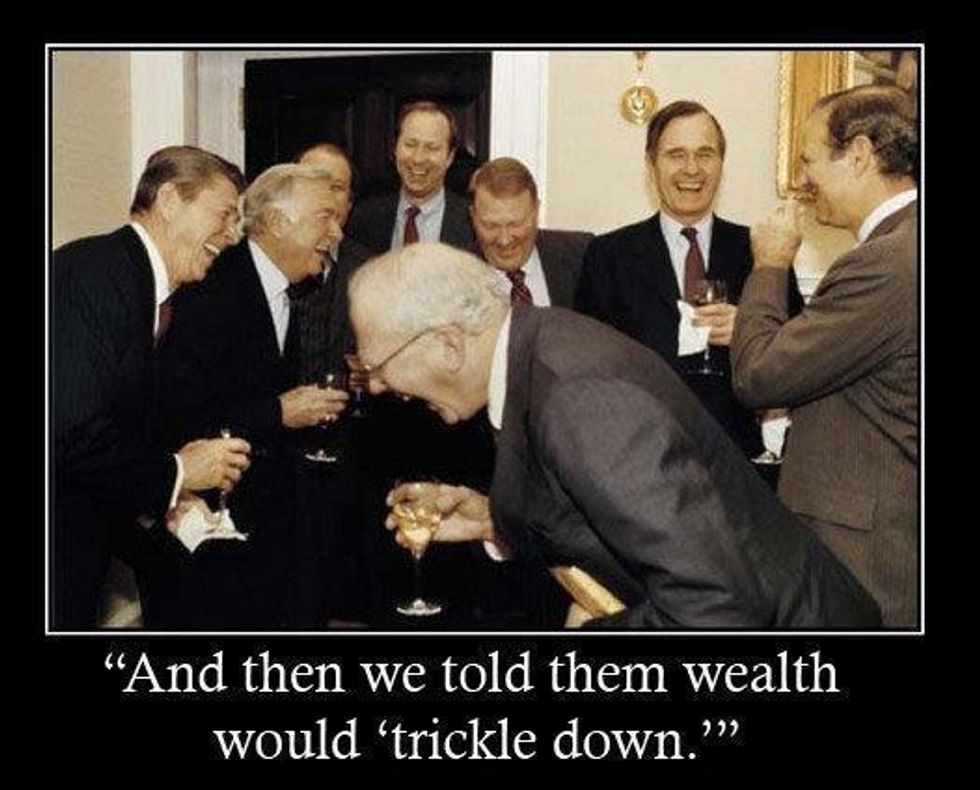
A clever wag attached a caption to the bottom of the photo: "We told them the wealth would trickle down!"
With that caption, the photo has gone viral on the Internet. One can imagine the photo capturing a 1980s scene inside the White House, as someone pulled back the curtain and caught the Reagan team in flagrante, celebrating how successfully they'd fooled the public about their "trickle down" theory.
With the revelations presented last week by Canada's Auditor General Michael Ferguson, it's easy to imagine a similar scene here: members of the Harper cabinet buckled over with laughter, celebrating how they successfully hid from the public $10 billion in costs connected to the purchase of dozens of fighter jets, even as they sold gullible Canadians on the need for "austerity."
Ha ha ha!
As the auditor general made clear, Stephen Harper's government failed to be honest with Canadians about the true costs of buying 65 of the pricey, U.S.-made jets, which were always much more popular with Canada's military brass, the Harper cabinet and the aerospace industry than with the general public.
Indeed, even before Ferguson's damning report, the public had good reason to be wary of plans to purchase the Lockheed Martin F-35 jets, without a tendering process open to competitors.
Costs of military contracts are notorious for escalating wildly, on average by triple the announced price, notes Peter Langille, a defence analyst formerly employed by Canada's defence department, who now teaches peace studies at McMaster University.
Langille says that the F-35 program, if it proceeds, will draw scarce government resources into preparing for war-fighting abroad, and away from public programs like health care and education -- a development Canadians would likely resist if they thought much about it.
Anxious to prevent the public from thinking much about it, the Harper team deliberately lowballed the costs, suggesting Canada could acquire the planes for $15 billion.
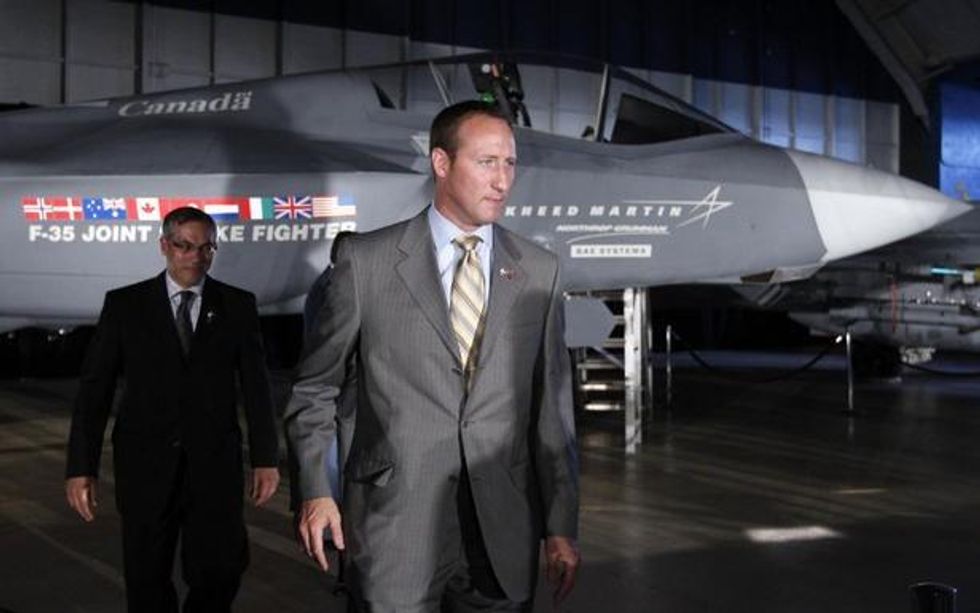
As the auditor general has revealed, Harper cabinet ministers continued to insist that $15 billion would be the cost, even after our defence department provided them with confidential information in June 2010 showing that the true costs would be $25 billion.
But Parliamentary Budget Officer Kevin Page smelled a rat, and produced his own estimate in March 2011 showing that the planes would cost $29 billion.
The Conservatives quickly dissed this annoying parliamentary watchdog as well as opposition critics, and insisted ever more vigorously that the price tag would not exceed $15 billion.
Still, some unpatriotic types remained skeptical. The government's refusal to provide a fuller accounting was, in part, what led to the non-confidence motion that prompted last spring's election.
Throughout that campaign, Harper and his ministers stuck adamantly to the $15 billion estimate -- while knowing it wasn't true -- and won a majority government.
Ha ha ha! What a knee slapper! And did you hear the one about the two Canadians who walked into a polling station, only to discover it was the wrong one!
But, while a $10 billion cost overrun is apparently no big deal to the Harperites (who, oddly, present themselves as sound fiscal managers), they quickly shifted into "austerity" mode after the election, lecturing Canadians on the dire need to reign in government spending.
Just last week, citing "challenging fiscal times," the Harper team ended a program that provides Internet access at libraries and community centres, giving low-income Canadians -- about half of whom lack Internet access -- a lifeline to the world, as well as a way to apply for jobs.
The nationwide program, which costs only $15 million, operates with the help of volunteers.
This example of generous Canadians volunteering to help Canada's most vulnerable citizens is enough to restore one's belief in the goodness of this country. But, suddenly, with the stroke of a pen, it was wiped out by the Harper cabinet, in the name of austerity.
Ha ha ha! High fives, boys!
There's a striking photo of Ronald Reagan and members of his inner circle, cocktails in hand, practically doubled over with laughter.
A clever wag attached a caption to the bottom of the photo: "We told them the wealth would trickle down!"
With that caption, the photo has gone viral on the Internet. One can imagine the photo capturing a 1980s scene inside the White House, as someone pulled back the curtain and caught the Reagan team in flagrante, celebrating how successfully they'd fooled the public about their "trickle down" theory.
With the revelations presented last week by Canada's Auditor General Michael Ferguson, it's easy to imagine a similar scene here: members of the Harper cabinet buckled over with laughter, celebrating how they successfully hid from the public $10 billion in costs connected to the purchase of dozens of fighter jets, even as they sold gullible Canadians on the need for "austerity."
Ha ha ha!
As the auditor general made clear, Stephen Harper's government failed to be honest with Canadians about the true costs of buying 65 of the pricey, U.S.-made jets, which were always much more popular with Canada's military brass, the Harper cabinet and the aerospace industry than with the general public.
Indeed, even before Ferguson's damning report, the public had good reason to be wary of plans to purchase the Lockheed Martin F-35 jets, without a tendering process open to competitors.
Costs of military contracts are notorious for escalating wildly, on average by triple the announced price, notes Peter Langille, a defence analyst formerly employed by Canada's defence department, who now teaches peace studies at McMaster University.
Langille says that the F-35 program, if it proceeds, will draw scarce government resources into preparing for war-fighting abroad, and away from public programs like health care and education -- a development Canadians would likely resist if they thought much about it.
Anxious to prevent the public from thinking much about it, the Harper team deliberately lowballed the costs, suggesting Canada could acquire the planes for $15 billion.
As the auditor general has revealed, Harper cabinet ministers continued to insist that $15 billion would be the cost, even after our defence department provided them with confidential information in June 2010 showing that the true costs would be $25 billion.
But Parliamentary Budget Officer Kevin Page smelled a rat, and produced his own estimate in March 2011 showing that the planes would cost $29 billion.
The Conservatives quickly dissed this annoying parliamentary watchdog as well as opposition critics, and insisted ever more vigorously that the price tag would not exceed $15 billion.
Still, some unpatriotic types remained skeptical. The government's refusal to provide a fuller accounting was, in part, what led to the non-confidence motion that prompted last spring's election.
Throughout that campaign, Harper and his ministers stuck adamantly to the $15 billion estimate -- while knowing it wasn't true -- and won a majority government.
Ha ha ha! What a knee slapper! And did you hear the one about the two Canadians who walked into a polling station, only to discover it was the wrong one!
But, while a $10 billion cost overrun is apparently no big deal to the Harperites (who, oddly, present themselves as sound fiscal managers), they quickly shifted into "austerity" mode after the election, lecturing Canadians on the dire need to reign in government spending.
Just last week, citing "challenging fiscal times," the Harper team ended a program that provides Internet access at libraries and community centres, giving low-income Canadians -- about half of whom lack Internet access -- a lifeline to the world, as well as a way to apply for jobs.
The nationwide program, which costs only $15 million, operates with the help of volunteers.
This example of generous Canadians volunteering to help Canada's most vulnerable citizens is enough to restore one's belief in the goodness of this country. But, suddenly, with the stroke of a pen, it was wiped out by the Harper cabinet, in the name of austerity.
Ha ha ha! High fives, boys!
There's a striking photo of Ronald Reagan and members of his inner circle, cocktails in hand, practically doubled over with laughter.
A clever wag attached a caption to the bottom of the photo: "We told them the wealth would trickle down!"
With that caption, the photo has gone viral on the Internet. One can imagine the photo capturing a 1980s scene inside the White House, as someone pulled back the curtain and caught the Reagan team in flagrante, celebrating how successfully they'd fooled the public about their "trickle down" theory.
With the revelations presented last week by Canada's Auditor General Michael Ferguson, it's easy to imagine a similar scene here: members of the Harper cabinet buckled over with laughter, celebrating how they successfully hid from the public $10 billion in costs connected to the purchase of dozens of fighter jets, even as they sold gullible Canadians on the need for "austerity."
Ha ha ha!
As the auditor general made clear, Stephen Harper's government failed to be honest with Canadians about the true costs of buying 65 of the pricey, U.S.-made jets, which were always much more popular with Canada's military brass, the Harper cabinet and the aerospace industry than with the general public.
Indeed, even before Ferguson's damning report, the public had good reason to be wary of plans to purchase the Lockheed Martin F-35 jets, without a tendering process open to competitors.
Costs of military contracts are notorious for escalating wildly, on average by triple the announced price, notes Peter Langille, a defence analyst formerly employed by Canada's defence department, who now teaches peace studies at McMaster University.
Langille says that the F-35 program, if it proceeds, will draw scarce government resources into preparing for war-fighting abroad, and away from public programs like health care and education -- a development Canadians would likely resist if they thought much about it.
Anxious to prevent the public from thinking much about it, the Harper team deliberately lowballed the costs, suggesting Canada could acquire the planes for $15 billion.
As the auditor general has revealed, Harper cabinet ministers continued to insist that $15 billion would be the cost, even after our defence department provided them with confidential information in June 2010 showing that the true costs would be $25 billion.
But Parliamentary Budget Officer Kevin Page smelled a rat, and produced his own estimate in March 2011 showing that the planes would cost $29 billion.
The Conservatives quickly dissed this annoying parliamentary watchdog as well as opposition critics, and insisted ever more vigorously that the price tag would not exceed $15 billion.
Still, some unpatriotic types remained skeptical. The government's refusal to provide a fuller accounting was, in part, what led to the non-confidence motion that prompted last spring's election.
Throughout that campaign, Harper and his ministers stuck adamantly to the $15 billion estimate -- while knowing it wasn't true -- and won a majority government.
Ha ha ha! What a knee slapper! And did you hear the one about the two Canadians who walked into a polling station, only to discover it was the wrong one!
But, while a $10 billion cost overrun is apparently no big deal to the Harperites (who, oddly, present themselves as sound fiscal managers), they quickly shifted into "austerity" mode after the election, lecturing Canadians on the dire need to reign in government spending.
Just last week, citing "challenging fiscal times," the Harper team ended a program that provides Internet access at libraries and community centres, giving low-income Canadians -- about half of whom lack Internet access -- a lifeline to the world, as well as a way to apply for jobs.
The nationwide program, which costs only $15 million, operates with the help of volunteers.
This example of generous Canadians volunteering to help Canada's most vulnerable citizens is enough to restore one's belief in the goodness of this country. But, suddenly, with the stroke of a pen, it was wiped out by the Harper cabinet, in the name of austerity.
Ha ha ha! High fives, boys!