The Best Reason for the Very Rich to be Paying a Lot More in Taxes
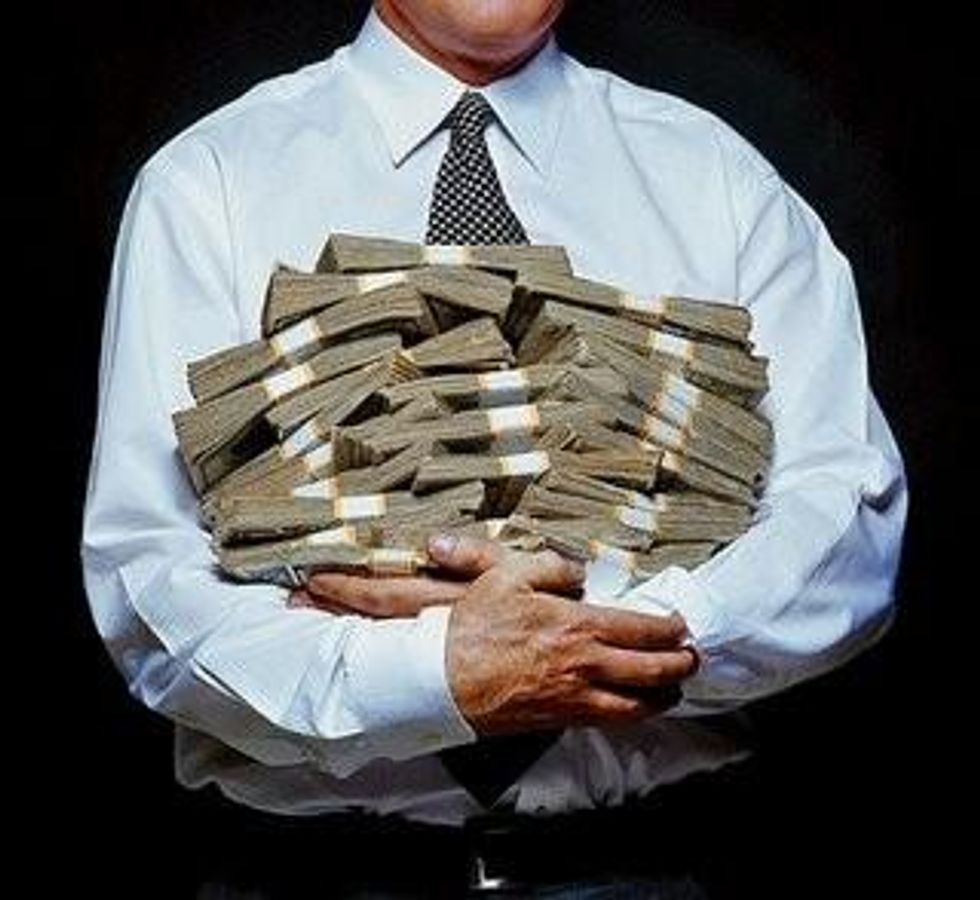
Before getting into the best reason, here are some of the usual -- and always good -- reasons. First of all, for every dollar the richest 1% earned in 1980, they've added three more dollars. The poorest 90% have added ONE CENT.
The richest million families have not worked three times (let alone 300 times) harder than the other 99 million families.
Before getting into the best reason, here are some of the usual -- and always good -- reasons. First of all, for every dollar the richest 1% earned in 1980, they've added three more dollars. The poorest 90% have added ONE CENT.

The richest million families have not worked three times (let alone 300 times) harder than the other 99 million families.
The richest 10% own 80% of the stock market, providing billions in "unearned income" that is taxed at less than half the rate of income earned through real work. The richest million families may have actually worked LESS than the other 99 million families.
A number of individuals have had one-year incomes over a billion dollars, enough to pay the salaries of 25,000 teachers or health care workers or emergency responders. It's questionable whether a guy who makes a billion betting on a mortgage collapse is worth even one teacher or health care worker or emergency responder.
Next is the woeful state of tax collections on the people making most of the money. Mitt Romney pays 15%, Warren Buffett 17.4%. The richest 400 Americans, 16.6%. The whole top 1% (a million families) paid less than 23% in 2006.
Average Americans pay more than that. Studies show that when state and local taxes, payroll taxes, property taxes, sales taxes, and excise taxes are tallied up, low-income people can be paying a higher percentage of taxes than the rich, perhaps up to 40% of their incomes.
Average Americans are also paying more than corporations. For every dollar of workers' payroll tax paid in the 1950s, corporations paid three dollars. Now it's 16 cents.
Whew. A lot of good reasons for the rich to be paying a lot more in taxes.
But here's the BEST REASON. The super-rich like to believe their own initiative and creativity have been the primary drivers of growth in technology and science and business and medicine. Some innovative business leaders deserve credit for putting the pieces together on specific initiatives. But the pieces themselves were put together over many years by thousands of less conspicuous people. As Elizabeth Warren said, "There is nobody in this country who got rich on his own. Nobody."
Consider just a simple communications device. The pieces were put together by a procession of chemists, physicists, chip designers, programmers, engineers, production-line workers, market analysts, testers, troubleshooters, etc., etc. They, in turn, couldn't have succeeded without another layer of people providing sustenance and medical support and security and administrative assistance and transportation and office maintenance for the technologists. ALL of them contributed to the final product.
You say a lot of them DID get paid? Well, then, something's wrong, because few of the profits over the last 30 years went to this "middle class" of people to keep them financially secure, and to keep them educated in all the new technologies that are replacing their jobs.
The long-term dependency on the supporting members of society is the best reason for the most fortunate among us to care about everyone else. Sadly, research suggests that wealthy people have less empathy for people unlike themselves, because they no longer have reason to associate with them.
This psychological gap between the rich and the rest of us naturally diminishes the incentive for the 1% to support anyone beneath their economic class. Thus less tax revenue and more cutbacks. Cuts in federal spending have been accompanied by an onslaught of social ills, including the highest poverty and homicide and incarceration and obesity and mental illness rates, an increasing child mortality rate, the highest health care costs, low global rankings in math and science scores. We continue to cut the programs that support a stable society.
The most fortunate among us have succeeded because all of America has supported them for 60 years. Yet they've somehow come to believe that they did it all on their own. Nothing could be further from the truth. They should be thanking all the people who contributed to their success.
Thanking them by paying taxes.

An Urgent Message From Our Co-Founder
Dear Common Dreams reader, It’s been nearly 30 years since I co-founded Common Dreams with my late wife, Lina Newhouser. We had the radical notion that journalism should serve the public good, not corporate profits. It was clear to us from the outset what it would take to build such a project. No paid advertisements. No corporate sponsors. No millionaire publisher telling us what to think or do. Many people said we wouldn't last a year, but we proved those doubters wrong. Together with a tremendous team of journalists and dedicated staff, we built an independent media outlet free from the constraints of profits and corporate control. Our mission has always been simple: To inform. To inspire. To ignite change for the common good. Building Common Dreams was not easy. Our survival was never guaranteed. When you take on the most powerful forces—Wall Street greed, fossil fuel industry destruction, Big Tech lobbyists, and uber-rich oligarchs who have spent billions upon billions rigging the economy and democracy in their favor—the only bulwark you have is supporters who believe in your work. But here’s the urgent message from me today. It's never been this bad out there. And it's never been this hard to keep us going. At the very moment Common Dreams is most needed, the threats we face are intensifying. We need your support now more than ever. We don't accept corporate advertising and never will. We don't have a paywall because we don't think people should be blocked from critical news based on their ability to pay. Everything we do is funded by the donations of readers like you. When everyone does the little they can afford, we are strong. But if that support retreats or dries up, so do we. Will you donate now to make sure Common Dreams not only survives but thrives? —Craig Brown, Co-founder |
Before getting into the best reason, here are some of the usual -- and always good -- reasons. First of all, for every dollar the richest 1% earned in 1980, they've added three more dollars. The poorest 90% have added ONE CENT.

The richest million families have not worked three times (let alone 300 times) harder than the other 99 million families.
The richest 10% own 80% of the stock market, providing billions in "unearned income" that is taxed at less than half the rate of income earned through real work. The richest million families may have actually worked LESS than the other 99 million families.
A number of individuals have had one-year incomes over a billion dollars, enough to pay the salaries of 25,000 teachers or health care workers or emergency responders. It's questionable whether a guy who makes a billion betting on a mortgage collapse is worth even one teacher or health care worker or emergency responder.
Next is the woeful state of tax collections on the people making most of the money. Mitt Romney pays 15%, Warren Buffett 17.4%. The richest 400 Americans, 16.6%. The whole top 1% (a million families) paid less than 23% in 2006.
Average Americans pay more than that. Studies show that when state and local taxes, payroll taxes, property taxes, sales taxes, and excise taxes are tallied up, low-income people can be paying a higher percentage of taxes than the rich, perhaps up to 40% of their incomes.
Average Americans are also paying more than corporations. For every dollar of workers' payroll tax paid in the 1950s, corporations paid three dollars. Now it's 16 cents.
Whew. A lot of good reasons for the rich to be paying a lot more in taxes.
But here's the BEST REASON. The super-rich like to believe their own initiative and creativity have been the primary drivers of growth in technology and science and business and medicine. Some innovative business leaders deserve credit for putting the pieces together on specific initiatives. But the pieces themselves were put together over many years by thousands of less conspicuous people. As Elizabeth Warren said, "There is nobody in this country who got rich on his own. Nobody."
Consider just a simple communications device. The pieces were put together by a procession of chemists, physicists, chip designers, programmers, engineers, production-line workers, market analysts, testers, troubleshooters, etc., etc. They, in turn, couldn't have succeeded without another layer of people providing sustenance and medical support and security and administrative assistance and transportation and office maintenance for the technologists. ALL of them contributed to the final product.
You say a lot of them DID get paid? Well, then, something's wrong, because few of the profits over the last 30 years went to this "middle class" of people to keep them financially secure, and to keep them educated in all the new technologies that are replacing their jobs.
The long-term dependency on the supporting members of society is the best reason for the most fortunate among us to care about everyone else. Sadly, research suggests that wealthy people have less empathy for people unlike themselves, because they no longer have reason to associate with them.
This psychological gap between the rich and the rest of us naturally diminishes the incentive for the 1% to support anyone beneath their economic class. Thus less tax revenue and more cutbacks. Cuts in federal spending have been accompanied by an onslaught of social ills, including the highest poverty and homicide and incarceration and obesity and mental illness rates, an increasing child mortality rate, the highest health care costs, low global rankings in math and science scores. We continue to cut the programs that support a stable society.
The most fortunate among us have succeeded because all of America has supported them for 60 years. Yet they've somehow come to believe that they did it all on their own. Nothing could be further from the truth. They should be thanking all the people who contributed to their success.
Thanking them by paying taxes.
Before getting into the best reason, here are some of the usual -- and always good -- reasons. First of all, for every dollar the richest 1% earned in 1980, they've added three more dollars. The poorest 90% have added ONE CENT.

The richest million families have not worked three times (let alone 300 times) harder than the other 99 million families.
The richest 10% own 80% of the stock market, providing billions in "unearned income" that is taxed at less than half the rate of income earned through real work. The richest million families may have actually worked LESS than the other 99 million families.
A number of individuals have had one-year incomes over a billion dollars, enough to pay the salaries of 25,000 teachers or health care workers or emergency responders. It's questionable whether a guy who makes a billion betting on a mortgage collapse is worth even one teacher or health care worker or emergency responder.
Next is the woeful state of tax collections on the people making most of the money. Mitt Romney pays 15%, Warren Buffett 17.4%. The richest 400 Americans, 16.6%. The whole top 1% (a million families) paid less than 23% in 2006.
Average Americans pay more than that. Studies show that when state and local taxes, payroll taxes, property taxes, sales taxes, and excise taxes are tallied up, low-income people can be paying a higher percentage of taxes than the rich, perhaps up to 40% of their incomes.
Average Americans are also paying more than corporations. For every dollar of workers' payroll tax paid in the 1950s, corporations paid three dollars. Now it's 16 cents.
Whew. A lot of good reasons for the rich to be paying a lot more in taxes.
But here's the BEST REASON. The super-rich like to believe their own initiative and creativity have been the primary drivers of growth in technology and science and business and medicine. Some innovative business leaders deserve credit for putting the pieces together on specific initiatives. But the pieces themselves were put together over many years by thousands of less conspicuous people. As Elizabeth Warren said, "There is nobody in this country who got rich on his own. Nobody."
Consider just a simple communications device. The pieces were put together by a procession of chemists, physicists, chip designers, programmers, engineers, production-line workers, market analysts, testers, troubleshooters, etc., etc. They, in turn, couldn't have succeeded without another layer of people providing sustenance and medical support and security and administrative assistance and transportation and office maintenance for the technologists. ALL of them contributed to the final product.
You say a lot of them DID get paid? Well, then, something's wrong, because few of the profits over the last 30 years went to this "middle class" of people to keep them financially secure, and to keep them educated in all the new technologies that are replacing their jobs.
The long-term dependency on the supporting members of society is the best reason for the most fortunate among us to care about everyone else. Sadly, research suggests that wealthy people have less empathy for people unlike themselves, because they no longer have reason to associate with them.
This psychological gap between the rich and the rest of us naturally diminishes the incentive for the 1% to support anyone beneath their economic class. Thus less tax revenue and more cutbacks. Cuts in federal spending have been accompanied by an onslaught of social ills, including the highest poverty and homicide and incarceration and obesity and mental illness rates, an increasing child mortality rate, the highest health care costs, low global rankings in math and science scores. We continue to cut the programs that support a stable society.
The most fortunate among us have succeeded because all of America has supported them for 60 years. Yet they've somehow come to believe that they did it all on their own. Nothing could be further from the truth. They should be thanking all the people who contributed to their success.
Thanking them by paying taxes.