

Universal Studio's animated film The Lorax opens in theaters tomorrow and environmentalists and people who care about children are already outraged--with good reason. For more than forty years, the Dr. Seuss classic has been a clarion call for reducing consumption and promoting conservation. But the book's eloquent environmental message is being crushed by the film's slew of corporate cross-promotions.
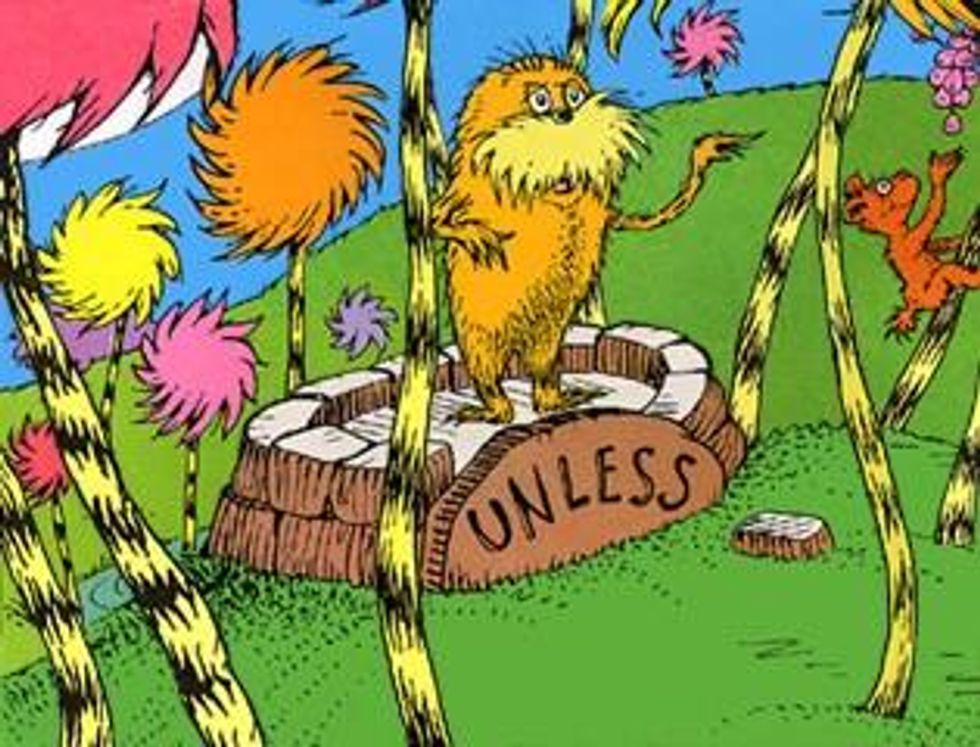
The Lorax, who once spoke for the trees, now speaks for corporations. While he once warned how rampant greed and consumerism destroyed the Truffula Trees, he now sells Truffula Chip Pancakes at IHOP. The Lorax, who taught a powerful lesson about the fragility of ecosystems by describing the fate of the Brown Bar-ba-loots, Swomee-Swans, and Humming-Fish after their forest was destroyed, now welcomes consumers-in-training at Target, Pottery Barn Kids, and Whole Foods. His image is emblazoned on Seventh Generation diapers and packages of YoKids Yogurt. He's marketing HP in classrooms. And he's promoting Target, Comcast Xfinity, and more through online Lorax advergames and sweepstakes.
Each of these corporate partnerships thumbs its nose at Dr. Suess and the character he created to embody an essential environmental message for children, but surely the most egregious Lorax promotion is for Mazda SUVs. Mazda has been flooding the airwaves with ads for its new CX-5, the only car with the "Truffula Seal of Approval." And if using the Lorax to sell kids on SUVs isn't bad enough, Mazda--in partnership with the National Education Association--is using school time to subject captive audiences of students as young as kindergartners to a Lorax-themed sales pitch for the SUVs. At one school assembly, the Lorax dished out hugs while a Mazda executive actually encouraged children to persuade their parents to test-drive the SUV. The children were led outside the school to view a Lorax-decorated car as the Mazda rep assured them that the CX-5 is "the kind of car we think the Lorax would want drive." In return for each test drive, Mazda is donating a paltry $25 to school libraries.
Of course it's not just the Lorax. Marketers routinely exploit children's emotional connection to media characters to sell them on practically everything. These cross-promotions not only encourage harmful environmental behaviors--like buying plastic toys or fast food--but also teach children to equate love with consumption. That's a pernicious and unsustainable message coming from anyone, but it's particularly perverse when it comes from a character who, until recently, was the quintessential anti-marketer.
The real Lorax wouldn't usurp valuable school time to sell cars. Nor would he leverage children's love for him to lure kids to IHOP or Pottery Barn or encourage them to nag their parents for an SUV. If that notoriously reclusive Lorax ever agreed to appear in a film, he would say a resounding "NO" to any commercial tie-ins. Instead of promoting a slew of "greener" products, he would tell corporations to stop bombarding kids with materialistic messages. He would never immerse children in the false corporate narrative that we can consume our way to everything, from happiness to sustainability. Instead he would join everyone who cares about children and the earth to give kids time and space to grow up free of commercial pressures.
So here's where we are. The products have been produced and distributed, and the airways are filled with commercials featuring the Lorax hawking this and that. Guys in synthetic Lorax suits are waiting to meet and greet in stores around the country. The phony corporate Lorax is out of the bag--we can't stop the current promotions. But we can refuse to participate.
Wouldn't it be great if no one bought the products, played the advergames, or turned up to see the fake Lorax at Target, Whole Foods, and Pottery Barn? Send a message to Universal, Dr. Seuss Enterprises, Mazda, and all the other corporate partners that you're not buying in. Celebrate the Lorax by reading the book. Go to the movie if you must. But refuse to spend one penny on any Lorax-themed product or promotion.
As the real Lorax said,
UNLESS someone like you
cares a whole awful lot.
Nothing is going to get better.
Universal Studio's animated film The Lorax opens in theaters tomorrow and environmentalists and people who care about children are already outraged--with good reason. For more than forty years, the Dr. Seuss classic has been a clarion call for reducing consumption and promoting conservation. But the book's eloquent environmental message is being crushed by the film's slew of corporate cross-promotions.
The Lorax, who once spoke for the trees, now speaks for corporations. While he once warned how rampant greed and consumerism destroyed the Truffula Trees, he now sells Truffula Chip Pancakes at IHOP. The Lorax, who taught a powerful lesson about the fragility of ecosystems by describing the fate of the Brown Bar-ba-loots, Swomee-Swans, and Humming-Fish after their forest was destroyed, now welcomes consumers-in-training at Target, Pottery Barn Kids, and Whole Foods. His image is emblazoned on Seventh Generation diapers and packages of YoKids Yogurt. He's marketing HP in classrooms. And he's promoting Target, Comcast Xfinity, and more through online Lorax advergames and sweepstakes.
Each of these corporate partnerships thumbs its nose at Dr. Suess and the character he created to embody an essential environmental message for children, but surely the most egregious Lorax promotion is for Mazda SUVs. Mazda has been flooding the airwaves with ads for its new CX-5, the only car with the "Truffula Seal of Approval." And if using the Lorax to sell kids on SUVs isn't bad enough, Mazda--in partnership with the National Education Association--is using school time to subject captive audiences of students as young as kindergartners to a Lorax-themed sales pitch for the SUVs. At one school assembly, the Lorax dished out hugs while a Mazda executive actually encouraged children to persuade their parents to test-drive the SUV. The children were led outside the school to view a Lorax-decorated car as the Mazda rep assured them that the CX-5 is "the kind of car we think the Lorax would want drive." In return for each test drive, Mazda is donating a paltry $25 to school libraries.
Of course it's not just the Lorax. Marketers routinely exploit children's emotional connection to media characters to sell them on practically everything. These cross-promotions not only encourage harmful environmental behaviors--like buying plastic toys or fast food--but also teach children to equate love with consumption. That's a pernicious and unsustainable message coming from anyone, but it's particularly perverse when it comes from a character who, until recently, was the quintessential anti-marketer.
The real Lorax wouldn't usurp valuable school time to sell cars. Nor would he leverage children's love for him to lure kids to IHOP or Pottery Barn or encourage them to nag their parents for an SUV. If that notoriously reclusive Lorax ever agreed to appear in a film, he would say a resounding "NO" to any commercial tie-ins. Instead of promoting a slew of "greener" products, he would tell corporations to stop bombarding kids with materialistic messages. He would never immerse children in the false corporate narrative that we can consume our way to everything, from happiness to sustainability. Instead he would join everyone who cares about children and the earth to give kids time and space to grow up free of commercial pressures.
So here's where we are. The products have been produced and distributed, and the airways are filled with commercials featuring the Lorax hawking this and that. Guys in synthetic Lorax suits are waiting to meet and greet in stores around the country. The phony corporate Lorax is out of the bag--we can't stop the current promotions. But we can refuse to participate.
Wouldn't it be great if no one bought the products, played the advergames, or turned up to see the fake Lorax at Target, Whole Foods, and Pottery Barn? Send a message to Universal, Dr. Seuss Enterprises, Mazda, and all the other corporate partners that you're not buying in. Celebrate the Lorax by reading the book. Go to the movie if you must. But refuse to spend one penny on any Lorax-themed product or promotion.
As the real Lorax said,
UNLESS someone like you
cares a whole awful lot.
Nothing is going to get better.
Universal Studio's animated film The Lorax opens in theaters tomorrow and environmentalists and people who care about children are already outraged--with good reason. For more than forty years, the Dr. Seuss classic has been a clarion call for reducing consumption and promoting conservation. But the book's eloquent environmental message is being crushed by the film's slew of corporate cross-promotions.
The Lorax, who once spoke for the trees, now speaks for corporations. While he once warned how rampant greed and consumerism destroyed the Truffula Trees, he now sells Truffula Chip Pancakes at IHOP. The Lorax, who taught a powerful lesson about the fragility of ecosystems by describing the fate of the Brown Bar-ba-loots, Swomee-Swans, and Humming-Fish after their forest was destroyed, now welcomes consumers-in-training at Target, Pottery Barn Kids, and Whole Foods. His image is emblazoned on Seventh Generation diapers and packages of YoKids Yogurt. He's marketing HP in classrooms. And he's promoting Target, Comcast Xfinity, and more through online Lorax advergames and sweepstakes.
Each of these corporate partnerships thumbs its nose at Dr. Suess and the character he created to embody an essential environmental message for children, but surely the most egregious Lorax promotion is for Mazda SUVs. Mazda has been flooding the airwaves with ads for its new CX-5, the only car with the "Truffula Seal of Approval." And if using the Lorax to sell kids on SUVs isn't bad enough, Mazda--in partnership with the National Education Association--is using school time to subject captive audiences of students as young as kindergartners to a Lorax-themed sales pitch for the SUVs. At one school assembly, the Lorax dished out hugs while a Mazda executive actually encouraged children to persuade their parents to test-drive the SUV. The children were led outside the school to view a Lorax-decorated car as the Mazda rep assured them that the CX-5 is "the kind of car we think the Lorax would want drive." In return for each test drive, Mazda is donating a paltry $25 to school libraries.
Of course it's not just the Lorax. Marketers routinely exploit children's emotional connection to media characters to sell them on practically everything. These cross-promotions not only encourage harmful environmental behaviors--like buying plastic toys or fast food--but also teach children to equate love with consumption. That's a pernicious and unsustainable message coming from anyone, but it's particularly perverse when it comes from a character who, until recently, was the quintessential anti-marketer.
The real Lorax wouldn't usurp valuable school time to sell cars. Nor would he leverage children's love for him to lure kids to IHOP or Pottery Barn or encourage them to nag their parents for an SUV. If that notoriously reclusive Lorax ever agreed to appear in a film, he would say a resounding "NO" to any commercial tie-ins. Instead of promoting a slew of "greener" products, he would tell corporations to stop bombarding kids with materialistic messages. He would never immerse children in the false corporate narrative that we can consume our way to everything, from happiness to sustainability. Instead he would join everyone who cares about children and the earth to give kids time and space to grow up free of commercial pressures.
So here's where we are. The products have been produced and distributed, and the airways are filled with commercials featuring the Lorax hawking this and that. Guys in synthetic Lorax suits are waiting to meet and greet in stores around the country. The phony corporate Lorax is out of the bag--we can't stop the current promotions. But we can refuse to participate.
Wouldn't it be great if no one bought the products, played the advergames, or turned up to see the fake Lorax at Target, Whole Foods, and Pottery Barn? Send a message to Universal, Dr. Seuss Enterprises, Mazda, and all the other corporate partners that you're not buying in. Celebrate the Lorax by reading the book. Go to the movie if you must. But refuse to spend one penny on any Lorax-themed product or promotion.
As the real Lorax said,
UNLESS someone like you
cares a whole awful lot.
Nothing is going to get better.