The political genius of an election-year State of the Union address is that it allows an incumbent executive to appear presidential while he is pounding his opponent into the ground.
No incumbent, Democrat or Republicans, liberal or conservative, is ever going to pass up the opportunity to slip the knife in, especially when the date for delivering the annual address happens to fall at a point on the electoral calendar when the president's likely opponent is locked in a bitter fight for his own party's nomination,
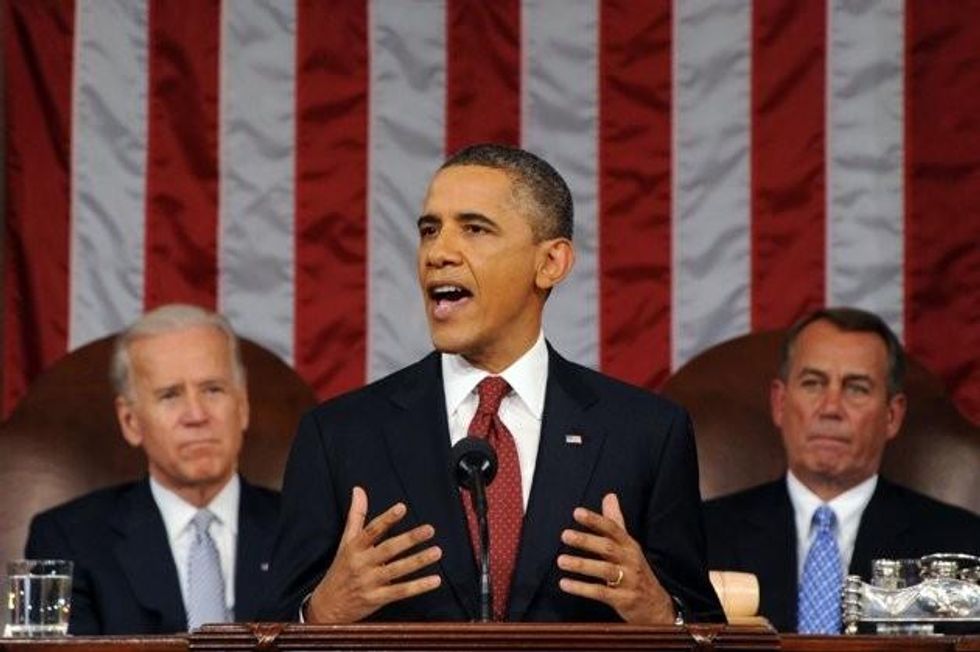
So it should come as no surprise that Barack Obama used Tuesday night's State of the Union speech to knock the legs out from under an already wobbly Mitt Romney.
What was remarkable was the precision with which Obama assaulted the man whom the president's aides still anticipate will be his Republican challenger.
Speaking on the very day that the Bain Capitaliist released tax returns that showed he paid taxes at a dramatically lower rate than most Americans--under 14 percent, as compared with 35 percent rate paid by many working Americans --Obama focused on the need to reform tax policy in order to extract a fairer fraction from the rich.
"You can call this class warfare all you want," Obama declared, in the night's takeaway line. "But asking a billionaire to pay at least as much as his secretary in taxes? Most Americans would call that common sense."
Ouch.
Obama made his support for the so-called "Buffett Rule"--a calculus based on the compaint of billionaire investor Warren Buffett that he pays taxes at a lower rate than his secretary--central to a speech that, while it may have fallen short of true progressive populism, certainly engaged in plenty of partisan populism.
Incorporating the call for tax justice into a broader economic fairness message--which included proposals to protect financial consumers, address trade-policy inequities and reward companies that repatriate jobs from overseas--Obama was steady and determined in framing the national debate as a choice between "two directions."
"One is towards less opportunity and less fairness," explained the president. "Or we can fight for where I think we need to go: building an economy that works for everyone, not just a wealthy few."
Sure, Romney complained. "Tonight, we'll also be treated to more divisive rhetoric from a desperate campaigner-in-chief," the former vulture, er, venture capitalist announced in a "prebuttal" to Obama's speech.
But Romney, who released his tax returns on State of the Union day in hopes that they would not get as much notice, had blundered into a classic political trap.
Obama did not merely use the bully pulpit to make his point. He invited Buffett's secretary to join the audience in the Capitol. And his aides and allies took every advantage of the media moment.
Technically, the State of the Union address is a report to Congress. But in re-election years it is never that. It is the second-most important speech of the campaign season--second only to the acceptance speech at the late-summer convention of the president's party.
And the Obama team did not miss a beat.
In addition to a speech that was tailored to emphasize Romney's misfortune--make that, Romney's fortune--the White House unveiled a website that poured salt into the wounds the frontrunner's chief challenger, former House Speaker Newt Gingrich, has already opened on the Bain Capitalist.
There were charts--"In 2009, the average CEO salary was 185 times bigger than that of the average worker." There was a "live panel" of White House advisers at the ready to pound the points home. And there was even a slogan--yes, a State of the Union address with a slogan--that was chosen to emphasize the night's takeaway message: that fair tax policies and smart investments in job creation are necessary to create: "An America Built to Last."
It probably goes without saying that such an America would have fewer rewards for "vulture capitalists" and more for people who actually make things: either as entrepreneurs or as workers on the line.
But Obama said it.
The president did not win any policy fights, or advance his legislative agenda very far.
But, by borrowing a rhetorical page (though not, unfortunately, a full outline) from Occupy Wall Street, Obama scored an election-season knockout--using the national platform that remains the most powerful of all political weapons available to a sitting president.
Republicans grumbled accordingly. Romney threw everything he could at the Obama. "It's shameful for a president to use the State of the Union to divide our nation," said the Republican contender.
Yet, Obama was being far less divisive than Romney's challengers for the Republican nomination.
Indeed, any damage that was not done to him by Obama Tuesday night would surely be done to Romney by Gingrich on Wednesday or Thursday or Friday--or, perhaps, next Tuesday, when a Republican primary vote in Florida might give Romney more to worry about than the agile use of the bully pulpit by a campaigner-in-chief Democrat.
© 2023 The Nation
The political genius of an election-year State of the Union address is that it allows an incumbent executive to appear presidential while he is pounding his opponent into the ground.
No incumbent, Democrat or Republicans, liberal or conservative, is ever going to pass up the opportunity to slip the knife in, especially when the date for delivering the annual address happens to fall at a point on the electoral calendar when the president's likely opponent is locked in a bitter fight for his own party's nomination,
So it should come as no surprise that Barack Obama used Tuesday night's State of the Union speech to knock the legs out from under an already wobbly Mitt Romney.
What was remarkable was the precision with which Obama assaulted the man whom the president's aides still anticipate will be his Republican challenger.
Speaking on the very day that the Bain Capitaliist released tax returns that showed he paid taxes at a dramatically lower rate than most Americans--under 14 percent, as compared with 35 percent rate paid by many working Americans --Obama focused on the need to reform tax policy in order to extract a fairer fraction from the rich.
"You can call this class warfare all you want," Obama declared, in the night's takeaway line. "But asking a billionaire to pay at least as much as his secretary in taxes? Most Americans would call that common sense."
Ouch.
Obama made his support for the so-called "Buffett Rule"--a calculus based on the compaint of billionaire investor Warren Buffett that he pays taxes at a lower rate than his secretary--central to a speech that, while it may have fallen short of true progressive populism, certainly engaged in plenty of partisan populism.
Incorporating the call for tax justice into a broader economic fairness message--which included proposals to protect financial consumers, address trade-policy inequities and reward companies that repatriate jobs from overseas--Obama was steady and determined in framing the national debate as a choice between "two directions."
"One is towards less opportunity and less fairness," explained the president. "Or we can fight for where I think we need to go: building an economy that works for everyone, not just a wealthy few."
Sure, Romney complained. "Tonight, we'll also be treated to more divisive rhetoric from a desperate campaigner-in-chief," the former vulture, er, venture capitalist announced in a "prebuttal" to Obama's speech.
But Romney, who released his tax returns on State of the Union day in hopes that they would not get as much notice, had blundered into a classic political trap.
Obama did not merely use the bully pulpit to make his point. He invited Buffett's secretary to join the audience in the Capitol. And his aides and allies took every advantage of the media moment.
Technically, the State of the Union address is a report to Congress. But in re-election years it is never that. It is the second-most important speech of the campaign season--second only to the acceptance speech at the late-summer convention of the president's party.
And the Obama team did not miss a beat.
In addition to a speech that was tailored to emphasize Romney's misfortune--make that, Romney's fortune--the White House unveiled a website that poured salt into the wounds the frontrunner's chief challenger, former House Speaker Newt Gingrich, has already opened on the Bain Capitalist.
There were charts--"In 2009, the average CEO salary was 185 times bigger than that of the average worker." There was a "live panel" of White House advisers at the ready to pound the points home. And there was even a slogan--yes, a State of the Union address with a slogan--that was chosen to emphasize the night's takeaway message: that fair tax policies and smart investments in job creation are necessary to create: "An America Built to Last."
It probably goes without saying that such an America would have fewer rewards for "vulture capitalists" and more for people who actually make things: either as entrepreneurs or as workers on the line.
But Obama said it.
The president did not win any policy fights, or advance his legislative agenda very far.
But, by borrowing a rhetorical page (though not, unfortunately, a full outline) from Occupy Wall Street, Obama scored an election-season knockout--using the national platform that remains the most powerful of all political weapons available to a sitting president.
Republicans grumbled accordingly. Romney threw everything he could at the Obama. "It's shameful for a president to use the State of the Union to divide our nation," said the Republican contender.
Yet, Obama was being far less divisive than Romney's challengers for the Republican nomination.
Indeed, any damage that was not done to him by Obama Tuesday night would surely be done to Romney by Gingrich on Wednesday or Thursday or Friday--or, perhaps, next Tuesday, when a Republican primary vote in Florida might give Romney more to worry about than the agile use of the bully pulpit by a campaigner-in-chief Democrat.
The political genius of an election-year State of the Union address is that it allows an incumbent executive to appear presidential while he is pounding his opponent into the ground.
No incumbent, Democrat or Republicans, liberal or conservative, is ever going to pass up the opportunity to slip the knife in, especially when the date for delivering the annual address happens to fall at a point on the electoral calendar when the president's likely opponent is locked in a bitter fight for his own party's nomination,
So it should come as no surprise that Barack Obama used Tuesday night's State of the Union speech to knock the legs out from under an already wobbly Mitt Romney.
What was remarkable was the precision with which Obama assaulted the man whom the president's aides still anticipate will be his Republican challenger.
Speaking on the very day that the Bain Capitaliist released tax returns that showed he paid taxes at a dramatically lower rate than most Americans--under 14 percent, as compared with 35 percent rate paid by many working Americans --Obama focused on the need to reform tax policy in order to extract a fairer fraction from the rich.
"You can call this class warfare all you want," Obama declared, in the night's takeaway line. "But asking a billionaire to pay at least as much as his secretary in taxes? Most Americans would call that common sense."
Ouch.
Obama made his support for the so-called "Buffett Rule"--a calculus based on the compaint of billionaire investor Warren Buffett that he pays taxes at a lower rate than his secretary--central to a speech that, while it may have fallen short of true progressive populism, certainly engaged in plenty of partisan populism.
Incorporating the call for tax justice into a broader economic fairness message--which included proposals to protect financial consumers, address trade-policy inequities and reward companies that repatriate jobs from overseas--Obama was steady and determined in framing the national debate as a choice between "two directions."
"One is towards less opportunity and less fairness," explained the president. "Or we can fight for where I think we need to go: building an economy that works for everyone, not just a wealthy few."
Sure, Romney complained. "Tonight, we'll also be treated to more divisive rhetoric from a desperate campaigner-in-chief," the former vulture, er, venture capitalist announced in a "prebuttal" to Obama's speech.
But Romney, who released his tax returns on State of the Union day in hopes that they would not get as much notice, had blundered into a classic political trap.
Obama did not merely use the bully pulpit to make his point. He invited Buffett's secretary to join the audience in the Capitol. And his aides and allies took every advantage of the media moment.
Technically, the State of the Union address is a report to Congress. But in re-election years it is never that. It is the second-most important speech of the campaign season--second only to the acceptance speech at the late-summer convention of the president's party.
And the Obama team did not miss a beat.
In addition to a speech that was tailored to emphasize Romney's misfortune--make that, Romney's fortune--the White House unveiled a website that poured salt into the wounds the frontrunner's chief challenger, former House Speaker Newt Gingrich, has already opened on the Bain Capitalist.
There were charts--"In 2009, the average CEO salary was 185 times bigger than that of the average worker." There was a "live panel" of White House advisers at the ready to pound the points home. And there was even a slogan--yes, a State of the Union address with a slogan--that was chosen to emphasize the night's takeaway message: that fair tax policies and smart investments in job creation are necessary to create: "An America Built to Last."
It probably goes without saying that such an America would have fewer rewards for "vulture capitalists" and more for people who actually make things: either as entrepreneurs or as workers on the line.
But Obama said it.
The president did not win any policy fights, or advance his legislative agenda very far.
But, by borrowing a rhetorical page (though not, unfortunately, a full outline) from Occupy Wall Street, Obama scored an election-season knockout--using the national platform that remains the most powerful of all political weapons available to a sitting president.
Republicans grumbled accordingly. Romney threw everything he could at the Obama. "It's shameful for a president to use the State of the Union to divide our nation," said the Republican contender.
Yet, Obama was being far less divisive than Romney's challengers for the Republican nomination.
Indeed, any damage that was not done to him by Obama Tuesday night would surely be done to Romney by Gingrich on Wednesday or Thursday or Friday--or, perhaps, next Tuesday, when a Republican primary vote in Florida might give Romney more to worry about than the agile use of the bully pulpit by a campaigner-in-chief Democrat.