SUBSCRIBE TO OUR FREE NEWSLETTER
Daily news & progressive opinion—funded by the people, not the corporations—delivered straight to your inbox.
5
#000000
#FFFFFF
To donate by check, phone, or other method, see our More Ways to Give page.
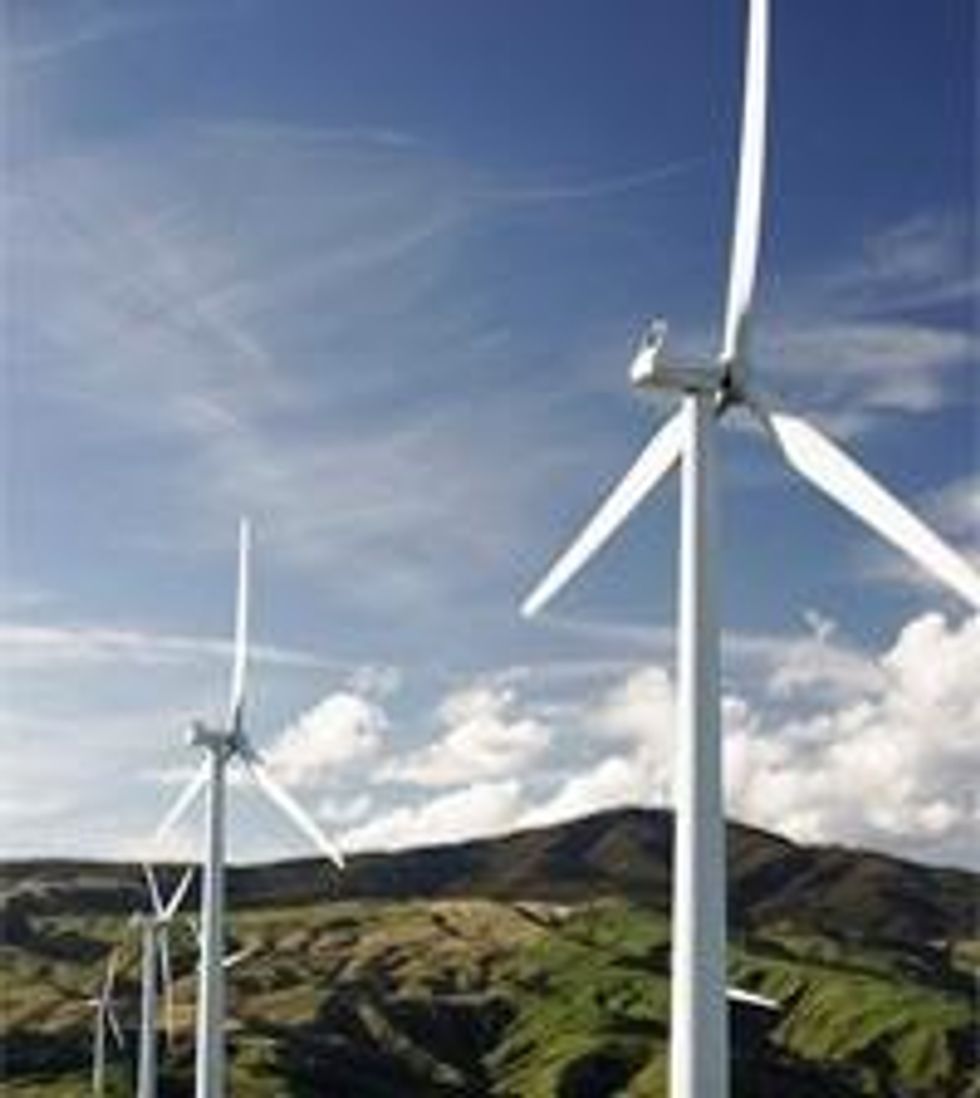
This is a good way to get 2012 rolling: A recent report reveals that for the first time renewable sources have outdone nuclear power in the United States.
" Renewable energy sources--wind, water, solar and others--passed nuclear generation as a share of U.S. power in September, according to the Energy Information Administration," reports the San Francisco Business Times. "The EIA report showed 6.944 quadrillion Btus, or 'quads,' of energy generated from renewable sources in the first nine months of 2011, compared with 6.173 quads from nuclear power."
Now, the "renewable" category here is a bit of a catch-all, since it includes sources that are somewhat dubious from a clean energy standpoint, such as biofuels. But, still, the fact that nuclear power is now contributing a smaller amount to the national grid than renewables is of major significance. We are on our way to a green energy future faster than many of us had imagined.
Many environmentalists, such as veteran anti-nuclear activist Harvey Wasserman, have been urging this course for a long time.
"When the No Nukes movement first started, it was hoped by many that solar, wind, tidal, geothermal, biomass, increased efficiency, and other renewable technologies would 'someday' be cheaper than nuclear power and fossil fuels," Wasserman wrote last May for The Progressive" in the wake of the Fukushima disaster. "By all accounts, that day has come."
The new numbers also lend credence to a report issued last year by the Nobel Peace Prize-winning Intergovernmental Panel on Climate Change stating that energy from clean sources could account for four-fifths of the global supply within a few decades--if governments show the necessary will.
"The report shows that it is not the availability of [renewable] resources but the public policies that will either expand or constrain renewable energy development over the coming decades," said Ramon Pichs, co-chair of one of the working groups of the organization.
The interesting thing is that the Obama Administration has had a mixed record here, voicing support for renewables but at the same time refusing to give up its infatuation with nuclear power. Nuclear energy has been bested despite the White House's ambivalence.
The United States needs to take its lead from a number of other Western countries that have ended their romance with nuclear power in the aftermath of Fukushima. Germany is shutting down all its nuclear reactors within ten years (with one-third of its power to come from renewables by then). The Italian people, by a margin of 9-1, last year rejected then-Prime Minister Silvio Berlusconi's attempts to reintroduce nuclear power in the country. And the Swiss government in May pledged to close all reactors by 2034. (Japan itself has promised to get off of nuclear energy, albeit on an ill-defined timeline.)
America's lukewarm attitude toward renewables has cost it in the recent past.
"There are reasons to be concerned about America's competitive position in the clean energy marketplace," says a Pew 2010 report. "In all, ten G-20 members devoted a greater percentage of gross domestic product to clean energy than the United States in 2009."
If renewables can perform so well in spite of such half-heartedness on the part of Washington, imagine what could happen it they were backed to the hilt.
This is a good way to get 2012 rolling: A recent report reveals that for the first time renewable sources have outdone nuclear power in the United States.
" Renewable energy sources--wind, water, solar and others--passed nuclear generation as a share of U.S. power in September, according to the Energy Information Administration," reports the San Francisco Business Times. "The EIA report showed 6.944 quadrillion Btus, or 'quads,' of energy generated from renewable sources in the first nine months of 2011, compared with 6.173 quads from nuclear power."
Now, the "renewable" category here is a bit of a catch-all, since it includes sources that are somewhat dubious from a clean energy standpoint, such as biofuels. But, still, the fact that nuclear power is now contributing a smaller amount to the national grid than renewables is of major significance. We are on our way to a green energy future faster than many of us had imagined.
Many environmentalists, such as veteran anti-nuclear activist Harvey Wasserman, have been urging this course for a long time.
"When the No Nukes movement first started, it was hoped by many that solar, wind, tidal, geothermal, biomass, increased efficiency, and other renewable technologies would 'someday' be cheaper than nuclear power and fossil fuels," Wasserman wrote last May for The Progressive" in the wake of the Fukushima disaster. "By all accounts, that day has come."
The new numbers also lend credence to a report issued last year by the Nobel Peace Prize-winning Intergovernmental Panel on Climate Change stating that energy from clean sources could account for four-fifths of the global supply within a few decades--if governments show the necessary will.
"The report shows that it is not the availability of [renewable] resources but the public policies that will either expand or constrain renewable energy development over the coming decades," said Ramon Pichs, co-chair of one of the working groups of the organization.
The interesting thing is that the Obama Administration has had a mixed record here, voicing support for renewables but at the same time refusing to give up its infatuation with nuclear power. Nuclear energy has been bested despite the White House's ambivalence.
The United States needs to take its lead from a number of other Western countries that have ended their romance with nuclear power in the aftermath of Fukushima. Germany is shutting down all its nuclear reactors within ten years (with one-third of its power to come from renewables by then). The Italian people, by a margin of 9-1, last year rejected then-Prime Minister Silvio Berlusconi's attempts to reintroduce nuclear power in the country. And the Swiss government in May pledged to close all reactors by 2034. (Japan itself has promised to get off of nuclear energy, albeit on an ill-defined timeline.)
America's lukewarm attitude toward renewables has cost it in the recent past.
"There are reasons to be concerned about America's competitive position in the clean energy marketplace," says a Pew 2010 report. "In all, ten G-20 members devoted a greater percentage of gross domestic product to clean energy than the United States in 2009."
If renewables can perform so well in spite of such half-heartedness on the part of Washington, imagine what could happen it they were backed to the hilt.
This is a good way to get 2012 rolling: A recent report reveals that for the first time renewable sources have outdone nuclear power in the United States.
" Renewable energy sources--wind, water, solar and others--passed nuclear generation as a share of U.S. power in September, according to the Energy Information Administration," reports the San Francisco Business Times. "The EIA report showed 6.944 quadrillion Btus, or 'quads,' of energy generated from renewable sources in the first nine months of 2011, compared with 6.173 quads from nuclear power."
Now, the "renewable" category here is a bit of a catch-all, since it includes sources that are somewhat dubious from a clean energy standpoint, such as biofuels. But, still, the fact that nuclear power is now contributing a smaller amount to the national grid than renewables is of major significance. We are on our way to a green energy future faster than many of us had imagined.
Many environmentalists, such as veteran anti-nuclear activist Harvey Wasserman, have been urging this course for a long time.
"When the No Nukes movement first started, it was hoped by many that solar, wind, tidal, geothermal, biomass, increased efficiency, and other renewable technologies would 'someday' be cheaper than nuclear power and fossil fuels," Wasserman wrote last May for The Progressive" in the wake of the Fukushima disaster. "By all accounts, that day has come."
The new numbers also lend credence to a report issued last year by the Nobel Peace Prize-winning Intergovernmental Panel on Climate Change stating that energy from clean sources could account for four-fifths of the global supply within a few decades--if governments show the necessary will.
"The report shows that it is not the availability of [renewable] resources but the public policies that will either expand or constrain renewable energy development over the coming decades," said Ramon Pichs, co-chair of one of the working groups of the organization.
The interesting thing is that the Obama Administration has had a mixed record here, voicing support for renewables but at the same time refusing to give up its infatuation with nuclear power. Nuclear energy has been bested despite the White House's ambivalence.
The United States needs to take its lead from a number of other Western countries that have ended their romance with nuclear power in the aftermath of Fukushima. Germany is shutting down all its nuclear reactors within ten years (with one-third of its power to come from renewables by then). The Italian people, by a margin of 9-1, last year rejected then-Prime Minister Silvio Berlusconi's attempts to reintroduce nuclear power in the country. And the Swiss government in May pledged to close all reactors by 2034. (Japan itself has promised to get off of nuclear energy, albeit on an ill-defined timeline.)
America's lukewarm attitude toward renewables has cost it in the recent past.
"There are reasons to be concerned about America's competitive position in the clean energy marketplace," says a Pew 2010 report. "In all, ten G-20 members devoted a greater percentage of gross domestic product to clean energy than the United States in 2009."
If renewables can perform so well in spite of such half-heartedness on the part of Washington, imagine what could happen it they were backed to the hilt.