On Dec. 13, BNY Mellon filed a court action seeking to evict the Occupy Pittsburgh encampment from Mellon Green, where occupiers have been peacefully protesting without complaints from the public or the city. This action is an attempt to squelch the vital public dialogue that the Occupy Wall Street movement has been advocating.
Evidence supporting the protesters' claim that major banks have engaged in illegal activities is mounting.
BNY Mellon is being sued by three states for allegedly generating $2 billion in profit through fraudulent charges on public and private pension funds. In another case, the company is charged with causing $1 billion in losses to firefighters, police and other workers in Detroit's pension system by keeping investments in Lehman Brothers well after it was clear that Lehman Brothers was in trouble. BNY Mellon is even being sued by some of its former employees, who raise similar complaints about its management of its workers' 401(k) plans.
Occupy Pittsburgh also charges the company with failing to pay some of its workers a living wage -- while generating huge profits by violating both the law and the trust of clients from among the 99 percent.
Despite such behavior, BNY Mellon and other banks are seen as respectable institutions deserving favorable governmental treatment. Mellon's ability to remain solvent and generate profits may even be deemed a virtue. Its right to occupy several Downtown city blocks is unquestioned. This is because over the last three decades, the United States has led the world in building a globalized market where the goal of making profits supersedes all other aims and values.
Herein lies the crux of the Occupy Wall Street movement's claims. Policies favoring wealth generation over all else have reinforced the power of those with large amounts of capital over those with little. The wealth of most Americans has been transferred to the 1 percent in the form of corporate profits.
Much of this wealth transfer has occurred through technically legal means, such as by suppressing the wages of the 99 percent, most of whose incomes have remained stagnant since the 1970s.
But a good deal of it results from illegal and deceptive business practices.
These violations are often ignored or even made legal through corporate-friendly policies because corporate money has corrupted our political system and given corporations more voice than citizens. Corporate influence in politics has prevented politicians from recognizing and responding to the enormous risks imposed by corporate practices on our national economy and the entire world.
Protesters occupy physical public spaces to open more figurative space for the public to look critically at how and by whom our economy is being run. Until the Occupy movement came along, public dialogue narrowly centered on policies designed to favor the banks and corporate elite -- how much to cut government services, whether to increase taxes on the top several percent of taxpayers, whether to have a little more government regulation of industry and banks. Neither major political party has questioned the moral legitimacy of the economic structure.
The verb "to occupy" means "to engage." Occupy Wall Street has engaged the public and enlarged public debate beyond a narrow range of so-called "realistic" policy choices. Occupy camps are both symbolic and instrumental in their demands that we shift the emphasis of public policy and debate away from the single-minded pursuit of profit.
By evicting BNY Mellon, Occupy Pittsburgh employs a strategy used by marginalized groups throughout history struggling for a moral economy organized to serve human beings against the dictatorship of markets. A moral economy requires that people come together to determine what sort of economy and society we desire.
Occupy Wall Street's presence creates the kinds of spaces -- not only in downtown encampments but also in coffee shops, living rooms and public gatherings such as Occupy Pittsburgh's Human Rights Day rally -- needed for the democratic dialogue that has been denied by the increasing privatization of public spaces and corporate control over our mass media.
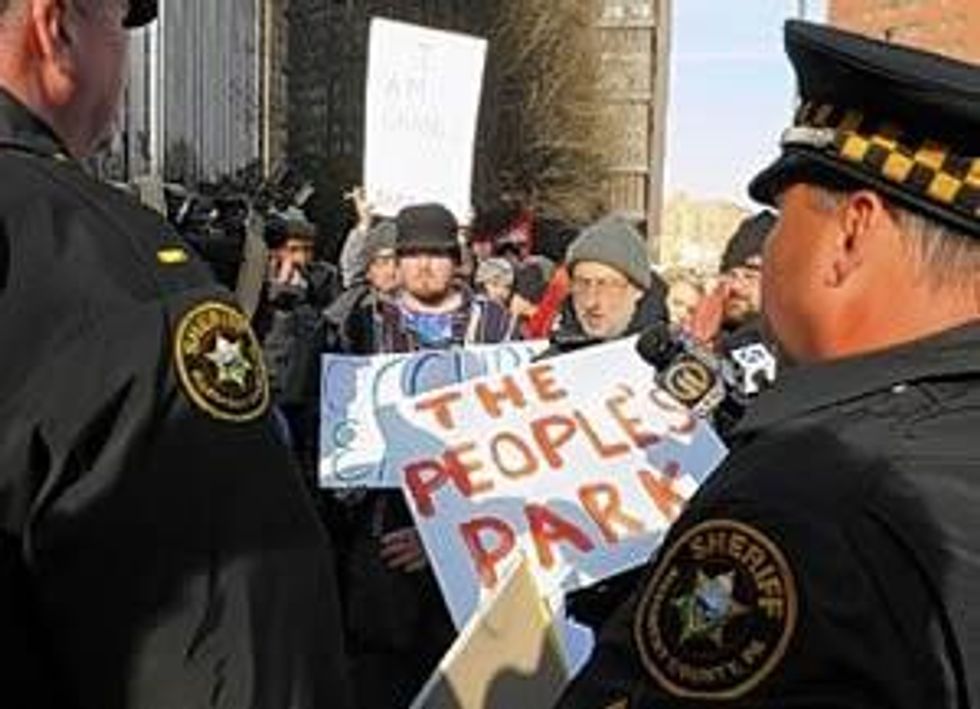
The public should support Occupy's right to stay in Mellon Green. People's Park is a space designated for public use but which BNY Mellon now wants to close to the public. More importantly, we must evict BNY Mellon and other corporations from their occupation of the public discourse. It is that occupation which really threatens both the public good and our democracy, not Occupy Pittsburgh's encampment in a tiny Downtown square.
On Dec. 13, BNY Mellon filed a court action seeking to evict the Occupy Pittsburgh encampment from Mellon Green, where occupiers have been peacefully protesting without complaints from the public or the city. This action is an attempt to squelch the vital public dialogue that the Occupy Wall Street movement has been advocating.
Evidence supporting the protesters' claim that major banks have engaged in illegal activities is mounting.
BNY Mellon is being sued by three states for allegedly generating $2 billion in profit through fraudulent charges on public and private pension funds. In another case, the company is charged with causing $1 billion in losses to firefighters, police and other workers in Detroit's pension system by keeping investments in Lehman Brothers well after it was clear that Lehman Brothers was in trouble. BNY Mellon is even being sued by some of its former employees, who raise similar complaints about its management of its workers' 401(k) plans.
Occupy Pittsburgh also charges the company with failing to pay some of its workers a living wage -- while generating huge profits by violating both the law and the trust of clients from among the 99 percent.
Despite such behavior, BNY Mellon and other banks are seen as respectable institutions deserving favorable governmental treatment. Mellon's ability to remain solvent and generate profits may even be deemed a virtue. Its right to occupy several Downtown city blocks is unquestioned. This is because over the last three decades, the United States has led the world in building a globalized market where the goal of making profits supersedes all other aims and values.
Herein lies the crux of the Occupy Wall Street movement's claims. Policies favoring wealth generation over all else have reinforced the power of those with large amounts of capital over those with little. The wealth of most Americans has been transferred to the 1 percent in the form of corporate profits.
Much of this wealth transfer has occurred through technically legal means, such as by suppressing the wages of the 99 percent, most of whose incomes have remained stagnant since the 1970s.
But a good deal of it results from illegal and deceptive business practices.
These violations are often ignored or even made legal through corporate-friendly policies because corporate money has corrupted our political system and given corporations more voice than citizens. Corporate influence in politics has prevented politicians from recognizing and responding to the enormous risks imposed by corporate practices on our national economy and the entire world.
Protesters occupy physical public spaces to open more figurative space for the public to look critically at how and by whom our economy is being run. Until the Occupy movement came along, public dialogue narrowly centered on policies designed to favor the banks and corporate elite -- how much to cut government services, whether to increase taxes on the top several percent of taxpayers, whether to have a little more government regulation of industry and banks. Neither major political party has questioned the moral legitimacy of the economic structure.
The verb "to occupy" means "to engage." Occupy Wall Street has engaged the public and enlarged public debate beyond a narrow range of so-called "realistic" policy choices. Occupy camps are both symbolic and instrumental in their demands that we shift the emphasis of public policy and debate away from the single-minded pursuit of profit.
By evicting BNY Mellon, Occupy Pittsburgh employs a strategy used by marginalized groups throughout history struggling for a moral economy organized to serve human beings against the dictatorship of markets. A moral economy requires that people come together to determine what sort of economy and society we desire.
Occupy Wall Street's presence creates the kinds of spaces -- not only in downtown encampments but also in coffee shops, living rooms and public gatherings such as Occupy Pittsburgh's Human Rights Day rally -- needed for the democratic dialogue that has been denied by the increasing privatization of public spaces and corporate control over our mass media.
The public should support Occupy's right to stay in Mellon Green. People's Park is a space designated for public use but which BNY Mellon now wants to close to the public. More importantly, we must evict BNY Mellon and other corporations from their occupation of the public discourse. It is that occupation which really threatens both the public good and our democracy, not Occupy Pittsburgh's encampment in a tiny Downtown square.
On Dec. 13, BNY Mellon filed a court action seeking to evict the Occupy Pittsburgh encampment from Mellon Green, where occupiers have been peacefully protesting without complaints from the public or the city. This action is an attempt to squelch the vital public dialogue that the Occupy Wall Street movement has been advocating.
Evidence supporting the protesters' claim that major banks have engaged in illegal activities is mounting.
BNY Mellon is being sued by three states for allegedly generating $2 billion in profit through fraudulent charges on public and private pension funds. In another case, the company is charged with causing $1 billion in losses to firefighters, police and other workers in Detroit's pension system by keeping investments in Lehman Brothers well after it was clear that Lehman Brothers was in trouble. BNY Mellon is even being sued by some of its former employees, who raise similar complaints about its management of its workers' 401(k) plans.
Occupy Pittsburgh also charges the company with failing to pay some of its workers a living wage -- while generating huge profits by violating both the law and the trust of clients from among the 99 percent.
Despite such behavior, BNY Mellon and other banks are seen as respectable institutions deserving favorable governmental treatment. Mellon's ability to remain solvent and generate profits may even be deemed a virtue. Its right to occupy several Downtown city blocks is unquestioned. This is because over the last three decades, the United States has led the world in building a globalized market where the goal of making profits supersedes all other aims and values.
Herein lies the crux of the Occupy Wall Street movement's claims. Policies favoring wealth generation over all else have reinforced the power of those with large amounts of capital over those with little. The wealth of most Americans has been transferred to the 1 percent in the form of corporate profits.
Much of this wealth transfer has occurred through technically legal means, such as by suppressing the wages of the 99 percent, most of whose incomes have remained stagnant since the 1970s.
But a good deal of it results from illegal and deceptive business practices.
These violations are often ignored or even made legal through corporate-friendly policies because corporate money has corrupted our political system and given corporations more voice than citizens. Corporate influence in politics has prevented politicians from recognizing and responding to the enormous risks imposed by corporate practices on our national economy and the entire world.
Protesters occupy physical public spaces to open more figurative space for the public to look critically at how and by whom our economy is being run. Until the Occupy movement came along, public dialogue narrowly centered on policies designed to favor the banks and corporate elite -- how much to cut government services, whether to increase taxes on the top several percent of taxpayers, whether to have a little more government regulation of industry and banks. Neither major political party has questioned the moral legitimacy of the economic structure.
The verb "to occupy" means "to engage." Occupy Wall Street has engaged the public and enlarged public debate beyond a narrow range of so-called "realistic" policy choices. Occupy camps are both symbolic and instrumental in their demands that we shift the emphasis of public policy and debate away from the single-minded pursuit of profit.
By evicting BNY Mellon, Occupy Pittsburgh employs a strategy used by marginalized groups throughout history struggling for a moral economy organized to serve human beings against the dictatorship of markets. A moral economy requires that people come together to determine what sort of economy and society we desire.
Occupy Wall Street's presence creates the kinds of spaces -- not only in downtown encampments but also in coffee shops, living rooms and public gatherings such as Occupy Pittsburgh's Human Rights Day rally -- needed for the democratic dialogue that has been denied by the increasing privatization of public spaces and corporate control over our mass media.
The public should support Occupy's right to stay in Mellon Green. People's Park is a space designated for public use but which BNY Mellon now wants to close to the public. More importantly, we must evict BNY Mellon and other corporations from their occupation of the public discourse. It is that occupation which really threatens both the public good and our democracy, not Occupy Pittsburgh's encampment in a tiny Downtown square.