

Two words stood out in the AP news story on Arizona's controversial SB 1070 immigration law yesterday: BREAKING: Supreme Court says it will rule on Arizona law targeting illegal immigrants
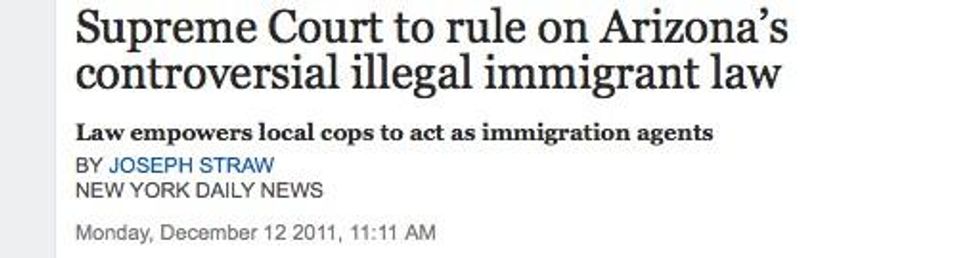
Within minutes, "illegal immigrants" headlined newspapers online across the country, such as the New York Daily News:
Thanks for the reminder.
As the U.S. Supreme Court prepares to take on Arizona's punitive immigration law, it's time for the AP -- and all journalists and editors -- to join Colorlines' campaign to drop the "I-word" and find a decent and more accurate way of framing immigration matters.
The AP correspondent, of course, was simply following protocol. The AP Stylebook notes: "Illegal Immigrant -- Used to describe those who have entered the country illegally. It is the preferred term rather than illegal alien or undocumented worker." But this decision, as author Gabriel Thompson noted in Colorlines magazine, "locked in an industry standard for so-called neutral language on unauthorized immigration -- and it focused on the person, not just the act."
More than five years have passed since the National Association of Hispanic Journalists called on the media to reassess its use of the "illegal" word and "stop using dehumanizing terms when covering immigration." The NAHJ noted:
The term criminalizes the person rather than the actual act of illegally entering or residing in the United States without federal documents. Terms such as illegal alien or illegal immigrant can often be used pejoratively in common parlance and can pack a powerful emotional wallop for those on the receiving end.
This year, in fact, the Society of Professional Journalists passed a resolution to re-evaluate "the politically charged phrase 'illegal immigrant.'" In October, SPJ President John Ensslin added his own voice to the long overdue I-word change:
My concern is not one of being politically correct as it being precise and accurate.
When police arrest someone on a burglary charge, we don't refer to them the next day as "illegal burglars." They are burglary suspects.I don't see why we can't treat immigration cases like any other arrests. A person under arrest is suspected of entering the country illegally until authorities are in fact sure that they did.
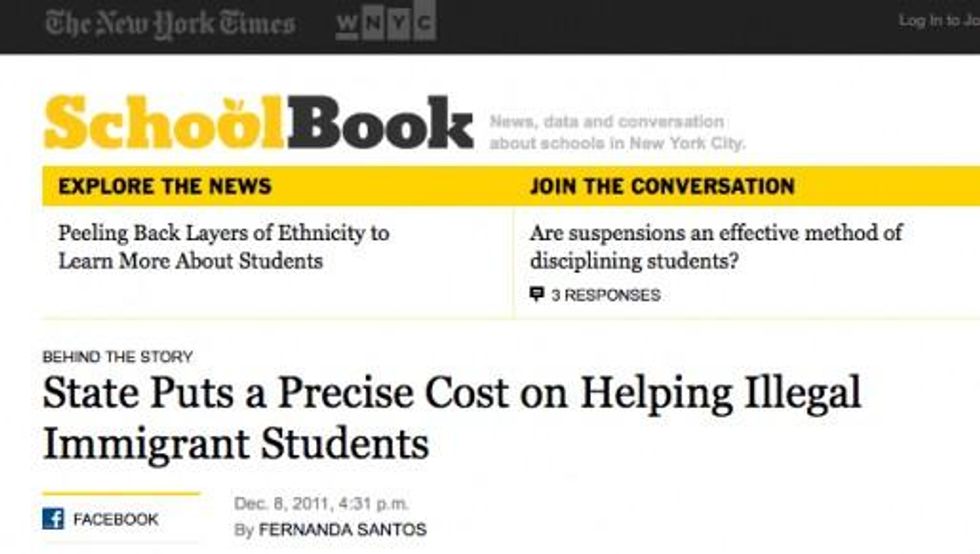
The term is even more offensive when applied to undocumented children and youth, who have had no control over their circumstances, such as the headline framing of this story on "illegal" immigrant students in the New York Times last week.
The U.S. Supreme Court has come a long way since former Chief Justice William Rehnquist referred to undocumented immigrants as "wetbacks." In an opinion earlier this year on another Arizona immigration law, Chief Justice John Roberts, Jr. knowingly used the terms, "unauthorized aliens" and "unauthorized workers."
It's time for journalists and editors to take the same step forward.
More than four decades ago, as former New York Times editor Gene Roberts noted in The Race Beat: The Press, The Civil Rights Struggle, and the Awakening of a Nation, his Pulitzer Prize-winning history on journalism during the Civil Rights Movement, writers and editors went through a similar debate over consistent style and word usage. "After discussion that ebbed and flowed for weeks," Roberts wrote, "the decision was made. Individuals of African descent, not the Times, would choose how they were designated for as long as the issue was in dispute."
Journalists and editors would be wise to do the same for all immigrants today.
More information on Colorlines and its campaign to Drop the I-Word is here.
Two words stood out in the AP news story on Arizona's controversial SB 1070 immigration law yesterday: BREAKING: Supreme Court says it will rule on Arizona law targeting illegal immigrants
Within minutes, "illegal immigrants" headlined newspapers online across the country, such as the New York Daily News:
Thanks for the reminder.
As the U.S. Supreme Court prepares to take on Arizona's punitive immigration law, it's time for the AP -- and all journalists and editors -- to join Colorlines' campaign to drop the "I-word" and find a decent and more accurate way of framing immigration matters.
The AP correspondent, of course, was simply following protocol. The AP Stylebook notes: "Illegal Immigrant -- Used to describe those who have entered the country illegally. It is the preferred term rather than illegal alien or undocumented worker." But this decision, as author Gabriel Thompson noted in Colorlines magazine, "locked in an industry standard for so-called neutral language on unauthorized immigration -- and it focused on the person, not just the act."
More than five years have passed since the National Association of Hispanic Journalists called on the media to reassess its use of the "illegal" word and "stop using dehumanizing terms when covering immigration." The NAHJ noted:
The term criminalizes the person rather than the actual act of illegally entering or residing in the United States without federal documents. Terms such as illegal alien or illegal immigrant can often be used pejoratively in common parlance and can pack a powerful emotional wallop for those on the receiving end.
This year, in fact, the Society of Professional Journalists passed a resolution to re-evaluate "the politically charged phrase 'illegal immigrant.'" In October, SPJ President John Ensslin added his own voice to the long overdue I-word change:
My concern is not one of being politically correct as it being precise and accurate.
When police arrest someone on a burglary charge, we don't refer to them the next day as "illegal burglars." They are burglary suspects.I don't see why we can't treat immigration cases like any other arrests. A person under arrest is suspected of entering the country illegally until authorities are in fact sure that they did.
The term is even more offensive when applied to undocumented children and youth, who have had no control over their circumstances, such as the headline framing of this story on "illegal" immigrant students in the New York Times last week.
The U.S. Supreme Court has come a long way since former Chief Justice William Rehnquist referred to undocumented immigrants as "wetbacks." In an opinion earlier this year on another Arizona immigration law, Chief Justice John Roberts, Jr. knowingly used the terms, "unauthorized aliens" and "unauthorized workers."
It's time for journalists and editors to take the same step forward.
More than four decades ago, as former New York Times editor Gene Roberts noted in The Race Beat: The Press, The Civil Rights Struggle, and the Awakening of a Nation, his Pulitzer Prize-winning history on journalism during the Civil Rights Movement, writers and editors went through a similar debate over consistent style and word usage. "After discussion that ebbed and flowed for weeks," Roberts wrote, "the decision was made. Individuals of African descent, not the Times, would choose how they were designated for as long as the issue was in dispute."
Journalists and editors would be wise to do the same for all immigrants today.
More information on Colorlines and its campaign to Drop the I-Word is here.
Two words stood out in the AP news story on Arizona's controversial SB 1070 immigration law yesterday: BREAKING: Supreme Court says it will rule on Arizona law targeting illegal immigrants
Within minutes, "illegal immigrants" headlined newspapers online across the country, such as the New York Daily News:
Thanks for the reminder.
As the U.S. Supreme Court prepares to take on Arizona's punitive immigration law, it's time for the AP -- and all journalists and editors -- to join Colorlines' campaign to drop the "I-word" and find a decent and more accurate way of framing immigration matters.
The AP correspondent, of course, was simply following protocol. The AP Stylebook notes: "Illegal Immigrant -- Used to describe those who have entered the country illegally. It is the preferred term rather than illegal alien or undocumented worker." But this decision, as author Gabriel Thompson noted in Colorlines magazine, "locked in an industry standard for so-called neutral language on unauthorized immigration -- and it focused on the person, not just the act."
More than five years have passed since the National Association of Hispanic Journalists called on the media to reassess its use of the "illegal" word and "stop using dehumanizing terms when covering immigration." The NAHJ noted:
The term criminalizes the person rather than the actual act of illegally entering or residing in the United States without federal documents. Terms such as illegal alien or illegal immigrant can often be used pejoratively in common parlance and can pack a powerful emotional wallop for those on the receiving end.
This year, in fact, the Society of Professional Journalists passed a resolution to re-evaluate "the politically charged phrase 'illegal immigrant.'" In October, SPJ President John Ensslin added his own voice to the long overdue I-word change:
My concern is not one of being politically correct as it being precise and accurate.
When police arrest someone on a burglary charge, we don't refer to them the next day as "illegal burglars." They are burglary suspects.I don't see why we can't treat immigration cases like any other arrests. A person under arrest is suspected of entering the country illegally until authorities are in fact sure that they did.
The term is even more offensive when applied to undocumented children and youth, who have had no control over their circumstances, such as the headline framing of this story on "illegal" immigrant students in the New York Times last week.
The U.S. Supreme Court has come a long way since former Chief Justice William Rehnquist referred to undocumented immigrants as "wetbacks." In an opinion earlier this year on another Arizona immigration law, Chief Justice John Roberts, Jr. knowingly used the terms, "unauthorized aliens" and "unauthorized workers."
It's time for journalists and editors to take the same step forward.
More than four decades ago, as former New York Times editor Gene Roberts noted in The Race Beat: The Press, The Civil Rights Struggle, and the Awakening of a Nation, his Pulitzer Prize-winning history on journalism during the Civil Rights Movement, writers and editors went through a similar debate over consistent style and word usage. "After discussion that ebbed and flowed for weeks," Roberts wrote, "the decision was made. Individuals of African descent, not the Times, would choose how they were designated for as long as the issue was in dispute."
Journalists and editors would be wise to do the same for all immigrants today.
More information on Colorlines and its campaign to Drop the I-Word is here.