SUBSCRIBE TO OUR FREE NEWSLETTER
Daily news & progressive opinion—funded by the people, not the corporations—delivered straight to your inbox.
5
#000000
#FFFFFF
To donate by check, phone, or other method, see our More Ways to Give page.
CAIRO - December 02, 2011 -- Standing at Tahrir Square, ground zero of Egypt's revolution, is exciting and intimidating. The explosive anger, pent-up frustrations, and yearning for revenge of tens of thousands of demonstrators and onlookers breaks like waves across this vast, unsightly plaza.
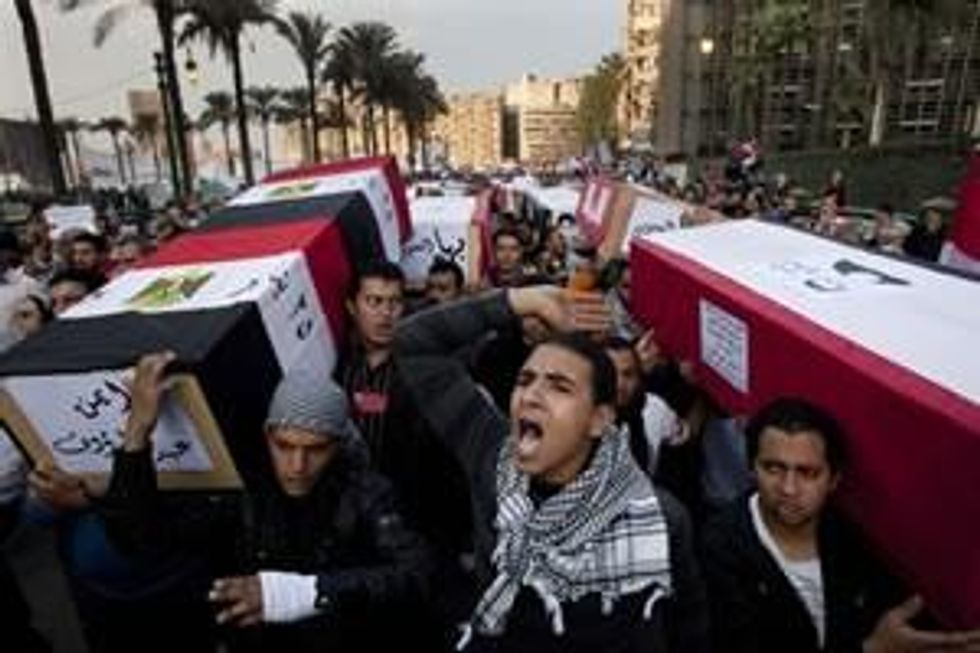
Off on side streets, wait large numbers of special black-uniformed security forces, ready to have another go at the thousands of young demonstrators thronging the world's most currently famous square.
So far, at least 45 demonstrators have been killed and thousands injured by rubber-coated bullets, riot gas, clubbing or being crushed by security vehicles. Tens of thousands more have been arrested by the police who are not known for their gentleness.
But even stronger than the fear hanging over Tahrir Square is the pulsating thrill of raw revolution, and the hope it might somehow rid Egypt of decades of oppression and misrule.
The nation's first honest elections were just held. They are supposed to be the initial step in electing a bicameral parliament that will write a new constitution. The military leadership, the real power in this nation of 81 million, now promises to hold presidential elections next June.
The 500,000-man military, armed and financed by billions in overt and covert American annual aid, is as confused as the public about what to do next.
Its old guard, closely aligned with the US Pentagon and Saudi Arabia, wants to retain its power and privileges. But most of its officers, and certainly its rank and file, have no desire to fight the public which esteems the armed forces for their heroic role in the 1973 War against Israel.
Turkey's armed forces, NATO's second largest, also long ruled from behind a veneer of politicians. Turkey did not achieve true democracy, rule of law or an economic boom until its bullying generals were forced back to its barracks - a process that took a decade of political warfare. A similar tug of war may occur in Egypt.
The way ahead is certainly murky. If a parliament is elected, will the military and its foreign allies allow it any power, or accept its mandates? Will a president, if elected, exercise true power or be just another figurehead? Egyptians have to sort out these thorny questions without, hopefully, resorting to violence.
The biggest winner of the current vote was the Freedom and Justice Party, the political arm of Egypt's venerable Muslim Brotherhood. Contrary to misleading views promoted in the West, the Brotherhood is a very conservative, even timid, movement that advocates Islamic social justice, not violent revolution. Young Egyptians dismiss it as "your grandfather's party."
Runner up in the vote was the al-Nour party, a hard-line Salafist group advocating a state under Islamic law. But it is strongly opposed by liberals, moderates, Christian Copts (10% of the population) and many urban dwellers.
Neither the Brotherhood noR al-Nour is inherently anti-western. But both, and most Egyptians, demand their new government cease kow-towing to Israel because of US pressure, and champion the Palestinian cause.
Egypt, however, may not enjoy such independence. The revolution that overthrew Pharaoh Mubarak has battered Egypt's economy. Political unrest caused tourism, which employs 10% of the work force, to drop over 50%, though Egypt is a much safer place than the US or Britain.
Egypt is a vast desert with one river. Almost 97% of Egypt's 81 million live on only 4% of its land. As a result, Egypt cannot feed itself. Half of Egypt's food comes from the US in the form of wheat aid. The US Congress, a close ally of Israel, controls the programs funding Egypt's food imports. So in this sense, Egypt's food security, as well as arms, munitions and spare parts, are heavily influenced by the US and Israel.
Accordingly, Egypt may not be able to cut the apron strings to its American patrons. For its part, Washington appears set on so far retaining Egypt's current military power structure in spite of lauding Egypt's struggle for democracy.
CAIRO - December 02, 2011 -- Standing at Tahrir Square, ground zero of Egypt's revolution, is exciting and intimidating. The explosive anger, pent-up frustrations, and yearning for revenge of tens of thousands of demonstrators and onlookers breaks like waves across this vast, unsightly plaza.
Off on side streets, wait large numbers of special black-uniformed security forces, ready to have another go at the thousands of young demonstrators thronging the world's most currently famous square.
So far, at least 45 demonstrators have been killed and thousands injured by rubber-coated bullets, riot gas, clubbing or being crushed by security vehicles. Tens of thousands more have been arrested by the police who are not known for their gentleness.
But even stronger than the fear hanging over Tahrir Square is the pulsating thrill of raw revolution, and the hope it might somehow rid Egypt of decades of oppression and misrule.
The nation's first honest elections were just held. They are supposed to be the initial step in electing a bicameral parliament that will write a new constitution. The military leadership, the real power in this nation of 81 million, now promises to hold presidential elections next June.
The 500,000-man military, armed and financed by billions in overt and covert American annual aid, is as confused as the public about what to do next.
Its old guard, closely aligned with the US Pentagon and Saudi Arabia, wants to retain its power and privileges. But most of its officers, and certainly its rank and file, have no desire to fight the public which esteems the armed forces for their heroic role in the 1973 War against Israel.
Turkey's armed forces, NATO's second largest, also long ruled from behind a veneer of politicians. Turkey did not achieve true democracy, rule of law or an economic boom until its bullying generals were forced back to its barracks - a process that took a decade of political warfare. A similar tug of war may occur in Egypt.
The way ahead is certainly murky. If a parliament is elected, will the military and its foreign allies allow it any power, or accept its mandates? Will a president, if elected, exercise true power or be just another figurehead? Egyptians have to sort out these thorny questions without, hopefully, resorting to violence.
The biggest winner of the current vote was the Freedom and Justice Party, the political arm of Egypt's venerable Muslim Brotherhood. Contrary to misleading views promoted in the West, the Brotherhood is a very conservative, even timid, movement that advocates Islamic social justice, not violent revolution. Young Egyptians dismiss it as "your grandfather's party."
Runner up in the vote was the al-Nour party, a hard-line Salafist group advocating a state under Islamic law. But it is strongly opposed by liberals, moderates, Christian Copts (10% of the population) and many urban dwellers.
Neither the Brotherhood noR al-Nour is inherently anti-western. But both, and most Egyptians, demand their new government cease kow-towing to Israel because of US pressure, and champion the Palestinian cause.
Egypt, however, may not enjoy such independence. The revolution that overthrew Pharaoh Mubarak has battered Egypt's economy. Political unrest caused tourism, which employs 10% of the work force, to drop over 50%, though Egypt is a much safer place than the US or Britain.
Egypt is a vast desert with one river. Almost 97% of Egypt's 81 million live on only 4% of its land. As a result, Egypt cannot feed itself. Half of Egypt's food comes from the US in the form of wheat aid. The US Congress, a close ally of Israel, controls the programs funding Egypt's food imports. So in this sense, Egypt's food security, as well as arms, munitions and spare parts, are heavily influenced by the US and Israel.
Accordingly, Egypt may not be able to cut the apron strings to its American patrons. For its part, Washington appears set on so far retaining Egypt's current military power structure in spite of lauding Egypt's struggle for democracy.
CAIRO - December 02, 2011 -- Standing at Tahrir Square, ground zero of Egypt's revolution, is exciting and intimidating. The explosive anger, pent-up frustrations, and yearning for revenge of tens of thousands of demonstrators and onlookers breaks like waves across this vast, unsightly plaza.
Off on side streets, wait large numbers of special black-uniformed security forces, ready to have another go at the thousands of young demonstrators thronging the world's most currently famous square.
So far, at least 45 demonstrators have been killed and thousands injured by rubber-coated bullets, riot gas, clubbing or being crushed by security vehicles. Tens of thousands more have been arrested by the police who are not known for their gentleness.
But even stronger than the fear hanging over Tahrir Square is the pulsating thrill of raw revolution, and the hope it might somehow rid Egypt of decades of oppression and misrule.
The nation's first honest elections were just held. They are supposed to be the initial step in electing a bicameral parliament that will write a new constitution. The military leadership, the real power in this nation of 81 million, now promises to hold presidential elections next June.
The 500,000-man military, armed and financed by billions in overt and covert American annual aid, is as confused as the public about what to do next.
Its old guard, closely aligned with the US Pentagon and Saudi Arabia, wants to retain its power and privileges. But most of its officers, and certainly its rank and file, have no desire to fight the public which esteems the armed forces for their heroic role in the 1973 War against Israel.
Turkey's armed forces, NATO's second largest, also long ruled from behind a veneer of politicians. Turkey did not achieve true democracy, rule of law or an economic boom until its bullying generals were forced back to its barracks - a process that took a decade of political warfare. A similar tug of war may occur in Egypt.
The way ahead is certainly murky. If a parliament is elected, will the military and its foreign allies allow it any power, or accept its mandates? Will a president, if elected, exercise true power or be just another figurehead? Egyptians have to sort out these thorny questions without, hopefully, resorting to violence.
The biggest winner of the current vote was the Freedom and Justice Party, the political arm of Egypt's venerable Muslim Brotherhood. Contrary to misleading views promoted in the West, the Brotherhood is a very conservative, even timid, movement that advocates Islamic social justice, not violent revolution. Young Egyptians dismiss it as "your grandfather's party."
Runner up in the vote was the al-Nour party, a hard-line Salafist group advocating a state under Islamic law. But it is strongly opposed by liberals, moderates, Christian Copts (10% of the population) and many urban dwellers.
Neither the Brotherhood noR al-Nour is inherently anti-western. But both, and most Egyptians, demand their new government cease kow-towing to Israel because of US pressure, and champion the Palestinian cause.
Egypt, however, may not enjoy such independence. The revolution that overthrew Pharaoh Mubarak has battered Egypt's economy. Political unrest caused tourism, which employs 10% of the work force, to drop over 50%, though Egypt is a much safer place than the US or Britain.
Egypt is a vast desert with one river. Almost 97% of Egypt's 81 million live on only 4% of its land. As a result, Egypt cannot feed itself. Half of Egypt's food comes from the US in the form of wheat aid. The US Congress, a close ally of Israel, controls the programs funding Egypt's food imports. So in this sense, Egypt's food security, as well as arms, munitions and spare parts, are heavily influenced by the US and Israel.
Accordingly, Egypt may not be able to cut the apron strings to its American patrons. For its part, Washington appears set on so far retaining Egypt's current military power structure in spite of lauding Egypt's struggle for democracy.