SUBSCRIBE TO OUR FREE NEWSLETTER
Daily news & progressive opinion—funded by the people, not the corporations—delivered straight to your inbox.
5
#000000
#FFFFFF
To donate by check, phone, or other method, see our More Ways to Give page.


Daily news & progressive opinion—funded by the people, not the corporations—delivered straight to your inbox.
In early October, a peculiar news item barely made its way into the back pages of Greek national press: in the northern city of Veria, a small group of people had started reconnecting the electricity supply of households disconnected from the national grid due to bill non-payment. This kind of solidarity action seemed rather abnormal.

Then again, it is difficult to define what constitutes normality in the country nowadays - the upper echelon of political power is in an unprecedented turmoil, and Tuesday's referendum announcement by prime minister George Papandreou, followed by him reportedly preparing to step down, has thrown his political allies and foes into a tailspin. Parliamentary opposition parties are calling for a "national unity" government, snap elections, or a succession of the two; the entire mainstream political spectrum in the country seems to have entered a delirious state of panic. In a stunningly surreal scene, eurozone leaders and global markets are nervously waiting for people in Greece to cast a vote.
And yet, at this precise moment, Greek people are realising they are left with what they had at the outset - that is, absolutely nothing to hope for from the mainstream political scene.
Take Yannis, a 43 year-old man working in a bank in Athens, who doesn't want to return home because it is going to be cold again. The heating will be off, as nobody in the block can afford the heating prices. His 16-year old daughter, Sophia, does not want to go to school, as she finds little meaning in preparing for her exams: why would she want to enter university knowing full well she will never find a job in Greece, anyway? Or take Eleftheria's father, a 72-year old pensioner leaving in the village of Kymi, who called her today while she was returning home and hesitantly asked her for money to buy his medicine that the state fund no longer covers for. His pension was recently cut by 50%. "But, please," he pleaded, "do not tell your mother." Back in the city, Eleftheria's streets are lined with garbage which has been lying there for more than three weeks.
Thousands of workers are to be put on reduced pay schemes across the country and hundreds are being fired on a daily basis. The government has raised already existing taxes and introduced a variety of new ones across the board, while slashing salaries and pensions in both the public and private sector. Official unemployment rose by more than 35% year-to-year and now stands at just under 20%; homelessness is on an enormous increase across the country, while tax on food consumption has shot up from 13 to 23%. At the same time, public transport is being dismantled and hospitals across the country barely function. For the first time, there were no books to be distributed in public schools and universities are in utter disarray. The "bloated" public sector has been portrayed as responsible for all the misery the country has to endure. At the same time, social services have been intentionally abandoned, making it easier for enraged citizens to accept the privatisation of the public sector in return.
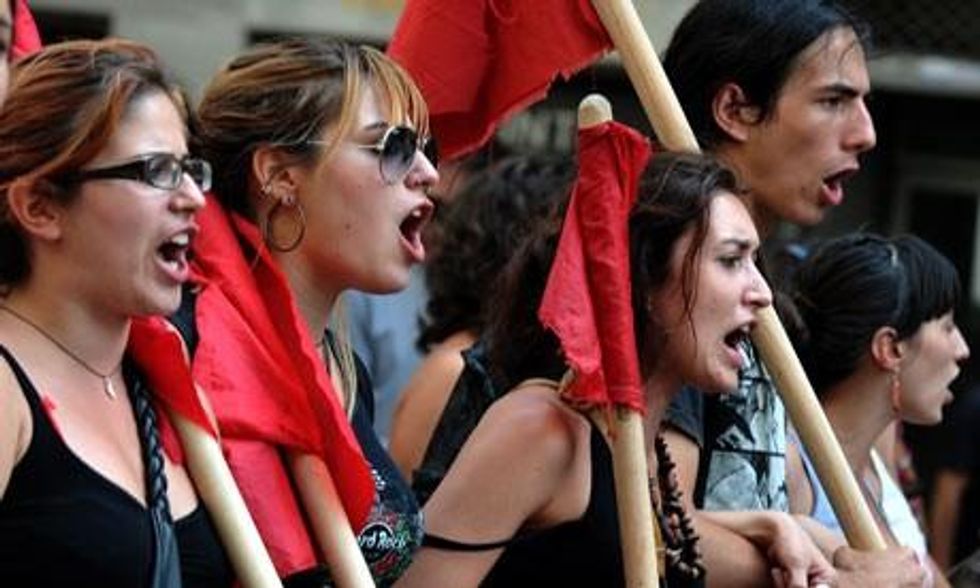
People here feel the country is gradually sinking, carrying them down a path dug in arbitrariness and injustice. Yet at this very moment - when it is not only the rules of the game that are challenged but the game itself - they seem to feel empowered to act in ways that would not have appeared feasible in the past: they physically attack politicians, mock and cancel military-inspired national public parades and humiliate army officials attending them, participate in neighbourhood assemblies and mass demonstrations (irrespective of the amount of tear gas thrown against them by the police), create grassroots trade unions to demand their labour rights, occupy workplaces, disrupt public services and protest in violent, impulsive, unpredictable ways.
In these peculiar times, when there is nothing to lose for so many, everything becomes possible. In the northern Athens suburb of Nea Ionia, the municipality is now actively calling for locals to shun the new tax, offering instructions to avoid its payment on its official website and promising legal support and even volunteers to reconnect potentially disconnected supplies. Grassroots refusal to put up with austerity is quickly gaining momentum, regardless of everyday politics of fear and emergency, or never-ending market crashes. In return, the realisation is sinking in that a possibility for tangible change only lies in people changing their understandings, their habits, the ways in which they do politics: while asked to cast a vote, Greek society sees a major role recast.
Dear Common Dreams reader, It’s been nearly 30 years since I co-founded Common Dreams with my late wife, Lina Newhouser. We had the radical notion that journalism should serve the public good, not corporate profits. It was clear to us from the outset what it would take to build such a project. No paid advertisements. No corporate sponsors. No millionaire publisher telling us what to think or do. Many people said we wouldn't last a year, but we proved those doubters wrong. Together with a tremendous team of journalists and dedicated staff, we built an independent media outlet free from the constraints of profits and corporate control. Our mission has always been simple: To inform. To inspire. To ignite change for the common good. Building Common Dreams was not easy. Our survival was never guaranteed. When you take on the most powerful forces—Wall Street greed, fossil fuel industry destruction, Big Tech lobbyists, and uber-rich oligarchs who have spent billions upon billions rigging the economy and democracy in their favor—the only bulwark you have is supporters who believe in your work. But here’s the urgent message from me today. It's never been this bad out there. And it's never been this hard to keep us going. At the very moment Common Dreams is most needed, the threats we face are intensifying. We need your support now more than ever. We don't accept corporate advertising and never will. We don't have a paywall because we don't think people should be blocked from critical news based on their ability to pay. Everything we do is funded by the donations of readers like you. When everyone does the little they can afford, we are strong. But if that support retreats or dries up, so do we. Will you donate now to make sure Common Dreams not only survives but thrives? —Craig Brown, Co-founder |
In early October, a peculiar news item barely made its way into the back pages of Greek national press: in the northern city of Veria, a small group of people had started reconnecting the electricity supply of households disconnected from the national grid due to bill non-payment. This kind of solidarity action seemed rather abnormal.

Then again, it is difficult to define what constitutes normality in the country nowadays - the upper echelon of political power is in an unprecedented turmoil, and Tuesday's referendum announcement by prime minister George Papandreou, followed by him reportedly preparing to step down, has thrown his political allies and foes into a tailspin. Parliamentary opposition parties are calling for a "national unity" government, snap elections, or a succession of the two; the entire mainstream political spectrum in the country seems to have entered a delirious state of panic. In a stunningly surreal scene, eurozone leaders and global markets are nervously waiting for people in Greece to cast a vote.
And yet, at this precise moment, Greek people are realising they are left with what they had at the outset - that is, absolutely nothing to hope for from the mainstream political scene.
Take Yannis, a 43 year-old man working in a bank in Athens, who doesn't want to return home because it is going to be cold again. The heating will be off, as nobody in the block can afford the heating prices. His 16-year old daughter, Sophia, does not want to go to school, as she finds little meaning in preparing for her exams: why would she want to enter university knowing full well she will never find a job in Greece, anyway? Or take Eleftheria's father, a 72-year old pensioner leaving in the village of Kymi, who called her today while she was returning home and hesitantly asked her for money to buy his medicine that the state fund no longer covers for. His pension was recently cut by 50%. "But, please," he pleaded, "do not tell your mother." Back in the city, Eleftheria's streets are lined with garbage which has been lying there for more than three weeks.
Thousands of workers are to be put on reduced pay schemes across the country and hundreds are being fired on a daily basis. The government has raised already existing taxes and introduced a variety of new ones across the board, while slashing salaries and pensions in both the public and private sector. Official unemployment rose by more than 35% year-to-year and now stands at just under 20%; homelessness is on an enormous increase across the country, while tax on food consumption has shot up from 13 to 23%. At the same time, public transport is being dismantled and hospitals across the country barely function. For the first time, there were no books to be distributed in public schools and universities are in utter disarray. The "bloated" public sector has been portrayed as responsible for all the misery the country has to endure. At the same time, social services have been intentionally abandoned, making it easier for enraged citizens to accept the privatisation of the public sector in return.
People here feel the country is gradually sinking, carrying them down a path dug in arbitrariness and injustice. Yet at this very moment - when it is not only the rules of the game that are challenged but the game itself - they seem to feel empowered to act in ways that would not have appeared feasible in the past: they physically attack politicians, mock and cancel military-inspired national public parades and humiliate army officials attending them, participate in neighbourhood assemblies and mass demonstrations (irrespective of the amount of tear gas thrown against them by the police), create grassroots trade unions to demand their labour rights, occupy workplaces, disrupt public services and protest in violent, impulsive, unpredictable ways.
In these peculiar times, when there is nothing to lose for so many, everything becomes possible. In the northern Athens suburb of Nea Ionia, the municipality is now actively calling for locals to shun the new tax, offering instructions to avoid its payment on its official website and promising legal support and even volunteers to reconnect potentially disconnected supplies. Grassroots refusal to put up with austerity is quickly gaining momentum, regardless of everyday politics of fear and emergency, or never-ending market crashes. In return, the realisation is sinking in that a possibility for tangible change only lies in people changing their understandings, their habits, the ways in which they do politics: while asked to cast a vote, Greek society sees a major role recast.
In early October, a peculiar news item barely made its way into the back pages of Greek national press: in the northern city of Veria, a small group of people had started reconnecting the electricity supply of households disconnected from the national grid due to bill non-payment. This kind of solidarity action seemed rather abnormal.

Then again, it is difficult to define what constitutes normality in the country nowadays - the upper echelon of political power is in an unprecedented turmoil, and Tuesday's referendum announcement by prime minister George Papandreou, followed by him reportedly preparing to step down, has thrown his political allies and foes into a tailspin. Parliamentary opposition parties are calling for a "national unity" government, snap elections, or a succession of the two; the entire mainstream political spectrum in the country seems to have entered a delirious state of panic. In a stunningly surreal scene, eurozone leaders and global markets are nervously waiting for people in Greece to cast a vote.
And yet, at this precise moment, Greek people are realising they are left with what they had at the outset - that is, absolutely nothing to hope for from the mainstream political scene.
Take Yannis, a 43 year-old man working in a bank in Athens, who doesn't want to return home because it is going to be cold again. The heating will be off, as nobody in the block can afford the heating prices. His 16-year old daughter, Sophia, does not want to go to school, as she finds little meaning in preparing for her exams: why would she want to enter university knowing full well she will never find a job in Greece, anyway? Or take Eleftheria's father, a 72-year old pensioner leaving in the village of Kymi, who called her today while she was returning home and hesitantly asked her for money to buy his medicine that the state fund no longer covers for. His pension was recently cut by 50%. "But, please," he pleaded, "do not tell your mother." Back in the city, Eleftheria's streets are lined with garbage which has been lying there for more than three weeks.
Thousands of workers are to be put on reduced pay schemes across the country and hundreds are being fired on a daily basis. The government has raised already existing taxes and introduced a variety of new ones across the board, while slashing salaries and pensions in both the public and private sector. Official unemployment rose by more than 35% year-to-year and now stands at just under 20%; homelessness is on an enormous increase across the country, while tax on food consumption has shot up from 13 to 23%. At the same time, public transport is being dismantled and hospitals across the country barely function. For the first time, there were no books to be distributed in public schools and universities are in utter disarray. The "bloated" public sector has been portrayed as responsible for all the misery the country has to endure. At the same time, social services have been intentionally abandoned, making it easier for enraged citizens to accept the privatisation of the public sector in return.
People here feel the country is gradually sinking, carrying them down a path dug in arbitrariness and injustice. Yet at this very moment - when it is not only the rules of the game that are challenged but the game itself - they seem to feel empowered to act in ways that would not have appeared feasible in the past: they physically attack politicians, mock and cancel military-inspired national public parades and humiliate army officials attending them, participate in neighbourhood assemblies and mass demonstrations (irrespective of the amount of tear gas thrown against them by the police), create grassroots trade unions to demand their labour rights, occupy workplaces, disrupt public services and protest in violent, impulsive, unpredictable ways.
In these peculiar times, when there is nothing to lose for so many, everything becomes possible. In the northern Athens suburb of Nea Ionia, the municipality is now actively calling for locals to shun the new tax, offering instructions to avoid its payment on its official website and promising legal support and even volunteers to reconnect potentially disconnected supplies. Grassroots refusal to put up with austerity is quickly gaining momentum, regardless of everyday politics of fear and emergency, or never-ending market crashes. In return, the realisation is sinking in that a possibility for tangible change only lies in people changing their understandings, their habits, the ways in which they do politics: while asked to cast a vote, Greek society sees a major role recast.