SUBSCRIBE TO OUR FREE NEWSLETTER
Daily news & progressive opinion—funded by the people, not the corporations—delivered straight to your inbox.
5
#000000
#FFFFFF
To donate by check, phone, or other method, see our More Ways to Give page.
Barack Obama delivered a credible if uninspired jobs speech Thursday night.
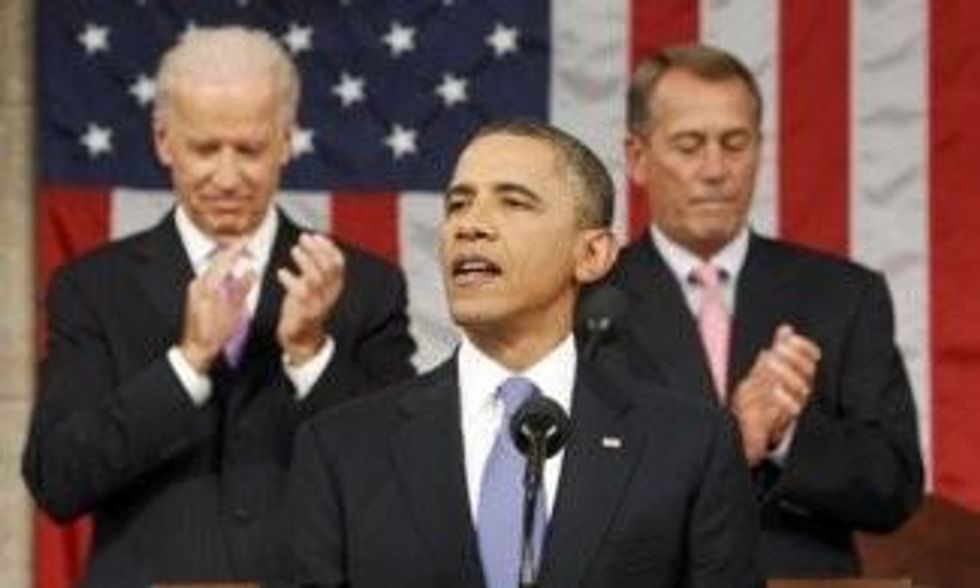
He communicated that the United States cannot meet the challenges of an unemployment crisis with an austerity agenda that owes more to Herbert Hoover than Franklin Roosevelt. But he muddied the message with too much debt and deficit talk.
He signaled to organized labor and progressives that he at least understands the point of a "go big" response to the challenge--even as his instinctive caution erred against going big enough.
In fact, his rhetoric was good deal better than the specifics of his plan.
"The people of this country work hard to meet their responsibilities. The question tonight is whether we'll meet ours," the president explained, to considerable applause. "The question is whether, in the face of an ongoing national crisis, we can stop the political circus and actually do something to help the economy. The question is whether we can restore some of the fairness and security that has defined this nation since our beginning."
Obama's "it's time to do what's right" proposal touches at least some of the right bases--even if it is a clumsy circumnavigation. He proposes to spend $450 billion. The $253 billion in tax cuts he wants go mainly to working folks. The $194 billion in new spending is aimed at hiring incentives, infrastructure projects and other job-creating and retaining programs that the moment demands and that polls suggest Americans are more than willing to fund.
So where does this leave us?
The standard analysis says "nowhere." Obama has proposed, now Republicans will reject. And that's that.
But the standard analysis presumes that Obama and his advisers--both economic and political--are rendered powerless by a Republican-controlled House of Representatives and a cloture-constricted Senate.
That's silly.
While Obama is in a political corner, he has the ability to fight his way out of it.
The question is whether he has the will. If he does, he will likely be a two-term president. If he does not, then he will be this generation's Jimmy Carter.
The speeches that matter are never valedictories delivered at the end of a struggle. Even eulogies--at least in the political context--are calls to action, not conclusions.
So now Obama must fight.
MoveOn.org's Justin Ruben got it right when he said that Americans--at least the Americans who would ever consider voting for him--"want to see the President stand up to Tea Party extremism, and push forward with a plan to create good jobs now, and pay for it by ending tax cuts for millionaires and corporations.
"Now that the President is turning the conversation back to jobs, he needs to keep it there," adds Ruben. "He can't return in a week or two with a plan that helps Tea Party extremists in their drive to slash vital programs like Medicare, Medicaid and Social Security."
Ruben's right.
But is Obama up to the task?
If he is, there is reason to believe that he can win in the short and long terms.
The short-term win is essential for the tens of millions of unemployed and underemployed Americans who are the human face of that 9.1 percent official unemployment rate and that 16.2 percent real unemployment rate.
Obama needs to turn the heat up on Congress. Way up. And the way to do this is not by offering to compromise or by talking about working with "my friends on the other side of the aisle."
The president must built national support for his plan. That's going to require him to campaign--not for himself but for an agenda, and for a vision. He must become the explainer-in-chief, using the bully pulpit to create a new narrative that counters the Republican "get-government-out-of-the-way" fantasy. And he can't stop until he succeeds, any more than Ronald Reagan could stop when he was wrangling with Tip O'Neill back in the 1980s.
Reagan did not win every fight. Neither did FDR. But the fights that they fought made them the dominant political players of their times.
Obama has the potential to be that, and in so doing to begin the renewal of the American economy.
For those who cannot see beyond Washington, that may seem unimaginable.
But for those who pay attention to America, it's an entirely doable project.
Why? Because the American people want a jobs program that pulls no punches. It matters far more to them than the Republican austerity agenda.
The new Pew Research Center/Washington Post confirms this.
By an almost 2-1 margin, Americans say they are more concerned about the jobs crisis than they are about federal deficits and debts.
What's the most popular response to the current economic malaise? "Additional infrastructure spending."
Not tax cuts for the rich. Not tax cuts for corporations. Not deficit reduction. According to the Pew poll, Americans think that "additional spending on roads, bridges, other public works" is the commitment that is most likely to improve the jobs situation. Seventy-seven percent of those surveyed said infrastructure spending would do the most to help put people back to work--significantly more than any GOP proposal.
New polling from the American Alliance for Manufacturing confirms that Americans are enthusiastic about federal policies designed to expand domestic manufacturing and a shift in trade policies to favor American workers and communities.
The bottom line: Americans want an activist government that is fighting to put them back to work.
President Obama's speech to the Congress did not go big enough. But it did outline a vision that was a good deal bolder than the one he advanced over the wasted summer of 2011--when Republican talking points about the debt ceiling dominated the discourse, and compromise with the unconscionable was the order of the day.
Now, Obama has a chance to shift the debate, to appeal to the great mass of Americans who are more worried about jobs than debt ceilings. He can win this debate, and in so doing he can put pressure on Congressional Republicans to act. Then, if they fail to do so, the president and his party will be positioned to fight the 2012 election on their terms.
Barack Obama delivered a credible if uninspired jobs speech Thursday night.
He communicated that the United States cannot meet the challenges of an unemployment crisis with an austerity agenda that owes more to Herbert Hoover than Franklin Roosevelt. But he muddied the message with too much debt and deficit talk.
He signaled to organized labor and progressives that he at least understands the point of a "go big" response to the challenge--even as his instinctive caution erred against going big enough.
In fact, his rhetoric was good deal better than the specifics of his plan.
"The people of this country work hard to meet their responsibilities. The question tonight is whether we'll meet ours," the president explained, to considerable applause. "The question is whether, in the face of an ongoing national crisis, we can stop the political circus and actually do something to help the economy. The question is whether we can restore some of the fairness and security that has defined this nation since our beginning."
Obama's "it's time to do what's right" proposal touches at least some of the right bases--even if it is a clumsy circumnavigation. He proposes to spend $450 billion. The $253 billion in tax cuts he wants go mainly to working folks. The $194 billion in new spending is aimed at hiring incentives, infrastructure projects and other job-creating and retaining programs that the moment demands and that polls suggest Americans are more than willing to fund.
So where does this leave us?
The standard analysis says "nowhere." Obama has proposed, now Republicans will reject. And that's that.
But the standard analysis presumes that Obama and his advisers--both economic and political--are rendered powerless by a Republican-controlled House of Representatives and a cloture-constricted Senate.
That's silly.
While Obama is in a political corner, he has the ability to fight his way out of it.
The question is whether he has the will. If he does, he will likely be a two-term president. If he does not, then he will be this generation's Jimmy Carter.
The speeches that matter are never valedictories delivered at the end of a struggle. Even eulogies--at least in the political context--are calls to action, not conclusions.
So now Obama must fight.
MoveOn.org's Justin Ruben got it right when he said that Americans--at least the Americans who would ever consider voting for him--"want to see the President stand up to Tea Party extremism, and push forward with a plan to create good jobs now, and pay for it by ending tax cuts for millionaires and corporations.
"Now that the President is turning the conversation back to jobs, he needs to keep it there," adds Ruben. "He can't return in a week or two with a plan that helps Tea Party extremists in their drive to slash vital programs like Medicare, Medicaid and Social Security."
Ruben's right.
But is Obama up to the task?
If he is, there is reason to believe that he can win in the short and long terms.
The short-term win is essential for the tens of millions of unemployed and underemployed Americans who are the human face of that 9.1 percent official unemployment rate and that 16.2 percent real unemployment rate.
Obama needs to turn the heat up on Congress. Way up. And the way to do this is not by offering to compromise or by talking about working with "my friends on the other side of the aisle."
The president must built national support for his plan. That's going to require him to campaign--not for himself but for an agenda, and for a vision. He must become the explainer-in-chief, using the bully pulpit to create a new narrative that counters the Republican "get-government-out-of-the-way" fantasy. And he can't stop until he succeeds, any more than Ronald Reagan could stop when he was wrangling with Tip O'Neill back in the 1980s.
Reagan did not win every fight. Neither did FDR. But the fights that they fought made them the dominant political players of their times.
Obama has the potential to be that, and in so doing to begin the renewal of the American economy.
For those who cannot see beyond Washington, that may seem unimaginable.
But for those who pay attention to America, it's an entirely doable project.
Why? Because the American people want a jobs program that pulls no punches. It matters far more to them than the Republican austerity agenda.
The new Pew Research Center/Washington Post confirms this.
By an almost 2-1 margin, Americans say they are more concerned about the jobs crisis than they are about federal deficits and debts.
What's the most popular response to the current economic malaise? "Additional infrastructure spending."
Not tax cuts for the rich. Not tax cuts for corporations. Not deficit reduction. According to the Pew poll, Americans think that "additional spending on roads, bridges, other public works" is the commitment that is most likely to improve the jobs situation. Seventy-seven percent of those surveyed said infrastructure spending would do the most to help put people back to work--significantly more than any GOP proposal.
New polling from the American Alliance for Manufacturing confirms that Americans are enthusiastic about federal policies designed to expand domestic manufacturing and a shift in trade policies to favor American workers and communities.
The bottom line: Americans want an activist government that is fighting to put them back to work.
President Obama's speech to the Congress did not go big enough. But it did outline a vision that was a good deal bolder than the one he advanced over the wasted summer of 2011--when Republican talking points about the debt ceiling dominated the discourse, and compromise with the unconscionable was the order of the day.
Now, Obama has a chance to shift the debate, to appeal to the great mass of Americans who are more worried about jobs than debt ceilings. He can win this debate, and in so doing he can put pressure on Congressional Republicans to act. Then, if they fail to do so, the president and his party will be positioned to fight the 2012 election on their terms.
Barack Obama delivered a credible if uninspired jobs speech Thursday night.
He communicated that the United States cannot meet the challenges of an unemployment crisis with an austerity agenda that owes more to Herbert Hoover than Franklin Roosevelt. But he muddied the message with too much debt and deficit talk.
He signaled to organized labor and progressives that he at least understands the point of a "go big" response to the challenge--even as his instinctive caution erred against going big enough.
In fact, his rhetoric was good deal better than the specifics of his plan.
"The people of this country work hard to meet their responsibilities. The question tonight is whether we'll meet ours," the president explained, to considerable applause. "The question is whether, in the face of an ongoing national crisis, we can stop the political circus and actually do something to help the economy. The question is whether we can restore some of the fairness and security that has defined this nation since our beginning."
Obama's "it's time to do what's right" proposal touches at least some of the right bases--even if it is a clumsy circumnavigation. He proposes to spend $450 billion. The $253 billion in tax cuts he wants go mainly to working folks. The $194 billion in new spending is aimed at hiring incentives, infrastructure projects and other job-creating and retaining programs that the moment demands and that polls suggest Americans are more than willing to fund.
So where does this leave us?
The standard analysis says "nowhere." Obama has proposed, now Republicans will reject. And that's that.
But the standard analysis presumes that Obama and his advisers--both economic and political--are rendered powerless by a Republican-controlled House of Representatives and a cloture-constricted Senate.
That's silly.
While Obama is in a political corner, he has the ability to fight his way out of it.
The question is whether he has the will. If he does, he will likely be a two-term president. If he does not, then he will be this generation's Jimmy Carter.
The speeches that matter are never valedictories delivered at the end of a struggle. Even eulogies--at least in the political context--are calls to action, not conclusions.
So now Obama must fight.
MoveOn.org's Justin Ruben got it right when he said that Americans--at least the Americans who would ever consider voting for him--"want to see the President stand up to Tea Party extremism, and push forward with a plan to create good jobs now, and pay for it by ending tax cuts for millionaires and corporations.
"Now that the President is turning the conversation back to jobs, he needs to keep it there," adds Ruben. "He can't return in a week or two with a plan that helps Tea Party extremists in their drive to slash vital programs like Medicare, Medicaid and Social Security."
Ruben's right.
But is Obama up to the task?
If he is, there is reason to believe that he can win in the short and long terms.
The short-term win is essential for the tens of millions of unemployed and underemployed Americans who are the human face of that 9.1 percent official unemployment rate and that 16.2 percent real unemployment rate.
Obama needs to turn the heat up on Congress. Way up. And the way to do this is not by offering to compromise or by talking about working with "my friends on the other side of the aisle."
The president must built national support for his plan. That's going to require him to campaign--not for himself but for an agenda, and for a vision. He must become the explainer-in-chief, using the bully pulpit to create a new narrative that counters the Republican "get-government-out-of-the-way" fantasy. And he can't stop until he succeeds, any more than Ronald Reagan could stop when he was wrangling with Tip O'Neill back in the 1980s.
Reagan did not win every fight. Neither did FDR. But the fights that they fought made them the dominant political players of their times.
Obama has the potential to be that, and in so doing to begin the renewal of the American economy.
For those who cannot see beyond Washington, that may seem unimaginable.
But for those who pay attention to America, it's an entirely doable project.
Why? Because the American people want a jobs program that pulls no punches. It matters far more to them than the Republican austerity agenda.
The new Pew Research Center/Washington Post confirms this.
By an almost 2-1 margin, Americans say they are more concerned about the jobs crisis than they are about federal deficits and debts.
What's the most popular response to the current economic malaise? "Additional infrastructure spending."
Not tax cuts for the rich. Not tax cuts for corporations. Not deficit reduction. According to the Pew poll, Americans think that "additional spending on roads, bridges, other public works" is the commitment that is most likely to improve the jobs situation. Seventy-seven percent of those surveyed said infrastructure spending would do the most to help put people back to work--significantly more than any GOP proposal.
New polling from the American Alliance for Manufacturing confirms that Americans are enthusiastic about federal policies designed to expand domestic manufacturing and a shift in trade policies to favor American workers and communities.
The bottom line: Americans want an activist government that is fighting to put them back to work.
President Obama's speech to the Congress did not go big enough. But it did outline a vision that was a good deal bolder than the one he advanced over the wasted summer of 2011--when Republican talking points about the debt ceiling dominated the discourse, and compromise with the unconscionable was the order of the day.
Now, Obama has a chance to shift the debate, to appeal to the great mass of Americans who are more worried about jobs than debt ceilings. He can win this debate, and in so doing he can put pressure on Congressional Republicans to act. Then, if they fail to do so, the president and his party will be positioned to fight the 2012 election on their terms.