

SUBSCRIBE TO OUR FREE NEWSLETTER
Daily news & progressive opinion—funded by the people, not the corporations—delivered straight to your inbox.
5
#000000
#FFFFFF
To donate by check, phone, or other method, see our More Ways to Give page.
Daily news & progressive opinion—funded by the people, not the corporations—delivered straight to your inbox.
As the clock counts down to the New Year and the world welcomes 2016, another clock will continue ticking, counting the days, hours, minutes and seconds since May 23, 2013, the day President Barack Obama promised to free all those prisoners at the U.S. base at Guantanamo Bay who have been cleared for release.
That clock was created by independent journalist Andy Worthington and is on the Internet at gtmoclock.com. Jan. 22, will mark the seventh anniversary of the day Obama signed Executive Order 13492, ordering the closure of the Guantanamo Bay prison within one year.
As Obama's time in the White House winds down, the prospects of closing the notorious gulag grow bleaker. Currently there are 107 men imprisoned there, 48 of whom have been cleared for release for almost six years. While the Republican-led Congress has long thwarted efforts to close the island prison, Reuters recently reported that the Pentagon itself, which is supposed to be under the civilian control of Commander-in-Chief Obama, may be resisting the order to close Guantanamo.
Obama's executive order in 2009 created the Guantanamo Review Task Force, chaired by then-Attorney General Eric Holder. It included representatives from the Departments of Justice, Defense, State, Homeland Security, the Office of the Director of National Intelligence, and the Joint Chiefs of Staff. All prisoners cleared for release have received unanimous consent from those authorities. While some of those prisoners have been released, it shocks the conscience to think that scores of men are suffering indefinite detention with no charges against them, many held for more than a decade.
Tariq Ba Odah is one of those men who was cleared for release. "He was assigned to Guantanamo in February of 2002. He's nearing the 14-year mark of indefinite detention, nearly nine years of that time on hunger strike and detained in solitary confinement," his attorney, Omar Farah of the Center for Constitutional Rights, told us on the Democracy Now! news hour. "The president has to insist that the Department of Defense and all other agencies fall in line behind what he says is his objective and ensure that Mr. Ba Odah is released immediately."
The hunger strike Farah described has reduced Tariq Ba Odah to a shadow of his former self. "I visited Mr. Ba Odah in March and April of this year and found him in utterly disastrous physical condition," Omar Farah said. "According to the government, not me, Mr. Ba Odah is just 74 and a half pounds, and that's 56 percent of his safe body weight." Ba Odah is forcibly fed twice daily through a nose tube. The force with which the U.S. military jailers insert the tube causes extreme pain, and has been deemed torture by the United Nations Human Rights Commission.
Tariq Ba Odah is from Yemen, but, because of the civil war there, the Obama administration will not release Yemenis directly to their home nation. Farah told us: "There is a foreign country, a third country, ready to accept him and help provide him medical care and rehabilitate him. This is a person who's desperately, desperately ill. And the last step of that negotiated release, it seems, is the simple task of forwarding his medical records." The Pentagon refuses to release his medical records, citing privacy rules. "That's a lie. And it's a bad lie," Farah told us. "I sat with Mr. Ba Odah while he provided his informed written consent to release his medical records to me as his counsel and also for the specific purpose of negotiating his release."
Reuters reporters Charles Levinson and David Rohde (the former New York Times reporter who was held captive by the Taliban in Afghanistan for seven months, until he escaped) cite Ba Odah's case in their latest article, writing, "Pentagon officials have been throwing up bureaucratic obstacles to thwart the president's plan to close Guantanamo."
While the Pentagon says it will release the first of 17 prisoners in January, you never know. However, what you can be sure of, like clockwork, peace activists from Witness Against Torture, wearing orange jumpsuits like the Guantanamo prisoners, will vigil as they do every Jan. 22 to mark the anniversary of Obama's executive order to close Guantanamo.
Last Thanksgiving, a delegation from Witness Against Torture went to Cuba, within view of the U.S. base, to hold a symbolic "Forced-Feeding, Not Feasting at Guantanamo." They described their action: "Twelve persons, all fasting for the day, sat at a table in front of empty plates to represent the terrible pain endured by hunger strikers, past and present, at Guantanamo. At the head of the table, one member dressed as a detained man sat in front of the terrible apparatus of forced feeding." They also wore orange jumpsuits, and each spoke about their reasons for coming. After each speaker, the group sang:
"Courage, Muslim brother
You do not walk alone
We will walk with you
And sing your spirit home."
Here in Kabul, young friends with the Afghan Peace Volunteers look forward to learning more about "The Tea Project" in late December, when Aaron Hughes arrives, an artist, a U.S. military veteran, and a core member of Iraq Veterans Against War. He'll carry with him 20 plaster replicas of a standard-issue, factory-made Styrofoam cup. They're part of a set numbering 779 replica cups, each cup dedicated to prisoners detained in Guantanamo. In the entire collection, 220 of the cups bear the names of Afghan citizens imprisoned in Guantanamo.
In Guantanamo, with each evening meal, Guantanamo prisoners are served tea in styrofoam cups. Many prisoners etch floral designs into their cups, which become a nightly artistic outlet for men with few other freedoms allowed them. Aaron had heard a former Guantanamo guard describe how deeply he grew to deeply love the cups that had become works of art.
The cups would then be collected, each night, and turned over to military intelligence which most likely just dumped them. Aaron's cups are more durable. A Guantanamo prisoner's name is written on the base of every cup, and each carries a unique design. Following the practice of the prisoners, Aaron focused on etching floral patterns into the cups he created, displaying flowers that are native to each prisoner's homeland. 220 of the cups he has sculpted bear the names of prisoners from Afghanistan.
Life stories represented by each cup are reaching a wide variety of individuals and groups during Aaron's travels on behalf of the project. He invites people to sit with him, sip tea from the cups, and talk about their stories related to war, destruction, peace, love, creativity ...the conversations range freely, but the cups bring a certain focus, remembering the prisoners in Guantanamo.
I wish Aaron could somehow sit across from Tariq Ba Odah and serve him tea. Now 36 years old, Tariq Ba Odah, a Yemeni citizen, arrived in Guantanamo in 2002, when he was only 23. Detained without charge in Guantanamo since 2002, Tariq has maintained a hunger strike since 2007. He now weighs 74 pounds. His lawyers say that he visibly suffers from severe effects of malnutrition and is at serious risk of permanent physical and neurological impairment and death. Tariq Ba Odah endures horrible force-feeding rather than cooperating with the system that has separated him and the other prisoners from loved ones, subjecting them to torture and dehumanizing conditions.
Witness Against Torture activists from the U.S. focused on Tariq Ba Odah's life in Guantanamo when they set up their encampment, in late November, 2015, in Cuba, outside the U.S. naval base. Like Aaron, they feel great empathy for the people imprisoned in Guantanamo, along with the responsibility to keep educating U.S. people about the plight of 107 prisoners still held there. The delegation demanded that the prison close. They reject a new plan being developed by the Obama administration, which would move the Guantanamo prisoners to prisons in the U.S., some still to be held indefinitely without charge or trial.
"Simply moving Guantanamo is no solution," says Helen Schietinger of Washington, D.C. "That would mean holding on to the barbaric practice of indefinite detention. Besides, the entire domestic system of "correctional' institutions is a travesty, poisoned by racism. We need to overhaul the U.S. justice system, not add Guantanamo to it."
Enmanuel Candelario, an artist from New York, spoke bluntly about the base itself, calling it "an unwelcome symbol of U.S. power, which houses a torture chamber."
We can't directly nourish Tariq Ba Odah or bring him the consolation and affection for which he must also be starving. But together we can invite people to slow down and think about their actual circumstances and relationships with supposed enemies. We can help dismantle the terrible Islamophobia and fear that keeps many people in the U.S. imprisoned in the reckless grip of warmakers.
When Aaron arrives in the Afghan Peace Volunteer community, he will sit with the young volunteers and the child laborers who are part of the Borderfree Street Kids School. He'll also connect with local artists. While here, he hopes to serve tea and converse with people in a variety of places.
The conversations will very likely stir up questions about the 220 Afghans who were imprisoned in Guantanamo, as well as Afghans detained in the 'Afghan Guantanamo', Bagram Prison. I asked friends in our community here what questions they hope might be raised. Here are two responses: "Prisoners of the U.S. military - are they people who can create and enjoy art?" "Do they love?"
Hours after President Barack Obama signed into law a defense bill that continues to thwart closure of the Guantanamo Bay detention facility, a group of human rights activists is staging a vigil and fast at its gates to say "the whole prison must shut down."
Under the banner "Forced-Feeding, Not Feasting at Guantanamo," the Thanksgiving Day action outside of the base in Cuba by 14 members of Witness Against Torture aims to put a spotlight on the men who continue to suffer unjust detention and the continued practice of force-feedings of hunger striking prisoners at "the site of one of our country's greatest shames."
"Our actions are a simple act of solidarity," Chris Knestrick from Cleveland, Ohio said in a media statement. "We are here to say: We know you are suffering; we have come to stand with you."
In addition to closing the prison, the group says the U.S. military needs to shut down entirely its naval base in Cuba.
"The military base itself is an unwelcome symbol of U.S. power, which houses a torture chamber," said New York artist Enmanuel Candelario. "No country should endure this breach of its sovereignty."
The group's current visit to Guantanamo marks their second; their initial trip was a decade ago. "We are impatient," said Frank Lopez, an educator from New York City. "That is the understatement of the century," he said, noting that though a few of the detainees have been freed and despite Obama's pledge in 2008 to close the prison, 47 men who've been cleared for release still languish there. "The whole prison must shut down," he said.
The action was met with praise by the Center for Constitutional Rights (CCR), which has represented current and former Guantanamo detainees.
Aliya Hana Hussain, Advocacy Program Manager for the Guantanamo Global Justice Initiative at CCR, writes Thursday, "In a place designed to dehumanize everyone it touches, this simple act of compassion has real power."
"In the absence of their own homecoming, these activists are bringing humanity to the prisoners," she writes, noting that
The protest comes at a significant moment. The Obama administration is finalizing its plan to close Guantanamo, which will likely involve bringing a number of prisoners to the United States for continued detention without charge. Like us at CCR, the activists with Witness Against Torture know that it is the barbaric practice of indefinite detention, the selective denial of due process for Muslim men, that needs to end. [...]
With the Obama administration entering its last year, we are coming to a critical juncture in the history of the prison. It is not just the President's legacy that is on the line; the lives of men like our clients Tariq Ba Odah, Fahd Ghazy, Mohammed Al Hamiri and Ghaleb Al-Bihani hang in the balance. Today, as I gather with friends and family, I will give thanks for not being alone in this effort, for having allies like Witness Against Torture who will continue to stand up to the injustice of indefinite detention no matter where it takes place.
Moath al-Alwi, who has been a prisoner of the U.S. government and detained at the offshore prison at Guantanamo Bay, Cuba since 2002 without ever being charged with a crime or afforded a trial, has a simple yet urgent question for the American people and the U.S. government: Why am I still here?
"The world may turn a blind eye and find this number small. But for each of us here, the cost of our indefinite and unfair imprisonment is beyond immeasurable. Our families have lost fathers, brothers, husbands, and sons to this hell on earth. Many of us have unnecessarily lost over a decade of our already short time in this world, yearning to be free again."
--Moath al-Alwi
If the war in Afghanistan is now over, as he has heard President Obama and other lawmakers say many times, the Yemeni national wonders what possible reason could the U.S. have in keeping a man like himself--guilty of no crime--locked away on an island prison for nearly thirteen years.
Despite the protests of dedicated human rights and legal activists in the U.S. and around the world, the fact that the U.S. government continues to justify the "indefinite detention" of human beings for a war that has become detached from geographical boundaries and has no end date, remains one of the most glaring, yet ignored, realities of post-9/11 America.
In a strikingly personal piece that has now appeared in both Al-Jazeera English and The Nation, al-Alwi expresses his grief, anger, and frustrations. "I wonder now," he writes, "if the U.S. follows any rule of law at all: the Geneva Conventions or even its own Constitution. Where is the freedom and justice for all that it so proudly boasts to the world?"
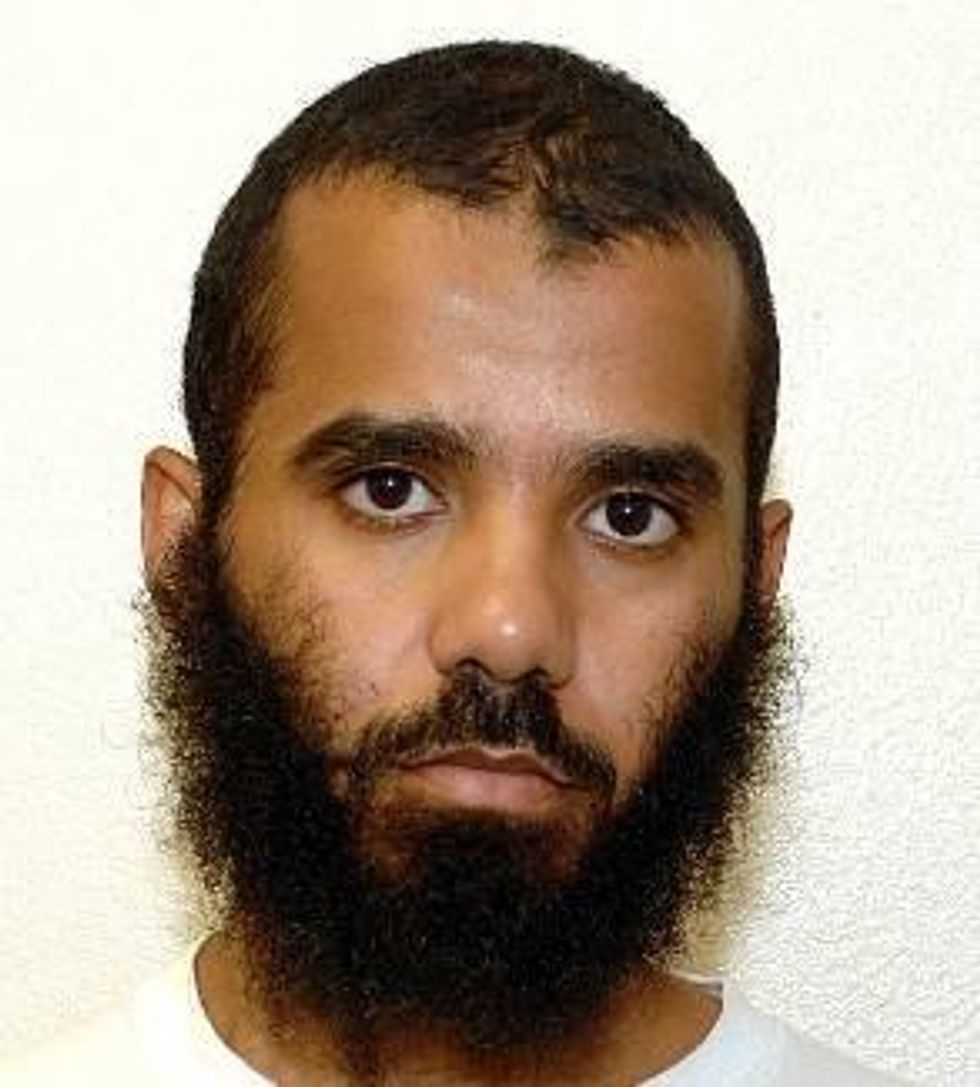
Un-edited and in full, his missive to those who hold him captive follows:
I hear the war in Afghanistan is over.
This war was supposedly the reason I remained trapped, rotting in this endless horror at Guantanamo Bay. I write this letter today to ask, if this war has ended, why am I still here? Why has nothing changed?
Amid falling bombs and mass hysteria, I fled Afghanistan for safety when the US launched its military operations in 2001. I was abducted despite never fighting against the United States, was sold into US military custody, and then imprisoned, tortured, and abused at Guantanamo since 2002 without ever being charged with a single crime.
I protest this injustice by hunger striking, refusing food and sometimes water.One of Guantanamo's long-term hunger strikers, I am a frail man now, weighing only 96 pounds (44kg) at 5'5" (1.68m).
Recently, my latest strike surpassed its second year. My health is deteriorating rapidly, but my intention to continue my strike is steadfast. I do not want to kill myself. My religion prohibits suicide. But despite daily bouts of violent vomiting and sharp pain, I will not eat or drink to peacefully protest against the injustice of this place. My protest is the one form of control I have of my own life and I vow to continue it until I am free.
I remain on lockdown alone in my cell 22 hours a day. Despite my condition, prison authorities unleash an entire riot squad of six giant guards to forcibly extract me from my cell, restrain me onto a chair and brutally force-feed me daily. They push a thick tube down my nose until I bleed, after which I vomit.
This gruesome procedure may not be written about so much any more, but it remains my everyday reality. It is painful. And it is bewildering. How can I possibly resist anyone, let alone these men? Hunger striking is a form of peaceful and civil disobedience. It is not a crime. So why am I being punished? Why not humanely tube-feed me instead?
My time here has been ridden with unanswered questions. Two years ago, as I attempted to pray, a sudden raid was ordered and a guard deliberately shot me without warning or provocation. Once again, I was not resisting. So why did he shoot? My clothes, torn, were soaked in my own blood. I want the government to ask the guard who shot me to account for his actions.
I began to wonder if shooting without any provocation is legal in the US. But now I realise that US police officers get away with ruthlessly killing black people all the time.
I wonder now if the US follows any rule of law at all: the Geneva Conventions or even its own Constitution. Where is the freedom and justice for all that it so proudly boasts to the world?
For us at Guantanamo, this place is not fit for any living, breathing, human being. The US seems to want to smother us, to kill us slowly as we are left in a vacuum of uncertainty wondering if we will ever be free.
I have lived the past 13 years in this despair, at the cost of my dignity, paying the price for the US government's political theatre. Meanwhile, little has changed for the 122 men remaining at Guantanamo.
The world may turn a blind eye and find this number small. But for each of us here, the cost of our indefinite and unfair imprisonment is beyond immeasurable. Our families have lost fathers, brothers, husbands, and sons to this hell on earth. Many of us have unnecessarily lost over a decade of our already short time in this world, yearning to be free again.
Over a dozen protesters disrupted the Senate Monday afternoon by chanting demands for an end to U.S. torture with impunity.
The civil disobedience, organized by Witness Against Torture, was a dramatic culmination of a week of action in Washington, D.C. to press for the closure of the military's offshore prison in Guantanamo Bay, Cuba as it enters its 14th year.
"Torture, It's Official, Prosecute Now!" protesters shouted in unison, in reference to the recently released, partially-redacted executive summary of the Senate report on CIA torture.
A video by Roll Call shows protesters sitting down on the gallery floor and halting Senate proceedings for at least a minute and a half before 11 people were arrested:
Meanwhile, more protesters filled the nearby Capitol Visitor Center, where they chanted and hoisted two banners which read: "Accountability for police Murder, Accountability for Torture" and "From Ferguson to Guantanamo, White Silence = State Violence" before more people were arrested, bringing the total detained at both actions to 21, according to Roll Call.
Just hours later, members of Witness Against Torture blocked the entrance to the D.C. police headquarters for 28 minutes "in recognition that a person of color is killed by police or vigilantes every 28 hours in the United States," according to an organizational statement. The D.C. Hands Up Coalition stood nearby chanting and singing support for the direct action.
The actions followed an earlier rally for an end to impunity for police who kill people of color and for indefinite detentions without trial in Guantanamo Bay.
Uruj Sheikh, from New York City, declared in a a Witness Against Torture statement that protesters sought "to convey with a new voice that racism and Islamophobia, torture tactics in US prisons like extended solitary confinement and the torture of indefinite detention at Guantanamo are two parts of the same system of white supremacy and militarized violence."
This is how it starts.
I am sitting on the floor in the living room. My son Seamus -- a two-and-a-half-year-old -- is cuddled in my lap. I am talking to my sister on the phone and then, suddenly, I am covered in vomit.
"Ah, Kate. I am going to have to call you back. Seamus just hurled all over me."
I throw down the phone and carry my screaming son upstairs and into the bathtub. He has the flu.
This is how it starts.
I am sitting on the floor in the living room. My son Seamus -- a two-and-a-half-year-old -- is cuddled in my lap. I am talking to my sister on the phone and then, suddenly, I am covered in vomit.
"Ah, Kate. I am going to have to call you back. Seamus just hurled all over me."
I throw down the phone and carry my screaming son upstairs and into the bathtub. He has the flu.
Meanwhile, my friends are fasting in Washington, D.C. They are vigiling, witnessing and organizing to shut down Guantanamo, end torture and ensure accountability for the perpetrators. They are wearing orange jumpsuits and black hoods (over very warm coats). They are at the Pentagon, the White House and the Capitol, as the new Congress is sworn in. They are embodying solidarity by showing up for demonstrations against police brutality and U.S. military aid to Mexico. They are waking up early, going to bed late and sleeping on mats on the floor. They are hungry and cold. They are meeting, planning, praying and singing.
I am not there. I am missing it and I am missing them.
Witness Against Torture started nearly 10 years ago as a small group of people looking at the issues of torture, indefinite detention, collective punishment, scapegoating, racism and violence in the George W. Bush administration's Global War on Terror. Through prayer, study and building community, we were able to stretch ourselves over fear to do what our consciences told us was right. We got on a plane, flew to Cuba and began walking to Guantanamo. We aimed to walk right onto the U.S. naval base and visit the men (at the time there were more than 700 Muslims and Arabs and others interred there). We got pretty close to the base and there we vigiled and prayed and fasted for five days while we held press conferences, did international media work and called the U.S. base incessantly asking to be let in. Flying back to Newark, N.J., we told customs agents that we had been to Cuba, hoping that we'd be tried for violating travel and financial restrictions. We never were.
Nine years later, those Cuba travel laws are all changing, but the reality for the more than 100 men still at Guantanamo remains the same. More men (nine) have died at Guantanamo than have been tried for their alleged crimes by military commissions (eight). Sixty-three of those still imprisoned at Guantanamo have been cleared for release by both the Bush administration and the Obama administration. Shaker Aamer, Fahd Ghazy and 61 others: These are the men my friends are fasting for in D.C. and beyond. This coming Sunday will mark 12 years of indefinite detention and separation for the men at Guantanamo.
Since coming home from Cuba in December 2005, Witness Against Torture has grown from 25 people to thousands. We have worked to make January 11 a day of national shame. Each year, we have gathered in Washington, D.C., in anger, outrage and the hope that we won't have to do it again the following year. And then we do it again the next year, and now it is 2015.
Today is day five of their fast. Our fast? I am not fasting. I am still nursing a 17-pound, 10-month-old and her demand for liquid nutrition is near constant. I am not fasting, but I have sworn off sweets and beer until the Witness Against Torture fast ends with breakfast on Tuesday, January 13.
It does not feel like enough, especially because I am not in D.C.
Seamus has stopped vomiting, but he still has a fever and is miserable. It is just by grace (and the bionic nursing baby immune system) that Madeline has not gotten his nasty bug, but she is teething and has a runny nose. While my friends have been marching, vigiling and singing, I have been marooned in various rooms in our house, with Seamus whining on one side of my lap and Madeline nursing on the other. My clothes are covered in kid snot, I have not been able to go to the bathroom by myself, and all I want at the end of the day is a beer and a brownie. (This unmet want makes me feel like my token fast is some small sacrifice after all. I guess that is something.)
I planned to take the kids to Baltimore to see their Grandma Liz and then on to D.C. on Wednesday, and then on Thursday, and now maybe Friday or even Saturday. We will see how they feel. I am struggling so much with this! I am still getting used to this being responsible for other people phenomenon called motherhood: I have to think about the health and warmth, food and nutrition, well-being and safety of two very little people. When we went to Cuba in 2005, I was not a mother, I was not nursing and I had never been covered in baby snot or toddler vomit. It doesn't seem like so long ago and I am not a different person, but it is hard to be here when my friends and part of my heart are in D.C., working so hard for justice, accountability and all that I hold so dear.
Thank you friends. I am with you in spirit. But those of you with immune systems degraded by cold, fasting and tiredness are surely happy I am not any closer.
Witness Against Torture's 100 Days Campaign to Close Guantanamo and End Torture began in the heady days following President Obama's Executive Orders, signed on day one, promising the closure of the detention camp at Guantanamo within a year and ending the CIA's "enhanced interrogation" program. Years of protest-- including a 2005 demonstration at the detention camp itself, arrest actions in Washington, D.C., and a resulting trial in which we condemned Guantanamo in the name of the detainees-- had paid off.
Witness Against Torture's 100 Days Campaign to Close Guantanamo and End Torture began in the heady days following President Obama's Executive Orders, signed on day one, promising the closure of the detention camp at Guantanamo within a year and ending the CIA's "enhanced interrogation" program. Years of protest-- including a 2005 demonstration at the detention camp itself, arrest actions in Washington, D.C., and a resulting trial in which we condemned Guantanamo in the name of the detainees-- had paid off. The nightmare appeared close to over.
As we vigiled at the White House every day since the inauguration to support Obama in his plans, countless people we met celebrated President Obama's promises and questioned our being there. "Guantanamo is shut down," we heard again and again. Yet the accumulated outrages of the last seven years and the tenacious defense of torture policies by some sectors of government and the media, cautioned against a premature sense of victory. Sadly, the cynicism of politics, the ignorance and paranoia of the right, and the Obama administration's own failure of both conviction and nerve have kept the nightmare of indefinite detention, torture, and immunity for war crimes alive. So we're coming to the White House, on day 101 of the Obama administration, to demand again that Guantanamo be closed, torture decisively ended, and torturers held to account.
Despite early, encouraging signs, the Obama presidency has been a disappointment with respect to detainee issues and torture. While releasing so-called "torture memos" drafted under Bush administration, the Obama administration has been reluctant to investigate possible, past crimes by those who may have committed or provided pseudo-legal cover for torture. Without such an investigation (and prosecutions, if warranted) Obama's pledge to bring accountability to the government will ring hollow. Neither can Obama fulfill his pledge to restore the rule of law if he won't enforce the law. Domestic and international law indeed require that the U.S. legal system investigate possible breaches of bans on torture.
Less acknowledged, but equally disturbing, the Obama administration has left untouched -- and even actively affirmed -- some of the worst of the Bush-era detention policies. The pledge to shut down Guantanamo has done nothing to relieve the ordeal of the men still held there, many of whom are innocent of allegations of terrorism and have been cleared for release. This is true of the 17 Uighur Muslims whom Judge Ricardo Urbina ordered last October to be released immediately into the United States. Yet the Obama Justice Department pursued a challenge to the ruling by the Bush administration, and the Uighurs remain at Guantanamo. The administration's recent pledge to release seven Uighurs into the United States leaves the status of the other Uighurs-- and dozens of prisoners wrongfully detained-- unresolved.
The denial of the rule of law and the abuse of detainees continues at Bagram Air Base in Afghanistan. The Department of Justice recently indicated it will challenge the April 3 ruling by conservative U.S. District Judge John Bates that habeas corpus rights, affirmed for Guantanamo inmates by the Supreme Court (Boumediene v. Bush), extend to Bagram inmates not captured on the Afghani battlefield. Bagram is fast becoming Obama's Guantanamo, where the same violations of American law and values take place.
Finally, in line with the Bush administration before it, the Obama administration has twice invoked the "state secrets" defense in efforts to dismiss lawsuits seeking redress for those rendered and tortured and damages against private companies participating in rendition (Arar v. Ashcroft et al; Mohamed et. al. v. Jeppesen Dataplan, Inc). This craven defense -- which seeks to bar discussion of these tragic cases even from courts of law well-equipped to handle sensitive national security matters -- adds insult to the ex-detainees' enormous injuries. It not only puts the United States above the law and public reproach, but denies the defendants' right to have their victimization acknowledged and their humanity recognized.
Witness Against Torture, like other human rights groups, is well aware of the awful dilemmas the Obama administration faces. Obama inherited a legal, political, and moral mess not of his own making. For his administration to pursue a criminal inquiry into alleged torture under Bush would be to invite further partisan backlash and possibly jeopardize many of his worthy policy goals. The CIA, by warning that that prosecutions of its officers would "weaken morale," all but says to Obama that his administration risks losing CIA cooperation in ongoing anti-terrorist operations. And the political right, led by Dick Cheney, continues to mangle the debate, defending torture with garish zeal, and fraudulently claiming that closing Guantanamo and trying its "high-value" detainees in real courts means letting terrorists loose in the streets of America.
Whatever these pressures, the Obama administration faces a clear choice to fulfill the rhetoric of true change by upholding the law, leading the country in reckoning with sordid policies, and putting institutional mechanisms in place to assure that the United States never again commits torture. To grant immunity to those who may have carried out torture upholds the Bush administration doctrine that the Executive, operating in secret, has the power to determine what is and is not lawful regardless of what U.S. and international law state. Any Department of Justice inquiry must also extend to the architects of the torture policies, as well as the widespread use of "enhanced interrogations" beyond the CIA's notorious program. And Obama must urgently address the cases of remaining detainees; bring those against whom evidence of wrongdoing exists into a real system of law and releasing the others without needless delay.
President Obama himself insists that the true measure of America's greatness lies how its people respond to daunting challenges, hard times, and tough choices. It is to time to be great, by simply doing what is good and right. Otherwise, America's intricate compact with the evil of torture and disregard for its laws and best traditions will continue.
What is Happening on April 30? Witness Against Torture On Thursday, April 30th, hundreds of human rights activists will gather near the White House to call on the Obama administration to support a criminal inquiry into torture under the Bush administration and to fully break with past detention policies.
At a rally at Lafayette Park at 11:15 am, members of Witness Against Torture, Amnesty International, the American Civil Liberties Union, and the Torture Abolition Survivors Support Coalition will speak out about the need for accountability and an end to Bush-era policies. At noon, sixty activists from Witness Against Torture -- each representing one of the Guantanamo inmates cleared for release but still imprisoned - will risk arrest.
Why Are We Protesting? Witness Against Torture
We seek to demonstrate, in a forceful way, that there is an informed and active public constituency for justice, the rule of law, and accountability in this country that is demanding a criminal inquiry into possible torture by the CIA and other US military personnel, as well as how torture policies were crafted, who crafted them, and what culpability they bear. We seek to pressure the Obama administration to stop its equivocation and move toward some process aimed at genuine justice and which will safeguard the country against the future use of torture.
We are not now content to wait, years into torture policies, for the slow wheels of the opinion machinery, bureaucracy, and partisan grinding to produce some watered-down version of what should be an investigation into lawbreaking, extending to the highest reaches of the Bush administration.
We are also marching to dramatize the ongoing plight -- at some cost to ourselves by virtue of our arrest (during which we'll wear orange jumpsuits with detainee names on our backs) of the are men at Guantanamo who have been cleared to release, pose no threat to the United States, and could be freed by the Obama administration much sooner than one year he has given himself to close the detention camp.
Please join us in Washington, DC on Thursday, April 30th. We gather at 10am at the Capitol Reflecting Pool, and then march in silent procession wearing orange jumpsuits and black hoods to Lafayette Park for a brief rally. Then 60 friends will cross onto the White House sidewalk to bring the names and identities of the 55 Guantanamo men cleared for release who remain in the prison, and those of the 5 men who died at Guantanamo, to the attention of President Barack Obama.
To learn more, and support this effort, please visit www.100dayscampaign.org